





Zestaw obrazów 2019
zdjecie1.jpg
zdjecie2.jpg
zdjecie3.jpg
zdjecie4.jpg
zdjecie5.jpg
zdjecie6.jpg
2019_1.JPG
2019_2.JPG
2019_4.JPG

Galeria
Powering the Future: What will fuel the next thousand years
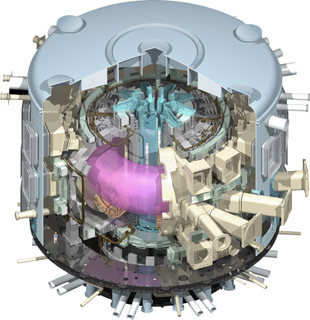 When you hear the term nuclear energy, images of Fukushima or Three Mile Island may come to mind. But harnessing nuclear power isn't limited to the reactors that we currently use, which rely on nuclear fission. Energy can also be harnessed from fusion.
"Nuclear fusion is the energy that powers the sun and stars," Mike Mauel, professor of applied physics at Columbia University, told CBSNews.com. "It takes hydrogen gas, heating up to millions of degrees, and brings the atoms together to release energy and make helium."
Instead of splitting an atom's nucleus, like in fission, nuclear fusion is the process of bringing together two atomic nuclei to form a new nucleus. And there is no need for dangerous chemical elements like uranium or plutonium -- easing the fears of nuclear proliferation. Energy derived from fusion is appealing because very few natural resources are required to create fuel.
"The fuel for fusion basically comes from sea water. Every bottle of water that we drink has heavy water -- deuterium -- inside. Enough that's equivalent to a whole barrel of oil," Mauel says.
According to the U.S. Energy Information Administration(EIA), approximately 68 percent of the country's electricity in 2011 was generated by coal, natural gas, petroleum and oil. The next highest energy source was nuclear energy at about 20 percent. About 13 percent was contributed by renewable sources, like solar, hydropower, wind, geothermal and biomass.
A United Nations panel of scientists has reportedly agreed, with near certainty, that humans have a direct influence on climate change. The organization is expected to release its findings in an upcoming annual report.
"It is extremely likely that human influence on climate caused more than half of the observed increase in global average surface temperature from 1951 to 2010," says a draft of the report, obtained by the New York Times. "There is high confidence that this has warmed the ocean, melted snow and ice, raised global mean sea level and changed some climate extremes in the second half of the 20th century."
or the first time in recorded history, the amount of carbon dioxide in the air could rise to 400 parts per million(ppm) -- it's currently just over 390 ppm.
According to the Scripps Institution of Oceanography at the University of California, San Diego, CO2 levels hadn't surpassed 300 ppm in 800,000 years.
The race to replace fossil fuels with a sustainable replacement includes advancements in solar, wind, biomass and nuclear technology. Scientists believe that energy created from nuclear fusion is not only inevitable, but the only option that makes sense as a long-term solution.
"Many people who work in fusion power look 50 to 100 years in to the future, and we say 'what else can provide sustainable clean energy source for thousands of years on a large scale,' and fusion's one of the only ways to do that," Mauel says.
"I think that advances that we're making in solar power, wind power, clean coal technology, nuclear power -- all that is going to help us get through the next 50 years. But after that, we have to have fusion power."
In France, the International Thermonuclear Experimental Reactor (ITER) is the world's largest science experiment, and aims to prove that fusion can be achieved on a mass scale. The European Union, United States, China, South Korea, Japan, India and Russia have agreed to invest in building a reactor that can conduct experiments in burning plasma.
"ITER solves the technical problems," Dr. Ned Sauthoff, director of the U.S. ITER Project, told CBSNews.com. "Then industries in each country decide whether it will build reactors."
Sauthoff says that we know fusion has been done, but not in a large enough quantity to provide electricity on a mass scale. It is estimated that ITER will produce 500 megawatts of power for about 50 megawatts put in.
Progress doesn't come cheap. In the United States, Sauthoff says it could cost $10 billion to build the first fusion reactor.
"There are a lot of cost reductions that will come in the future," Sauthoff says. "Right we have an R&D system with lots of knobs and lots of dials. And that's expensive."
Mauel believes that while it's important to continue investing in renewable energy in the interim, it's only a matter of time before fusion energy will be a viable option for producing electricity.
"The fusion power will be ready in the second half of this century, and I think that's when we're going to need it most," Mauel says.
Source: CBS NEWS
Scientific Vandalism helps ITER
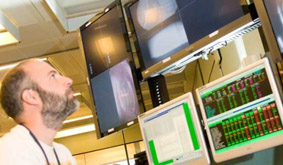 Scientists at JET, the world’s largest fusion energy research facility, have been deliberately melting parts of their own machine as they test materials for the fusion reactors of the future. These apparent acts of scientific vandalism are actually courageous experiments which have yielded valuable information for JET’s successor – the huge international ITER project being built in the south of France.
The experiments were requested by ITER, which is currently assessing what material should be used for its plasma-facing wall. To achieve fusion, gas is heated to over one hundred million degrees, at which temperature it becomes a plasma, similar to the sun. Plasma is held inside a magnetic chamber known as a tokamak. Of particular concern to researchers are bursts of turbulence on the edge of the plasma similar to solar flares, which can momentarily inflict on to small areas of the tokamak wall heat loads far greater than a blow torch.
JET scientists have been astonished by the machine’s faultless performance during the recent tests.
“There was a slight worry we would see uncontrolled, firework-like splashes of molten metal,” said Dr Gilles Arnoux, one of the scientific coordinators of the experiment, “and that might affect subsequent experiments. But it was a smooth melt; the plasma didn’t seem to notice. I was surprised at how little impact it had.”
The tests at JET involved subjecting a small area of deliberately misaligned tungsten wall tile to regulated bursts of turbulent events. The peak temperature of the tile during the transient bursts was slowly increased until it exceeded tungsten’s melting point, 3422 degrees Celsius, to assess what effect molten tungsten might have on the operation of the plasma. In particular, it was feared that a melt event might contaminate the hydrogen-based plasma with tungsten and lead to a disruption – an uncontrolled energy dump from the plasma – which could lead to further surface melting in a fusion experiment as large as ITER.
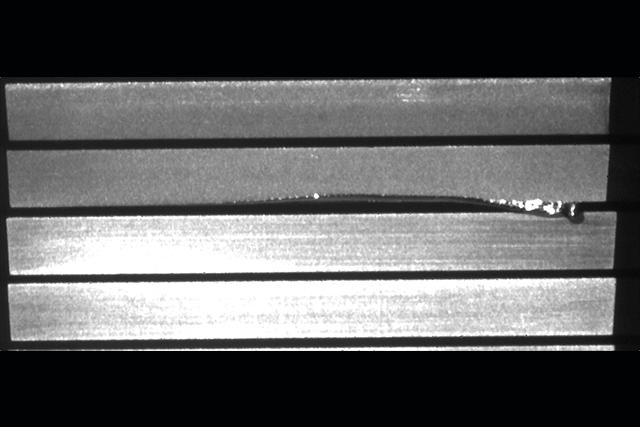
Instead, as shown in the picture, the molten tungsten moved smoothly to one end of the tile and formed a droplet, that grew with each additional plasma pulse. Curiously the molten metal did not run downwards – a result of the magnetic forces inside the tokamak – and, to the scientists’ relief, moved away from the hottest part of the plasma rather than being swept back into the exposed area. Subsequent experiments were performed without any interruption to proceedings.
Joining the JET team in the control room was the leader of ITER’s Divertor and Plasma Wall Interactions section, Dr Richard Pitts, who has been involved throughout the planning of the experiment.
Dr Pitts said: “It has been a great success and has achieved what it set out to do: to demonstrate that repetitive, fast transient heat pulses pushing tungsten over the melt threshold for just a millisecond or two each time, do not drive melt splashing nor do they appear to have any observable effect on the core plasma. It seems that we can broadly understand what we have seen on the basis of complex computer simulations describing the melt dynamics and thus our confidence is increased in the extrapolations we make for the behaviour to expect on ITER, which use the same computer codes. These results are extremely significant for the choice which ITER is preparing to make regarding the use of tungsten.”
Despite the early optimism much analysis remains to be done. The full story will not be known until mid 2014, when JET’s current run of experiments concludes and the melted tile can be removed and analysed.
Source: EFDA
JET scientists melt tokamak for the sake of ITER
 The team constructing the International Thermonuclear Experimental Reactor (ITER) requested their colleagues operating UK’s tokamak JET to expose the machine to extreme loads to find the best materials for ITER’s plasma facing wall.
“There was a slight worry we would see uncontrolled, firework-like splashes of molten metal and that might affect subsequent experiments,” said Dr Gilles Arnoux, one of the scientific coordinators of the experiment. “But it was a smooth melt; the plasma didn’t seem to notice. I was surprised at how little impact it had.”
The tests at JET involved subjecting a small area of a deliberately misaligned tungsten wall tile to regulated bursts of turbulent plasma. During the experiment, the exposed tile was heated up to peak temperatures of 3422° C, to allow the researchers assessing what affect molten tungsten might have on the plasma.
The team’s biggest concern was the melt event could result in contamination of the hydrogen-based plasma with tungsten, which would cause disruption and uncontrolled energy dump of the plasma. Such situation would lead to further melting of the surface, which might become detrimental to the equipment's safety.
However, the molten material moved smoothly to one end of the tile during the experiment, forming a droplet that grew with each additional plasma pulse. Surprisingly, the droplet did not run downwards, but moved away from the hottest part of the plasma instead, due to magnetic forces inside the tokamak.
“It has been a great success and has achieved what it set out to do,” said Dr Richard Pitts, the leader of ITER’s Divertor and Plasma Wall Interactions section, who joined the JET team during the experiment.
“It seems that we can broadly understand what we have seen on the basis of complex computer simulations describing the melt dynamics and thus our confidence is increased in the extrapolations we make for the behaviour to expect on ITER,” he said, adding the results are extremely significant for the ITER team, currently considering the use of tungsten for the construction of ITER.
To achieve fusion inside a tokamak, gas needs to be heated to more than one hundred million ° C, at which temperature it turns into sun-like plasma. Of particular concern to researchers are bursts of turbulence on the edge of the plasma similar to solar flares, which can momentarily inflict heat loads far greater than a blow torch on small areas of the tokamak wall.
The experiments at JET, which is currently the world’s biggest operating tokamak, will continue until mid-2014
Source: E&T
First ever full-size prototype of the double pancake for the TF coil has been wound
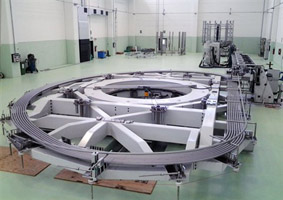 For the first time ever, a Toroidal Field (TF) coil full-size super-conducting prototype of the double pancake (DP) is being manufactured and the first step of the manufacturing process, winding, has been completed at the beginning of August. This milestone, which was carried out at the ASG premises in La Spezia, Italy, follows the production of the winding line.
The ITER device will operate with a system of superconducting magnets which relies on the Toroidal Field coils, the Central Solenoid, the Poloidal Field coils and the Correction coils. F4E is responsible for procuring ten TF coils (Japan will contribute an additional nine TF coils) – “D” shaped coils which will be operated with an electrical current of 68,000 amps, in order to produce the magnetic field which confines and holds the plasma in place in the ITER tokamak. Each TF coil weighs about 300 tons and it is about 16.5 m tall and 9.5 m wide.
Each TF coil contains in total seven double pancakes which produce the magnetic field (two DPs which contain cable-in-conduit conductors measuring 450 m, and five DPs where the conductors measure 750 m in length). Each double pancake is composed of a of conductor length which carries the electrical current, and of a stainless steel D-shaped plate called a radial plate, which holds and mechanically supports the conductor through groves machined on both sides along a spiral trajectory. The conductor is composed of about 1000 superconducting and copper wires cabled inside a 2 mm thick round stainless steel jacket 43.7 mm in diameter.
The winding of the DP, the most challenging component in the TF coil from the manufacturing point of view, consists of bending the conductor length along a D-shaped double spiral trajectory. As it is necessary that the double pancake conductor fits precisely inside the radial plate groove, it is vital to control the trajectory of the conductor in the double pancake and the trajectory of the groove in the radial plate with an extremely high accuracy. In particular, the trajectory of the conductor must be controlled with an accuracy as high as 0.01%, and this is why the winding line utilises a numerically controlled bending unit as well as laser-based technology to measure the position and the dimensions of the conductor. The winding takes place in an environment with a controlled temperature of 20 °C +/-1 C, and at an average speed of 5 m of conductor length per hour.
A consortium composed of Italian company ASG and Spanish companies Iberdrola and Elytt is responsible for the manufacturing of the prototype as well as the future actual double pancakes. With the winding of the prototype now completed, other manufacturing steps are needed: the DP will be heat-treated at 650° C in a specially constructed inert atmosphere oven, then electrically insulated and finally transferred into the grooves of the stainless steel radial plates. After assembly and the application of electrical insulation on the outside of the radial plate, the module is finally impregnated with special radiation resistant epoxy resin thus forming the prototype double pancake module. This work is scheduled to be completed by the beginning of next year and will then allow for the prototype to be tested by being cooled to -77 K in order to assess the effect of the low temperature. It will then be cut in sections in order to analyse the quality of the impregnation of the insulation of the superconducting conductor.
Source: F4E
New imaging technique provides improved insight into controlling the plasma in fusion experiments
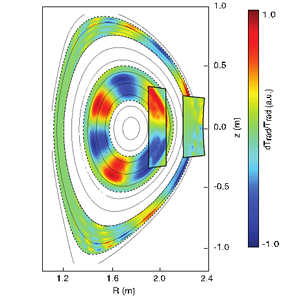 A key issue for the development of fusion energy to generate electricity is the ability to confine the superhot, charged plasma gas that fuels fusion reactions in magnetic devices called tokamaks. This gas is subject to instabilities that cause it to leak from the magnetic fields and halt fusion reactions.
Now a recently developed imaging technique can help researchers improve their control of instabilities. The new technique, developed by physicists at the U.S. Department of Energy's Princeton Plasma Physics Laboratory (PPPL), the University of California-Davis and General Atomics in San Diego, provides new insight into how the instabilities respond to externally applied magnetic fields.
This technique, called Electron Cyclotron Emission Imaging (ECEI) and successfully tested on the DIII-D tokamak at General Atomics, uses an array of detectors to produce a 2D profile of fluctuating electron temperatures within the plasma. Standard methods for diagnosing plasma temperature have long relied on a single line of sight, providing only a 1D profile. Results of the ECEI technique, recently reported in the journal Plasma Physics and Controlled Fusion, could enable researchers to better model the response of confined plasma to external magnetic perturbations that are applied to improve plasma stability and fusion performance.
Source: phys.org


nsp_154.JPG)


nsp_154.JPG)


 |
 |
 |
 |
 |
 |
 |
 |
Media


Projekty badawcze realizowane przez IFPiLM są finansowane ze środków Ministerstwa Edukacji i Nauki i Narodowego Centrum Nauki oraz ze środków Komisji Europejskiej na podstawie umowy grantowej No 101052200, w ramach Konsorcjum EUROfusion. Wsparcia finansowego udzielają także: Międzynarodowa Agencja Energii Atomowej, Agencja Fusion for Energy, Europejska Agencja Kosmiczna i Konsorcjum LaserLab.