





Zestaw obrazów 2019
zdjecie1.jpg
zdjecie2.jpg
zdjecie3.jpg
zdjecie4.jpg
zdjecie5.jpg
zdjecie6.jpg
2019_1.JPG
2019_2.JPG
2019_4.JPG

Galeria
Congress Supercharges Funding for Fusion Energy Technology
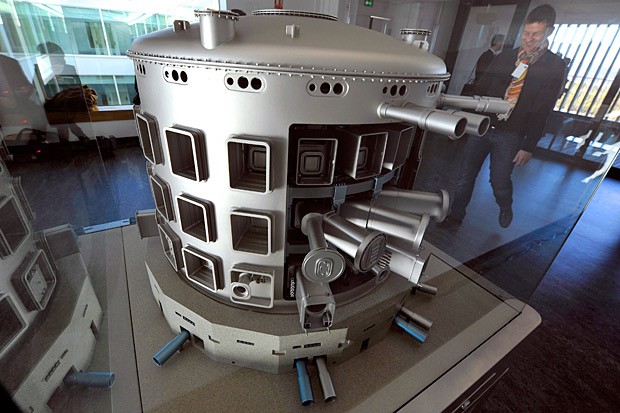 Physicists from France to California rejoiced this week over Congress's new spending bill, which would increase funding for fusion-energy research by more than $100 million over last year.
 MIT fusion experiment benefits from budget deal, but more uncertainty looms
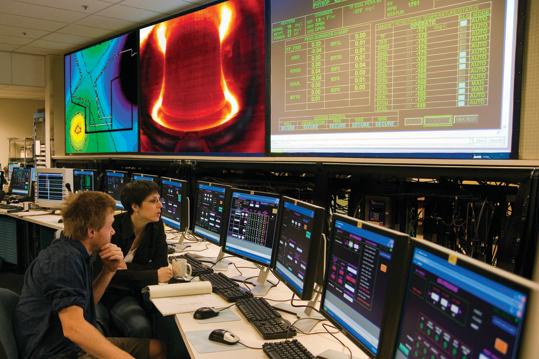 It’s a universal source of anxiety among scientists these days: the uncertainties about federal funding for research. Every time I speak to someone, whether they research cancer or the cosmos, the topic seems to come up. People are spending lots of time writing grants, and the competition is getting more intense for fewer funds. Scientists complain that the budget uncertainties mean they spend much of their time advocating for their research and scrambling for funds, instead of doing the thing they’re best at—science. Talented researchers are, they fear, avoiding science.
Nowhere was that conversation more stark than at a fusion experiment at the Massachusetts Institute of Technology, which was slated to be zeroed out altogether in the federal budget. The scientists began a spirited save-our-experiment campaign, but all appeared to be lost last year. The Alcator C-Mod experiment at MIT had stopped accepting new graduate students in 2012, and 70 employees were facing layoffs.
Those researchers, engineers, and technicians breathed a sigh of relief this week, with the unexpected news that the budget deal released by Congress Monday night included $22 million for the experiment, which had been slated to shut down completely. The goal of the experiment is to learn how to harness nuclear fusion—combining atoms—to produce energy.
With the flush of new funding, the experiment will run for its typical span, 12 to 14 weeks this year. No one will be laid off, according to Miklos Porkolab, director of the Plasma Science and Fusion Center where the project is housed. On Friday, the scientists will meet to talk about the experiments and the research schedule.
Porkolab said that the project had gone into survival mode. Layoffs that had been expected to take place in December were delayed when the Department of Energy gave MIT enough money for the researchers to maintain the experiment in a “warm shutdown” phase, at least until the budgetary situation was settled.
Although the funding announcement is great news for the project, it doesn’t resolve the larger problem—the project was treading water month-to-month. Even with the new funding, which ensures the experiment can continue until the end of the September, the reprieve is short on a scientific time scale.
“What we’d like to do is again resume bringing in more graduate students. At this funding level, we could do that. The only issue is what happens in 2015,” Porkolab said. “If we bring in students, they expect five years of support for a Ph.D.”
Porkolab said a significant number of new applicants for graduate school at MIT have expressed interest in plasma research, but that when the Obama Administration’s budget proposal for the next fiscal year is unveiled, it may not have set aside any money for the fusion experiment for next year.
“We may have to go through the same cycle again,” Porkolab said. The uncertainty, he said, takes its toll on the science, the ability to plan research projects, and the people who work on the experiment.
The United States has made investments in a giant international fusion experiment that will be much more powerful that the MIT project. The international investment is continuing in the current budget, but Porkolab says that it is equally important to keep up the domestic program running. Insights gained from the smaller experiment, he said, will ultimately help researchers run the larger one more efficiently.
Source: Boston.com
Europe Focuses Fusion Research on Building a Working Power Reactor
 As the new year dawned, nuclear fusion researchers in the European Union woke to an entirely new funding system aimed at sharpening their focus on generating energy. Gone are the annual block grants to national fusion laboratories; now, teams must compete to participate in "work packages" supporting the international ITER reactor in France and preparing for a prototype power reactor before the middle of the century. "It's a substantial change in the way we work," says Francesco Romanelli, acting head of EUROfusion, a consortium of all of Europe's fusion labs that will manage the new program.
The change is the handiwork of the European Union's nuclear research arm, Euratom. It funds both ITER construction, shouldering 45% of the cost—a €6.6 billion share by the time the reactor is completed in 2020—and related fusion research in labs across the continent. That is the part of the budget that the new system redirects.
In the old system, in place since the 1950s, Euratom simply gave each of the national labs a lump of money every year equal to as much as 20% of the lab's budget and gently coordinated research. Euratom also funded the only common facility, the Joint European Torus (JET) reactor in Culham, U.K., through the European Fusion Development Agreement (EFDA).
In 2011, Euratom appointed a panel to recommend how to organize fusion research in the European Union's next 7-year financial period, starting in 2014. Headed by Albrecht Wagner, former head of the DESY particle physics lab in Germany, the panel recommended a more mission-oriented approach focusing on fusion energy. "If ITER is not a success, there is no need for future research," says Alain Bécoulet, head of France's Research Institute for Magnetic Fusion.
In 2012, Euratom tasked EFDA with drawing up a road map for refocusing Europe's fusion efforts. Published at the beginning of 2013, the road map called for the European Union to concentrate on finishing and operating ITER while also preparing for its successor, a power-producing prototype, dubbed DEMO. In response, Euratom announced that the annual grants would cease at the end of the year and that the fusion community must devise a 5-year program of research based on the aims of the road map.
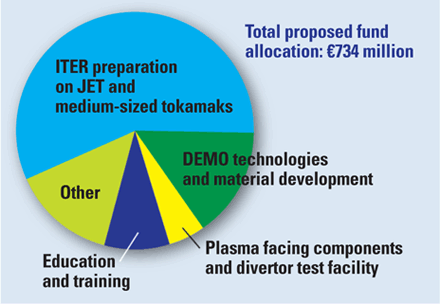
Since then, the heads of the fusion labs have been working furiously to comply, and they finalized the work program last month. The program, which Euratom will spend the next 3 months evaluating, includes a campaign of experiments on JET to simulate ITER operation plus experiments at smaller reactors across Europe. There's money for technology R&D for ITER and DEMO, for training future fusion scientists, and for a neutron source to test materials in the sort of neutron bombardment they will experience in a working reactor. The program also hedges its bets by supporting work on stellarators, an alternative fusion technology that could play a role if ITER fizzles.
Bécoulet worries that the program focuses too much on the future—ITER operation and DEMO—and not on the immediate needs of ITER construction. "We're very upset with the proposal," he says, adding that the program "needs to focus more on what is urgent now." Romanelli responds that the program already addresses urgent needs, with 85% of the funding directly or indirectly supporting ITER. "ITER is the first priority," he says.
Source: sciencemag.org
Fusion instabilities lessened by unexpected effect
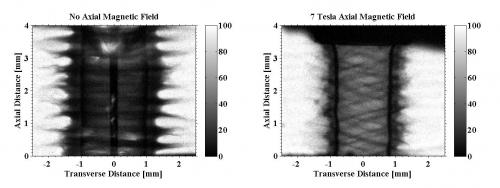 A surprising effect created by a 19th century device called a Helmholz coil offers clues about how to achieve controlled nuclear fusion at Sandia National Laboratories' powerful Z machine.
A Helmholz coil produces a magnetic field when electrified. In recent experiments, two Helmholz coils, installed to provide a secondary magnetic field to Z's huge one, unexpectedly altered and slowed the growth of the magneto-Rayleigh-Taylor instabilities, an unavoidable, game-ending plasma distortion that usually spins quickly out of control and has sunk past efforts to achieve controlled fusion. "Our experiments dramatically altered the nature of the instability," said Sandia physicist Tom Awe. "We don't yet understand all the implications, but it's become a different beast, which is an exciting physics result."
The purpose of adding two Helmholz coils to fusion experiments at the Z machine, which produces a magnetic field 1,000 times stronger than the coils, was to demonstrate that the secondary field would create a magnetic barrier that, like insulation, would maintain the energy of charged particles in a Z-created plasma. Theoretically, the coils' field would do this by keeping particles away from the machine's walls. Contact would lower the fusion reaction's temperature and cause it to fail.
Researchers also feared that the Helmholz field might cause a short in Z's huge electrical pulse as it and its corresponding magnetic field sped toward the target, a small deuterium-stuffed cylinder.
Z's magnetic field is intended to crush the cylinder, called a liner, fusing the deuterium and releasing neutrons and other energies associated with nuclear fusion. Anything hindering that "pinch" or "z-pinch," would doom the experiment.
In preliminary experiments by Awe's group, the coils indeed buffered the particles and didn't interfere with the pinch.
Enter the coils
But unexpectedly, radiographs of the process showed that the coils' field had altered and slowed the growth of the magneto-Rayleigh-Taylor instabilities. Those distortions had been thought to occur unavoidably because even the most minute differences in materials turned to plasma are magnified by pressures applied over time.
The strength of instabilities seen in hundreds of previous z-pinches was reduced, possibly significantly.
The typical distortion pattern also changed shape from horizontal to helical.
The unexpected results occurred in a series of experiments to study a concept called Magnetized Liner Inertial Fusion, or MagLIF.
Experimental process like French toast
Researchers placed the Helmholz coils around a liner containing deuterium so the coils' magnetic field lines soaked both container and fuel over a period of milliseconds. The relatively slow process, like soaking bread in beaten eggs and milk to make French toast, allowed time for the magnetic field lines to fully permeate the material. Then the liner was crushed in tens of nanoseconds by the massive magnetic implosion generated by Sandia's Z machine. In previous attempts to use Z's huge field without the Helmholz coils, radiographs showed instabilities appearing on the exterior of the liner. These disturbances cause the liner's initially smooth exterior to resemble a stack of metallic washers, or small sausage links separated by horizontal rubber bands. Such instabilities increase dramatically in nanoseconds, eating through the liner wall like decay through a tooth. Eventually, they may collapse portions of the inner wall of the liner, releasing microrubble and causing uneven fuel compression that would make fusing significant amounts of deuterium impossible.
The disturbances are a warning sign that the liner might crumple before fully completing its fusion mission.
But firing with the secondary field running clearly altered and slowed formation of the instability as the liner quickly shrank to a fraction of its initial diameter. Introducing the secondary magnetic field seemed to realign the instabilities from simple circles—stacked washers, or rubber bands around sausages—into a helical pattern that more resembled the slanting patchwork of a plaid sweater.
Like a kayak crossing a river
Researchers speculate that the vertical magnetic field created by the helical coils, cutting across Z's horizontal field, may create the same effect as a river slanting a kayak downstream rather than straight across a channel. Or it may be that the kayak's original direction is pre-set by the secondary magnetic field to angle it downstream. Whatever the reason, the helical instability created does not appear to eat through the liner wall as rapidly as typical horizontal Rayleigh-Taylor instabilities.
Flashes of X-rays that were released when material from the horizontal instabilities collided in the liner's center no longer appeared, suggesting more uniform fuel compression occurred, possibly a result of the increasing resistance of the implanted vertical magnetic field to the compression generated by the Z horizontal field.
The overall approach of Awe and his colleagues uses a method described in two papers by Sandia theorist Steve Slutz. In a 2010 article in Physics of Plasmas, Slutz suggested that the magnetic field generated by Z could crush a metallic liner filled with deuterium, fusing the atoms. Slutz and co-authors then indicated, in a 2012 paper in Physical Review Letters, that a more powerful version of Z could create high-yield fusion—much more fusion energy out than the electrical energy put in.
The apparently simple method—turn on a huge magnetic field and wait a few nanoseconds—takes for granted the complicated host of engineered devices and technical services that allow Z to function. But, those aside, the process as described by Slutz needed only two additional aids: a powerful laser to preheat the fuel, making it easier for the compressed fuel to reach fusion temperatures, and Helmholz coils above and below the target to generate a separate, weaker magnetic field that would insulate charged particles from giving up their energy, thereby lowering the temperature of the reaction.
Ongoing experiments on Z will determine how well reality bears out Slutz's predictions. But for now, the reduction of distortions has been warmly received by fusion researchers, leading to an invitation to Awe to present his team's results at the 55th Annual Meeting of the APS Division of Plasma Physics, the world's largest plasma meeting.
The principle of the Z machine is simple: Z's magnetic force can crush any metal in its path. Possibly, then, it could force the fusion of ions like deuterium in a metal liner a few millimeters in diameter. The magnetic field would crush the liner's fuel to the diameter of a human hair, causing deuterium to fuse. This would release neutrons that could be used to study radiation effects, one of the key concerns of the National Nuclear Security Administration, which funds the bulk of this research. Further, in the far future, and with additional engineering problems solved, the technique when engineered to fire repetitively could be used as the basis for an electrical generating plant whose fuel is sea water, a carbon-free energy source for humankind.
"Of course the reality is not that simple," said Awe, "but the new ability to modify the instability growth on the liner surface may be a step in the right direction."
Source: phys.org
Sophisticated miniatures: IPP developing bolometers for ITER
 The contract for developing an important diagnostic method for the ITER international test reactor went to Max Planck Institute of Plasma Physics (IPP) at Garching: The ITER Fusion for Energy Agency will be funding a German research and industrial consortium, headed by IPP, with a total of 4.8 million euros in the next four years. The objective is advanced development of so-called bolometer cameras for recording the heat and X-radiation emitted from the ITER plasma. Award of the contract was based on a preparatory phase supported with national project funds in which the participants’ suitability for this and other ITER tasks was verified.
The measuring method is to record the heat and light emission from the infrared to X-ray region and pinpoint their origin in the plasma. The radiation power is part of the total energy balance of the plasma. It has to be known in order to control the plasma or apply certain modes of operation.
Measuring principle of a bolometer: A metal plate the size of a postage stamp absorbs the radiation emitted from the plasma along a narrow line of sight, thus heating up. The electric resistance of a conductor located below it changes according to the temperature and is therefore a direct measure of the radiation power. Additional calculations and measured data allow the radiation to be assigned to its origin in the plasma insofar as a sufficient number of bolometers are available. This reveals exactly what site in the plasma has emitted what power.
This measuring method, developed at and patented by IPP, has been successfully applied for many years. However, the ITER large-scale device, which is to produce a burning fusion fire for the fist time, imposes new requirements: Unlike hitherto, the detectors have to withstand impinging fusion neutrons and also be capable of working reliably at temperatures of up to 450 degrees.
For this further development IPP have since 2008 been using funds provided by the Federal Ministry of Research to pursue fruitful cooperation ventures: For example, previous IPP designs were used to develop first prototypes at the Institut für Mikrotechnik Mainz – platinum absorbers galvanically deposited on thin ceramic membranes. They have already passed neutron tests in the research reactor of the Hungarian Academy of Sciences and their spectral sensitivity has been tested in cooperation with Germany’s Physikalisch-Technische Bundesanstalt. Heat tests at IPP, however, were only partially successful. Modelling calculation with the support of the KRP Mechatec company subsequently helped to modify the design appropriately. Alternatives for the absorber material and its suspension are also being investigated.
Later about 500 lines of sight will traverse the ITER plasma and observe it from all angles in various cross-sectional planes. The absorber plates, which pick up this radiation, are located deep in the wall of the plasma vessel – at the end of long ducts covered with narrow diaphragms: the smaller the angle of sight scanned by the individual detector, the more precisely is the plasma imaged. The large ITER plasma also calls here for much higher requirements than do present-day fusion devices.
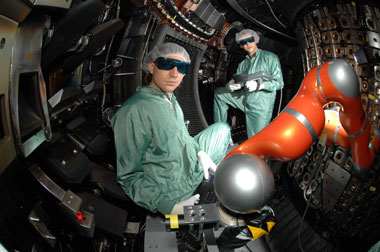
To test the accuracy attainable, a robot test rig was specially installed in conjunction with a doctoral thesis and tested in the plasma vessel of the ASDEX Upgrade fusion device at Garching. It can direct a laser beam from all directions to the entry slot of a bolometer. The measured results helped to improve the diaphragm design so as to largely suppress scattered light and reflection in the camera. Much in the way of optics, assembly, material and electronics still needs to be optimised until in four years a fully documented prototype integrable in the ITER design becomes available.
Source: ipp.mpg.de


nsp_154.JPG)


nsp_154.JPG)


 |
 |
 |
 |
 |
 |
 |
 |
Media


Projekty badawcze realizowane przez IFPiLM są finansowane ze środków Ministerstwa Edukacji i Nauki i Narodowego Centrum Nauki oraz ze środków Komisji Europejskiej na podstawie umowy grantowej No 101052200, w ramach Konsorcjum EUROfusion. Wsparcia finansowego udzielają także: Międzynarodowa Agencja Energii Atomowej, Agencja Fusion for Energy, Europejska Agencja Kosmiczna i Konsorcjum LaserLab.