





Zestaw obrazów 2019
zdjecie1.jpg
zdjecie2.jpg
zdjecie3.jpg
zdjecie4.jpg
zdjecie5.jpg
zdjecie6.jpg
2019_1.JPG
2019_2.JPG
2019_4.JPG

Galeria
Preparations for operation of Wendelstein 7-X starting
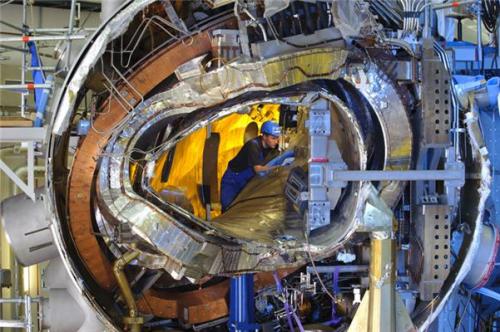 After years of calculation, planning, component production and installation the Wendelstein 7-X project is now entering a new phase: Max Planck Institute for Plasma Physics (IPP) in Greifswald in May started the preparations for operation of this the world's largest fusion device of the stellarator type.
Assembly began in April 2005: A special grab hoisted the first of 70 more than man-sized magnet coils carefully over a just finger-wide slit onto a bizarrely shaped steel vessel. The coil, weighing six tons, and the vessel part were the first components of the Wendelstein 7-X fusion device to arrive at Greifswald from their production facilities throughout Europe. Here, more than 800 kilometres from the home institute at Garching in Bavaria, IPP had opened a second site in 1994 within the framework of a special programme "Aufbau Ost" to support the eastern part of Germany.
The two sites are pursuing the same objective: copying on earth the energy production of the sun. A fusion power plant is to produce energy from fusion of atomic nuclei. As the fusion fire does not ignite till a temperature of over 100 million degrees is attained, the fuel, viz. a low-density hydrogen plasma, ought not to come into contact with the cold walls. Confined by magnetic fields, the fuel is suspended inside a vacuum chamber almost without contact. The two types of configuration for the magnetic cage are being investigated by IPP at the two separate sites: the ASDEX Upgrade tokamak is being operated at Garching, the Wendelstein 7-X stellarator is being built at Greifswald.
The more simply designed tokamaks are still to the fore. Today only a tokamak such as the ITER international test reactor has the confidence to produce an energy-supplying plasma. "But", states Project Head Professor Dr. Thomas Klinger, "the stellarator principle promises strengths where its fellow campaigner shows weaknesses." Unlike tokamaks, which work in pulsed mode, stellarators are suitable for continuous operation, by virtue of their specially configured magnetic system.
Proving this makes Wendelstein 7-X the key experiment. The structure of its magnetic field is the result of sophisticated optimisation calculations made by the Stellarator Theory division and of its more than ten years of searching for a particularly stable and thermally insulating magnetic cage. Professor Klinger states: "Wendelstein 7-X is expected to put, for the first time, the quality of its plasma equilibrium and confinement on an equal footing with those of a tokamak. The experiment is to show that stellarators are also suitable for power plants." And with discharges lasting 30 minutes, it is to demonstrate its essential superiority, viz. continuous operation. This does not require Wendelstein 7-X to produce energy: Many properties of an ignited plasma can be transferred to stellarators from the ITER tokamak.
The device comprises five almost identical modules preinstalled and assembled in a circle in the experimentation hall: 70 superconducting coils strung along a steel plasma vessel are enclosed in a ring-shaped shell. In their vacuum-pumped interior the magnets are later cooled with liquid helium to superconduction temperature at nearly absolute zero. They then need hardly any energy. Besides the major components, miles of cooling ducts, current leads, measuring cables, numerous observation ports and sensors were installed, always in conjunction with control measurements and tightness testing of the many thousands of brazing seams.
"The industrial production and assembly were already an experiment in itself", states Professor Klinger, "a task that we at first underestimated: The superconduction technology coupled with the elaborate geometry of the components presented us with exacting quality requirements." In fact, construction did not take six years as planned, but nine years. Design and production, measurement and calculation – the complex shaping called for new methods that had first to be developed by the institute and industry during construction. A new basis plan was therefore drawn up in 2007. Since then assembly of Wendelstein 7-X is within schedule and the budget plan, and since 2009 – as first research project in Germany – it is even certified in accordance with industry standard ISO 9001.
Companies from the whole of Europe produced the components for Wendelstein 7-X. The investment costs met by the Federal Government, the State of Mecklenburg-Western Pomerania and the EU came to 370 million euros. Contracts worth more than 80 million were awarded to regional companies. Numerous research facilities at home and abroad were involved in construction of the device: Within the framework of Helmholtz Association Karlsruhe Institute of Technology was responsible for the entire microwave plasma heating, Jülich Research Centre built diagnostics and produced the elaborate connections of the superconducting magnet coils. Installation of these required 160 person-years of work time by superconduction technology specialists from the Polish Academy of Sciences in Krakow. The US fusion institutes at Princeton, Oak Ridge and Los Alamos made contributions that included auxiliary coils and measuring instruments worth 7.5 million dollars for equipping Wendelstein 7-X.
At the beginning of May the shell of the device was closed and the first pumps started up. The inauguration ceremony on 20 May 2014 will mark entry into the next work phase, viz. preparation of operation. This will involve testing all technical systems: the vacuum in the vessels, the cooling system, the superconducting coils and the magnetic field produced by them. Professor Klinger: "If all goes well, we can produce the first plasma in about a year."
Source: phys.org
FPA signed for design on system to monitor ITER’s plasma core
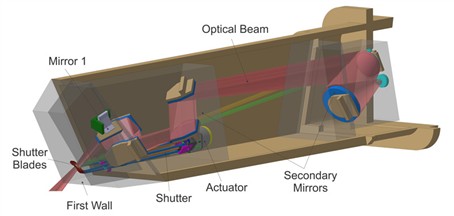 A Framework Partnership Agreement (FPA) for the design of the ITER Core Plasma Charge Exchange Recombination Spectroscopy diagnostic system (CP CXRS) has been signed by F4E and a consortium consisting of Forschung Zentrum Jülich (FZJ), Karlsruhe Institute of Technology (KIT); universities of technology in Budapest (BME) and Eindhoven (TU/e); the Dutch Institute for Fundamental Energy Research (DIFFER); and Culham Centre for Fusion Energy (CCFE) in the UK. Contributing third parties include the Spanish CIEMAT centre and the Hungarian Wigner-RCP institute. The FPA will run for four years with an F4E contribution of 4.9 million EUR.
The CP CXRS diagnostic will view a region of the ITER plasma illuminated by a high-energy beam of neutral hydrogen particles injected by a companion device (the Diagnostic Neutral Beam) being constructed by ITER’s Indian partners. Collisions of particles in this beam with particles in the fusion plasma will produce visible light. Measurement by the CP CXRS of the wavelength and spatial distribution of this light will allow conclusions to be drawn on various properties of the plasma. This includes the density of helium, which is formed during the fusion reaction and must be removed from the combustion chamber in order for the fusion reaction to be sustained. Other important parameters such as the concentration, temperature and velocity of different plasma species can also be determined using the diagnostic.
Once the CP CXRS diagnostic is designed, it will be procured by F4E and assembled into an ITER port plug to be installed in an inset at the upper edge of the vacuum vessel.
Source: F4E
A visit from the Groningen University at IPPLM
 On the 17th of April 2014 a group of students and PhD students from Groningen University („T.F.V. ‘Professor Francken’”) visited IPPLM. Young people, students of applied physics, were welcomed by Prof. Jerzy Wołowski, deputy director for research. A short introduction to nuclear fusion and works performed at IPPLM were presented by Dr. Piotr Rączka. During and after the presentation many questions were asked and the discussion turned into a very fruitful one. Our guests learnt more about magnetic confinement fusion as well as inertial confinement fusion. Dr. P. Rączka focused also on the IPPLM involvement in the European projects related to fusion and tasks performed by the local researchers.
We could also listen to two lectures, namely “Enhancing molecular switching efficiency by co-tunnelling in Coulomb blockaded molecule-nanoparticle networks” by Sander Block, PhD at the University of Leiden at the Department of Condensed Matter Physics, and “Switchable self-cleaning surfaces: a computational approach” by Edwin de Jong, PhD at the University of Groningen at the Department of Micro Mechanics. After the lectures, the guests had a chance to visit IPPLM’s laboratories, that is DPF1000U, PlanS, and 10TW Laser Laboratory. It was pleasure to host a group of passionate physics students who came in white and red ties on the occasion of their stay in Poland.
A promising concept on the path to fusion energy
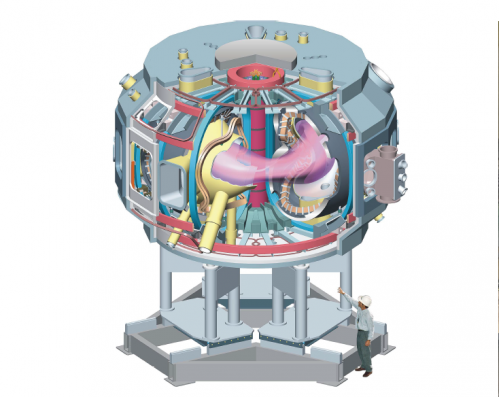 Completion of a promising experimental facility at the U.S. Department of Energy's Princeton Plasma Laboratory (PPPL) could advance the development of fusion as a clean and abundant source of energy for generating electricity, according to a PPPL paper published this month in the journal IEEE Transactions on Plasma Science.
The facility, called the Quasi-Axisymmetric Stellarator Research (QUASAR) experiment, represents the first of a new class of fusion reactors based on the innovative theory of quasi-axisymmetry, which makes it possible to design a magnetic bottle that combines the advantages of the stellarator with the more widely used tokamak design. Experiments in QUASAR would test this theory. Construction of QUASAR—originally known as the National Compact Stellarator Experiment—was begun in 2004 and halted in 2008 when costs exceeded projections after some 80 percent of the machine's major components had been built or procured.
"This type of facility must have a place on the roadmap to fusion," said physicist George "Hutch" Neilson, the head of the Advanced Projects Department at PPPL.
Both stellarators and tokamaks use magnetic fields to control the hot, charged plasma gas that fuels fusion reactions. While tokamaks put electric current into the plasma to complete the magnetic confinement and hold the gas together, stellarators don't require such a current to keep the plasma bottled up. Stellarators rely instead on twisting—or 3D —magnetic fields to contain the plasma in a controlled "steady state."
Stellarator plasmas thus run little risk of disrupting—or falling apart—as can happen in tokamaks if the internal current abruptly shuts off. Developing systems to suppress or mitigate such disruptions is a challenge that builders of tokamaks like ITER, the international fusion experiment under construction in France, must face.
Stellarators had been the main line of fusion development in the 1950s and early 1960s before taking a back seat to tokamaks, whose symmetrical, doughnut-shaped magnetic field geometry produced good plasma confinement and proved easier to create. But breakthroughs in computing and physics understanding have revitalized interest in the twisty, cruller-shaped stellarator design and made it the subject of major experiments in Japan and Germany.
PPPL developed the QUASAR facility with both stellarators and tokamaks in mind. Tokamaks produce magnetic fields and a plasma shape that are the same all the way around the axis of the machine—a feature known as "axisymmetry." QUASAR is symmetrical too, but in a different way. While QUASAR was designed to produce a twisting and curving magnetic field, the strength of that field varies gently as in a tokamak—hence the name "quasi-symmetry" (QS) for the design. This property of the field strength was to produce plasma confinement properties identical to those of tokamaks.
"If the predicted near-equivalence in the confinement physics can be validated experimentally," Neilson said, "then the development of the QS line may be able to continue as essentially a '3D tokamak.'"
Such development would test whether a QUASAR-like design could be a candidate for a demonstration—or DEMO —fusion facility that would pave the way for construction of a commercial fusion reactor that would generate electricity for the power grid.
Source: phys.org
How to operate a tokamak
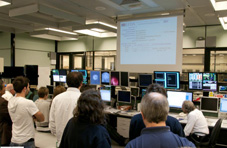 The new App ‘Operation Tokamak’ invites gamers to have a go at realising fusion power. Being the operator of a fusion machine, players have to control the plasma by shaping the magnetic field, bring up the heat with the help of powerful microwaves and blast harmful magnetic islands away.
It goes without saying that the script of a game has different requirements than a fusion device. Therefore some simplifications were necessary to develop the gameplay of ‘Operation Tokamak’. Despite that the motivation of this game has been to give the player a sense of the essential requirements that make fusion happen. The biggest difference between the game and reality is certainly that in ‘Operation Tokamak’ fusion energy is produced regularly and widely in many countries. In reality about 40 fusion laboratories do research on how this goal can be achieved.
Operation Tokamak in the control room
In a real control room there is more than one actor to run an experiment which is carefully planned in advanced. For a start, there are two main players working hand in hand: The Session Leader and the Engineer-in-Charge. The Session Leader is in charge of the scientific aims of the experiment while the Engineer-in-Charge makes sure that the systems are functioning properly and are used safely – he or she will hit the stop button if the scientists are getting too creative.
The Session Leaders’ job starts some days ahead of their duty in the control room: They design the plasma pulses to achieve the experimental goals as defined by the Scientific Coordinator. This means setting the plasma parameters such as magnetic field, plasma current, or gas, planning the sequence of steps from the start through to the end of the pulse and defining the required heating power. Together with the Additional Heating Pilots, the Session Leader discusses the best strategy for when and how to apply the heating systems – for instance, the powerful microwave systems also featured in ‘Operation Tokamak’. The Diagnostic Coordinators request all the measurement systems that are necessary to monitor the plasma and to record the experimental data.
The countdown begins
To begin a plasma pulse, the Power Supply Engineer starts JET’s two flywheel generators to build up hundreds of megawatts of power. Two nine meter wide steel wheels are set into a horizontal rotation and reach 225 rounds per minute – a spinning rate at which their edges rotate at a speed of 380 km/h. At the same time, The CODAS Duty Officers make sure that the computers and software are ready. A two and a half minute long countdown begins, urging all coordinators to ensure that their systems are ready. Once that is confirmed, the Engineer in Charge starts the pulse and the experiment is on. The magnetic field builds up. The heating pilots make sure that the microwave and particle beam systems to heat the plasma function correctly. The diagnostic coordinators monitor their systems to ensure the best quality of the experimental data.
Sorry, no shooting of instabilities in the control room
And the magnetic islands which players blast away in the game? Fusion scientists investigate various ways to mitigate these plasma instabilities. One of them is an automated feedback system. It picks up the magnetic islands thanks to their emission of tiny amounts of microwaves, automatically directs powerful microwaves at their spot and shrinks them to harmless size. Just like the players in ‘Operation Tokamak’.
You find lots of general and more in-depth information on our web site to get a better understanding of the real science is pursued in a mutual European effort.
But you are already prepared to run your own session in the ‘Operation Tokamak’ game. Find out how much energy you produced and how much CO2 you saved. And do not forget to share your score with your friends on the Leaderboard on the EFDA website or on your private Facebook account. Tweet about it using #optok. Good luck!
Source: EFDA


nsp_154.JPG)


nsp_154.JPG)


 |
 |
 |
 |
 |
 |
 |
 |
Media


Projekty badawcze realizowane przez IFPiLM są finansowane ze środków Ministerstwa Edukacji i Nauki i Narodowego Centrum Nauki oraz ze środków Komisji Europejskiej na podstawie umowy grantowej No 101052200, w ramach Konsorcjum EUROfusion. Wsparcia finansowego udzielają także: Międzynarodowa Agencja Energii Atomowej, Agencja Fusion for Energy, Europejska Agencja Kosmiczna i Konsorcjum LaserLab.