





Zestaw obrazów 2019
zdjecie1.jpg
zdjecie2.jpg
zdjecie3.jpg
zdjecie4.jpg
zdjecie5.jpg
zdjecie6.jpg
2019_1.JPG
2019_2.JPG
2019_4.JPG

Galeria
Magnetic behavior discovery could advance nuclear fusion
 ANN ARBOR—Inspired by the space physics behind solar flares and the aurora, a team of researchers from the University of Michigan and Princeton has uncovered a new kind of magnetic behavior that could help make nuclear fusion reactions easier to start.
Fusion is widely considered the ultimate goal of nuclear energy. While fission leaves behind radioactive waste that must be stored safely, fusion generates helium, a harmless element that is becoming scarce. Just 250 kilograms of fusion fuel can match the energy production of 2.7 million tons of coal.
Unfortunately, it is very difficult to get a fusion reaction going.
"We have to compress the fuel to a temperature and density similar to the core of a star," said Alexander Thomas, assistant professor of nuclear engineering and radiological sciences.
Once those conditions are reached, the hydrogen fuel begins to fuse into helium. This is how young stars burn, compressed by their own gravity.
On Earth, it takes so much power to push the fuel atoms together that researchers end up putting in more energy than they get out. But by understanding a newly discovered magnetic phenomenon, the team suggests that the ignition of nuclear fusion could be made more efficient.
Two methods dominate for confining the fuel, made of hydrogen atoms with extra neutrons, so that fusion can begin. Magnetic confinement fusion uses magnetic fields to trap the fuel in a magnetic 'bottle,' and inertial confinement fusion heats the surface of the fuel pellet until it blows off in a way that causes the remaining pellet to implode. The team explored an aspect of the latter method through computer simulations.
"One of the concerns with nuclear fusion is to squeeze this very spherical fuel pellet perfectly into a very small spherical pellet," said Archis Joglekar, a doctoral student in nuclear engineering and radiological sciences.
To avoid pushing the ball of fuel into an irregular shape that won't ignite, the fuel must be exposed to uniform heat that will cause its surface layer to evaporate all at once. As this layer pushes off at high speed, it applies equal pressure to all sides of the pellet and causes it to shrink to one thousandth of its original volume. When that happens, the fuel begins to fuse.
Joglekar calls even heating "the biggest concern in terms of achieving inertial confinement fusion."
The heat comes from about 200 laser beams hitting the inside of a hollow metal cylinder with the fuel pellet sitting at its heart. The trouble is that the light energy from the laser is converted to heat in the metal by way of electrons, and the electrons can get trapped in magnetic fields created by the laser spots.
When the laser light hits the metal, it turns some of the surface metal into plasma, or a soup of electrons and free atomic nuclei. The laser and the heat drive the electrons to move in a way that sets up a magnetic field circling the laser spot.
The magnetic field acts as a boundary for the electrons—they can't cross it. But until now, researchers didn't know that the hot electrons, in an effort to get to cooler areas, are able to push the magnetic fence outward.
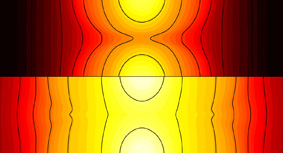
The team showed that the flow of hot electrons could drive the magnetic fields around neighboring laser spots together, causing them to join up. Instead of forming a barrier between the laser spots, the joined fields open a channel between them.
"Now there's a clear path for the electrons to move into what would otherwise be the cold region," Joglekar said.
Designers of inertial fusion ignition systems may be able to use this newly discovered feature to place the laser spots so that they heat the cylinder more quickly and efficiently.
"Essentially, what we found is a completely new magnetic reconnection mechanism," Thomas said. "Though we're studying it in an inertial confinement fusion process, it might be relevant to the surface of the sun and magnetic confinement fusion."
For instance, knowing that the flow of hot, charged particles on the sun can push magnetic fields around could inspire new theories about how solar flares occur.
A paper on this work, titled "Magnetic reconnection in plasma under inertial confinement fusion conditions driven by heat flux effects in Ohm's law," is published in Physical Review Letters. It was carried out in collaboration with Amativa Bhattacharjee and William Fox of the Princeton Plasma Physics Laboratory.
Source: www.ns.umich.edu
The Future May Be Getting Close to Reality in Vancouver, With D-Wave and General Fusion
 Vancouver is a land of scenic harbors, tall mountains and startups trying to harness the limits of physics.
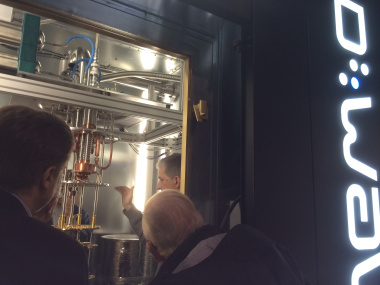
In town for the TED conference, I had the occasion to visit two such companies yesterday:D-Wave and General Fusion. D-Wave, a quantum computing company, is all about the very cold and the rather tiny. It has built enormous refrigerators that each house a single chip, laced with “qubits” that can be in the superposition of both 1 and 0 at the same time and can carry an electric current with no resistance at low temperatures.
Meanwhile, General Fusion is all about huge and hot. The company is putting together the pieces for an alpha version of a nuclear reactor plant that would use magnetized target fusion. That is, it slams together hydrogen atoms by shooting donut-shaped electrified plasma into a chamber where it’s squished by synchronized pistons from all angles. This happens at a temperature of 150 million degrees. The point: To create clean and cheap energy.
Both of the companies say their products are on the verge of a breakthrough. Over about a decade of research and development, they have each acquired their own posse of doubters, who say they are designing expensive, impractical systems that don’t really work yet.
That may well be true, but people at both D-Wave and General Fusion like to compare their cost of development — and the broader investment in their respective spaces — to the estimated trillion dollars of investment over the past decades that have fueled the rise of traditional computing and its generational leaps forward associated with Moore’s Law.
Fusion always seems like a far-away prospect, but it’s closer than you might think, said General Fusion founder Michel Laberge in a talk at TED. “Very soon, somebody will crack that nut,” he said.
In fact, plotted against the curve of Moore’s Law, progress in fusion performance looks pretty parallel, according to Laberge.
The difference is, fusion doesn’t really work at all until it crosses a threshold on that chart — one Laberge and General Fusion think they are very close to achieving, if they can only create a system that is 150 million degrees, dense and long-lasting.
Over at D-Wave, which is headquartered about a 20-minute drive from the Vancouver Convention Centre, a 512-qubit quantum computer is already in the hands of customers and research partners, who have demonstrated that these machines can match the state of the art in classical computing.
What that means is, for certain problems — generally where someone is trying to optimize something — the D-Wave machine can already compute something just as fast as a state-of-the art classical set-up by considering multiple options simultaneously.
But that’s not enough. At this point there’s no big advantage to quantum computing because it’s not cost effective. The big leap is when quantum computers can do things demonstrably better than classical computers so they justify the big fridge and the big price.
D-Wave hopes and believes that will happen later this year, upon the arrival of a 1024-qubit quantum computer that’s close to being ready.
The promise of quantum computing is the possibility of solving problems that would require massive quantities of computers — perhaps more than are available in the world.
Because the combination of computing capacity and big data has been so effective in machine learning, it’s quite possible that this work will aid leaps forward in artificial intelligence. In fact, Google has a D-Wave machine and is working on that now. So is D-Wave co-founder Geordie Rose, who emphasized in an interview yesterday, “Whether or not it’s quantum is not important. It’s what it does.”
Meanwhile, a 15-minute drive away, General Fusion, which shares investors with D-Wave, is about two to three years out from creating its own power plant. Today, the pistons work well, and the plasma is hot enough and dense enough. Within the last month, the gas donut has started lasting long enough for the system to work, so now the company is turning its focus to compression and timing, according to Michael Delage, VP of strategy and corporate development.
Similar to D-Wave, General Fusion is at a point where it needs to get its system working and cost effective. “We expect to be at break-even energy in a couple of years,” said CEO Nathan Gilliland.
When this is built out, General Fusion thinks it can provide power at a cost of seven cents per kilowatt, comparable to the cost of coal.
Why this is important? As Laberge said, “It could solve all our energy problems cleanly for the next billion years.”
So why are both of these companies in Vancouver? Part of it is the investment climate. D-Wave founder Rose called out Haig Farris of Ventures West and Mike Brown of Chrysalix as “gunslinger types” who invest for the long term. D-Wave has raised $130 million, while General Fusion has raised $50 million.
Or maybe it’s the mountains meeting the sea. “There’s something around competency in hardware and pushing boundaries,” said General Fusion’s Delage.
And especially during the week of TED, it’s a place of optimism. “With AI, or quantum computing, or fusion, there are these things the world should have — and the fact they don’t is a travesty,” said Rose. “We’ve created tremendous wealth on this planet, and we should be using it on our sense of wonder.”
Source: recode.net
Drugie wynalezienie ognia
 Fusion for Energy (F4E), the organisation managing Europe’s contribution to ITER, has signed a contract with Ampegon to design, manufacture, install and commission the power supplies for the Electron Cyclotron system, one of ITER’s heating systems, that will make its hot plasma reach 150 million degrees Celsius.
The company has made history being Switzerland’s first ever SME to contribute to the prestigious fusion energy project. According to Professor Henrik Bindslev, F4E Director, “ITER offers a vast range of business opportunities to small, medium and larger companies. Today’s signature proves yet again that SMEs have a role to play to the most ambitious international collaboration in the field of energy”. Josef Troxler, Ampegon CEO, explained that “the power supplies are a critical element of the machine. We are proud to offer our expertise and be amongst the companies that will build the world’s largest fusion project”.
It will operate like a powerful microwave oven. High frequency electromagnetic waves will transfer their energy to the plasma, raise its temperature and drive additional current to sustain longer discharges. The precision of the electron cyclotron will help scientists to target specific plasma areas that require an extra blast of heat and maintain plasma confinement and stability.
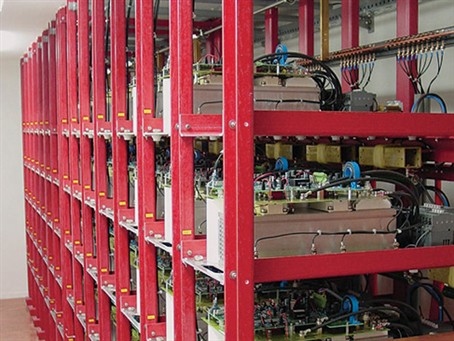
During the next six years, Ampegon AG will work to deliver 8 out of the ITER’s 12 main high voltage power supplies (55kV/100A) and 16 body power supplies (35kV/100mA). The main task of power supplies will be to transform the electricity from the grid to regulated direct current and voltage that ITER will need to generate the electromagnetic waves. The power supplies system will be designed to shut down in less than 10 micro-seconds.
Source: F4E
Nuclear fusion: Julich's role in ITER
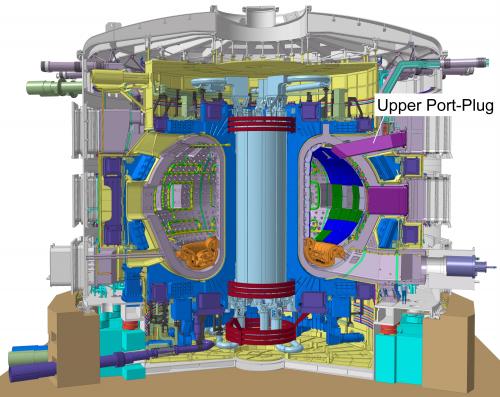 Forschungszentrum Jülich will lead a consortium of European partners to design a measuring system for the fusion experiment ITER. The facility is currently under construction in Cadarache in the south of France as part of a major international cooperation. The consortium signed a Framework Partnership Agreement with the European Union's Joint Undertaking for ITER and the Development of Fusion Energy (F4E) to develop the ITER core plasma Charge Exchange Recombination Spectroscopy (CXRS) diagnostic. This measuring system will help determine the composition and temperature of the plasma in the vacuum vessel. The Framework Partnership Agreement runs for four years with an F4E contribution of 4.9 million euros.
ITER is the next major step in international fusion research. F4E is responsible for providing the European contribution to ITER, which is scheduled to go into operation in the early 2020's and demonstrate the feasibility of fusion energy on a power-plant scale for the first time ever. The fusion of atomic nuclei will be used to generate energy. Similar processes occur inside the sun. If they can be controlled here on Earth, then we would have access to a safe and practically inexhaustible source of energy.
Once designed by the consortium, the core plasma CXRS system will be procured by F4E and assembled into a port plug, to be installed in an inset at the upper edge of the vacuum vessel. The consortium gained a significant knowledge related to this diagnostic through R&D tasks funded in the past years by the European Fusion Development Association (EFDA) and by the Federal Ministry of Education and Research (BMBF). In particular, deployment of such a system under the extreme conditions that will be encountered in ITER necessitates complex development work and tests. Indeed, temperatures exceeding 100 million degrees Celsius are expected within the vacuum vessel and the associated plasma radiation, neutron flux, and electromagnetic forces all impact significantly on the design choices for components. In addition, maintenance and repairs are usually only possible using remote-controlled tools or robots.
The CXRS diagnostic views a region of the ITER plasma illuminated by a high-energy beam of neutral hydrogen particles injected into the plasma by a companion device being constructed by ITER's Indian partners. Collisions with particles in the fusion plasma produce visible light. Its wavelength and spatial distribution allow conclusions to be drawn on various properties of the plasma. The measurements provide information that is crucial for sustaining the fusion reaction. The density of helium, in particular, is recorded. Helium is formed during the fusion reaction and must be removed from the combustion chamber if the fusion fire is to be kept alight. Other important parameters such as the concentration, temperature and velocity of different plasma species can be determined using the diagnostic.
The design of the CXRS diagnostic device is being performed, in particular, by physicists and engineers from the Jülich Institute of Energy and Climate Research (IEK-4) and by their colleagues at Jülich's Central Institute of Engineering, Electronics and Analytics (ZEA-1) as well as by their European partners (members of the consortium) including Karlsruhe Institute of Technology (KIT), universities of technology in Budapest (BME) and Eindhoven (TU/e), the Dutch Institute for Fundamental Energy Research (DIFFER), and CCFE in the UK. Contributing third parties include the Spanish CIEMAT centre and the Hungarian Wigner-RCP institute.
Source: phys.org
When Canada operated a tokamak in Varennes
Solar energy is a potential resource for power. But how about having a mini Sun right here on Earth?
Built at Hydro Quebec's Research Institute facility in Varennes, Que. and operational from 1987 to 1997, the Tokamak Fusion Reactor was an attempt at just that.
This week's video explains the science behind this reactor. Unlike modern nuclear reactors that produce energy through fission — splitting large particles into smaller ones — the Tokamak tried to do the opposite. It used fusion, which has the potential to produce nearly limitless, non-polluting energy. In fact, people may not realize it, but they witness the power of fusion everyday by walking in sunlight.
Source: Canadian Geographic


nsp_154.JPG)


nsp_154.JPG)


 |
 |
 |
 |
 |
 |
 |
 |
Media


Projekty badawcze realizowane przez IFPiLM są finansowane ze środków Ministerstwa Edukacji i Nauki i Narodowego Centrum Nauki oraz ze środków Komisji Europejskiej na podstawie umowy grantowej No 101052200, w ramach Konsorcjum EUROfusion. Wsparcia finansowego udzielają także: Międzynarodowa Agencja Energii Atomowej, Agencja Fusion for Energy, Europejska Agencja Kosmiczna i Konsorcjum LaserLab.