





Zestaw obrazów 2019
zdjecie1.jpg
zdjecie2.jpg
zdjecie3.jpg
zdjecie4.jpg
zdjecie5.jpg
zdjecie6.jpg
2019_1.JPG
2019_2.JPG
2019_4.JPG

Galeria
In the Face of Fracking: Nuclear Fusion
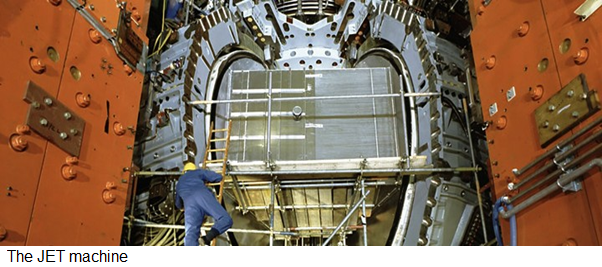 News stories riddled with firm words about the controversies surrounding the process of fracking have recently been at the forefront of discussion in energy production circles. As a source of power it has come under large amounts of scrutiny due to its potential to pollute water supplies and cause earthquakes, and because of its perpetuation of the obsession with clinging on to fossil fuels – more information on which can be found here.
But over-shadowed by the fracking dispute are some promising and far more bold initiatives taking place to achieve the goal of providing energy in a post-fossil fuel world, initiatives that have subsequently been somewhat relegated to the side-lines of public attention.
Obviously there are the famous front-runners: wind power, hydropower, and solar power are among the best known.
The problem with these lies in the scale on which each process needs to be undertaken to produce the energy required. Giant wind farms erected in the sea and endless carpets of solar panels may not be a future some people will want to be a part of.
So if not these and if not fracking (or any other fossil fuel based process), what else? Well, some very talented and ambitious researchers are now trying to use a scaled-down version of the process that powers the sun to provide the world with a new energy source for the future – this is known as nuclear fusion.
According to the EFDA (European Fusion Development Agreement), demand for energy worldwide may quadruple by 2100, meaning that a high-yield, long-lived, and stable source of energy needs to be established. It is likely that fracking and other current methods of fossil fuel usage will not be able to cope with this increase, not to mention them being finite nature – other renewables such as solar power may not be up to the challenge either.
In response to this, projects like JET (Oxfordshire, UK) and ITER (St Paul-lez-Durance, France) now harbour (or will harbour in ITER’s case) giant nuclear fusion reactors, with the aim of utilising them to try and draw energy from fusion reactions (these will be discussed below).
But why is fusion a better future for energy? What do JET and ITER actually do? To answer this, Inlec spoke to a number of experts in involved in nuclear fusion – they’re busy people and we are very grateful for their input to this article.
Nuclear Fusion: what is it?
Existing Projects
The commercial use of nuclear fusion as a viable energy source is no longer an idea locked in the realms of science fiction. For years now projects have been underway to harness this power and overcome the technological difficulties that surround fusion power. As mentioned earlier, two of the world’s major centres for nuclear fusion lie in the UK and France: JET and ITER.
JET:
JET is a UK based experimental fusion project located at Culham Centre for Fusion Energy. Its fusion reactor (tokomak) is currently the biggest in the world, although this will not be the case once its colossal successor ITER is built (see below).
Construction on JET started in 1977 and it was completed and opened in 1984 – its major milestone came when it played host to the world’s first controlled release of fusion energy in November 1991. Today, JET still conducts extensive fusion research.
To get an insider’s look at work on JET, Inlec spoke to Duarte Borba, JET’S Senior Advisor:
Duarte Borba: Senior Advisor at JET
- Q: What advances has JET made in recent years towards the goal of producing energy from nuclear fusion?
A: One key aspect for the successful development of Fusion Power is the materials choice for the interior of the device, i.e. the materials that will face the harsh conditions near the very high temperature fusion plasma. The use of very powerful magnetic fields keeps the fusion plasma from contacting directly the walls, but this containment is not perfect and some of the energy escapes leading to the erosion of the plasma facing components.
The materials selected to be used in the next step fusion device ITER are Tungsten and Beryllium; and JET has been doing key experiments with this precise mixture of materials in preparation of the operation of ITER. These experiments have been very successful, and the recent results have been very important in supporting the choice of materials to be used in ITER.
- Q: What are the technological difficulties surrounding work with nuclear fusion?
A: Fusion relevant conditions have been demonstrated on JET, and a significant amount of fusion power has been produced (>16 MW). However, the process needs to be more efficient, for it to produce more energy than the energy required to achieve the conditions for fusion to occur. For this, a more powerful magnetic field and a larger device is required. This is the main objective of the ITER experiment, under construction in southern France, together with the demonstration of the required technologies to sustain net energy production (>500 MW) for long periods of time (1000 s).
- Q: Are there are any political barriers you have to cross in doing research like this?
A: Fusion research is strongly supported worldwide and it is being carried out in an international collaborative framework. The ITER project is an international collaboration involving all countries in the EU and Switzerland, together with China, Russia, South Korea, Japan, India and the United States.
- Q: In your opinion, how long will it take for nuclear fusion to become useable as an energy source for the world?
A: The aim is to build the first fusion power plant in the 2030s, which would produce electricity by 2050. The European Commission’s new Framework Programme for Research and Innovation (Horizon 2020) has just been agreed and includes the resources to implement the R&D roadmap for achieving the 2050 target. If all goes according to plan, during the second half of this century fusion will become one of the world’s major sources of energy.
ITER:
ITER is a current project being undertaken in the south of France to build the largest tokomak on the planet, with a view to actually using it as a genuine producer of energy to be made available to the public. This will be done by using the heat produced by the fusion reaction (mentioned earlier) to create steam, which will in turn power turbines and provide us with energy. Michel Claessens, Head of ITER Communications, told us more:
Michel Claessens: ITER’s Head of Communications
- Q: The ITER project looks very exciting for the future of energy – how is it progressing to date?
A: ITER will be the biggest fusion reactor on Earth. Here in St Paul-lez-Durance (80 km from Marseille, in France), the ITER project is now transitioning to full construction. There is an increasing pace of construction activities at the ITER site and good progress in the manufacturing of the reactor components and supporting systems, currently underway in all the ITER Members. Major contracts have been placed and many leading industries are now involved in the project; the first delivery of large components is expected on site in the third quarter of 2014. The end of the buildings construction is scheduled for 2020.
- Q: How is ITER different to previous nuclear fusion efforts, for example JET?
A: ITER will be the biggest fusion reactor on Earth, about 10 times bigger (in volume) than JET. And also ITER is the first fusion reactor specifically designed and built to produce energy. It is expected that ITER will produce 10 times the energy injected in the machine
- Q: There seems to have been some delays and difficulties in building the site for ITER; why is that? What have the major delays or difficulties been caused by?
A: For a project of such unprecedented nature and scale, involving worldwide cooperation and billions of euros of expenditure, challenges to the schedule along the way can be expected.
The ITER Organization has identified the following impediments to optimal schedule performance: delays in the signature of agreements and contracts, lengthy design review and design change processes, and complex approval procedures for nuclear components.
It is also true that the earthquake and tsunami in Japan on 11 March 2011 has affected some of the installations producing components for ITER. In particular, the buildings for superconducting magnet test equipment and neutral beam test equipment were seriously damaged. In its initial assessment, the Japanese government estimated at one year the delay in its contribution of key components.
- Q: In your opinion, how long will it take for nuclear fusion to become useable as an energy source for the world?
A: According to current plans and research, it is expected that fusion could become a commercial energy source around 2050.
Source: inlec.com
Ważne osiągnięcie w badaniach fuzji termojądrowej inicjowanej laserem w Narodowym Laboratorium im. E.O. Lawrence'a w Livermore (Lawrence Livermore National Laboratory – LLNL, California, USA)
W dniu 29 września b.r. w LLNL w Kalifornii uzyskano bardzo ważny wynik eksperymentalny w badaniach kontrolowanej syntezy termojądrowej (fuzji) realizowanej za pomocą lasera wielkiej mocy i energii.
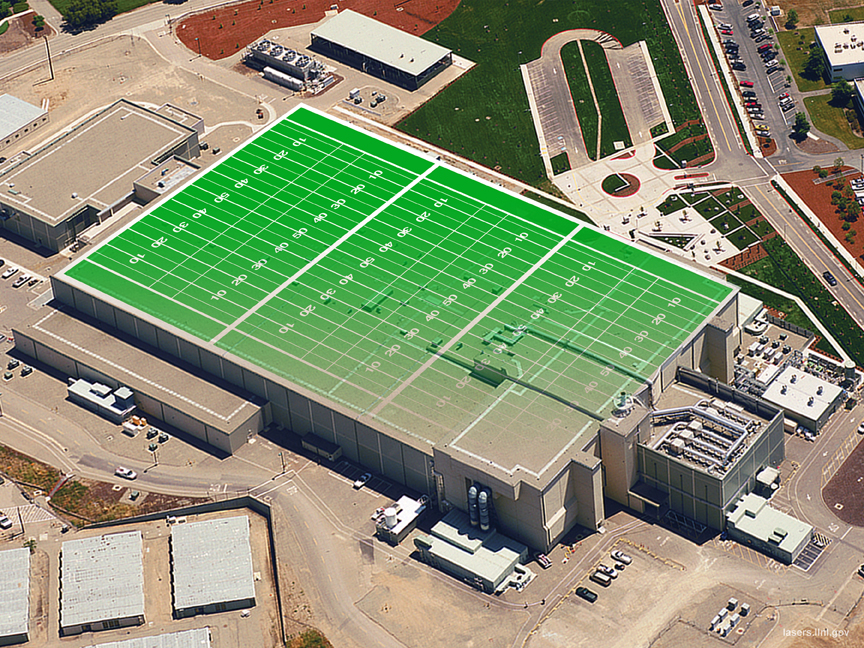
Widok laboratorium NIF w LLNL z lotu ptaka. LLNL Photo Gallery.
W eksperymentach realizowanych ostatnio w LLNL wykorzystany jest największy na świecie 192-wiązkowy laser NIF (National Ignition Facility) generujący impulsy o energii ~1.80 MJ i czasie trwania kilku nanosekund (moc impulsu wynosi do ~400 TW). Wiązki lasera NIF o długość fali 351 nm (nadfiolet) są symetrycznie wprowadzane przez otworki w ”denkach” złotej tarczy-cylinderka (zwanego hohlraum target) o wymiarach: długość ~10 mm średnica – 4-5 mm. Wiązki laserowe wchodzą do cylinderka pod różnymi kątami i oddziałują z jego wewnętrznymi ściankami generując intensywne miękkie promieniowanie rentgenowskie. W centrum cylindra znajduje się cienkościenna kulka o średnicy ~2 mm wykonana z plastiku, albo innych lekkich materiałów. Na wewnętrznej ściance kulki znajduje się warstwa zamrożonej mieszaniny cięższych izotopów wodoru - deuteru (D) i trytu (T). Intensywne promieniowanie rentgenowskie oddziałując z powierzchnią kulki-tarczy powoduje gwałtowną jonizację i odparowanie (ablację) warstwy powierzchniowej kulki skutkujące implozję warstwy wewnętrznej pokrytej „lodem” DT (efekt „rakietowy”). W wyniku kompresji i grzania plazma w centrum kulki DT osiąga setki g/cm3 a temperatura przekracza kilkadziesiąt milionów stopni Kelvina. W tych warunkach zachodzą reakcje syntezy (fuzji) jąder izotopów wodoru, głównie najbardziej prawdopodobna reakcja D+T z emisją wysokoenergetycznych cząstek alfa i neutronów.
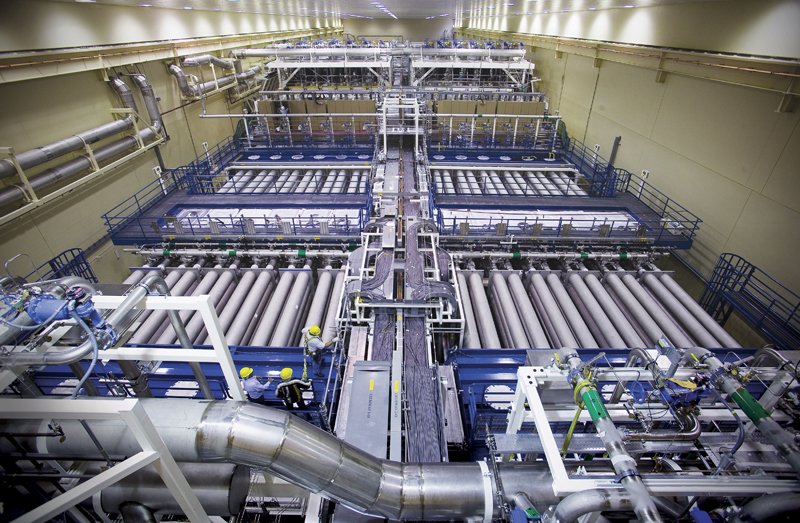
Fragment lasera NIF. LLNL Photo Gallery.
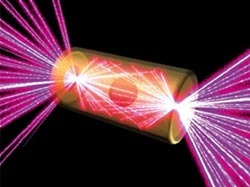
Schemat oddziaływania wiązek lasera NIF z wewnętrznymi ściankami złotego cylinderka (hohlraum target) z kulką zawierającą paliwo DT. LLNL Photo Gallery.
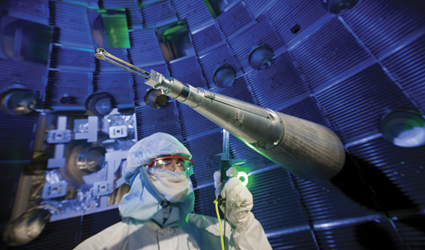
Wnętrze komory eksperymentalnej przy laserze NIF z urządzeniem do ustawiania tarczy w ognisku wiązek laserowych. LLNL Photo Gallery.
W ostatnio wykonanym w LLNL eksperymencie uzyskano rekordową generację ~5x10¹⁵ neutronów o całkowitej energii ~14 kJ. Stwierdzono, że wydzielona energia termojądrowa była większa od energii pierwotnie dostarczonej przez promieniowanie rentgenowskie do paliwa DT. Bardzo ważnym rezultatem tego eksperymentu było potwierdzenie przewidywań modeli teoretycznych, co stanowiło problem we wcześniejszych badaniach na układzie NIF. Pokazany wynik ostatnich badań wykonanych w LLNL jest bardzo ważnym osiągnięciem na drodze do efektywnej produkcji energii w wyniku fuzji inicjowanej laserem. Następnym krokiem będzie zwiększenie wzmocnienia energetycznego w skomprymowanym, gorącym paliwie DT w wyniku przekazu do tego paliwa energii cząstek alfa produkowanych w reakcji syntezy D+T. Informacje o ostatnim eksperymencie wykonanym w LLNL można znaleźć na stronie internetowej: http://www.bbc.co.uk/news/science-environment-24429621.
Opanowanie kontrolowanej syntezy termojądrowej (fuzji) dla przyszłej produkcji energii elektrycznej jest obecnie jednym z najważniejszych zadań światowej nauki i technologii. Realizacja tego zadania wiąże się z szybkim wzrostem zapotrzebowania na energię elektryczną i koniecznością radykalnego ograniczenia energetyki wykorzystującej paliwa kopalne. Stosowanie odnawialnych źródeł energii jest mało wydajne w skali globalnej i wiąże się z ingerencją w środowisko naturalne. Energetyka termojądrowa w przeciwieństwie do energetyki jądrowej nie łączy się z produkcją dużej ilości długożyciowych odpadów radioaktywnych i z możliwością katastrofalnego rozprzestrzenienia się materiałów radioaktywnych. Do wytwarzania energii w wyniku fuzji izotopów wodoru D i T wykorzystuje się deuter, który znajduje się w dużych ilościach w wodzie, i tryt produkowany w reakcji neutronów z łatwo dostępnym litem.
Reakcje fuzji w gorącej i bardzo gęstej, krótkożyciowej plazmie wytwarzanej laserem, jak to ma miejsce w układzie NIF, zachodzi bez stosowania zewnętrznych układów do utrzymania plazmy. Reakcja ta zachodzi przy jedynie inercyjnym utrzymaniem paliwa DT. Metoda taka jest nazywana Inertial Confinement Fusion - ICF. Programy dotyczące opracowania fuzji ICF realizowane są także w Europie (projekt HiPER) i w Japonii (projekt FIREX). Inną metodą opanowania efektywnej produkcji energii fuzji, bardziej rozpowszechnioną niż ICF, jest zastosowanie pól magnetycznych w toroidalnych pułapkach typu tokamak albo stellarator służących do odpowiednio długiego utrzymania bardzo gorącej i rzadkiej plazmy. Czas utrzymania plazmy, jej temperatura i gęstość powinny umożliwić uzyskanie energii fuzji przewyższającej energię dostarczaną do tych układów przez zewnętrzne strumienie cząstek i mikrofal. Metoda ta nazywana jest Magnetic Confinement Fusion - MCF). W ramach międzynarodowego projektu ITER w południowej Francji jest obecnie budowany przez Unię Europejską, St. Zjed. Am. Pn., Japonię, Chiny, Republikę Korei, Kanadę i Indie wielki tokamak jako fuzyjny reaktor eksperymentalny.
Instytut Fizyki Plazmy i Laserowej Mikrosyntezy jest wiodącym w Polsce ośrodkiem naukowym realizującym prace dotyczące fuzji w ramach projektów europejskich zarówno w wersji ICF jak i MCF. Informację o badaniach realizowanych w IFPiLM można znaleźć na stronie www.ifpilm.pl.
Europe signs its largest ever contract for ITER with GDF SUEZ Group and M+W Group
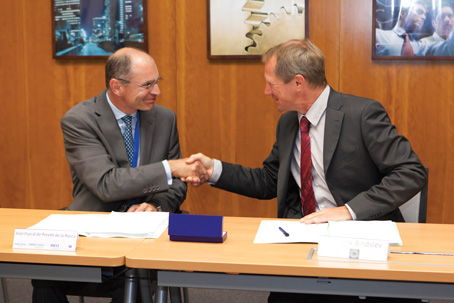 Fusion for Energy (F4E) has signed its largest contract to date with Cofely Axima, Cofely Ineo, Cofely Endel (GDF Suez Group) and M+W Group. The strong expertise of the Franco-German group of companies will be used to provide the building services for the Tokamak complex, where the ITER Tokamak machine will be located, and the surrounding buildings. The contract is expected to run for six years and its budget is approximately 530 million EUR.
Professor Henrik Bindslev, F4E’s Director, stated that “this is an important achievement for Europe not only because of the volume of the contract but also because European companies will be given an unprecedented opportunity to share and acquire new know-how that will generate future business opportunities.” Guy Lacroix, Managing Director of GDF SUEZ Energy Services in charge of Cofely Axima, Cofely Ineo and Cofely Endel confirmed that “being part of the largest international collaboration in the field of fusion energy makes us extremely proud. All the members of the consortium bring together a diversity of skills and expertise which allow us to demonstrate that we can be at the forefront of large scale industrial projects like ITER.”
The ITER site in figures:
The size of the ITER platform is 42 hectares and Europe is the party responsible for the delivery of the 39 buildings that the ITER platform will host. Currently, the personnel directly involved in construction counts 250 people and by the end of 2014 it is expected to reach 2,000 people. One of the key challenges will be to accommodate the needs of the rapidly growing workforce and to guarantee an optimal use of space to the different companies operating on the ground, in order to carry out the construction of all infrastructures in parallel and on time.
The scope and key figures of the contract:
The contract covers the design, supply, installation and commissioning of the mechanical and electrical equipment for the Tokamak complex, which consists of the Tokamak, Diagnostic and Tritium buildings, plus the surrounding buildings which reach a total of 97,200 m3. Thanks to this contract all the necessary works of the ITER Assembly phase will start in order to host ITER’s high tech equipment in compliance with the strict safety requirements and in line with the rigorous qualification tests.
Through this contract a Heating Ventilation Air Conditioning (HVAC) system will be delivered powerful enough to treat the air flow of 1,000,000 m3/hour which corresponds to the volume of air that is inhaled and exhaled by 3,5 million people/hour. Furthermore, Instrumentation and Control (IC) systems, power supplies, interior and exterior lighting, gas and liquid networks will be installed. State of the art fire detection and extinguishing systems, consisting of 2,000 fire detectors, will be supplied, pipe fittings and handling equipment with various interfaces connecting buildings and systems.
Source: F4E
ITER Test Blanket Modules: tomorrow’s technology gets tested today
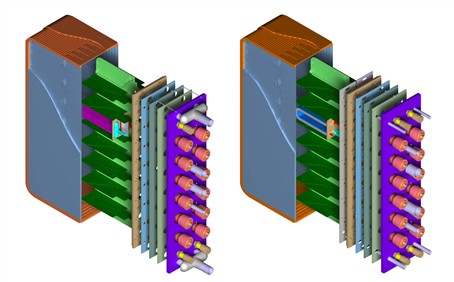 One of the most fascinating aspects of the ITER project is the technology that is being deployed in order to test the viability of fusion energy at such scale. For an outsider, the project is a leap to the future. For scientists and technical experts who have spent most of their life in the fusion community, ITER is validating and upgrading existing know-how that has been accumulated throughout the years in fusion laboratories around the world.
There will be some, however, who will be given a once in a lifetime opportunity to push the envelope further and use ITER as a laboratory. They will witness technological breakthroughs and pave the way for DEMO, the fusion demonstration reactor planned to come after ITER. Amongst the fortunate vanguard fusion specialists are those involved in the Test Blanket Modules (TBMs). During the last International Symposium on Fusion Nuclear Technology there was a lot of buzz about the progress made in the area of TBMs. What is this blanket made of that is exposed to plasma reaching 150 million°C and what purpose does it serve? We met with Yves Poitevin, F4E’s Project Team Leader for TBMs and Materials Development, to understand the background, the state of play and potential of this domain.
Apart from deuterium, ITER will require the administration of tritium in order to make the fusion reaction happen. In DEMO, it will need to be bred continuously within the reactor in order to keep the fusion reaction going. How can this be achieved? Tritium can be produced within the reactor once the neutrons of the fusion reaction bounce on lithium, which is contained in the reactor’s blanket. “One of our aims is to test the prototypes of future breeding blankets in real fusion conditions offered by ITER and then export that knowledge to DEMO. In essence, we are generating a new component and qualifying it in unprecedented conditions. Furthermore, through this process, we are licensing a nuclear system based on advanced materials and top fabrication technology” Yves Poitevin explains. “We are writing a new chapter in this field by collecting new data, developing new codes and extrapolating them to DEMO. This is a real opportunity for Europe’s research and industrial communities to collaborate and develop together a vital technology for fusion reactors.”
Work started in the late 90s when the European Fusion Development Agreement (EFDA) conducted research to address the need for the development of new materials and technologies for tritium production. The transition from research to licensing and fabrication is challenging. F4E has been collaborating with specialised engineering companies like IDOM, Atmostat, Iberdrola, AMEC, Empresarios Agrupados to take stock of their expertise. Similarly, for the design and qualification phases the input received by laboratories like KIT, CEA, ENEA, CIEMAT, UJV, KFKI, NRG, etc. has proved extremely valuable. Approximately 30 contracts have already been signed in this domain and the work is gradually increasing in volume.
Europe is standing at the crossroads of two blanket concepts: the Helium-Cooled Pebble-Bed (HCPB) and the Helium-Cooled Lead Lithium (HCLL). The key difference lies in the type of material used for the tritium breeder. In order to choose which way to go for DEMO, it has been decided to test both concepts simultaneously in ITER by placing the TBMs in an equatorial port of the machine.
In terms of the TBMs structural materials, Europe has set its hopes on EUROFER, a newly developed reduced activation ferritic/martensitic (RAFM) steel developed in Europe, which provides adequate resistance to neutron irradiation, corrosion and with acceptable resistance at high temperatures. “EUROFER is Europe’s choice for ITER’s TBMs because of its properties, its mechanical resistance and its tolerance to neutrons irradiation” explains Yves Poitevin. Part of EUROFER design limits have been recently added to the RCC-MRx nuclear construction code and progress is being made to complete them. Japan, Korea, India and China are also developing their own TBMs for ITER. The potential of developing in parallel different degrees of expertise is there. What is here, however, is the opportunity to invest and test today a technology that will be necessary tomorrow.
Source: F4E
Fusion Researchers Recommend ITER Design Tweaks
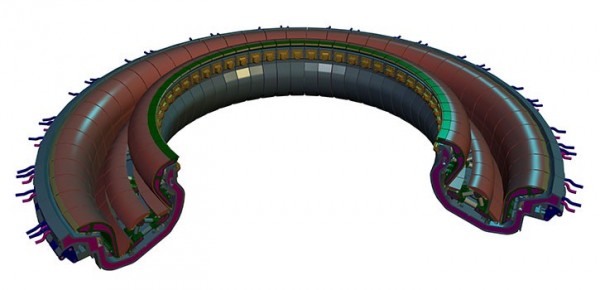 Scientific advisers to the ITER fusion reactor project have recommended several key changes to its design that could increase technical risks—but also smooth the path to producing excess energy. The recommendations, made last week by ITER’s Science and Technology Advisory Committee (STAC), will have to be approved by the full ITER council in November. But if approved, as expected, “the chance of surprises later is reduced,” says Alberto Loarte, head of ITER’s confinement and modeling section. “The risk will pay off.”
ITER, being built in France by an international collaboration, aims to show that nuclear fusion, the reaction that powers the sun, can be controlled on earth to produce energy. But reaching that goal involves heating hydrogen gas to more than 150 million°C so that hydrogen nuclei slam together with enough force to fuse. To do this, researchers are building a huge doughnut-shaped container called a tokamak to confine the ionized gas—or plasma—using enormously strong magnetic fields. ITER’s goal is to coax the plasma to produce 500 megawatts (MW) of heat, 10 times the 50 MW of power required to heat the plasma; this multiplying effect is known as a gain of 10.
The most significant change decided at the STAC meeting concerns a structure at the base of the tokamak vessel called the divertor. Its main function is to remove the helium that is the “exhaust” gas of the fusion reaction. The divertor is the only part of the vessel where the superhot plasma actually touches a solid surface, so it has to be able to absorb huge quantities of heat, as much as 10 MW per square meter of surface.
Existing plans call for making ITER’s first divertor with an outer layer of carbon. This is the safe option: Carbon is well proven in tokamak interiors; it can easily withstand the temperatures; and if any is blasted off into the plasma, it doesn’t affect the performance very much. The problem with carbon, however, is that it happily reacts with hydrogen, binding atoms into its structure. This wouldn’t be a problem during the early phases of ITER operation when researchers plan to use simple hydrogen or helium in the machine to get the hang of how it works. But a carbon coating could be a huge problem in later phases, when researchers plan to switch to real fusion fuel—a more reactive mixture of the hydrogen isotopes deuterium and tritium. Tritium is radioactive and so needs to be carefully controlled and accounted for. Nuclear regulators would never accept a divertor material that absorbs tritium and so makes it impossible to locate.
To address that problem, planners had proposed running ITER for several years with the carbon-coated divertor, and then switching to one made of tungsten. Tungsten has the highest melting point of any metal: 3422°C. That should be fine for withstanding the heat produced during normal, steady ITER operations. But any unexpected bursts of heat could potentially melt the divertor, and tungsten—unlike carbon—instantly poisons the plasma, bringing fusion to a halt. So ITER’s operators would have to run the reactor much more carefully with a tungsten divertor, not pushing it to limits where the plasma might become unstable.
Despite this drawback of tungsten, STAC has recommended that ITER be built with a tungsten divertor from the start. “It was not an easy decision,” says STAC Chair Joaquín Sánchez, head of Spain’s National Fusion Laboratory in Madrid. The decision was made after years of research at other tokamak laboratories, in particular the Joint European Torus (JET) at Culham in the United Kingdom, which is the closest machine to ITER in size and design. Several years ago, JET researchers refitted the reactor with a tungsten divertor and beryllium lining (as ITER will have). After a year of testing, they confirmed that this “ITER-like wall” worked well enough not to cause problems for ITER.
Although some fusion researchers think that it would be safer to start ITER with a well understood carbon divertor, allowing them to push the reactor to extremes in search of high performance, starting with tungsten has advantages, too. Changing divertors is a complex process that would take many months. In addition, once operation with deuterium-tritium fuel has started, the interior of the vessel becomes radioactive (or “activated”), making it much harder to modify internal components. “If we start with tungsten, we save the cost of the change,” Sánchez says. “We know tungsten will be more difficult, but we will start learning earlier in the nonactivated phase and if there is a problem we can send people inside to fix it.”
The other design changes concern two separate magnetic coils to be inserted inside the reactor vessel to fine-tune control of the plasma. ITER’s main plasma-confining magnets are outside the vessel and act as something of a blunt instrument. About 5 years ago, researchers highlighted the fact that operators would have difficulty keeping the vertical position of the plasma steady, and so proposed some extra magnetic coils on the inside.
In addition to those for vertical stability, researchers proposed installing a second set of internal coils to combat a troubling phenomenon in superhot fusion plasma called edge-localized modes, or ELMs. ELMs occur when energy builds up in the plasma during fusion and then bursts out of the edge unpredictably, potentially damaging the lining or the divertor. The second set of coils deploys a magnetic field to roughen up the surface of the plasma so that it leaks energy at a constant rate rather than in erratic bursts.
Anything inside the vessel is subjected to extreme heat, radioactivity, and magnetic forces, so researchers had to persuade STAC that these two sets of coils could be made resilient enough to survive. “There was some reluctance in STAC and the ITER Organization because of the technical issues of installation,” Loarte says. Experiments at other labs around the world reassured them. “The results obtained were very positive,” he says.
STAC also took a hard look at the delivery schedule of components for ITER. The original plan called for everything—heating systems, instruments, ELM mitigation—to be in place when ITER is completed in 2020. But delays have meant that some items will be arriving later. “We needed to redo the schedule with a logic consistent with [achieving deuterium-tritium operation] faster. It was not consistent before and that led to criticism,” Loarte says. “Now we have to do the organizational part, which is not simple.”
Source: news.sciencemag.org


nsp_154.JPG)


nsp_154.JPG)


 |
 |
 |
 |
 |
 |
 |
 |
Media


Projekty badawcze realizowane przez IFPiLM są finansowane ze środków Ministerstwa Edukacji i Nauki i Narodowego Centrum Nauki oraz ze środków Komisji Europejskiej na podstawie umowy grantowej No 101052200, w ramach Konsorcjum EUROfusion. Wsparcia finansowego udzielają także: Międzynarodowa Agencja Energii Atomowej, Agencja Fusion for Energy, Europejska Agencja Kosmiczna i Konsorcjum LaserLab.