



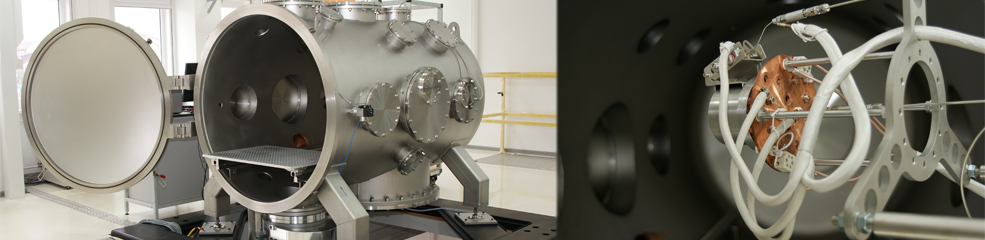


Zestaw obrazów 2019
zdjecie1.jpg
zdjecie2.jpg
zdjecie3.jpg
zdjecie4.jpg
zdjecie5.jpg
zdjecie6.jpg
2019_1.JPG
2019_2.JPG
2019_4.JPG

Galeria
Fusion, anyone? Not quite yet, but researchers show just how close we've come
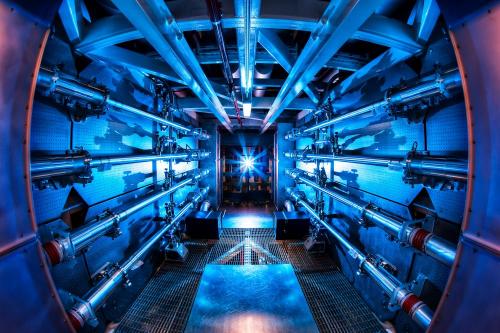 The dream of igniting a self-sustained fusion reaction with high yields of energy, a feat likened to creating a miniature star on Earth, is getting closer to becoming reality, according the authors of a new review article in the journal Physics of Plasmas
Researchers at the National Ignition Facility (NIF) engaged in a collaborative project led by the Department of Energy's Lawrence Livermore National Laboratory, report that while there is at least one significant obstacle to overcome before achieving the highly stable, precisely directed implosion required for ignition, they have met many of the demanding challenges leading up to that goal since experiments began in 2010.
The project is a multi-institutional effort including partners from the University of Rochester's Laboratory for Laser Energetics, General Atomics, Los Alamos National Laboratory, Sandia National Laboratory, and the Massachusetts Institute of Technology.
To reach ignition (defined as the point at which the fusion reaction produces more energy than is needed to initiate it), the NIF focuses 192 laser beams simultaneously in billionth-of-a-second pulses inside a cryogenically cooled hohlraum (from the German word for "hollow room"), a hollow cylinder the size of a pencil eraser. Within the hohlraum is a ball-bearing-size capsule containing two hydrogen isotopes, deuterium and tritium (D-T). The unified lasers deliver 1.8 megajoules of energy and 500 terawatts of power—1,000 times more than the United States uses at any one moment—to the hohlraum creating an "X-ray oven" which implodes the D-T capsule to temperatures and pressures similar to those found at the center of the sun.
"What we want to do is use the X-rays to blast away the outer layer of the capsule in a very controlled manner, so that the D-T pellet is compressed to just the right conditions to initiate the fusion reaction," explained John Edwards, NIF associate director for inertial confinement fusion and high-energy-density science. "In our new review article, we report that the NIF has met many of the requirements believed necessary to achieve ignition—sufficient X-ray intensity in the hohlraum, accurate energy delivery to the target and desired levels of compression—but that at least one major hurdle remains to be overcome, the premature breaking apart of the capsule."
In the article, Edwards and his colleagues discuss how they are using diagnostic tools developed at NIF to determine likely causes for the problem. "In some ignition tests, we measured the scattering of neutrons released and found different strength signals at different spots around the D-T capsule," Edwards said. "This indicates that the shell's surface is not uniformly smooth and that in some places, it's thinner and weaker than in others. In other tests, the spectrum of X-rays emitted indicated that the D-T fuel and capsule were mixing too much—the results of hydrodynamic instability—and that can quench the ignition process."
Edwards said that the team is concentrating its efforts on NIF to define the exact nature of the instability and use the knowledge gained to design an improved, sturdier capsule. Achieving that milestone, he said, should clear the path for further advances toward laboratory ignition.
Source: phys.org
Annual Meeting of the International Centre of Dense Magnetized Plasmas (ICDMP)
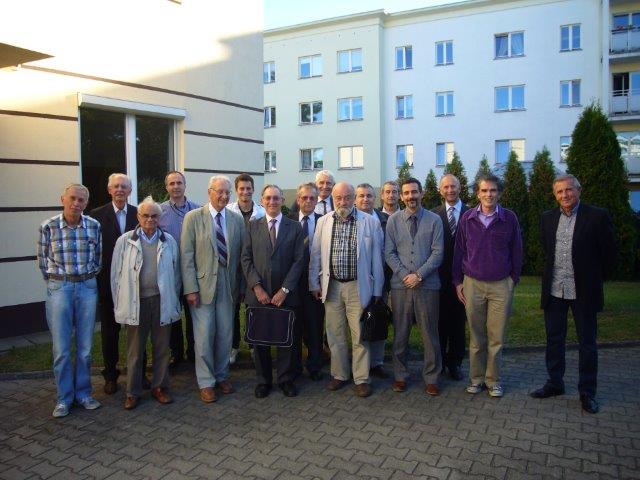 During the last few years a group of plasma physicists from countries all over the world has been meeting to analyse the scientific basis and prepare the programme of an International Centre for Dense Magnetised Plasmas (ICDMP).
On the 6th and 7th of September 2013 the Annual Meeting of the International Scientific Committee of ICDMP took place in Warsaw, at the IPPLM premises. The participants included Alexander Blagoev (Bulgaria), Alain Bernard (France), Igor Garkusha (Ukraina), Karel Kolacek (Czech Republic), Vyacheslav Krauz (Russia), Pavel Kubes (Czech Republic), Maurizio Samuelli (Italy), Hellmut Schmidt (Germany), Ülo Ugaste (Estonia), Eric Lerner (USA), Marek Scholz (INP PAS), Alireza Talebitaher, and IPPLM group: Marek Sadowski, Andrzej Galkowski (director of IPPLM), Pawel Nadrowski, Marian Paduch, Ryszard Miklaszewski, and Włodzimierz Stepniewski.
The Foundation Council presented its report and the International Scientific Committee elected a new ICDMP director. Dr. Marek Scholz was replaced by Dr. Marian Paduch, and Dr. Ryszard Miklaszewski became the deputy director of ICDMP. Pavel Kubes sent to absent Marek Scholz thanks for his long and demanding work in the leading position in ICDMP.
The workshop participants discussed the accomplished goals within the activities at PF-1000 and laboratories in frame of ICDMP and defined the scope of works for the future. The presentations were delivered by turns by Richard Miklaszewski, Sasha Blagoev, Igor Garkusha, Pavel Kubes, Slawa Krauz, Eric Lerner, Marek Sadowski, Ali Talebitaher and Üllo Ugaste. Moreover, P. Kubes announced that the grant of Ministry of Education, Youth and Sports of the Czech Republic, supporting activities of ICDMP, would continue up to the year 2015.
The next ISC-meeting together with Workshop will take place at IPPLM in Warsaw on October 10-11, 2014.
The success of the International PLASMA-2013 Conference organized by IPPLM
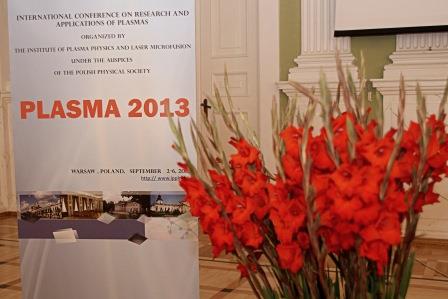 The international conference PLASMA-2013 was organized by the Local Organizing Committee created at IPPLM. The Polish Physical Society was the co-organizer of this venture. More than 140 participants from various countries declared the participation in PLASMA-2013. The International Scientific Committee invited more than 20 recognized specialists from Poland and abroad to give an oral presentation. The Ministry of Science and Higher Education supported the organization of the conference with a special subsidy. Several Polish and foreign private companies sponsored the conference presenting their scientific equipment. More detailed information is available on http://plasma2013.ipplm.pl.
The PLASMA conferences have been organized since 1993 mainly in Poland. In 2007 the conference took place in Germany and in 2010 – in France. The main goal of the next PLASMA conferences is to create a scientific forum for detailed discussion and evaluation of progress in research of plasma physics and plasma technology as well as thermonuclear fusion. The majority of presented works is performed in the framework of the international cooperation, most frequently covered by the European programmes. The conference has been considered an important international scientific event of exceptional importance for scientific communities in Eastern and Western Europe. It facilitates the meetings of young scientists with experienced researchers from renowned centres in Poland and abroad.
Let us provide the reader with some statistics. The total number of participants (including 11 IPPLM scientists) amounted to 131 persons from 24 countries. The invited lectures were presented by 18 distinguished researchers and oral presentations (2 of them by IPPLM scientists - P. Gąsior and M. Kubkowska) were delivered by 24 participants. Moreover, 90 posters (10 from IPPLM) were put on display and discussed. The conference participants took part in a trip to Wilanów Palace, which was built for the Polish king Jan III Sobieski in the last quarter of the 17th century, and enjoyed it immensely.
The research and implementation of plasma in different branches of science and technology are being intensively developed around the world. An important goal of hot plasma research is to harness the controlled thermonuclear fusion for the future production of safe and applicable energy for people and the environment. Low-temperature plasma finds various technological applications, among others in electronics, space technology and modification of material characteristics.
Several research centres in Poland deal with plasma and thermonuclear research within close international collaboration. Those include: Institute of Plasma Physics and Laser Microfusion, National Centre for Nuclear Research, PAS Institute of Nuclear Physics, PAS Space Research Centre, PAS Institute of Fluid-Flow Machinery, Opole University and several other scientific communities in other universities and institutes. IPPLM coordinates works regarding thermonuclear fusion in tokamaks and stellarators in the framework of the Association EURATOM-IPPLM and laser fusion within the European HiPER project.
Last artificial star in tokamak MAST before major upgrade
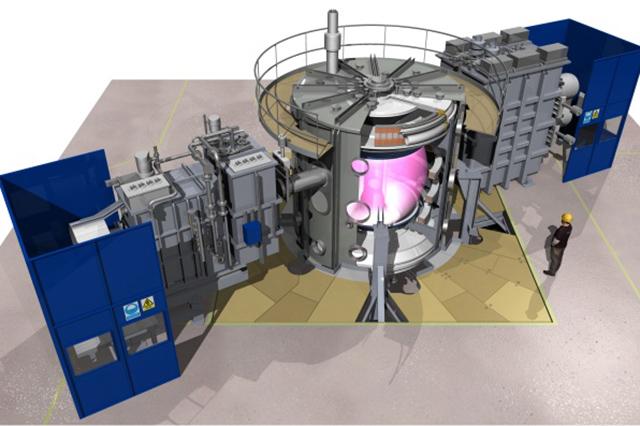 Scientists at the UK’s Culham Centre for Fusion Energy (CCFE) have run final experiments on the MAST tokamak on Friday 27 September before starting a major overhaul of the device that will pave the way for a prototype fusion plant.
“It’s a bittersweet moment for us because we are saying goodbye to the old machine but at the same time, we are already looking forward to the new one,” said the CCFE spokesman Nick Holloway.
“At 4pm today, we will run the last plasmas and within minutes after that, engineers will move in to shut down the tokamak for the next 18 months. By Monday, the roof beams in the MAST machine area will have been taken off before the 25-tonne MAST vessel will be lifted on a big crane and moved to the assembly hall.”
The £30m upgrade is set to make MAST (the Mega Ampere Spherical Tokamak), a cutting edge facility. It will increase its power and enable testing technologies that will improve the knowledge base needed for the construction of ITER, but also to test systems for the DEMO prototype fusion power plant.
“To take fusion forward to ITER and through to commercial power, we need to keep improving our research facilities. In 2015, CCFE will have a machine that we and our collaborators from around the world can use to explore exciting new areas of plasma physics and test innovative concepts for fusion technology. We can’t wait,” said Dr Brian Lloyd, Head of CCFE Experiments Department.
One of the key technologies the upgraded MAST will be equipped with is the Super-X divertor, an innovative high-power exhaust system that will reduce the power loads from particles leaving the plasma.
The divertor is an exhaust system at the bottom of the fusion chamber, through which waste rejected from the plasma leaves the reactor. The particles being exhausted are extremely energetic, resulting in extreme power loads on in this part of the reactor. The idea of Super-X is to steer the particles along a longer exhaust path, allowing them to cool down and spreading them over a larger area, so that the power loads on materials are significantly reduced.
“This technology could actually pave the way towards future fusion power stations. It will be the very first time anyone will be using this technology,” Holloway said.
Since 1999, MAST, an innovative spherical tokamak, a successor of UK’s earlier venture called START, has created over 24,000 man-made stars, providing a wealth of data. The knowledge gathered during the MAST experiments has helped advance understanding in many key areas including plasma instabilities and start-up methods.
The spherical concept that MAST inherited from START, has proven over the years to be more efficient than the conventional toroidal design, adopted by JET and ITER.
MAST has originally been commissioned by Euroatom and the UK Atomic Energy Agency, the current upgrade, however, is funded by the Engineering and Physical Sciences Research Council.
Apart from the Super-X divertor, the tokamak will receive a new centre column, better divertor coils, and a cryopump and power supplies that will provide pulse lengths up to ten times that of the existing machine.
As Holloway said, the MAST engineers and physicist are definitely not going on a 18-month vacation. They will be busy analysing the data the tokamak has provided previosly and will have to prepare new experiments for the improved machine.
“There will also be a lot of work developing the new systems and also a lot of theoretical work to do that will be put to practice later,” Holloway concluded.
VIDEO: A fusion experiment inside the MAST device
Source: Engineering and Technology Magazine
From doughnuts to bananas
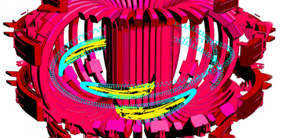 Andy Warhol elevated the humble banana to an icon of pop art, with his 1967 album cover for the band the Velvet Underground. Proving its versatility, the banana is now also an icon of magnetically confined fusion research, thanks to the curious shapes traced out by particles zigzagging around the tokamak; every student of fusion physics has to learn about banana orbits.
Often the food analogies applied to tokamaks centre around doughnuts, due to the shape of magnetic field that confines the hot fusion plasma. But as one delves deeper into the complicated world of gyrokinetics, the simplistic doughnut transforms into a more complex banana orbit in a journey from the ideal to the real world.
Simple spirals
In the simplistic, doughnut-shaped magnetic field, charged particles are constrained to spiral along the magnetic field by one of the Universe’s strangest phenomena, the Lorentz force, which governs the interaction of charged particles with a magnetic field. This interaction happens when the particle is moving at an angle to the magnetic field. Bizarrely the field neither attracts nor repels the particle, but applies to it a sideways force, at right angles to both the direction of travel, and the magnetic field lines. For example, a particle travelling horizontally through a vertical magnetic field might experience a force to turn left (depending on the respective polarities of the particle’s charge and the magnetic field). Having turned left, it’s still travelling horizontally – at right angles to the vertical field – so it continues to feel a force to the left. And so it turns some more, and more, and more – trapped in a never-ending circle.
If the original angle of travel of the particle was not exactly at right angles to the magnetic field (in the example above, perhaps travelling slightly upwards) then it will still circulate around the field line, but moving along it as well, tracing out a spiral path. The closer the particle’s path is to parallel with the magnetic field, (in our example vertical) the more stretched out the spiral is – but always following the field line.
Banana realities
The premise of the tokamak is to construct a doughnut shaped magnetic field and then the plasma particles will merrily spiral around it for ever. Enter an uncomfortable reality of geometry; as you can see in the main image above, the magnets are closer together in the centre of the torus (the hole of the doughnut) than they are around the outside. This means the magnetic field is not uniform: it is stronger in the inside part of the ring.
This means that the helical path the particle follows is not symmetrical. A tighter turn on the high field (inner) side of the line, and looser on the outside leads to a drift either upwards or downwards (depending on the direction of rotation). This is the beginning of our banana orbit , as shown in the projected cross-section at the left-hand side of the figure. As an example, let’s follow a particle on the inside of the banana halfway up, gradually creeping downwards to trace the banana’s inner edge.
If this downward drift continued unchecked, the particles would escape the plasma all too soon. Countering this drift was one of the master strokes of tokamak design, via the inclusion of a solenoid in the hole of the doughnut. Driving a changing current through this solenoid drives a plasma current around the doughnut, serving to generate a field at right angles to the ring of magnet coils. This additional right-angled field gives a twist to the doughnut’s magnetic field, thereby circulating the particles that would otherwise drift away back into the middle. This gives the banana its curve.
The pointy end of the banana
As the particles circulate around into the higher field area their progress along the field line slows, because the field lines are no longer parallel, but converge slightly as the field increases. In fact for particles moving slowly along the field but rapidly around it – i.e. in more tightly wound spirals – this field convergence is enough to stop them altogether, and bounce them back towards to where they came from. This defines the apex of the banana orbit.
However, the particles do not retrace their steps exactly, because of the continuous drifting below the field line. Instead they trace the outer part of the banana’s outline, back to the middle and then continue downwards to its lower apex. However, beyond the centreline – the part of the banana orbit the furthest from the centre – our example particle’s downward drift now brings it back towards the centre of the plasma. Its path traces the lower half of the banana’s outline, to the lower apex in the higher magnetic field and then back up to its original starting place. In addition, the magnetic field line angle is different on the outer part of the banana from that on the inner part, producing the zig-zag shown in the figure.
A tangled tale
The cross section of this orbit is banana shaped, although the reality for the many particles in the plasma is much more of a tangle… the initial speed and angle of the particle can radically vary the exact number and distribution of bounces, and indeed whether any particle stays within the plasma or escapes.
The shape can change too, close to the centre of the plasma the cross section of the orbit is more like a potato, or a kidney bean; the other particles that do not bounce – called the passing particles – follow orbits that are just slightly outwardly displaced with respect to the magnetic field lines.
Put them all together, it all begins to merge into one giant bowl of spaghetti. Endlessly complex, but delicious nonetheless!
Thanks for all the help on this article and image, from Sean Conroy for orbit data, Dave Cooper for data processing, Russell Perry and Chad Heys for graphics flair, and Tom Todd for technical discussions.
SOurce: EFDA


nsp_154.JPG)


nsp_154.JPG)


 |
 |
 |
 |
 |
 |
 |
 |
Media


Projekty badawcze realizowane przez IFPiLM są finansowane ze środków Ministerstwa Edukacji i Nauki i Narodowego Centrum Nauki oraz ze środków Komisji Europejskiej na podstawie umowy grantowej No 101052200, w ramach Konsorcjum EUROfusion. Wsparcia finansowego udzielają także: Międzynarodowa Agencja Energii Atomowej, Agencja Fusion for Energy, Europejska Agencja Kosmiczna i Konsorcjum LaserLab.