





Zestaw obrazów 2019
zdjecie1.jpg
zdjecie2.jpg
zdjecie3.jpg
zdjecie4.jpg
zdjecie5.jpg
zdjecie6.jpg
2019_1.JPG
2019_2.JPG
2019_4.JPG

Galeria
Infrared Camera System to View Inside Tokamak Magnetic Fusion Energy Chamber
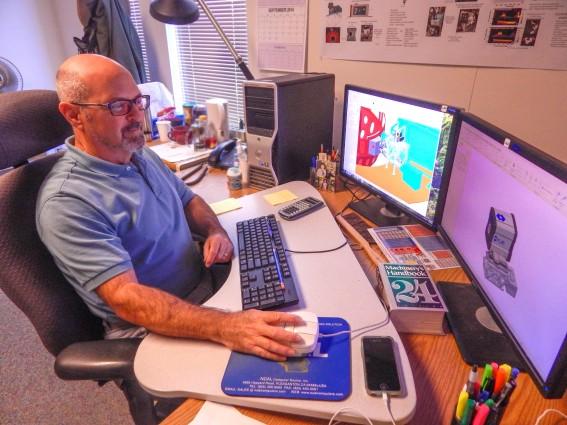 General Atomics’ DIII-D Tokamak has been a critical part of the nation’s magnetic fusion energy research since it was built in the 1980s.
Over the years, wear and tear has taken its toll. However, it was impossible for researchers to see inside the San Diego company’s highly complicated machine to assess damage - until now.
Lawrence Livermore National Laboratory researchers, in collaboration with General Atomics and the University of Arizona, have developed an infrared and visible camera viewing system that’s able to produce wide-angle, tangential views of full poloidal (north-south direction of the magnetic field) cross-sections inside the tokamak.
The camera’s images provide researchers with data about the interior conditions of the DIII-D, which was built under contract for the Department of Energy. DOE provides funding for its operation.
“We wanted to look inside the tokamak’s chamber to see where things were heating up on the walls,” said Kevin Morris, a designer with LLNL’s National Security Engineer Division, who was part of the research team that developed the camera system. “There are a lot of critical areas that are heated by the plasma, and researchers want to understand them better.”
Tokamaks are devices that use a magnetic field to confine plasma in the shape of a torus, which looks like doughnut. The plasma is produced by heating a mixture of deuterium and tritium – two isotopes of hydrogen – to temperatures greater than 150 million degrees Celsius.
In order to keep the hot electrically charged plasma particles away from the machine’s walls, strong magnetic field lines cause them to move around the torus in a helical shape.
A rendering of the inside of the DIII-D Tokamak. Image credit: LLNL“The plasma can be unstable,” Morris said. “This can result in heating of the wall in new places.”
The camera system consists of a commercially available infrared camera, a fast visible camera and an optical system designed by a collaboration of physicists, engineers, optical designers and mechanical designers.
Their design will be used as a prototype for a set of larger cameras that will be built for the International Thermonuclear Experimental Reactor project. The international nuclear fusion megaproject seeks to build the world’s largest experimental tokamak in France.
DIII-D’s camera system, which looks like a periscope, has three polished stainless steel mirrors in a vacuum that view the tokamak through an aperture in the first mirror. It views the machine’s lower divertor, upper divertor, inner wall and outer wall in infrared and visible light.
Experiments with the infrared camera have produced results including surface temperatures measurements, surface heat flux profiles and heat distribution along the wall, both in latitude and longitude.
The research team’s findings were published in the American Institute of Physics Review of Scientific Instruments.
Team members include LLNL's Lynn Seppala, Dean Urone, Kevin Morris, Shannon Ayers and Bill Meyer; General Atomics: Charles Lasnier, Steve Allen and Ron Ellis.
Source: Product Design&Development
Promise of Clean Energy One Step Closer with Nuclear Fusion Milestone
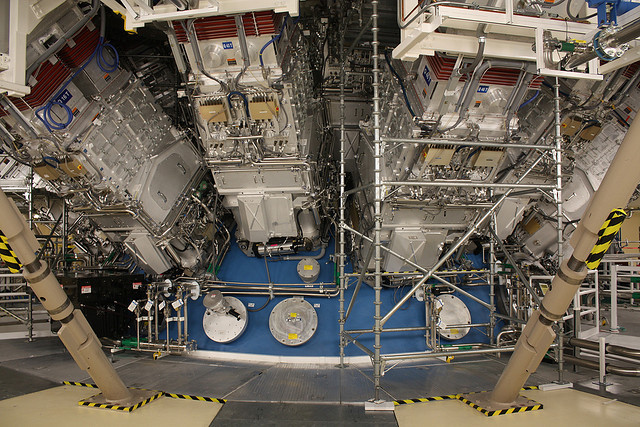 A crucial milestone has been reached by US lab researchers in their quest towards cracking self-sustaining nuclear fusion.
Harnessing fusion, the process powering the sun, has the potential to create an abundant source of low-cost energy. Despite being the object of significant study, it has so far remained elusive, as artificial fusion reactions created here on earth consume more energy than they produce. Following a breakthrough by the $35bn National Ignition Facility (NIF) in Livermore, California, there are new hopes of achieving a self-sustaining reaction, or ignition where the power output exceeds the power required to start the reaction.
Scientists at NIF reached the point of nuclear fusion by heating and compressing a small pellet of hydrogen fuel using 192 beams from the world’s most powerful laser. According to a recent update, one NIF experiment in late September resulted in the amount of energy being produced through the fusion reaction exceeding the amount of energy consumed by the fuel for the first time in any facility in the world.
‘Promising’ breakthrough demonstration
NIF is yet to reach the point of ‘ignition’, a self-sustaining reaction where the amount of energy produced exceeds the energy supplied to the laser. This delay in research is known to be due to inefficiencies in the system, meaning that most of the energy delivered by the lasers is lost in the effort to achieve the temperatures required for fusion, rather than on the reaction itself. However, this latest breakthrough in fusion is the most promising in recent years, moving fusion research forward significantly.
It has been hoped that the NIF would make a breakthrough after almost half a century of striving towards this goal. The NIF team announced a plan in 2009 to demonstrate nuclear fusion providing net energy by the 30th September 2012. However, this deadline was unmet due to technical errors, and the output was less than that predicted by mathematical models. Later, the facility shifted its focus from fusion to nuclear weapons, part of its original purpose.
Nevertheless, the latest experiment’s results are in keeping with output predictions, which is encouraging both for future ignition research at NIF, and for general advocates of nuclear fusion.
Current nuclear power operates on the concept of nuclear fission, which is the splitting of the atom, rather than the fusing of the atom. NIF is one of several fusion research projects worldwide that are conducting research into nuclear fusion. One such project is the multi-billion pound ITER facility which is being constructed in Cadarache, France. In contrast with the NIFs approach to fusion, ITER aims to use the concept of ‘magnetic confinement’ to contain fusion fuel within a magnetic field. The Nuclear Power Plant Generation The Fukushima Daiichi Nuclear Power Plant is an example of the current use of nuclear power. Located in the Futaba District of Fukushima Prefecture, Japan. This plant has been disabled since it was hit by the magnitude 9.0 earthquake and tsunami on the 11th March in 2011.
Recently, an isotope ratio analysis of 235U and 238U in the soil was performed using ICP-MS, which you can read in this article: Soil Survey Related to the Fukushima Daiichi Nuclear Power Plant Accident. After the disaster, the Japanese government had planned to gradually reduce its dependence on nuclear power. However, Japan has since revised their nuclear power plan and a new energy policy has been approved which will see nuclear generation continue.
Source: Pollution Solutions
Are mini fusion power plants possible?
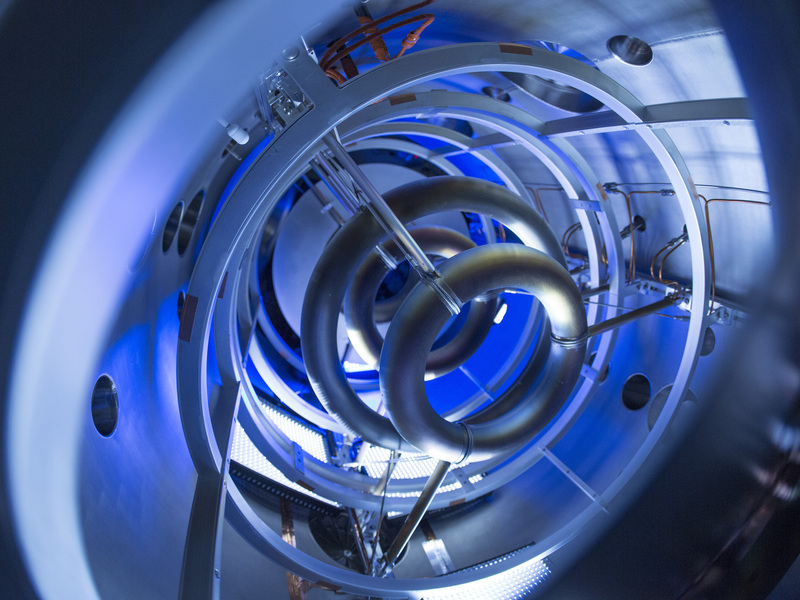 Lockheed Martin’s compact reactor concept / fusion drives for aircraft and trucks?
Building a small, transportable fusion power plant has long been a dream of fusion researchers. In the course of their research, however, it became clear that a functioning power plant has to be of a certain minimum size. Nevertheless, there are occasionally renewed attempts (see “The fusion upstarts”, in Nature, Vol. 511, 14/7/2014, p. 398 ff.). IPP scientists Professor Sibylle Günter and Professor Karl Lackner explain why also the latest version proposed by US technology concern Lockheed Martin might well remain a dream:
The patent applications for the device proposed by Lockheed Martin do not involve a really new concept, but combine the known concepts of a magnetic cusp and a magnetic mirror. Both are impaired by the fact that charged particles can escape along the magnetic field lines out of the confinement region. This leads to an intolerable energy loss, because it is primarily the fast, hot particles that get lost first. Nor does it help here, as proposed, to link several cusps behind one another or combine them with magnetic mirrors.
What is envisaged is incorporating coils in the vessel, i.e. inside the plasma. This needs connections to the outside and fixtures in the plasma vessel. Hot plasma particles from the core of the device would thus come into direct contact with these fixtures. The fundamental idea of magnetic confinement, however, is precisely to keep the high-energy plasma particles in the core moving along the magnetic field lines at always the same volume without impinging on material walls. Otherwise the plasma cools down very fast. One solution here would be superconducting coils levitating in the vessel without support, this leaving, however, the above energy loss problem: The configuration proposed is not suitable for confining hot plasmas.
Furthermore, the coils inside the plasma vessel have to be shielded not only from the surrounding hot plasma, but also from the neutrons produced in the fusion process. With superconducting coils, at least 80 centimetres of shielding around each coil is needed. This does not accord with the power plant size envisaged.
All of these problems have been resolved by the tokamak and stellarator concepts pursued today. Nevertheless, it is not possible to build small, transportable power plants. This is because attaining a positive energy balance, i.e. producing more fusion power than needed for heating the plasma, calls for extremely good thermal insulation of the plasma, viz. about 50 times better than styropor. In a power plant a temperature in the plasma core of 100 to 200 million degrees is needed, while at the walls no more than 1,000 degrees is tolerable. Such large temperature differences in the plasma drive turbulent flows that mix hot and cold regions with one another, i.e. impair the thermally insulating effect of the magnetic field. This has to be compensated with a larger volume. Here it is the size of the temperature gradient that determines the turbulent flows and hence the minimum size of a power plant. How a positive energy balance is to be achieved with the compact version propagated by Lockheed Martin is not even remotely mentioned in the patent applications.
Source: Max-Planck-Institut für Plasmaphysik
How Lockheed Martin's Power Play Could Boost Fervor Over Fusion
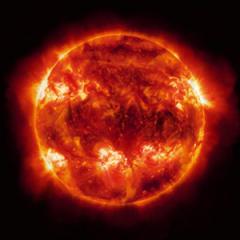 Lockheed Martin's project to create a compact fusion reactor could provide a boost for other ventures aiming to harness nuclear fusion energy on a small scale — or at least they hope so.
"I'm glad to see them pursuing high-pressure plasma, because it's the only logical way to have an economical fusion reactor," Jaeyoung Park, president and chief scientist at New Mexico-based EMC2 Fusion Development Corp., told NBC News on 16 October. "Life is lonely if you're the only one doing it."
EMC2 Fusion has been working on a concept similar to Lockheed Martin's for years, as a follow-up to decades' worth of research by physicist Robert Bussard. The company is just one of a myriad of ventures aiming to turn nuclear fusion, the reaction that powers the sun as well as hydrogen bombs, into a commercial power-generating technology.
If fusion could be commercialized, it would offer a new kind of always-on power source that's cleaner than nuclear fission and fossil fuels, and potentially be cheaper than coal.
Some fusion research efforts are getting millions or even billions of dollars in government support — including the Z Machine at Sandia National Laboratories in New Mexico; the $3.5 billion laser-blasting National Ignition Facility in California; and the international ITER experimental project in France, which has a price tag that estimates say could rise as high as $50 billion over the next decade.
Other ventures, such as EMC2 Fusion and Lockheed Martin's newly revealed T4 project, aim to commercialize fusion for far less, using far less orthodox technological approaches.
Fusion reactor on a truck?
Over the past few years, the Navy spent $12 million to support EMC2 Fusion's research — and now EMC2 Fusion, like Lockheed, is looking for support from investors and other partners to take their experiments to the next level. In EMC2 Fusion's case, that means finding roughly $30 million for a demonstration reactor that shows how its Polywell concept could scale up to a net energy gain, and eventually commercial-scale reactors.
"We are getting decent exposure," Park said in an email. "This has helped us to make progress in our fundraising. It is moving forward, and I am cautiously optimistic about the chance of getting funded for the next phase, though everything takes a lot longer than expected. It is certainly an exciting roller coaster ride for a scientist." Another couple of months could tell the tale, Park said. And it doesn't hurt that the leader of Lockheed Martin's compact fusion research team, Tom McGuire, said his concept has some similarities to EMC2 Fusion's Polywell, which involves shooting positive ions into a powerful electromagnetic field. "I am happy to see the core principle of the Polywell concept is being adopted by others for their efforts for economical fusion power," Park said.
'The race is on'
Park's not the only one: Lockheed Martin's news was also cheered on the Talk-Polywell discussion forum, where members delve into the nitty-gritty of unorthodox fusion physics. "The race is on to achieve major funding for this general approach," one commenter wrote.
Lockheed Martin is by far the biggest company to reveal its interest in creating compact fusion reactors, and the fact that it's looking for partners should add to the already-percolating interest in commercial fusion research. Amazon.com billionaire Jeff Bezos, for instance, is one of the investors in Canada-based General Fusion. Meanwhile, Microsoft co-founder Paul Allen has invested in California-based Tri-Alpha Energy.
Other ventures such as Lawrenceville Plasma Physics are flying relatively under the radar but aiming for big breakthroughs in fusion physics.
Helion Energy, a start-up that was spun off from a University of Washington fusion research project, is working on its own demonstration fusion reactor — and recently announced a $1.5 million venture capital infusion.
Lockheed Martin's McGuire said his team would build a prototype compact fusion reactor within five years, but Helion's schedule is even more ambitious: The company's CEO, David Kirtley, hopes to get to the break-even point — that is, a fusion reaction where the energy output exceeds the input — within three years. In a recent email, Kirtley said Helion was making good progress toward that goal. "We have increased our demonstrated plasma temperatures to over 5 KeV [5,000 electron volts] and continue work on the engineering hardware of our next, break-even machine," he said.
So who'll win the commercial fusion race? Will anyone ever cross the break-even line and turn fusion into a cheap power source? Stay tuned ... at least it's good to know there's a race.
Source: NBC News
Europe takes ITER construction to the next level
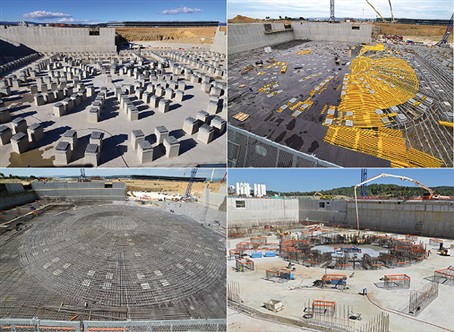 The floor upon which the biggest fusion machine in the world will rely on has been constructed.
This landmark achievement marks the conclusion of the works that started in August 2010 and represent an investment of around 100 million EUR for F4E, the European Union’s organisation responsible for Europe’s contribution to ITER. The construction has been carried out by a group of companies led by GTM SUD and under the supervision of F4E and the ENGAGE consortium consisting of Assystem, Atkins, Empresarios Agrupados and Egis. The floor will be able to support more than 400,000 tonnes of buildings infrastructure and equipment, including the ITER machine weighing 23,000 tonnes.
Professor Henrik Bindslev, Director of Fusion for Energy (F4E), explained that “Europe is taking the ITER construction to the next level. The basemat is the test bed of the biggest international collaboration in the field of energy. It’s where the scientific work and industrial know-how will come together and be deployed to seize the power of fusion energy”. Professor Osamu Motojima, Director General of ITER International Organization (ITER IO) stated that “the conclusion of this task is a historical moment for the project. Years of hard work by all ITER parties are bearing fruit as the facility takes shape and makes progress on all fronts”.
The ITER basemat in figures:
The basemat is far more complex that it seems. It has a surface of 9,600m2 and a thickness of 1,5 m of reinforced concrete consisting of four successive layers - two of 50cm, one of 30cm and one of 20cm. The first of the fifteen plots of concrete was poured in December 2013. Following the approval of the French Nuclear Authority in July 2014, regarding the robustness of the building design, nine central sections of the slab were poured within seven weeks leading to a successful completion of the works in late August 2014. In total 150 workers were involved in this operation, using 14,000m3 of concrete, 3,600 tonnes of steel and 2,500 embedded plates.
A web of 493 plinths coated with pads, lies beneath the upper slab, able to absorb the effect of an intense seismic shock. More concrete and thick steel rebars form a mesh to keep the foundations stable and lift the immense load of the machine. The design and validation process have been extremely challenging because the basemat will be the floor of the Tokamak building that will house the machine and shield it. For this reason it is has been subjected to heavy scrutiny from ITER IO and the French Nuclear Regulator. The infrastructure fully complies with the set of nuclear safety requirements branding ITER as the biggest nuclear facility in France and the first ever nuclear fusion facility in the world.
How will the ITER site evolve?
With the ITER basemat now completed, the construction of the complex that will house the core buildings of the machine has started. The VFR consortium, consisting of VINCI Construction Grands Projets, Ferrovial Agroman, Razel-Bec, Dodin Campenon Bernard, Campenon Bernard Sud-Est, GTM Sud and Chantiers Modernes Sud are responsible for carrying out the works. The building will be 80 metres tall, 120 metres long and 80 metres wide. It will require 16,000 tonnes of steel rebars and 150,000 m3 of concrete.
There has also been progress at the Assembly Hall building, where the massive ITER components will be put together. The steel structure of the building has become visible and so far the lower sections of the eight first columns have been erected. They weigh around 15 tonnes and are currently 12 metres high (once fully erected they will be 60 metres high).
The temporary road network, infirmary and restaurant have also completed making it possible for the contractors to set up their company offices on the site.
Source: Fusion for Energy


nsp_154.JPG)


nsp_154.JPG)


 |
 |
 |
 |
 |
 |
 |
 |
Media


Projekty badawcze realizowane przez IFPiLM są finansowane ze środków Ministerstwa Edukacji i Nauki i Narodowego Centrum Nauki oraz ze środków Komisji Europejskiej na podstawie umowy grantowej No 101052200, w ramach Konsorcjum EUROfusion. Wsparcia finansowego udzielają także: Międzynarodowa Agencja Energii Atomowej, Agencja Fusion for Energy, Europejska Agencja Kosmiczna i Konsorcjum LaserLab.