





Zestaw obrazów 2019
zdjecie1.jpg
zdjecie2.jpg
zdjecie3.jpg
zdjecie4.jpg
zdjecie5.jpg
zdjecie6.jpg
2019_1.JPG
2019_2.JPG
2019_4.JPG

Galeria
UW researchers working on novel nuclear fusion technique
 Sustainable nuclear fusion has long been a dream for most scientists and energy experts alike. Clean, abundant, and economical, there have been many attempts to make it workable. Now, researchers at the University of Washington have stepped up their existing involvement in the fusion field with a $5.3 million Department of Energy grant to scale up their “Sheared Flow Stabilized Z-Pinch” fusion device.
Uri Shumlak, a professor in the department of aeronautics and astronautics, co-leads the project and explained that the Z-Pinch technique is smaller and cheaper than more conventional magnetic field coil-driven reactors. “The large size of the magnetic field coils drives up the cost,” he said. “In Z-Pinch, the plasma column is quite small. In order to get fusion, you scale up in the opposite direction, and get smaller.”
The small size and relative inexpensiveness helps in its possible applications, which can be both terrestrial and celestial. “The real interest of mine is in space propulsion,” he said. “Because it is a linear device, it fits better into a spacecraft.”
Michal Hughes, a fifth-year graduate student who has been working in the Z-Pinch lab, elaborates on the uses of the technique. “We can use this device both as a power plant and as propulsion,” he said. “That makes it easier to fly the mission and is potentially much more powerful than solar panels.”
However, there are problems to be overcome, chiefly the instability of the plasma. “The real challenge has been to find a configuration that is stable,” Shumlak said.
The team plans to build a new Z-Pinch device, which will be ready by summer 2016. It will be the third machine they’re building. “We built three machines,” said Elliot Claveau, a graduate student in aeronautics and astronautics who joined the lab in 2014. “The first was 16 years ago. Last year, we got the second machine.” He said the third machine will be 10 times as powerful as the present one and the lab will be running two machines at the same time.
This more powerful machine will be useful in giving the researchers a better understanding of what they’re studying. “For the second machine, we went past a million degrees,” Hughes said. “For the third machine, we’re looking to reach even higher temperatures, which will help us investigate different responses of the plasma.”
There have been a number of graduate and undergraduate students who have worked in the lab, including Hughes, who has been involved for six years. Shumlak is appreciative of the students’ contribution to the project. “This research has been made possible by dedicated undergraduate and graduate students,” he said. “There have been many students who’ve made significant contributions.”
The professor and the students are cautiously optimistic about the prospects of the research and its potential massive impact. “If everything turns out as expected, we should be able to get to a viable fusion reactor ready for commercial scale in 10-15 years,” Shumlak said.
The students are less reserved about the potential of the project. “The goal we have is the advancement of this field in general, because eventually if everything succeeds, the research is the first step in developing a cheap fusion reactor,” Claveau said. “This is potentially world changing, but we’re not there yet.”
Source: The Daily of the University of Washington
Two transformers installed on the ITER site
 The transformers that have been designed by F4E, procured by the US Domestic Agency (DA) and manufactured by Hyundai Heavy Industry, have reached the ITER site. Qualified as Heavy Exceptional Loads (HEL), the two pieces of equipment have been delivered by DAHER, the exclusive logistics provider for HELs, raising the total number of components transferred so far with this protocol to six. F4E has already started with the assembly and once completed, the equipment will be handed over to ITER International Organization (IO).
The design process started in 2009 in close collaboration with ITER IO, the US DA, F4E and its contractors- Energhia, Engage and Apave. The equipment has been delivered near the 400 kV network, where F4E has been responsible for the infrastructure works under the supervision of Ferrovial. The contractor has been constructing four oil retention pits measuring 100 m2 and 70m3 each to collect any possible leakage of the oil from the transformers. Through the second contract, four 400 kV transformers for the steady state electrical network will be positioned, assembled, tested and commissioned. Three additional transformers will be installed in the northern part of this area and all of them will be connected to the grid.
A power of 1200 MVA will run through the ITER electrical system using a Pulsed Power Electrical Network (PPEN) and a Steady-State Electrical Network (SSEN). For example, the AC/DC converters, the Heating and Current Drive systems, and the Reactive Power Compensation will be supplied through the PPEN, whose high voltage components will come from China. Thanks to this electrical network, the ITER plasma will be heated and the powerful superconductive magnets will operate in order to confine it. Meanwhile, the major consumers of the SSEN, whose high voltage components will come from the US, will supply with power the cryogenic and cooling water systems, the tritium plant and the general infrastructures. This network will provide the power needed to generate the low temperatures for some of the components in the machine.
A series of studies will be carried out regarding the different infrastructure works for the foundations of the electrical components, the precipitation drainage systems and the earthing grid system, the lighting and fences to be installed. Once the electrical assembly of the other components is in place the works for the entire high voltage electrical substation will be considered completed.
The installation of all other components in order to connect the transformers to the 400 kV network, and the construction of the building that will house the 22 kV switchgear on the site, are planned for mid-2016.
Source: F4E
Europe’s first-ever equipment arrives to ITER
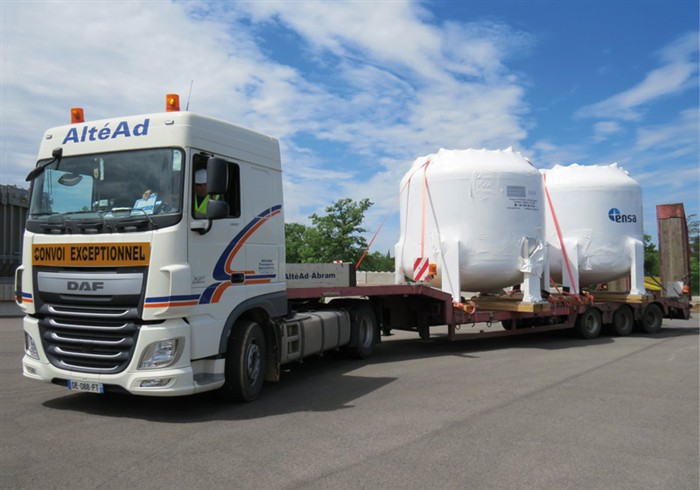 Europe, the biggest shareholder out of the seven parties contributing to ITER, the largest international scientific collaboration in the field of energy bringing together 80% of the global GDP and 50% of the world’s population, has celebrated a symbolic milestone with the arrival of its first-ever piece of equipment to the project’s seat in Cadarache, south of France.
Fusion for Energy and Ensa, a Spanish company responsible for the design and manufacturing of six tanks that will be part of the fusion reactor’s fuel cycle system, have made history the moment the equipment crossed the gates of ITER. The European contribution to ITER is in the range of 50%. In other words, Europe’s industry, SMEs and laboratories will have the opportunity to develop and manufacture almost half of the components required through the contracts launched by F4E. Currently, Europe has signed more than 400 contracts reaching a cumulative value of 3 billion EUR with more than 250 companies and 50 laboratories.
The contract awarded to Ensa builds on the expertise of Empresarios Agrupados and GEA as subcontractors. It has taken roughly 20 months for the six tanks to be designed and manufactured, whose cost is in the range of 2 million EUR. Pietro Barabaschi, F4E’s Acting Director, explained that “the arrival of this equipment marks the beginning of a long list of components that we, as Europeans, have the duty to manufacture and deliver to ITER-the biggest fusion energy project”. Rafael Triviño, Ensa’s Managing Director, stated that “ITER is an impressive technological project and it has been a great honour to be the first European company supplying the first components”.
The scope of the contract
The six large-sized tanks are part of ITER’s water detritiation system. When ITER starts operating, the purpose of these tanks will be to collect the water containing tritium in order to recover it and subsequently use it in future fusion reactions. Four tanks, weighing approximately 5 tonnes and measuring 20m3 each, will be part of this system. Two bigger tanks, weighing approximately 20 tonnes and measuring 100m3 each, will be used for the tritium recovery phase in exceptional circumstances. The six tanks will be initially kept at a safe area, and once the Tritium plant is ready, they will be installed in the building. Ensa had to comply with a series of stringent safety and quality requirements that apply to ITER components.
The role of the water detritiation system
To get fusion going two hydrogen isotopes- deuterium and tritium- need to collide at extremely high temperatures reaching 150 million ˚C. According to the sequence of actions of the ITER fuel cycle, the two hydrogen isotopes will be supplied in the machine through the Tritium plant. The two isotopes will travel through the pipes of the system to reach the core of the machine and fuse to release energy. What is left from the fuel of the fusion reaction, together with other gases produced, will return through pumps to the Tritium plant in order to recover the tritium and use it to start all over a new series of fusion reactions.
Source: F4E
Europe and Japan celebrate achievement of important JT-60SA milestones
 The concurrent achievement of several important milestones of the JT-60SA project was celebrated by some 200 high-level European and Japanese guests at the JT-60SA project site in Naka, Japan, on 20 April. The JT-60SA project is a “satellite” to the international ITER project and aims to model proposals for optimising plasma operation and investigate advanced plasma modes that could be tested on ITER or used later on DEMO. This satellite tokamak programme was established in 1997 as one of three joint projects between Europe and Japan within the Broader Approach Agreement.
Hosted by the Japanese Atomic Energy Agency (JAEA), the Japanese Implementing Agency for Broader Approach activities, the event was in celebration of the excellent progress achieved to date, with the coincidence of four major achievements. Interest in the project was clearly high – the celebration and the reasons behind it were also covered in several print, online and audio-visual media reports.
Yutaka Kamada, the Japanese home team project manager and Pietro Barabaschi, the European home team project manager and acting Director of Fusion for Energy, welcomed the guests and acted as masters of ceremony. Addresses by high ranking representatives of the Japanese government, European Embassies and the European Commission expressed satisfaction with the contributions of all institutions involved, and drew attention to the mutual trust that had developed between the partners. Finally the Project Leader of JT-60SA, Hiroshi Shirai, gave an overview of the state of the project. After a tree planting ceremony, guided tours of the site offered visitors the opportunity to see for themselves the state of technical achievements in the different areas.
The first achievement concerned the assembly of 17 out of 18 sectors of the plasma vessel (the double-walled vacuum vessel which will enclose the 100 million degrees hot plasma). This large vessel 6.6 m high and 10 m in diameter was manufactured by Toshiba as part of JAEA´s contribution to the JT-60SA project. All stringent pressure and leak tests have been passed successfully and all tight manufacturing tolerances have been maintained.
The second achievement was the completion of the installation and testing of the quench protection system for the superconducting coils, which create a magnetic bottle to confine the plasma for the fusion reaction. If, for whatever reason, part of the coils stop being superconducting, the quench protection system avoids overheating of the coils by immediately discharging their stored electromagnetic energy into a set of resistors. The system is composed of 13 units applying the most advanced hybrid mechanical-static circuit breaker technology to interrupt currents of more than 25 kA at voltages of about 5 kV. It was procured by Italian CNR acting through Consorzio RFX in Padua. The contractor was Nidec ASI company. The system has just been installed and commissioned at JAEA, and the acceptance tests are being completed in April according to the agreed schedule before ownership is transferred to JAEA.
The third achievement was the arrival of the main subsystems of the cryogenic system on site. The cryogenic system is a very powerful fridge able to reach temperatures close to absolute zero (-269 degrees C). This system is provided by the French CEA Grenoble through their contractor Air Liquide Advanced Technologies. The main duty of the cryogenic system is to maintain the magnetic coils in a superconducting state. At the end of March all subsystems of the cryogenic system arrived in Japan and are now being assembled and commissioned. Just beforehand, again on schedule, JAEA finished construction of a new compressor building and the refurbishment of an existing hall for the refrigerator coldboxes.
The electrical connection between the warm power cables of the magnet power supply and the cold superconducting electrical network of the coils is realised by special helium-cooled connectors, so-called current leads. Twenty-six such current leads are being developed, manufactured and tested in a dedicated test facility by Karlsruhe Institute of Technology (KIT) in Germany. The current leads use high-temperature superconductor (HTS) tapes to reduce the resistive losses while creating a thermal barrier to reduce the heat flow to the very cold electrical networks. After their successful test at nominal operation conditions, KIT delivered the first two HTS current leads very recently to JAEA – the fourth achievement. The remaining current leads are in different advanced stages of construction and testing and will be delivered subsequently.
Source: F4E
Tough Questions for ITER's New Director General, Bernard Bigot
 When ITER, the International Thermonuclear Experimental Reactor project, was launched in 1985, the plans called for a huge reactor that would demonstrate that the fusion of hydrogen atoms into helium atoms would be a source of unlimited energy. Its founding nations (Russia, the United States, Japan, and the EU (China and Korea subsequently joined the project in 2003, and India in 2005)) also hoped it would reduce drastically the problem of nuclear waste that plagues fission reactor projects.
The design approved in 1988 featured a tokamak in which huge superconducting magnets would trap an extremely hot plasma made of hydrogen atoms inside a toroidal steel vessel. Because of the vessel’s size, scientists would be able to induce a fusion reaction that would yield up to 10 times as much energy as is injected in order to heat the plasma.
But that early promise quickly hit the cold reality that large-scale projects frequently encounter large-scale problems. The ITER project never enjoyed an easy life, especially when the United States withdrew its support in 1998, hopped in again in 2005, then drastically reduced its outlays for the project in 2008.
An external report in 2013 blamed a series of missed deadlines and cost overruns on the ITER organization’s weak management of a decentralized organization. The total estimated cost for the project is now at €15 billion (about $16.5 billion), which is almost double the cost of CERN's Large Hadron Collider. Despite that level of government largesse, recent plans to achieve “first plasma” by 2020, and the first demonstration of energy production by 2027, are now being revised. A new schedule should be finalized by the end of the year.
So, what happens if the sponsors of the reactor, located in Cadarache in Southern France, decide to pull the plug? Contracts totaling €6.5 billion (about $7 billion)— €3.5 billion of which are for completing construction on the site—would be in limbo. The 500 contractors who now work on the building site would be out of work. So might the 600 staffers employed directly by ITER organization with its €275 million annual budget. According to ITER, 72 percent of these employees are engineers and scientists.
On 5 March, the ITER Council, in an extraordinary session, confirmed the appointment of Bernard Bigot as the Director General of ITER. Bigot, a physicist and chemist by training, has had a long career in research, but also as Chairman and CEO of the French Alternative Energies and Atomic Energy Commission (CEA). He takes over from Osamu Motojima, who started his term as head of ITER in July 2010. Bigot spoke to IEEE Spectrum last week; his comments have been abridged.
Spectrum: On 5 March, you presented an action plan, proposing changes to the management of ITER. What are the specific problems that you are addressing?
Bigot: What has plagued the ITER project so far is that we had no efficient decision process, caused by the fact that the ITER Organization and the seven domestic agencies did not operate as an integrated team. We have to make decisions every day, take financial decisions; we need to learn to work together. The question is not to ‘control,’ but the capacity to work together.
Spectrum: What are the changes you proposed?
Bigot: There are three important points. The first one is that the members, represented by the domestic agencies they have established, must consider it fully legitimate that the Director General is fully empowered to take any decision with eventual implications to the main interest of the project. The domestic agencies and the Central Team, here in France, worked quite independently, and I strongly believe that they should work closely together and be placed on an equal footing, and that we need someone who can arbitrate.
Secondly, we need to set up an organization in such a way that people feel associated with the decisions taken. We will set up an Executive Project Board that will be chaired by the DG, and in which the seven domestic agencies will be represented by their heads. In this way we can discuss issues and take decisions. Previously, representatives of the domestic agencies had also the rank of Deputy-Director General, confusing the technical role they had in the ITER Central Team and their responsibility in representing their own country. Now the Central team consists only of technical people, that way we simplify the process of diffusion and discussion.
My last point is that I will ask the ITER Council to provide the DG with a reserve fund that will be fully available to implement the technical decisions taken by the Executive Project Board. We are now in a new phase, starting with the assembly of the test reactor, and we have to operate as a single organization, despite the fact that the domestic agencies will continue as legally separate organizations.
Spectrum: Past delays and mistrust of the technology have sometimes resulted in funding problems. Is outreach sufficient?
Bigot: The questions are legitimate, and that is why we have to communicate. We have to answer these questions, and not only from the general public. A large part of my duties will be to keep in close touch with the members, with political leaders, congressmen, in such a way that they feel fully associated, fully understanding how we work, and what the possibilities of this technology are.
We have to demonstrate that we can deliver. ITER is not just a nice research project, it has to fulfill the expectation that in the long term fusion will be a reliable, sustainable, and environmentally friendly way to supply energy.
Spectrum: What makes you optimistic that the ITER project will succeed in demonstrating this?
Bigot: I have now visited several of the members, and I realize there are many issues to be addressed. So far we are moving in the right direction. The more we advance with the project, the more we see what the difficulties are and we address them, and we find solutions. For example, a few years ago we did not master the technology for producing superconducting coils required for the large magnets. We are now proceeding with the manufacture, and we're satisfied with the results.
And it is encouraging that some members are considering the next step, after ITER. China, with its large population, expects that fusion technology will be able to provide a share of their energy supplies some time this century. We view their own plans for fusion energy as an endorsement of ITER.
Source: IEEE Spectrum


nsp_154.JPG)


nsp_154.JPG)


 |
 |
 |
 |
 |
 |
 |
 |
Media


Projekty badawcze realizowane przez IFPiLM są finansowane ze środków Ministerstwa Edukacji i Nauki i Narodowego Centrum Nauki oraz ze środków Komisji Europejskiej na podstawie umowy grantowej No 101052200, w ramach Konsorcjum EUROfusion. Wsparcia finansowego udzielają także: Międzynarodowa Agencja Energii Atomowej, Agencja Fusion for Energy, Europejska Agencja Kosmiczna i Konsorcjum LaserLab.