





Zestaw obrazów 2019
zdjecie1.jpg
zdjecie2.jpg
zdjecie3.jpg
zdjecie4.jpg
zdjecie5.jpg
zdjecie6.jpg
2019_1.JPG
2019_2.JPG
2019_4.JPG

Galeria
Latest issue of „Fusion in Europe” now available
 “Fusion in Europe” magazine continues to spread the latest news about the progress of fusion research. The new issue begins optimistically with the statement that EUROfusion marks the beginning of a new era. Looking around the world of fusion there are updates about JET project, WEST project, power plant DEMO and its correlation with ITER. Reading this issue you also get a view from journalist Daniel Clery giving his opinion on diversity of fusion research.
All articles are available online.
Italian EU Presidency highlights the potential of ITER
 Almost like passing the torch every six months the Presidency of the European Council of the EU is held by a different member state. It is the 12th time that Italy has been put in the driving seat of EU integration in order to set the political agenda. One of the three priorities, set by one of the EU’s founding members, has been economic growth and employment. Europe needs to kick start its economy, become more competitive, unleash its potential and find inspiration. Science and innovation tick all of the previous boxes because they are vital in Europe’s search of an industrial renaissance. Big science projects like ITER enhance this possibility and drive our ambition to think and act big!
This line of thinking led la Agenzia nazionale per le nuove tecnologie, l’energia e lo sviluppo ecnomico sostenible (ENEA), Italy’s National Agency for New Technologies, Energy and Sustainable Economic Development, and Confidustria Lombardia, the confederation of Lombardy’s industry, to organise during the Italian Presidency a seminar on “ITER- the way to global competitiveness through European fusion” on 24 November 2014 in Milan.
The seminar brought together 80 participants and a distinguished set of speakers from politics, research, industry and enterprise. ENEA reminded the participants of Italy’s proven track record in the field of fusion research. The know-how and the commitment to support R&D in this scientific domain appear to have paid off. The statement was confirmed by F4E’s statistics indicating that Italy has secured the second position from all member states, receiving for the period 2008-2014 an amount close to 800 million EUR for its involvement to ITER.
The strategy of investing in big science projects and in fusion energy was also discussed. Policy-makers were of the opinion that not placing all eggs in one basket is the sensible way to go about rethinking Europe’s energy policy and stimulating industrial expertise. The unique selling points of big science projects are the de-facto international collaboration with different entities, the critical mass of skills, and the expectation of continuity through a follow up project. These points were highlighted by F4E contractors present at the meeting, who shared with the rest of the audience the tangible benefits of their involvement. In order to maintain the industrial momentum and keep skills alive there has to be continuity in big projects as such. Unlocking the potential of SMEs and encouraging them through different measures to participate, were also highlighted because of their remarkable flexibility to acquire specialised skills and cope with the evolving demands of the market of innovation.
Source: F4E
MAST rebuild continues with coil installation
 The latest picture from the MAST-Upgrade project shows the UK fusion machine's largest magnetic coil being carefully positioned into the vacuum vessel.
This is the second of four poloidal field coils that will help confine the fusion fuel in a magnetic ‘cage' within the MAST-Upgrade device during experiments. The coils will keep the intensely hot fuel – in the form of a plasma – away from the walls of the steel vessel, and will provide the spherical plasma shape that physicists want to study in the device.
Now that the coil is safely installed, its magnetic centre will be aligned to the vessel axis to sub-millimetre accuracy.
“Aligning these coils is not easy, but since we put the first coil in we've refined the process and tweaked the tooling to speed things up,” comments Joe Milnes, MAST-Upgrade Project Leader. “This will help us meet our target of getting all four coils in the vessel early in the New Year – a significant build milestone on the way to the completion of the main vessel module.”
Source: CCFE
Scientists to create prototype for new hot plasma nuclear reactor
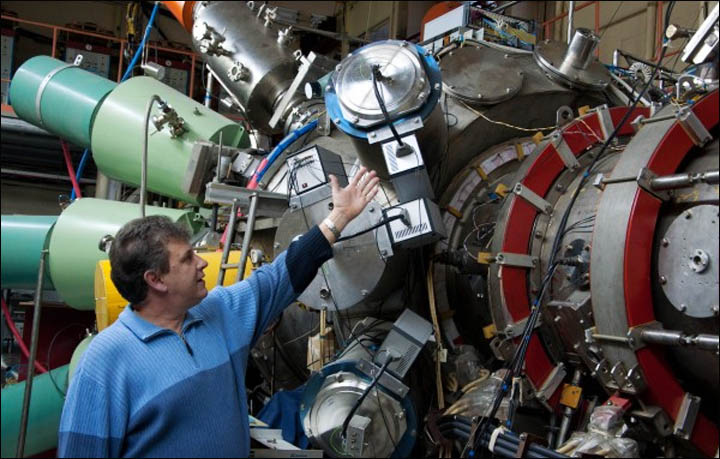 Scientists in Siberia are developing a pioneering new type of nuclear reactor using temperatures twice as hot as the sun that could create an energy of the future. Costing approximately 500 million roubles ($9.8 million), it is being built near Novosibirsk by the Budker Institute of Nuclear Physics and will allow the study of high energy plasma heated to to an incredible 30 million degrees Celsius to make power.
It is an experimental form of thermonuclear fusion, and it is initially hoped it could be harnessed to incinerate radioactive waste. But if successful, it could eventually pave the way for a new way of generating electricity. And since it uses hydrogen isotope deuterium - rather than the radioactive tritium - it is considered far less dangerous and gives out a lower output of energy.
Alexander Ivanov, the deputy director of the institute, said a working prototype of the new reactor will be constructed over the next few years. He told the Siberian Times: 'This will be a full-scale model of the reactor, which can be used for research or, for example, for the processing of radioactive waste. 'There are a lot of technologies to create such a complex. They are new and it takes some time to master them. All the problems with plasma physics that we will address are relevant to the global scientific community.'
Scientists at the Budker Institute have been experimenting with plasma physics for decades and last December managed a world record temperature of 4.5million degrees Celsius when heating hot plasma in an open quasi-stationary magnetic trap. Heated by a powerful source of microwave radiation, the plasma was confined for about ten milliseconds, enough time for it to create a neutron source for hybrid reactors. It is this process that the experts hope to develop further to create power. 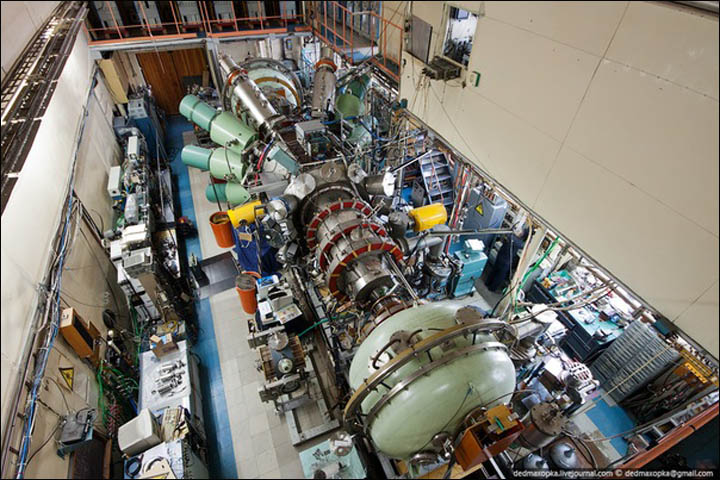
The idea of using plasma in controlled thermonuclear reactors actually dates back to the 1950s, when the institute's founder Gersh Budker proposed such a method. Since then the facility, in the scenic town of Akademgorodok, has become one of the world experts in studying its properties and its potential use in fusion reactors. They key problem in achieving thermonuclear fusion, however, is how to confine this extra hot plasma. Due to its high temperature it cannot be in direct contact with any solid material and has to be held in a vacuum. Using a mirrored gas dynamic trap, the scientists hope to control the plasma.
The new reactor - which has financial support from the Russian Science Foundation and the Ministry of Education - will have powerful radiation protection and allow the experts to study the properties of the substance in safe conditions. Deputy Director Yuri Tikhonov said: 'We will carry out only modelling experiments with the generation of electrons, but the reactions will match reality. 'We won't be generating electricity either but we just need to probe the reaction can occur and that the demanded plasma parameters can be achieved.'
His colleague, Dr Ivanov, said these parameters will be set at an incredible 10 million degrees Celsius, more than twice what was reached last December, with the hope of eventually reaching 30 million degrees. At its core the temperature of the sun is 15 million degrees Celsius, or about 27 million degrees Fahrenheit. He added: 'We hope to increase this temperature [of 10 million degrees] to double or triple that, so we will create a virtually pure reactor.'
The development comes at a time in which Russia is participating in a separate global project aimed at the creation of a new thermonuclear reactor. Known as ITER - the International Thermonuclear Experimental Reactor - aims to build the world's largest tokamak fusion facility in the south of France. Costing at least 607 billion roubles ($12.8 billion) it hopes to make the long-awaited transition to allow the use of plasma in the full-scale production of electricity. Following a series of delays and budget problems, completion of the reactor is expected in 2027 with funding from the United States, South Korea, China, Japan, India and the European Union as well as Russia.
The Budker facility is based in Akademgorodok, a satellite town south of Novosibirsk and home to some of the greatest scientific minds anywhere in Russia. The town was created in Soviet times to allow forward-thinking scientists from Moscow and St Petersburg to have a pleasant lifestyle, enabling them to work successfully. Set amid enchanting woodland, and close to the Ob Sea, it is now home to 32 institutes and researching centres, the Siberian branch of the Russian Academy of Sciences, and the Novosibirsk State University.
Source: The Siberian Times
Scientific conference on fusion opened in Split
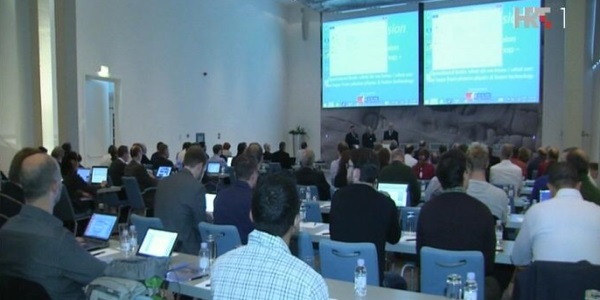 A three-day scientific conference on fusion began in Split on Monday, bringing together about a hundred experts from European Union countries.
The conference, called the European Fusion Programme Workshop, was organised by the Zagreb-based Rudjer Boskovic Institute and the University of Split Faculty of Electrical Engineering, Mechanical Engineering and Naval Architecture as part of the EUROfusion consortium which comprises institutes and universities from 29 countries.
"The purpose of the conference is to present the existing knowledge in the field of plasma and advanced materials, physics and technology at the start of a five-year period of joint research within the EUROfusion programme, which is financed by the EU with 850 million euros," Tonci Tadic, coordinator of the Croatian Fusion Research Unit and member of the Euratom Science and Technology Committee, said in his opening remarks.
Tadic said that the EU wanted to become the global centre of fusion energy and supporting technologies. "Fusion occupies an important place in the EU's energy strategy over the next 30 years," he said, adding that the conference would focus on issues relating to strategic planning of further fusion research in Europe, with special emphasis on operational limitations and challenges in fusion physics and technology.
Source: Dalje.com


nsp_154.JPG)


nsp_154.JPG)


 |
 |
 |
 |
 |
 |
 |
 |
Media


Projekty badawcze realizowane przez IFPiLM są finansowane ze środków Ministerstwa Edukacji i Nauki i Narodowego Centrum Nauki oraz ze środków Komisji Europejskiej na podstawie umowy grantowej No 101052200, w ramach Konsorcjum EUROfusion. Wsparcia finansowego udzielają także: Międzynarodowa Agencja Energii Atomowej, Agencja Fusion for Energy, Europejska Agencja Kosmiczna i Konsorcjum LaserLab.