





Zestaw obrazów 2019
zdjecie1.jpg
zdjecie2.jpg
zdjecie3.jpg
zdjecie4.jpg
zdjecie5.jpg
zdjecie6.jpg
2019_1.JPG
2019_2.JPG
2019_4.JPG

Galeria
NRL Nike Laser focuses on nuclear fusion
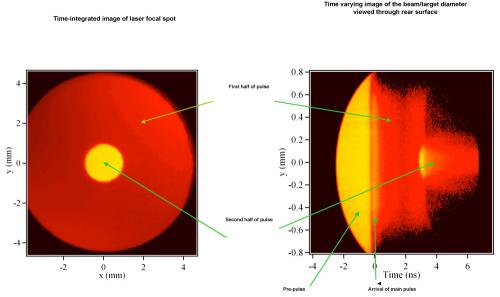 Researchers at the U.S. Naval Research Laboratory have successfully demonstrated pulse tailoring, producing a time varying focal spot size known as 'focal zooming' on the world's largest operating krypton fluoride (KrF) gas laser.
The Nike laser is a two to three kilojoule (kJ) KrF system that incorporates beam smoothing by induced spatial incoherence (ISI) to achieve one percent non-uniformity in single beams and 0.16 percent non-uniformity for 44 overlapped target beams. The facility routinely conducts experiments in support of inertial confinement fusion, laser-matter interactions and high energy density physics. "The development of an energy production system that utilizes thermonuclear fusion is an ongoing process of important incremental steps," said David Kehne, research scientist, NRL Plasma Physics Division. "As such, the use of focal zooming in an inertial fusion energy system is expected to reduce the required laser size by 30 percent, resulting in higher efficiency and lower construction and operating costs." In the direct-drive inertial confinement fusion (ICF) concept, numerous laser beams are used to implode and compress a pea-sized pellet of deuterium-tritium (D-T) to extreme density and temperature, causing the atoms to fuse, resulting in the release of excess energy. In an ICF implosion, a progressively diminishing portion of the beams will engage the shrinking pellet if the focal spot diameter of the laser remains unchanged. For optimal coupling, it becomes desirable to decrease the laser focal spot size to match the reduction in the pellet's diameter, minimizing wasted energy. "Matching the focal spot size to the pellet throughout the implosion process maximizes the on-target laser energy," Kehne said. "This experiment validates the engineering of focal zooming in KrF lasers to track the size of an imploding pellet in inertial confinement fusion." With single-step focal zooming implemented, the Nike laser provides independent control of pulse shape, time of arrival, and focal diameter allowing greater flexibility in the profiles and pulse shapes that can be produced. The flexibility in pulse shaping provides promising uses in both future experiments and laser diagnosis.
Source: phys.org
Nuclear fusion is the 'perfect energy source'
 Until recently, fears of peak oil and dependence on Middle Eastern suppliers were the key factors shaping our energy policy, pushing governments to scramble for fossil fuel alternatives. Then came shale gas, tar sands, and other unconventional sources. Industry found ways to affordably extract fuel for decades to come. So many are now imagining an end to the energy crisis. That's a dangerous mistake.
First, even the most optimistic predictions leave our grandchildren exposed to an uncertain future. More immediately -- and maybe more importantly -- burning fossil fuels is the number one cause of global warming and its catastrophic consequences.
We need to innovate alternative energy sources now more than ever ... and our choices are limited. There are few viable options that will preserve the levels of prosperity that modern industrial economies have come to expect.
Solar, advanced nuclear fission, and fusion offer the best hope but, unfortunately, none are ready for large-scale deployment. All need time-consuming innovations so we cannot afford to hesitate; research must be ramped up across the board and government must keep up the pace.
Of our three most promising technologies, fusion would be the biggest prize. It is in many respects the perfect energy source. Sea water provides millions of years of fusion fuel. Fusion reactions are safe, they emit neither radioactive waste nor greenhouse gasses and fusion reactors would take up relatively little space.
The catch is fusion is very hard to do. Two isotopes of hydrogen (deuterium and tritium) must be held at 200-million degrees until they collide and fuse to make helium. It is not easy to build a device that runs at ten times the temperature of the Sun, but it is possible.
In fact, the European experimental facility, JET -- hosted in the UK, has already done it. For a couple of seconds, it generated 16 megawatts of fusion power -- enough to supply around 8,000 homes. This is an astonishing achievement. We must now extend that duration and power and innovate technologies to make fusion electricity at a price that the consumer will pay.
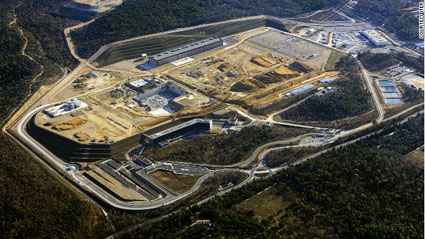
We're working flat out on the first of those goals. Seven international partners representing more than half the world's people are constructing the critical experiment right now in Southern France. Called ITER -- it is designed to reach a self-sustaining fusion burn -- the last scientific hurdle to fusion power. Construction will complete in 2020 with a fusion burn expected by 2030.
There are other approaches to fusion -- for example the laser experiments at the National Ignition Facility in California -- but for many of us in the scientific trenches, the fusion burn on ITER is expected to be the defining moment.
But what about our second objective of economic viability? ITER isn't meant to achieve that goal. In addition to clearing our last remaining scientific hurdle, we need to advance a parallel engineering agenda into key reactor technologies that will enable commercial fusion power plants to reliably deliver electricity in a highly competitive market.
This means technological advances in areas such as structural and functional materials, power conversion, and reliability. China and Korea are on the job but the U.S. and Europe are reluctant to face the engineering issues. Certainly, cost increases on ITER haven't helped. If we continue to starve the technological research agenda of funds, however, we risk delaying fusion power and ceding technological leadership to China and Korea.
It goes without saying that resources are limited in our recession-ravaged economies ... but disinvesting in seed corn is obviously self-defeating.
What can we afford? The world energy market is approximately €5-€10 trillion ($6.5-13 trillion) a year. The total world spend on energy research is about 0.5% of this -- strikingly low. Fusion research including ITER construction is less than €1.5 billion ($2 billion) a year -- not even 0.05% of the market.
We are, it seems, not taking the threat of climate change and energy shortages seriously. In this context, the roughly €200-500 million ($260-650 million) per year needed to vigorously pursue the parallel track of technology innovation in fusion seems absurdly small.
We often hear that Thomas Malthus' dire predictions about population growth were wrong because humans innovated solutions to food shortages. Will we innovate ourselves out of our long-term energy constraints too? Only if we sufficiently fund alternative energy research now.
Source: CNN
Cooperation on fusion energy
 When the new Wendelstein 7-X facility for researching nuclear fusion as a future energy source becomes operational in 2014, it will also incorporate high-precision work and scientific expertise from Poland.
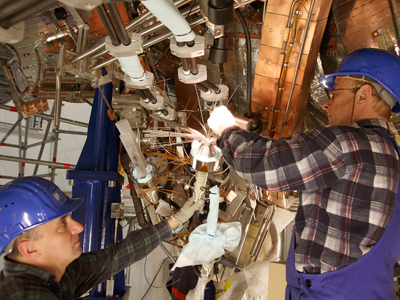
Although scientists from the Max Planck Institute for Plasma Physics (IPP) will play a leading role in the construction of the research facility in Greifswald, quite a few partners will also participate. After the USA, Poland will provide the largest contribution through two cooperative projects. The close of 2012 saw completion of a key six-year project: superconduction technology experts from the Institute of Nuclear Physics of the Polish Academy of Sciences in Cracow connected the 50 superconducting electromagnets – the technical centrepiece of the facility – together in a ring. Around 45 technicians and engineers assembled 121 superconductors up to 14 m long, as well as 240 connectors and 400 supports that had been manufactured at the Forschungszentrum Jülich. When the research facility is operational, current flows through the ring and creates a magnetic cage. This magnetic cage - when hydrogen nuclei are to ignite the fire of fusion and melt into helium nuclei at 100 million degrees Celsius in a future power plant – is prerequisite for containing the plasma to maintain stable, continuous energy production.
After the departure of the technical staff from Cracow, cooperative efforts will continue with the National Centre for Nuclear Research in Swierk, Poland: The accelerator experts there will take care of production of components for neutral particle heating at Wendelstein 7-X. High-speed particles will be fired into the plasma to help heat it. Manufacturing orders have already been placed with Polish and other European industrial companies.
Around two-thirds of the costs for both projects are being carried by the Polish Ministry of Science, which made available a total of 6.5 million euros and wants to build its fusion research programme around Wendelstein 7-X. In addition, IPP is funding plasma diagnostics in the form of cooperative projects with universities in Warsaw and Opole. In future, Polish scientists will also carry out research projects directly at Wendelstein 7-X.
Source: Max Planck Institutes
Removing tiles for analysis
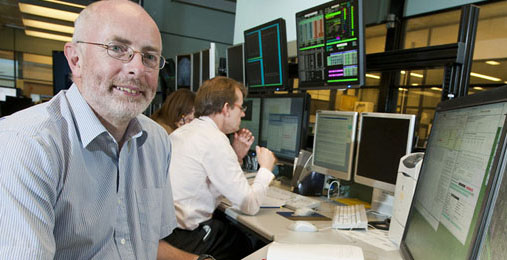 The JET shutdown is progressing steadily. Remote Handling Group has been working in-vessel since December. The first task was to conduct a full photographic survey of the inside of the vessel, so that the effects of a year of plasma operations on the ITER-like wall can be assessed. Scientists are now poring over the photographs in detail.
Meanwhile various components have been removed from the torus for closer examination. The tiles in the divertor region (at the bottom of the torus) are fixed to ‘carriers’, and around 20 of these carriers have been removed. They have been transferred to the Beryllium Handling Facility for maintenance of some of the embedded diagnostic systems and removal of a few tiles.
About 600 individual tiles and components have also been removed. Most of these will be replaced without modification, but it was necessary to remove this number in order to gain access to about 50 in particular regions of interest. The 50 will be analysed in laboratories around Europe to look for evidence of erosion and deposition. As many of the tests will be destructive, they will be replaced by brand new tiles as the 600 are re-assembled. Already more than half the tiles taken from the poloidal limiters are back in place.
The next instalment will cover calibration of some diagnostic systems.
Source: EFDA
The Biggest Centralized Cryogenic System ever Built
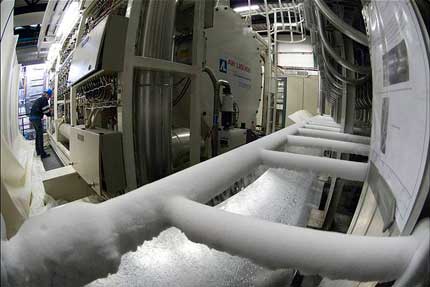 ENGINEERINGNET.EU – The engineering company Air Liquide has secured two contracts to build extreme cryogenic systems for the ITER and the related JT-60SA research projects on fusion. The total value of these equipment sales contracts will reach over €100million.
Based near Marseille, in France, the ITER project plans the creation of an experimental reactor intended to illustrate the scientific and technical feasibility of fusion. This process generates little waste and eliminates any risk of reactor runaway.
To obtain the very powerful electromagnetic fields necessary to confine fusion, superconducting magnets must be used, which only work at extremely low temperatures.
For this project, Air Liquide will provide the biggest centralized refrigeration system ever built. This cryogenic equipment is essential for maintaining an extremely cold temperature for the 10,000 tonnes of superconducting magnets used on the Tokamak.
This sophisticated scientific instrument confines the plasma that makes it possible to achieve the conditions necessary for controlled fusion. The closed circuit refrigeration system is based on the properties of liquefied helium, whose temperature is close to the lowest possible temperature 0 K, or -273°C, called "absolute zero".
Between the end of 2015 and the beginning of 2017, Air Liquide will install three refrigerators for a global cooling capacity of 75 kW at 4.5 K, or - 269 °C.
The purpose of another project, JT-60SA, is to support the ITER project's research activities by working on the capacity to control and maintain the plasma for several hours.
JT-60SA, based in Japan, is designed to optimize plasma configurations for the ITER project. It is led by the Japanese Atomic Energy Agency in collaboration with the French organisation CEA. For this project, Air Liquide will commission, in 2015, a helium refrigeration system, intended to cool the Tokamak.
François Darchis, Senior Vice-President: "After the CERN's LHC and Kstar in Korea, these projects once again prove our capacity to meet major scientific challenges by supplying very high tech systems." << (BB) (photo: Air Liquide, cryogenic system at CERN)
Source: engineeringnet.eu


nsp_154.JPG)


nsp_154.JPG)


 |
 |
 |
 |
 |
 |
 |
 |
Media


Projekty badawcze realizowane przez IFPiLM są finansowane ze środków Ministerstwa Edukacji i Nauki i Narodowego Centrum Nauki oraz ze środków Komisji Europejskiej na podstawie umowy grantowej No 101052200, w ramach Konsorcjum EUROfusion. Wsparcia finansowego udzielają także: Międzynarodowa Agencja Energii Atomowej, Agencja Fusion for Energy, Europejska Agencja Kosmiczna i Konsorcjum LaserLab.