





Zestaw obrazów 2019
zdjecie1.jpg
zdjecie2.jpg
zdjecie3.jpg
zdjecie4.jpg
zdjecie5.jpg
zdjecie6.jpg
2019_1.JPG
2019_2.JPG
2019_4.JPG

Galeria
F4E signs contract for the supply of ITER Pre-Compression Rings
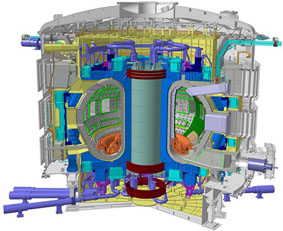 The contract for the supply of nine Pre-Compression Rings (PCRs), among which three spares, that will support the ITER machine’s magnet system, has been signed between Fusion for Energy (F4E) and EADS CASA Espacio. The total budget of the contract is in the range of 12 million EUR and it is expected to run for approximately four years.
The key function of PCRs is to reduce the fatigue of the ITER machine’s magnet structures from the powerful electro-magnetic forces and consequently prolong their operation from ten to over twenty years. The signature of the PCRS contract marks another European milestone that will deliver the largest composite structures ever built for operation in a cryogenic environment. The work will be carried out in a centre of excellence located in Spain, which has a proven track record in field of composites for space applications.
The function of PRCs in the ITER machine:
The ITER machine will operate with a system of superconducting magnets which relies on the Toroidal Field coils, the Central Solenoid, the Poloidal Field coils and the Correction coils (see ITER image).
Toroidal Field (TF) coils are “D” shaped coils whose core task in the ITER device is the confinement of plasma. PRCs are the keystones of the TF coils system and will be assembled to the top and bottom of TF coils in order to prevent them from deforming when the powerful magnetic field is created.
The size of the PCRs, their assembly and maintenance:
The basic design relies on 5 m diameter fibreglass composite rings with a cross section of about 300 mm x 300 mm at top and three at the bottom of the TF coil system. Three PCRs will be installed and loaded at the top and three at the bottom of the TF coil system and will apply a centripetal force equivalent to that of 3,000 tonnes on the top and bottom of each TF coil reducing their overall constraints.
In order to avoid the circulation of electrical currents and withstand high loads, the PCRs will be manufactured of fibreglass composite, where in every cross section nearly a billion of miniscule glass fibres will be glued together.
Their load will need to be maintained for the entire 20 years of ITER operation, while accommodating thermal shrinkages during cool-down/warm-up, cyclic forces, settlements and unexpected motions. Due to the limited access to carry out in-service inspection of the PCRs, in case there is a need for the replacement of the lower PCRs, it will be carried out by using one or more of three spare rings made available below the Tokamak in the cryostat.
Source: F4E
Elise opens the door for ITER’s heaters
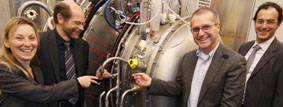 The heat source is a particle beam named Elise (Extraction from a Large Ion Source Experiment), and was unveiled at the Max-Planck Institute for Plasma Physics in Garching near Munich on 27th of November. It represents a major step forward not only in the energy of the particles, but also in the size of the beam; its cross-section is about half the area of the final models planned for ITER, reckoned as being the size of a door.
Elise is the largest device of its kind in the world, eclipsing the dinner-plate sized neutral beam heaters at JET. However it is planned to only retain that crown for the next two years, at which point MITICA, a neutral beam facility in Padova, Italy, will come online, with a full size prototype of one of ITER’s heating beams.
The successive generations of test facilities are important because ITER’s high energy beams use negative ion beams, a different technology to most existing systems. All accelerated ion beams need to be neutralised just before they enter the vessel so that they can penetrate the magnetic field. Lower energy systems, such as JET, accelerate positive ions; however positive ions present a problem because at the higher energies required to penetrate deeply into ITER’s large plasma it is almost impossible to re-attach electrons to neutralise the ions. Instead the new systems will accelerate negative ions, which are harder to create and have a very short lifetime, but have a much higher neutralisation efficiency (around 60 percent at 1 megavolt).
The ion beam is created by injecting a high frequency RF wave in hydrogen, thereby creating a plasma. This plasma is then brought into contact with a material with loosely bound electrons, for example caesium. The hydrogen picks up electrons from the material, creating negative ions, which are then separated by a complex series of water cooled grids from the other species – such as electrons, which are also negatively charged.
The Elise experiment will be conducted within IPP’s newly established “ITER Technology and Diagnostics” research division headed by Prof. Dr. Ursel Fantz.
The Max Planck Institute for Plasma Physics is one of three German signatories to the European Fusion Development Agreement.
Source: EFDA
Bringing the sun down to earth an amazing achievement
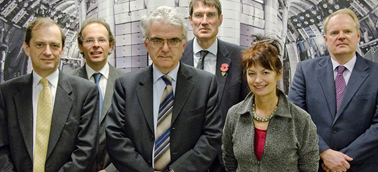 The European Commission’s Chief Scientific Advisor has praised JET’s achievements during a visit there last week. Professor Anne Glover, a biologist by training, commented that she “very much enjoyed my visit to Culham and found the tour of the torus hall inspirational.” Professor Glover is particularly passionate about public engagement – the perception of scientists by the public, and the need for inspiring stories were some of the many topics of discussion with the hosts from JET, Francesco Romanelli, Steve Cowley, Tim Jones, Lorne Horton and Duarte Borba. “Bringing the Sun down to Earth is a good example of the amazing achievements of science,” said Professor Glover, “and we can all be inspired by these outstanding advances in delivering fusion energy.”
Source: EFDA
In Defense of Sustained Research on Fusion
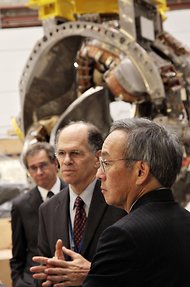 Stewart C. Prager, the director of the Department of Energy’s Princeton Plasma Physics Laboratory and a professor of astrophysical sciences at Princeton University, here offers a fresh defense of continued substantial support for research on extracting usable energy from nuclear fusion.
His “Your Dot” contribution builds on a recent fusion post by Burton Richter, a Nobelist in physics and author of a valuable book on energy, and another from Robert L. Hirsch, who directed the country’s fusion energy program in the 1970s. Here’s Prager’s post:
The Way Forward with Magnetic Fusion Energy
By Stewart C. Prager, Princeton Plasma Physics Laboratory
As budget negotiations heat up, so does the debate over the balance between investments in the long-term future and short-term necessities. Fusion is a long-term opportunity that will transform how we energize our society. The fact that ignition in a large American experimental inertial confinement fusion facility did not occur as hoped by Sept. 30 has sadly raised questions about the scientific legitimacy of that pursuit. That the scientists did not meet their goal by that day probably has little bearing on that field’s ultimate success. Importantly, this non-event should not bear any relation to the fate of other vital work centering on an entirely different approach known as magnetic fusion.
We need to keep our eyes on fusion as a transformative source of energy for the world. There are many powerful reasons why we need to forge ahead.
The magnificent lasers at the Lawrence Livermore National Laboratory’s National Ignition Facility are aimed to compress a pellet of fusion fuel such that it “ignites” – converts the energy of the lasers that bombard the pellet into fusion energy. The lasers work spectacularly well but the problem of fusion ignition is scientifically rich and complex. So far at least, the pellets have not yet behaved as expected and the milestone of ignition has not yet been achieved. This, of course, should not dull interest in the American inertial confinement fusion program: Not achieving a major scientific result by a pre-determined and artificial deadline is far from a failure.
Further, the fact that conquering this complex problem in laser fusion has not been “on schedule” has nothing to say about progress in magnetic fusion – it has been and continues to be remarkable.
Those with a long memory will recall the very early optimism about fusion energy that existed in the late 1950s and 1960s. On the heels of the quick success in moving fission energy forward, it was thought practical fusion would follow closely behind. Instead, the world’s scientists ran into an unexpected barrier — the immense physics complexity and seeming impossibility of taming fusion plasmas.
The ensuing decades have seen an intense scientific focus on what is truly a grand scientific challenge. Scientists now are teasing out the secrets of complex multi-scaled layers of turbulence in plasmas, the movement of particles through those plasmas, their interaction with magnetic fields, and numerous other phenomena that impact the plasma’s ability to be harnessed as an energy source. This focus in magnetic fusion has driven the development of a new scientific field, plasma physics, with huge benefits for science in general – from understanding cosmic plasmas to employing these hot, ionized gases for computer chip manufacturing.
On the energy front, we have advanced from fusion energy production of milliwatts in the 1970s to 16 megawatts (for a duration of 1 second) in the 1990s. With our existing underpowered machines, magnetic fusion scientists are producing and producing close to fusion energy-grade plasmas around the world on a daily basis. We are confident that abundant fusion energy can be produced on a very large scale and are now focused on the remaining physics and engineering challenges to make it practical and attractive.
The next major experimental step in magnetic fusion is ITER – the international experiment that will generate 500 megawatts of fusion power, at a physical scale of a power plant. Under construction in France, ITER will begin operation within ten years. It involves participation of the entire developed world, with the ITER partners representing the governments of half the world’s population. The scientific basis for ITER was separately scrutinized and approved by scientific panels in each of these nations. ITER is large, complex, and full of challenges. But, the likelihood of scientific success is high.
Most nations involved in ITER have robust fusion research programs that are essential to tackle other key scientific and technical issues. With these accompanying programs, we would be ready to operate a demonstration fusion power plant following ITER about 25 years from today.
The charge by some that both inertial and magnetic fusion have been beset with failure is unwarranted. These include remarks in a commentary by Dr. Burton Richter in the Oct. 18 Dot Earth blog: “Both approaches have gone from failure to ever larger failure, but each time a great deal has been learned…”
In fairness, the comment is preceded by brief, informative technical capsules. As a fusion-knowledgeable scientist who does not work in fusion energy research, Dr. Richter includes some supportive comments for the fusion program, tempered by discerning skepticism. But, for fusion scientists, Dr. Richter’s comments on failure are difficult to understand. We are unaware of any major project failures in magnetic fusion research. Quite the opposite: One of the key reasons that ITER was funded across the world is that a series of ever larger experiments have been so successful as to provide confidence that the yet larger ITER will be similarly successful.
Other commentary has appeared, offering incorrect information. In a separate Dot Earth commentaryconcerning magnetic fusion on Oct. 19, Dr. Robert Hirsch, an administrator of the fusion energy program at the U.S. Atomic Energy Commission in the 1970s, offers views reflecting the state of the field at the time of his departure from the AEC some 35 years ago. His view is framed by stating that fusion must be made practical, which means economically and technologically attractive. This is certainly correct and indeed, the criteria for such practicality have provided significant guidance to fusion research for decades. Dr. Hirsch cites a series of challenges that he thinks are roadblocks, but are not. He worries that the energy stored by superconducting magnets poses a serious threat and regulatory burden. This is not so. ITER has proven otherwise. France’s strict nuclear regulatory authorities have concluded the magnets pose no radiological safety concerns for the public. Dr. Hirsch states that the radioactive materials of a fusion reactor will be a major problem. This also is not so. The amount and toxicity is orders of magnitude less than for fission. Dr. Hirsch would be interested to learn that the rigorous French licensing regime is very successfully nearing completion. Licensing, although requiring significant efforts, will not be a barrier to fusion.
Some, like Dr Hirsch, have suggested that fusion machines are so large and complex that they will never be cost competitive. No one knows the ultimate costs, but our best engineering analyses indicate that, with some luck, fusion can indeed be cost- competitive. As an alternative to the mainline approaches to fusion energy, Dr. Hirsch puts forth his research idea from the 1970s of inertial electrostatic confinement (IEC). I agree that the fusion program very much needs to pursue multiple approaches, even within magnetic fusion. But extensive peer review has found IEC far more difficult to achieve than the ITER and related approaches in magnetic fusion.
Fusion is a nearly ideal energy source – essentially inexhaustible, clean, safe, and likely available to all nations. When proven practical, it will transform our energy future. At this moment, research investment by the rest of the world – China, Korea, the EU – is surging in magnetic fusion, while the U.S. investment is stagnating. The U.S. is at a turning point. We either maintain our long-developed leadership position in this energy and science frontier, or slip behind as other nations take the fruit of decades of scientific research – much of it from the U.S. – and convert it into a practical energy source for powering the world.
Source: The New York Times
Watch the latest clip from the ITER construction site
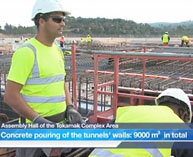 Our October clip offering an overview of the works carried out on the ITER construction site has just been released. We report on the progress of the site adaptation works and the Assembly Hall of the Tokamak complex area.
The excavation works for the sanitary and secondary precipitation drainage systems are advancing according to schedule together with the foundations of the modular buildings. The the Assembly Hall of the Tokamak area, with a slab measuring 5,400m2 and a volume of 1,400 tonnes of steel in total for reinforcement activities, are also documented.
Source: F4E


nsp_154.JPG)


nsp_154.JPG)


 |
 |
 |
 |
 |
 |
 |
 |
Media


Projekty badawcze realizowane przez IFPiLM są finansowane ze środków Ministerstwa Edukacji i Nauki i Narodowego Centrum Nauki oraz ze środków Komisji Europejskiej na podstawie umowy grantowej No 101052200, w ramach Konsorcjum EUROfusion. Wsparcia finansowego udzielają także: Międzynarodowa Agencja Energii Atomowej, Agencja Fusion for Energy, Europejska Agencja Kosmiczna i Konsorcjum LaserLab.