





Zestaw obrazów 2019
zdjecie1.jpg
zdjecie2.jpg
zdjecie3.jpg
zdjecie4.jpg
zdjecie5.jpg
zdjecie6.jpg
2019_1.JPG
2019_2.JPG
2019_4.JPG
Światowe
 A Department of Energy internal review committee has concluded that the US share of ITER, the international project to build a fusion test reactor in Cadarache, France, could cost as much as $6.5 billion—$2.6 billion more than is estimated by DOE’s ITER project office. At the insistence of congressional appropriators who requested the figures, the Obama administration is now reviewing ongoing US participation in ITER. A possible shift in policy would be included in the department’s fiscal year 2015 budget request, the release of which reportedly has been delayed by at least one month from the first Monday in February date set by statute.
The US contribution to ITER consists mainly of components for the giant tokamak. A small fraction, though, would be in cash to pay for the US share of assembly costs and central office administration. Originally expected to cost €5 billion ($6.8 billion), ITER currently has no official price tag. (See Physics Today, July 2013, page 24.)
A DOE spokesperson said the department would not release details of the $6.5 billion estimate, which was prepared by the Office of Science’s office of project assessment (OPA), until a decision has been made. In a statement, Edmund Synakowski, DOE’s associate director of science for fusion energy sciences, said, “The new cost estimate, which is a range from $4.0 to $6.5 billion, is a reflection of the historical cost growth of the project and the high level of risk and uncertainty associated with this highly complicated international undertaking.”
Ned Sauthoff, director of the US ITER project office, told the nonprofit industry group Fusion Power Associates in December that his office stands behind its $3.9 billion US contribution estimate. He said his office included a contingency of $800 million (47%) on the remaining $1.5 billion of the US hardware contribution. (About $400 million worth of hardware has already been produced in the US.) The project office estimated the cash portion of the contribution would be $800 million, including the US share of a potential €1 billion operations overrun for ITER’s central offices in Cadarache, and $400 million to cover a cost escalation resulting from an expected three-year delay of ITER’s official 2020 completion date.
A worst-case scenario?
The OPA assessment tacked $1.5 billion onto the US project office’s $3.1 billion hardware cost estimate, including upping the contingency to 130%. The OPA review more than doubled the project office’s cash estimate, to $1.9 billion. “What [OPA] did was to answer the question, ‘How bad could it get—what is the outer bound on the cost?’ They took pessimistic assumptions,” Sauthoff said.
Ironically, US ambivalence to ITER is contributing to the cost escalation. The Obama administration has imposed a $225 million limit on the US annual contribution. At that rate, US obligations to the project won’t be finished until 2033—10 years after the expected date for completion of the reactor. Sauthoff estimated that the total US contribution to ITER could be reduced by as much as $500 million if the annual cap were eliminated.
Complicating matters, Congress has imposed a cap of $2.2 billion on the US total contribution for ITER’s construction phase. The other six ITER members—the European Union (EU), Japan, Russia, China, India, and South Korea—appear committed to contribute whatever it takes to build the reactor. The ITER Council, the ministerial-level body that is the project’s governing board, already has agreed to defer the cash portion of US contributions to a later date so that the entire annual payments can fund critical components.
Another look
Senator Dianne Feinstein (D-CA), who chairs the Appropriations subcommittee that funds DOE, has insisted that the administration reassess its commitment to ITER. “[She] put the onus on the White House and the administration to decide what to do,” says a Senate source. “The current approach is intolerable; either withdraw from the project or give it the necessary resources. We have to go higher than $225 million.” The administration should be able to find a few more million for several years to support the US’s largest international scientific project, he said, considering that the White House asked for a $1 billion increase for its energy efficiency and renewable energy programs in FY 2014.
Osamu Motojima, ITER director general, told the Fusion Power Associates meeting that the OPA’s numbers are too high compared with the EU’s estimate of €7.4 billion ($10.2 billion) to cover its 45% share of construction costs. Indeed, extrapolating the $6.5 billion estimate for the US’s 9.1% share would put ITER’s total cost well over $50 billion.
But the OPA review said the US ITER project office had underestimated the difficulty of obtaining seismic, safety, and tritium operating approvals from French regulatory authorities. It also was concerned that the ITER design is just 55% complete and that there is insufficient project management expertise at Cadarache to integrate so many components from such a variety of countries.
Meanwhile, the ITER Council is to consider the findings of a biennial external review of project management at a special meeting in France this month. Although the ITER Organization (IO) declined to release the review report, the Senate source says it urged major changes in IO staffing practices. Rather than having key technical positions designated for particular member nations, as is currently the case, the best-qualified individuals for those positions should be installed without regard to their nationality, the review said. The outcome of the council meeting will be critical in determining ITER’s cost, the Senate source says. Should the recommended reforms be implemented, they could bring the cost well below the upper OPA estimate.
Motojima said he agrees with all of the management review’s recommendations and is now taking steps to centralize construction management at the IO. The central office is working to reduce bureaucracy and simplify decision-making processes and approvals and will eliminate three of its nine directorates. Kattalai Sriram, director for ITER’s finance, budget, and management systems, said the IO had achieved 92% of milestones for “critical and supercritical” components—including the vacuum vessel, toroidal and poloidal field magnets, and the building that will house the reactor—during the year that ended August 2013. But he acknowledged that only 52% of milestones for all ITER’s components were met during that period.
The US and the former Soviet Union initiated ITER in the 1980s as a Cold War tension-easing cooperative science program. It was quickly joined by Japan and the EU. Bowing to pressure from Representative James Sensenbrenner (R-WI), then chairman of the House Science and Technology Committee, the US withdrew from the project in 1999. Since US reentry in 2003, much of the ITER contribution has been taken from the existing DOE budget for fusion, resulting in substantial reductions to the US domestic fusion research program.
Source: AIP Scitation
 This week a two-week long marathon of meetings ended kicking off a package of 25 research topics defined in Europe’s Roadmap to the realisation of fusion electricty published twelve months ago.
Fusion energy is still in the research phase, making it all the more important to focus the European funded part of the programme on areas which are relevant for bringing electricity to the grid. Even more so given the latest BP Energy Outlook prediction of a 40% increase in the demand for electricity by 2035.
Since the publication of the Roadmap, physicists, engineers and administrators all across Europe have been working feverishly to turn paper into reality. EFDA and JET Leader Francesco Romanelli explains: ‘I appreciate the devotion that our colleagues in about 40 laboratories show to face the challenges that come with every change. On our journey from the old EFDA to the establishment of the new Consortium EUROfusion we can built on the profound experience and dedication of the colleagues involved to shape the new fusion research landscape.’
Project and Task Force Leaders like Piero Martin, Consorzio RFX; Italy, are enthusiastic. He sees the position as a unique opportunity of professional growth. He adds inspired: ‘Managing a large scientific team coming potentially from all EU countries, designing and implementing scientific programs, building consensus, and communicating efficiently will require creativity and vision.’
The accompanying or Medium-Size Tokamak campaigns expand the proven scheme used to operate and exploit JET. The first physics plasma of the Medium-Sized Tokamak campaigns was run yesterday on the tokamak ASDEX Upgrade in Germany.
Darren McDonald, Head of the ITER Physics Department, comments: ‘The programme brings together JET and the other key fusion experimental machines in Europe. These devices will be exploited on the basis of the roadmap’s defined missions using a scheme based on the one under which JET has been working effectively for a long time.’
Francesco Romanelli already looks at the next step towards fusion energy, ITER: ‘The main aim of the roadmap and the re-organisation of the research programme is to make ITER a success.’
Read more: EFDA
 The International Fusion Materials Irradiation Facility (IFMIF) will count on a world leading accelerator to mimic the neutronic conditions of the first wall in future fusion demonstration and commercial power plants. The role of F4E is to coordinate the European activities supported by the voluntary contributions of Belgium, France, Germany, Italy, Spain and Switzerland. F4E’s main responsibilities are the integration and follow‐up of the activities conducted by the European groups working on the prototype accelerator, the test facility and the target facility. The prototype systems have to be designed, manufactured, installed, commissioned and tested in order to validate the newly developed features.
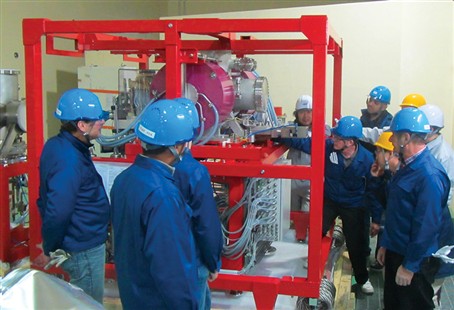
Following months of preparatory work, the installation activities for the Linear Prototype Accelerator (LIPAc) have now started with the set-up of the deuteron injector. This was designed and manufactured at CEA Saclay, one of the voluntary contributions from France to the IFMIF/EVEDA project. The injector, whose target was to generate a 140 mA deuteron beam at 100 keV, passed the acceptance tests and was then shipped to Rokkasho, Japan. In mid-November a joint team of European and Japanese engineers unpacked the injector components and proceeded with the pre-installation activities under the guidance of Raphael Gobin and Patrick Girardot, experts from CEA. The first phase was completed at the end of last year and the installation phase has been initiated under the monitoring of F4E’s Broader Fusion Development Department based Garching, Germany. The aim is to complete the assembly of the accelerator components and begin testing by early 2017.
Source: F4E
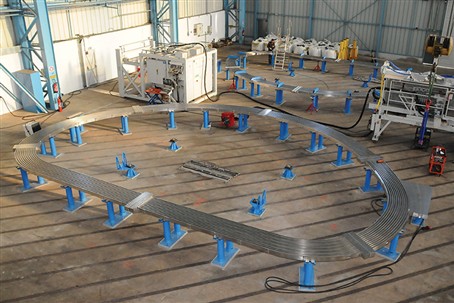 CNIM Industrial Systems and SIMIC Spa have started manufacturing the first of the 70 radial plates that will support the superconducting cables of ITER’s Toroidal Field coils. The components will essentially confine the hot plasma with the help of powerful magnets. Each company will have to manufacture 35 radial plates that measure 14m by 9m. We visited the facilities of the two companies to find out how works are advancing.
CNIM’s building at its Brégaillon industrial site has been renovated, and a brand new 3000m² production hall has been constructed close to the sea, to facilitate the transportation of large items that will be manufactured. The new building is fully air-conditioned to enable equipment to be kept at a constant temperature during its final machining. Inside the building, a 36m by 9m portal machining centre stands out “ready to machine two radial plates simultaneously to a precision of several tens of microns”, as Jean-Claude Cercassi, CNIM Commercial Development Manager, confirms. Work is progressing fast at CNIM after the first batches of raw materials were delivered. “The stainless steel segments have been machined and we are about to start with the electron beam welding,” Cercassi explains. This is now possible thanks to the installation of a dismountable vacuum chamber.
SIMIC Spa has also built a new industrial building in Porto Marghera to accommodate the production of the radial plate prototype, with brand new facilities and tooling, in order to support the production of the radial plates. A massive portal machine has been installed, which will operate in addition to the existing one that was used for the machining of the prototype, to manufacture the 35 radial plates. Marianna Ginola, SIMIC Spa, explains that “the manufacturing phase of the radial plates is the most exciting part of our contribution to the project. Our new building is ready, new tooling is in place. The production of the radial plates has started! This is a turning point for the project because the design starts taking shape and the impressive milling machine that SIMIC has invested into is put to operation. Our expertise will be fully deployed to deliver these key components”.
The first radial plates are scheduled to be completed in July, when they will be transported by sea to La Spezia (Italy) to be fitted inside the ITER Toroidal Field coils at a facility run by ASG Superconductors. After producing a second radial plate five weeks later, CNIM and SIMIC Spa are expected to accelerate production to a rate of one plate every four weeks.
Source: F4E
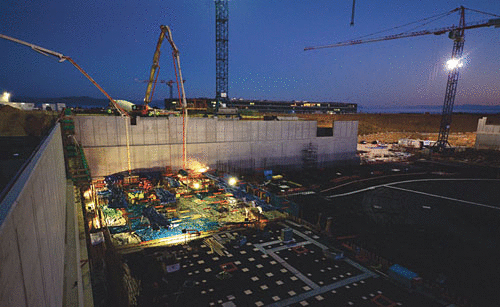
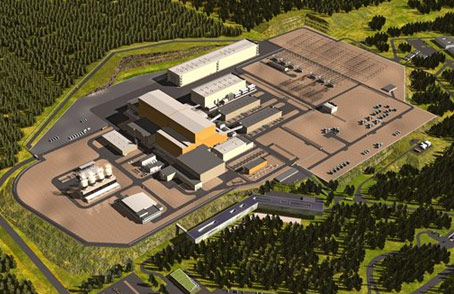 The world’s biggest energy research project, the $20bn ITER nuclear fusion reactor, entered a key construction phase last month, as contractors began to pour 15,000 cubic metres of concrete into a pit in the south of France. It will house a huge doughnut-shaped machine, where scientists hope to tame the fusion reaction that powers the sun as a source of clean energy on Earth.
ITER is the standard bearer in a quest to generate power by fusing together the nuclei of hydrogen atoms, which dates back to the years after the second world war. This turned out to be far harder than it was to exploit fusion in explosive form in the H-bomb.
Because the potential benefits of fusion power are so great – it produces far less radioactive waste than nuclear fission (splitting heavy atoms such as uranium) and its raw materials are almost inexhaustible – the industrialised world has persisted in the costly quest, in the face of sceptics who claim that its commercial application will always lie half a century in the future.
The ITER project was born at the Geneva Superpower Summit in 1985, when Mikhail Gorbachev of the Soviet Union and Ronald Reagan of the US agreed to launch an international initiative aimed at developing fusion energy for peaceful purposes. The initial signatories to what was originally known as the International Thermonuclear Energy Reactor – Russia, the US, EU and Japan – were joined later by China, South Korea and India.
Conceptual design work began in 1988, followed by increasingly detailed engineering design phases until members approved ITER’s basic design in 2001. But it was then a reactor without a site. A battle over its location finally ended in 2005 with agreement to build ITER at Cadarache, near Aix-en-Provence.
Since construction started in 2010, the project has fallen further behind the original schedule for a variety of technical, contractual and financial reasons. Now the organisation expects to begin experiments in 2020, though fusion fuel – the heavy isotopes of hydrogen: deuterium and tritium – will not be fed into the reactor until 2027.
The plan is then to have a superheated “plasma” of reactants, burning at 150m degrees and generating 500MW of energy – comparable to a medium-sized power station – for several minutes at a time.
David Campbell, the project’s head of plasma operation, says: “Although there are a lot of uncertainties in fusion plasma physics and it will take some time to optimise conditions in the reactor, the work already done [in smaller experiments and computer modelling] makes me confident there are no show-stoppers to prevent us producing a few hundred megawatts of fusion power.”
The latest design changes – adding more magnetic coils inside the reactor to control the plasma and lining the vessel with metal (tungsten and beryllium) instead of carbon – are intended to smooth the way to its successful production of fusion energy.
Meanwhile, tests elsewhere are contributing invaluable data. The Joint European Torus or JET, an EU facility hosted by the UK Atomic Energy Authority at Culham, Oxfordshire, is the most important, because it is the world’s largest existing fusion reactor and the closest to ITER in design.
JET has been running for more than 30 years, but still has several years working life. Its greatest moment so far came in 1997 when it created a world record 16MW of fusion power in short bursts of up to a second.
Since then, experiments at JET have used non-reactive hydrogen to test plasma physics, systems and materials for ITER. But Steven Cowley, UKAEA chief executive, is looking forward to another power-generating run with deuterium-tritium fuel in two or three years. “We are planning to break our world record by sustaining a fusion output of perhaps 20MW for six or seven seconds,” he says.
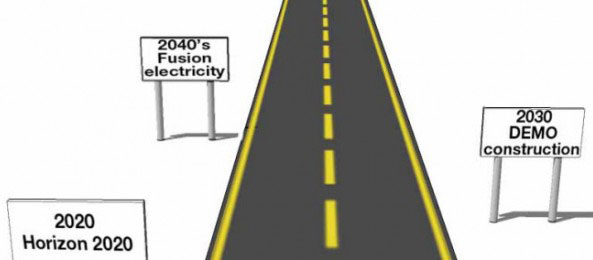
The next step beyond ITER will be DEMO, a similar sized machine likely to be built in Asia. Its job will be to demonstrate sustained large-scale production of electric power and self-sufficiency in tritium fuel. If all goes well – politically and financially as well as technically – DEMO will be designed as ITER is running, in the hope that it could begin operations in the 2030s and feed fusion power into an electric grid in the early 2040s.
The ITER approach of magnetic confinement, confining the D-T fuel within an extremely powerful magnetic field, is the most generously funded fusion technology but not the only one. An alternative approach, called inertial confinement, involves focusing an array of ultra-powerful lasers or ion beams on a small pellet of D-T fuel – though its showcase, the US National Ignition Facility in California, is making progress more slowly than expected.
It remains to be seen whether fusion will confound the sceptics and meet what is likely to be a desperate need for clean, affordable power in the late 21st century. But the world’s leading industrial powers judge the prospect of success to be high enough to justify many billions of dollars further investment.
Source: Peak Oil
Informacje z Kraju
- 1
- 2
- 3
- 4
- 5
- 6
- 7
- 8
- 9
- 10
IFPiLM podczas Nocy Muzeów w Narodowym Muzeum Techniki
14-05-2026

16 maja 2026 roku Narodowe Muzeum Techniki w Warszawie stanie się miejscem spotkania historii nauki z technologiami przyszłości. W ramach tegorocznej Nocy Muzeów odwiedzający będą mogli zapoznać się m.in. z...
Czytaj więcejPolskie konsorcjum CeNTE ze statusem obserwatora w programie DONES
28-04-2026
Program DONES, jeden z kluczowych projektów wspierających rozwój energetyki fuzyjnej i badań w obszarze fizyki plazmy, wchodzi w kolejny etap rozwoju instytucjonalnego i technicznego. Podczas posiedzenia Komitetu Sterującego w Misawie...
Czytaj więcejIFPiLM partnerem Enterprise Europe Network
31-03-2026
23 marca 2026 r. Instytut Fizyki Plazmy i Laserowej Mikrosyntezy (IFPiLM) dołączył ze swoją ofertą technologiczną do grona podmiotów zrzeszonych w Europejskiej Sieci Przedsiębiorczości Enterprise Europe Network (EEN), zainteresowanych współpracą...
Czytaj więcejIFPiLM współtwórcą wystawy "E = mc² – wzór, który zmienił świat" w Narodowym Muzeum Techniki
18-02-2026

16 lutego 2026 roku w Narodowym Muzeum Techniki w Warszawie odbyło się uroczyste otwarcie dwóch nowych wystaw stałych. Instytut Fizyki Plazmy i Laserowej Mikrosyntezy im. Sylwestra Kaliskiego (IFPiLM) miał zaszczyt...
Czytaj więcejOdszedł prof. dr hab. Wojciech Nawrocik (1938–2026)
11-02-2026
Z głębokim żalem zawiadamiamy, że 9 lutego 2026 roku zmarł prof. dr hab. Wojciech Nawrocik – pierwszy dziekan Wydziału Fizyki i Astronomii Uniwersytetu im. Adama Mickiewicza w Poznaniu, wybitny specjalista...
Czytaj więcejGO4FUSION Capability Mapping Survey – termin do 21 stycznia 2026 r.
15-01-2026
Projekt GO4FUSION zaprasza europejskie organizacje działające w obszarze energii termojądrowej do udziału w badaniu Capability Mapping Survey (mapowanie kompetencji i potencjału). Celem ankiety jest przygotowanie kompleksowego przeglądu europejskich kompetencji w zakresie...
Czytaj więcejIFPiLM wspiera podopiecznych Centrum TPD "Helenów"
22-12-2025

Instytut Fizyki Plazmy i Laserowej Mikrosyntezy im. Sylwestra Kaliskiego (IFPiLM) od wielu lat angażuje się w działania na rzecz podopiecznych Centrum Rehabilitacji, Edukacji i Opieki TPD „Helenów” w Warszawie. 9 grudnia...
Czytaj więcejNaukowcy z IFPiLM uczestniczyli w kampanii eksperymentalnej na laserze GEKKO XII
20-11-2025

W dniach 10–14 listopada 2025 r. zespół naukowców z Instytutu Fizyki Plazmy i Laserowej Mikrosyntezy im. Sylwestra Kaliskiego (IFPiLM) w składzie: dr hab. Katarzyna Batani, dr Hanna Marchenko oraz dr...
Czytaj więcejZgłoś swój udział w 18. edycji Letniej Szkoły Fizyki Plazmy!
07-11-2025

Zapraszamy do udziału w 18. edycji Letniej Szkoły Fizyki Plazmy – Kudowa Summer School "Towards Fusion Energy", która odbędzie się 8–12 czerwca 2026 r. w Kudowie-Zdroju. Organizatorem wydarzenia jest Instytut...
Czytaj więcejOdszedł prof. dr hab. Zbigniew Kłos
05-11-2025
Z głębokim żalem zawiadamiamy, że 3 listopada 2025 roku zmarł prof. dr hab. Zbigniew Kłos – wybitny naukowiec, współtwórca i wieloletni dyrektor Centrum Badań Kosmicznych PAN. W latach 2008–2011 Profesor pełnił...
Czytaj więcejKonsultacje Strategic Research & Innovation Agenda (SRIA) – do 5 listopada 2025 r.
17-10-2025
Europejska Platforma Interesariuszy Fuzji Jądrowej (European Fusion Stakeholder Platform), powołana w ramach projektu GO4FUSION CSA, pracuje nad przygotowaniem Strategicznego Programu na rzecz przyszłego partnerstwa publiczno-prywatnego (PPP) w obszarze energii termojądrowej....
Czytaj więcejIFPiLM wziął udział w drugim spotkaniu technicznym w ramach projektu DONES Con-P1
17-10-2025
Instytut Fizyki Plazmy i Laserowej Mikrosyntezy (IFPiLM) wziął udział w drugim spotkaniu technicznym realizowanym w ramach projektu DONES Consolidation Phase 1 (DONES ConP1) współfinansowanego przez Komisję Europejską w ramach programu...
Czytaj więcejProf. Jan Badziak z IFPiLM w gronie World's Top 2% Scientists
15-10-2025
Prof. dr hab. Jan Badziak z Zakładu Fizyki Plazmy Laserowej i Gęstej Plazmy Namagnetyzowanej w Instytucie Fizyki Plazmy i Laserowej Mikrosyntezy znalazł się na prestiżowej liście Stanford/Elsevier Top 2% Scientists...
Czytaj więcej29. Festiwal Nauki z udziałem IFPiLM
10-10-2025

Podczas 29. Festiwalu Nauki w Warszawie, który odbył się w dniach 19–28 września 2025 roku, naukowcy z Instytutu Fizyki Plazmy i Laserowej Mikrosyntezy przeprowadzili lekcje dla uczniów klas 7–8 szkół...
Czytaj więcejPLASMA 2025 i 20-lecie Asocjacji Euratom–IFPiLM – podsumowanie wydarzenia
26-09-2025

W dniach 15–19 września 2025 roku w Warszawie odbyła się międzynarodowa konferencja naukowa PLASMA 2025 – International Conference on Research and Application of Plasmas, poświęcona badaniom, diagnostyce i zastosowaniom plazmy....
Czytaj więcejZ żalem żegnamy Profesora Jerzego Wołowskiego
25-09-2025

Z głębokim smutkiem przyjęliśmy wiadomość o śmierci prof. dr. hab. Jerzego Wołowskiego (1936–2025), wybitnego fizyka, wieloletniego pracownika Instytutu Fizyki Plazmy i Laserowej Mikrosyntezy, mentora i przyjaciela. Jerzy Wołowski urodził się w...
Czytaj więcej20. rocznica Asocjacji Euratom-IFPiLM (CeNTE): Obchody dwóch dekad koordynacji badań nad syntezą jądrową
16-09-2025

19 września 2025 roku, podczas międzynarodowej Konferencji PLASMA 2025 odbywającej się w Warszawie i poświęconej badaniom, diagnostyce i zastosowaniom plazmy, IFPiLM będzie obchodzić 20. rocznicę koordynacji badań nad syntezą jądrową...
Czytaj więcejUdział IFPiLM w 49. Zjeździe Fizyków Polskich w Katowicach
13-09-2025
Podczas 49. Zjazdu Fizyków Polskich, który odbył się w dniach 5–11 września 2025 roku w Katowicach, Instytut Fizyki Plazmy i Laserowej Mikrosyntezy (IFPiLM) był reprezentowany zarówno w gronie prelegentów, jak...
Czytaj więcejProf. Agata Chomiczewska powołana na zastępcę dyrektora ds. naukowych w IFPiLM
03-09-2025

Informujemy, że Minister Energii Miłosz Motyka z dniem 1 września 2025 roku powołał dr hab. Agatę Chomiczewską na stanowisko zastępcy dyrektora do spraw naukowych w Instytucie Fizyki Plazmy i Laserowej...
Czytaj więcejPubliczna obrona rozprawy doktorskiej mgr. inż. Przemysława Tchórza - 21 sierpnia 2025 roku
15-07-2025
Instytut Fizyki Plazmy i Laserowej Mikrosyntezy im. Sylwestra Kaliskiego zaprasza na publiczną obronę rozprawy doktorskiej mgr. inż. Przemysława Tchórza, która odbędzie się 21 sierpnia 2025 r. (czwartek) o godz. 12:00...
Czytaj więcejZawiadomienie o publicznej obronie rozprawy doktorskiej mgr. inż. Przemysława Tchórza
10-07-2025
Instytut Fizyki Plazmy i Laserowej Mikrosyntezy im. Sylwestra Kaliskiego zaprasza na publiczną obronę rozprawy doktorskiej mgr. inż. Przemysława Tchórza, która odbędzie się 21 sierpnia 2025 r. (czwartek) o godz. 12:00...
Czytaj więcejHistoryczne wydarzenie – Rada Naukowa Instytutu nadała stopień doktora habilitowanego
10-07-2025
Po raz pierwszy w historii Instytutu Fizyki Plazmy i Laserowej Mikrosyntezy im. Sylwestra Kaliskiego (IFPiLM) Rada Naukowa podjęła uchwałę w sprawie nadania stopnia doktora habilitowanego. Było to możliwe dzięki uzyskaniu...
Czytaj więcejNowy skład Rady Oddziału Fizyki Plazmy Europejskiego Towarzystwa Fizycznego
04-07-2025

W pierwszym kwartale 2025 roku przeprowadzono wybory do Rady Oddziału Fizyki Plazmy Europejskiego Towarzystwa Fizycznego (EPS Plasma Physics Division). Sześciu kandydatów z najwyższą liczbą głosów zostało wybranych do Zarządu, a...
Czytaj więcejOgłoszenie o postępowaniu konkursowym na stanowisko zastępcy dyrektora do spraw naukowych
30-06-2025
OGŁOSZENIE o postępowaniu konkursowym na stanowisko zastępcy dyrektora do spraw naukowychw Instytucie Fizyki Plazmy i Laserowej Mikrosyntezy im. Sylwestra Kaliskiego w Warszawie Działając na podstawie art. 27 ust. 1 ustawy z dnia...
Czytaj więcejZawiadomienie o kolokwium habilitacyjnym
30-06-2025
ZAWIADOMIENIE o kolokwium habilitacyjnym Dnia 4 lipca 2025 r. o godz. 11:00 odbędzie się kolokwium habilitacyjne dr Katarzyny Batani (Instytut Fizyki Plazmy i Laserowej Mikrosyntezy) w trybie hybrydowym. Określenie osiągnięcia będącego podstawą ubiegania...
Czytaj więcejNaukowcy z IFPiLM dzielą się wiedzą specjalistyczną w zakresie fuzji na 10. Kongresie Przemysłu Jądrowego Europy Środkowej i Wschodniej 2025
12-06-2025
Naukowcy z Instytutu Fizyki Plazmy i Laserowej Mikrosyntezy (IFPiLM) – dr inż. Natalia Wendler i dr inż. Paweł Gąsior – wzięli udział w panelu dyskusyjnym podczas 10. Kongresu Przemysłu Jądrowego...
Czytaj więcejIFPiLM na 3. Kongresie "Nauka dla Społeczeństwa"
29-05-2025

W dniach 25-26 maja 2025 roku w Dużej Auli Politechniki Warszawskiej odbyła się 3. edycja Kongresu "Nauka dla Społeczeństwa". Celem wydarzenia było pokazanie, że nauka to nie tylko praca w...
Czytaj więcejZaproszenie na 3. edycję Kongresu „Nauka dla Społeczeństwa” z udziałem IFPiLM
22-05-2025

W dniach 25–26 maja 2025 roku na terenie Politechniki Warszawskiej odbędzie się 3. edycja Kongresu „Nauka dla Społeczeństwa” – wydarzenia, które pokazuje, że nauka to nie tylko praca w laboratoriach,...
Czytaj więcejZapraszamy na 28. Piknik Naukowy!
06-05-2025

Instytut Fizyki Plazmy i Laserowej Mikrosyntezy (IFPiLM) zaprasza w sobotę, 10 maja, na swoje stoisko podczas 28. Pikniku Naukowego, organizowanego przez Polskie Radio i Centrum Nauki Kopernik. Tegoroczna edycja wydarzenia,...
Czytaj więcejPorozumienie o współpracy pomiędzy IFPiLM a Narodowym Muzeum Techniki
18-04-2025

17 kwietnia 2025 roku zostało podpisane porozumienie o współpracy pomiędzy Narodowym Muzeum Techniki (NMT) a Instytutem Fizyki Plazmy i Laserowej Mikrosyntezy (IFPiLM). Uroczyste spotkanie, z udziałem dyrektor IFPiLM dr hab. Moniki...
Czytaj więcejPolscy i francuscy naukowcy łączą siły w badaniach nad fuzją jądrową
28-03-2025

W dniach 24-25 marca 2025 roku w siedzibach IFJ PAN i Instytutu Francuskiego w Krakowie odbyło się spotkanie polsko-francuskie, którego celem była wymiana doświadczeń oraz rozwój współpracy naukowej między instytucjami...
Czytaj więcejOtwarcie likwidacji fundacji "Wspieranie Międzynarodowego Centrum Gęstej, Namagnesowanej Plazmy"
14-03-2025

OGŁOSZENIE O OTWARCIU LIKWIDACJI FUNDACJI "WSPIERANIE MIĘDZYNARODOWEGO CENTRUM GĘSTEJ, NAMAGNESOWANEJ PLAZMY"wraz z wezwaniem wierzycieli Podaje się do publicznej wiadomości, że w dniu 20 stycznia 2025 r. Rada Fundacji "WSPIERANIE MIĘDZYNARODOWEGO CENTRUM GĘSTEJ, NAMAGNESOWANEJ...
Czytaj więcejZapraszamy na międzynarodową konferencję na temat badań, diagnostyki i zastosowań plazmy – PLASMA 2025!
13-03-2025

Instytut Fizyki Plazmy i Laserowej Mikrosyntezy (IFPiLM) zaprasza na międzynarodową konferencję na temat badań, diagnostyki i zastosowań plazmy – PLASMA 2025, która odbędzie się w dniach 15-19 września 2025 roku...
Czytaj więcejEksperymentalna sesja badawcza w laboratorium Plasma-Focus PF1000U w ramach współpracy ICDMP
27-02-2025

W dniach 10–21 lutego 2025 r. w laboratorium Plasma-Focus PF-1000U przeprowadzono sesję eksperymentalną, w której, obok zespołu IFPiLM, uczestniczył trzyosobowy zespół pracowników naukowych z Politechniki Praskiej (ČVUT), kierowany przez prof....
Czytaj więcejPaliwa termojądrowe wykryte podczas demonstracji lasera na JET
11-02-2025

Naukowcy i inżynierowie z ośmiu krajów, w tym z Polski, z powodzeniem zademonstrowali zastosowanie laserów na tokamaku Joint European Torus (JET), udowadniając, że jest to opłacalna technologia pomiaru retencji paliwa...
Czytaj więcejPracownik IFPiLM nominowany do tytułu Osobowość Roku w kategorii Nauka
24-01-2025
Pracownik badawczo-techniczny mgr inż. Olgierd Cichorek z Laboratorium Plazmowych Napędów Satelitarnych w IFPiLM został nominowany do tytułu Osobowość Roku 2024 w kategorii Nauka. Kapituła Redakcji „Polskiej Metropolii Warszawskiej”, „Echa Dnia” i...
Czytaj więcejProf. Monika Kubkowska nowym dyrektorem IFPiLM
02-01-2025

Z przyjemnością informujemy, że Pani Minister Przemysłu Marzena Czarnecka z dniem 1 stycznia 2025 roku powołała dr hab. Monikę Kubkowską na stanowisko dyrektora Instytutu Fizyki Plazmy i Laserowej Mikrosyntezy im....
Czytaj więcejChristian Perez von Thun członkiem grupy ITPA w obszarze Pedestal & Edge Physics
31-12-2024
Dr Christian Perez von Thun z Zakładu Badań Plazmy Termojądrowej w Instytucie Fizyki Plazmy i Laserowej Mikrosyntezy został członkiem grupy International Tokamak Physics Activity (ITPA) w obszarze Pedestal & Edge...
Czytaj więcejPrzemysław Tchórz nowym co-Leaderem grupy roboczej WG2 w ramach COST Action PROBONO
23-12-2024

Przemysław Tchórz z Zakładu Fizyki i Zastosowań Plazmy Laserowej w Instytucie Fizyki Plazmy i Laserowej Mikrosyntezy został mianowany w ramach konkursu co-Leaderem grupy roboczej WG2: Experiments: Proton boron and Towards...
Czytaj więcejIFPiLM wspiera podopiecznych z Centrum Rehabilitacji, Edukacji i Opieki TPD „Helenów”
20-12-2024

Instytut Fizyki Plazmy i Laserowej Mikrosyntezy (IFPiLM) od lat angażuje się w pomoc podopiecznym z Centrum Rehabilitacji, Edukacji i Opieki TPD „Helenów” w Warszawie. W 2024 roku wsparcie Instytutu miało...
Czytaj więcejWykład naukowców z IFPiLM podczas Śląskiego Festiwalu Nauki w Katowicach!
25-11-2024

Dr hab. Agata Chomiczewska i dr inż. Natalia Wendler z Instytutu Fizyki Plazmy i Laserowej Mikrosyntezy (IFPiLM) wygłoszą wykład pt. „Synteza jądrowa – przełomowe wyniki badań, które mogą zmienić przyszłość...
Czytaj więcejModernizacja diagnostyki PHA i udział naukowców z IFPiLM w nowej kampanii na W7-X
24-10-2024

Zespół naukowców z Instytutu Fizyki Plazmy i Laserowej Mikrosyntezy (IFPiLM) przeprowadził znaczącą modernizację diagnostyki PHA (pulse-height analyzer), która jest obecnie aktywnie wykorzystywana na stellaratorze Wendelstein 7-X w ramach kampanii OP.2.2,...
Czytaj więcejOGŁOSZENIE
22-10-2024
Ogłoszenie o postępowaniu konkursowym na stanowisko dyrektora w Instytucie Fizyki Plazmy i Laserowej Mikrosyntezy im. Sylwestra Kaliskiego Działając na podstawie art. 24 ust. 2 ustawy z dnia 30 kwietnia 2010 r....
Czytaj więcejOd powstania lasera do fuzji jądrowej – zapraszamy na wykład dr Agnieszki Zaraś-Szydłowskiej
21-10-2024

Zapraszamy na wykład dr Agnieszki Zaraś-Szydłowskiej z Zakładu Fizyki i Zastosowań Plazmy Laserowej. Temat wystąpienia: Od powstania lasera do fuzji jądrowej: technologia, zastosowania i najnowsze osiągnięcia w świecie laserów Spotkanie odbędzie się...
Czytaj więcejZapraszamy na wykład o plazmowych napędach kosmicznych
27-09-2024

Zapraszamy na wykład mgr. inż. Macieja Jakubczaka z Laboratorium Plazmowych Napędów Satelitarnych. Temat wystąpienia: Nadniebny rejs - historia i przyszłość plazmowych napędów kosmicznych. Spotkanie odbędzie się 3 października 2024 r. o godz....
Czytaj więcejEksperymenty z mieszaniną paliw fuzyjnych stabilizują plazmę w reaktorach fuzyjnych
25-09-2024
Przyszłe elektrownie termojądrowe mogą doświadczać mniejszych strat energii w spalanej plazmie niż dotychczas przewidywano. Autorzy badania - naukowcy z konsorcjum EUROfusion, w tym dr Michał Poradziński z Instytutu Fizyki Plazmy...
Czytaj więcejRozwój AI w syntezie jądrowej – IFPiLM z nowym projektem badawczym
12-09-2024

Konsorcjum EUROfusion, wspierając postępy w badaniach nad energią z syntezy jądrowej, uruchomiło 15 nowych projektów badawczych, które angażują ekspertów z dziedziny data science z całej Europy. Projekty te wykorzystają największy...
Czytaj więcejWizyta naukowców z IFPiLM na budowie tokamaka ITER
21-06-2024
W ostatnim czasie dr hab. Agata Chomiczewska, prof. IFPiLM, oraz dr inż. Natalia Wendler wzięły udział w międzynarodowej konferencji Plasma Surface Interaction in Controlled Fusion Devices PSI-26 w Marsylii, podczas...
Czytaj więcejIFPiLM na Kongresie "Nauka dla Społeczeństwa"
19-06-2024

W dniach 9-10 czerwca 2024 roku w Auli Wielkiej Politechniki Warszawskiej odbył się 2. Kongres "Nauka dla Społeczeństwa" pod hasłem "Tak nauka w Polsce wpływa na życie każdego człowieka". Instytut...
Czytaj więcejPodsumowanie 17. edycji Letniej Szkoły Fizyki Plazmy w Kudowie-Zdroju
18-06-2024

Zakończyła się 17. edycja Letniej Szkoły Fizyki Plazmy Kudowa Summer School „Towards Fusion Energy”. W wydarzeniu zorganizowanym przez Instytut Fizyki Plazmy i Laserowej Mikrosyntezy (IFPiLM) w dniach 3-7 czerwca 2024...
Czytaj więcejInformacje ze Świata
- 1
- 2
- 3
- 4
- 5
- 6
- 7
- 8
- 9
- 10
In Memoriam — Professor Francesco Romanelli
24-03-2026

The world of fusion research mourns the loss of Professor Francesco Romanelli, a visionary scientist whose work helped bring humanity closer to clean, limitless energy. Over four decades, he explored...
Czytaj więcejIgniting the future: Breakthroughs in inertial confinement Fusion
25-07-2025

In December 2022, the National Ignition Facility (NIF) at Lawrence Livermore National Laboratory (USA) marked a historic milestone in fusion science: an experiment produced 3.15 MJ of fusion energy from 2.05 MJ of laser...
Czytaj więcejWendelstein 7-X sets new fusion performance records
04-06-2025

On May 22, 2025, the Wendelstein 7-X (W7-X) stellarator at the Max Planck Institute for Plasma Physics (IPP) in Greifswald concluded its latest experimental campaign with a major success: a...
Czytaj więcejEuropean tokamak sets new fusion plasma record
20-02-2025

On February 12, 2025, the WEST tokamak, located at CEA Cadarache in southern France, set a new world record by sustaining fusion plasma for 1,337 seconds, or over 22 minutes....
Czytaj więcejDr. Gianfranco Federici appointed as the new EUROfusion Programme Manager
17-12-2024
At the 49th General Assembly held in Barcelona, December 2024, Dr. Gianfranco Federici was elected as the new Programme Manager of EUROfusion. He succeeds Prof. Ambrogio Fasoli, who will return...
Czytaj więcejEUROfusion and F4E join forces for Europe’s fusion future
16-12-2024

EUROfusion and Fusion for Energy (F4E) have signed a Memorandum of Understanding (MoU) to advance fusion research and development in Europe. This agreement reinforces cooperation in...
Czytaj więcejJohn J. Hopfield and Geoffrey E. Hinton awarded the 2024 Nobel Prize in Physics
08-10-2024

John J. Hopfield and Geoffrey E. Hinton have been awarded the 2024 Nobel Prize in Physics "for foundational discoveries and inventions that enable machine learning with artificial neural networks." The Nobel...
Czytaj więcejWendelstein 7-X begins new experimental campaign
10-09-2024

The Wendelstein 7-X, the world’s most advanced stellarator, is launching a new experimental campaign after a year of intensive maintenance and upgrades. This phase, known as OP2.2, begins on 10...
Czytaj więcejITER's New Project Baseline: A Robust Path to Fusion Energy Research
04-07-2024

On 3 July, ITER Director-General Pietro Barabaschi presented the new project baseline, under evaluation by the ITER Organization's governing body. This plan aims to ensure a robust start to scientific...
Czytaj więcejITER Council Presents Updated Project Baseline
21-06-2024

The ITER Council convened this week for its 34th meeting, where nearly 100 attendees reviewed significant updates to the project baseline. The proposed changes aim to optimize the overall project...
Czytaj więcejEurope and Japan celebrate breakthrough in paving the way for fusion energy
01-12-2023

The prospect of harnessing fusion energy is closer. The successful operation of JT-60SA, the most powerful experimental device to date, built by Europe and Japan, is a landmark achievement for...
Czytaj więcejFirst plasma was successfully generated at JT-60SA
26-10-2023

A momentous achievement in the field of nuclear fusion has been accomplished by a collaborative team of engineers from Europe and Japan. They have successfully generated tokamak plasma for the...
Czytaj więcejThe Nobel Prize in Physics 2023
03-10-2023
Pierre Agostini, Ferenc Krausz and Anne L’Huillier are the winners of this year's Nobel Prize in Physics. It was awarded "for experimental methods that generate attosecond pulses of light for...
Czytaj więcejUS Lab Replicates Fusion Ignition Breakthrough
08-08-2023
The US National Ignition Facility (NIF) has achieved fusion ignition once again, building on its landmark 2022 success. This achievement, powered by hydrogen within a diamond capsule, signifies a major...
Czytaj więcejNew Programme Manager Elect announced by EUROfusion
20-07-2023
Professor Ambrogio Fasoli became the new EUROfusion Programme Manager Elect. The decision was made by EUROfusion General Assembly at the meeting on 18 July 2023. His tenure will officially commence...
Czytaj więcejEUROfusion stands in solidarity with research in Ukraine
24-02-2023

Today, as we commemorate the anniversary of the invasion of Ukraine by Russia, the EUROfusion consortium stands in solidarity with our Ukrainian member and research colleagues. EUROfusion remains committed to supporting...
Czytaj więcejEight-minute production of plasma with gigajoule energy turnover at Wendelstein 7-X
23-02-2023

Another target has been achieved only recently by the W7-X researchers, namely they managed to acquire an energy turnover of 1.3 gigajoules in the device, which is 17 times higher...
Czytaj więcejThe Nobel Prize in Physics 2022
04-10-2022

Alain Aspect, John F. Clauser and Anton Zeilinger are the winners of this year's Nobel Prize in Physics. It was awarded “for experiments with entangled photons, establishing the violation of...
Czytaj więcejNew experiments for fusion energy record breaker JET
27-09-2022

A new wave of fusion energy experiments on UK Atomic Energy Authority’s record-breaking Joint European Torus (JET) started this month. EUROfusion researchers are using the famous JET machine to conduct a...
Czytaj więcejITER appoints new Director-General
21-09-2022
Pietro Barabaschi has become the next Director-General of the ITER Organization as a result of the unanimous choice of the Council from among finalist candidates. In the transition period Dr....
Czytaj więcejStarting power plant design
07-07-2022

At a livestreamed Horizon EUROfusion event in Brussels on 5 July 2022, EUROfusion celebrated the start of conceptual design activities for Europe's first demonstration fusion power plant DEMO. This first-of-a-kind...
Czytaj więcejCelebration of achieving a crucial assembly milestone in the ITER Project
17-05-2022

This month, we have witnessed the successful lifting and lowering into the machine well of the first sub-section of the ITER plasma chamber. The weight of the component is the...
Czytaj więcejBurning plasma achieved in inertial fusion at the National Ignition Facility
15-02-2022
Obtaining a burning plasma is a critical step towards self-sustaining fusion energy. A burning plasma is one in which the fusion reactions themselves are the primary source of heating in...
Czytaj więcejHistoric milestone reached by JET scientists
20-01-2022

Iconic fusion energy machine JET – which reaches controlled temperatures 10 times hotter than the core of the sun – completed its 100,000th live pulse last night. Weighing 2,800 tonnes, the...
Czytaj więcejHorizon Europe Grant Agreement signed
20-12-2021

15 December 2021 saw the EUROfusion consortium signing the Grant Agreement under Horizon Europe, the European Framework Programme from 2021 – 2027, in an aim to launch comprehensive R&D approach...
Czytaj więcejExhibition brings fusion power to the people of Marseille
25-10-2021

The European research consortium EUROfusion presents a game-based exhibition blending art, science and technology to explore fusion energy and get visitors' input on how fusion could fit into society. Fusion, Power...
Czytaj więcejNagroda Nobla z fizyki 2021
06-10-2021
Laureatami tegorocznej Nagrody Nobla z fizyki zostali Syukuro Manabe, Klaus Hasselmann i Giorgio Parisi. Nagrodę przyznano im „za przełomowy wkład w zrozumienie złożonych systemów fizycznych”. Manabe i Hasselmann zostali uhonorowani „za...
Czytaj więcejNational Ignition Facility experiment puts researchers at threshold of fusion ignition
16-08-2021

On Aug. 8, 2021, an experiment at Lawrence Livermore National Laboratory’s (LLNL’s) National Ignition Facility (NIF) made a significant step toward ignition, achieving a yield of more than 1.3 megajoules...
Czytaj więcej"Chinese artificial sun" proves to be the hottest
01-06-2021
It turned possible for the Chinese scientists from Hefei to achieve a plasma temperature of 120 million degrees Celsius for 101 seconds. Thus they set a new world record about...
Czytaj więcejA solution provided by the UK experimental results at MAST
31-05-2021

The exhaust system proved commercially effective for fusion power plants thanks to the UK Atomic Energy Authority’s new MAST Upgrade experiment at CCFE. Culham scientists performing testing applied the Super-X system...
Czytaj więcejPrecision under the microscope for plasma impurity behaviour study
02-04-2021
How to track impurities such as titanium, iron, nickel, copper or tungsten migrating throughout fusion plasmas? It is possible that tiny hand-made pellets manage to perform this task. The study...
Czytaj więcejASDEX Upgrade celebrating its 30 anniversary of generating plasma
29-03-2021

30 years ago, on 21 March 1991, the ASDEX Upgrade experimental device at Max Planck Institute for Plasma Physics (IPP) in Germany generated its first plasma. The main aim of...
Czytaj więcejCompletion of the first phase of WEST operation
22-03-2021

The WEST experimental campaign which took place between the 27th of November and the 27th of January 2021 proved successful with testing of a significant number of ITER-like Plasma Facing...
Czytaj więcejFull design toroidal field reported successfully reached by JT-60SA
03-03-2021

The scientific world can boast about efficient energizing of the toroidal field magnet, which made it possible to attain its full magnetic field. Plasma inside the vessel will be generated...
Czytaj więcejPrototype of another ITER divertor proves successful thanks to efforts of the European team
10-02-2021
The team of engineers from the Research Instruments (RI), Germany, has successfully completed the ITER Inner-Vertical Target (IVT) prototype’s engineering phase. The very complex component was produced no matter how...
Czytaj więcejDEMO - the next step towards fusion energy production
07-01-2021

The recommendations of the DEMO expert panel will facilitate the implementation of the next step of the Roadmap aimed at the construction of the demonstration power plant. Review-based approach makes...
Czytaj więcejFirst plasma in the MAST spherical tokamak device
02-11-2020

We have recently seen the launch of the MAST Upgrade tokamak which produced the first plasma (the video is available on YouTube). This brings us closed to obtain safe low-carbon...
Czytaj więcejSoon we will witness a new experimental campaign on the WEST tokamak
29-10-2020

Similarly to the cycle of nature, winter is coming also in the field of science. Namely, the cool down of the 140 tons superconducting Toroidal Field magnet has started under...
Czytaj więcejEUROfusion joins Neutral Beam Test Facility
08-10-2020

A new Cooperation Agreement between the international ITER fusion project, the Italian Consorzio RFX and EUROfusion will allow European researchers from eight countries to join the Neutral Beam Test Facility...
Czytaj więcejThe assembly of the ITER experimental reactor has started
10-08-2020

Ten years after the start of construction in August 2010, ITER marked a new chapter in its long history. This historic moment was witnesses by distinguished guests, including French President...
Czytaj więcejPreparations are underway for a new experimental campaign on the W7-X stellarator
23-07-2020

In the recent newsletter published on the Max Planck Institute for Plasma Physics website you can learn more about the preparation of the Wendelstein 7-X stellarator for the next experimental...
Czytaj więcejJapanese-European fusion plant JT-60SA is complete
28-04-2020
The JT-60SA assembly was completed at the end of March 2020. This device, located at the National Institute for Quantum and Radiological Science and Technology at Naka in Japan, will...
Czytaj więcejJET researchers find 'win-win' scenario for future fusion reactors
01-04-2020

Recent experiments at JET (Joint European Torus, Culham) showed how to spread the heat load across different tiles by moving the 'strike point' (specific divertor tiles which spread the heat)....
Czytaj więcejWendelstein 7-X fusion device at Greifswald to be upgraded
30-03-2020

The Max Planck Institute for Plasma Physics (IPP) in Greifswald, Germany, is ready for new improvements of the Wendelstein 7-X stellarator facility which are needed to obtain higher heating power...
Czytaj więcejWielki tokamak HL-2M zacznie działać w Chinach w 2020 roku
11-12-2019
W listopadzie br. chińska agencja prasowa Xinhua poinformowała, że wielki tokamak HL-2M, nazywany „sztucznym Słońcem”, ma być uruchomiony w przyszłym roku w Południowo-Zachodnim Instytucie Fizyki w Chengdu. Zakłada się, że...
Czytaj więcejNagroda Nobla z fizyki
14-10-2019

Tegoroczną Nagrodę Nobla z fizyki otrzymali Kanadyjczyk James Peebles oraz dwóch Szwajcarów Michel Mayor i Didier Queloz za odkrycia, które pozwoliły zrozumieć historię i budowę Wszechświata. Połowę nagrody otrzymał James Peebles...
Czytaj więcejUK invests in domestic fusion plant
08-10-2019

The UK government has committed GBP220 million (USD270 million) over four years for the conceptual design of the Spherical Tokamak for Energy Production (STEP). The STEP programme aims to construct...
Czytaj więcejEUROfusion – F4E Collaboration Inked
16-09-2019
Fusion for Energy (F4E) in collaboration with EUROfusion, drafted an MoU with EUROfusion for the implementation of the reorganization of the Test Blanket Module and Breeding Blanket programme. This MoU...
Czytaj więcejReport from the 19th Coordinated Working Group Meeting
11-09-2019

This annual meeting was held at the headquarters of the Helmholtz Society in Berlin March 12–14, 2019. Roughly forty on-site and ten remote participants provided reports on collaborations, grouped into...
Czytaj więcejThe EU proposal 871124 - LASERLAB-EUROPE; evaluation results and the start of grant preparation
27-08-2019

The evaluation of the EU proposal 871124 - LASERLAB-EUROPE for a new EU contract for Laserlab-Europe, "Laserlab-5" is completed and the EC has just announced the result. The proposal reached...
Czytaj więcej |
 |
 |
 |
 |
 |
 |
 |


Projekty badawcze realizowane przez IFPiLM są finansowane ze środków Ministerstwa Edukacji i Nauki i Narodowego Centrum Nauki oraz ze środków Komisji Europejskiej na podstawie umowy grantowej No 101052200, w ramach Konsorcjum EUROfusion. Wsparcia finansowego udzielają także: Międzynarodowa Agencja Energii Atomowej, Agencja Fusion for Energy, Europejska Agencja Kosmiczna i Konsorcjum LaserLab.