





Zestaw obrazów 2019
zdjecie1.jpg
zdjecie2.jpg
zdjecie3.jpg
zdjecie4.jpg
zdjecie5.jpg
zdjecie6.jpg
2019_1.JPG
2019_2.JPG
2019_4.JPG

Gallery
 Will fusion come too late? Won't other technologies already have a stranglehold on the energy market? Or will fusion make a viable contribution to the energy market? These are the important considerations that EFDA's socio-economic research into fusion (SERF) project addresses.
 There are good reasons why the European Union supports, and will continue to support, ITER.
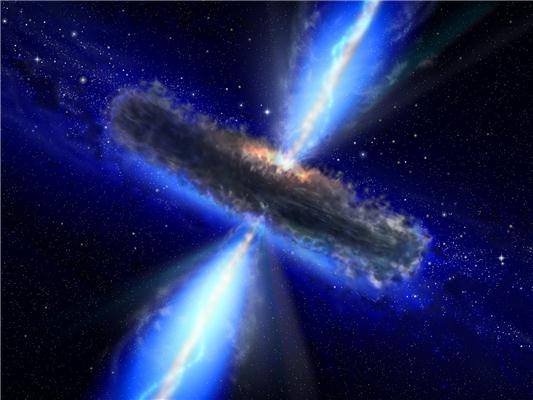 HITS astrophysicists discover a new heating source in cosmological structure formation
So far, astrophysicists thought that super-massive black holes can only influence their immediate surroundings. A collaboration of scientists at the Heidelberg Institute for Theoretical Studies (HITS) and in Canada and the US now discovered that diffuse gas in the universe can absorb luminous gamma-ray emission from black holes, heating it up strongly. This surprising result has important implications for the formation of structures in the universe. The results have just been published in "The Astrophysical Journal" and "Monthly Notices of the Royal Astronomical Society".
Every galaxy hosts a supermassive black hole at its center. Such black holes can emit high-energy gamma rays and are then called blazars. Whereas other radiation such as visible light and radio waves traverses the universe without problems, this is not the case for high-energy gamma rays. This particular radiation interacts with the optical light that is emitted by galaxies, transforming it into the elementary particles electrons and positrons. Initially, these elementary particles move almost at the speed of light. But as they are slowed down by the ambient diffuse gas, their energy is converted into heat, just like in other braking processes. As a result, the surrounding gas is heated efficiently. In fact, the temperature of the gas at mean density becomes ten times higher, and in underdense regions more than one hundred times higher than previously thought.
Source: AlphaGalileo
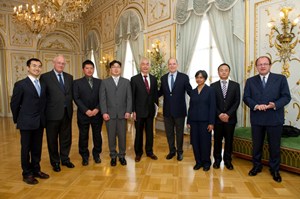 His Serene Highness Prince Albert II of Monaco met with the five researchers who were awarded postdoctoral fellowships from the Principality of Monaco last year to work at ITER Organization in 2011-2012. This was the second group of ITER postdoctoral fellows funded by Monaco under a Partnership Arrangement with the ITER Organization.
During a reception at the Prince's Palace, Sun Hee Kim (Korea), Shimpei Futatani (Japan), Debasmita Samaddar (India), Jing Na (China) and Ian Pong (UK) gave short presentations on their research, which the Prince received with great interest. The topics ranged from advanced simulation codes and modelling, to the performance of ITER superconductor strands and advanced control of the cryogenic system. (See Newsline 206 for more information on the Fellows' research.)
Like his father before him, HSH Prince Albert II shows a deep interest in science and environment. During the reception, he reiterated his wish to contribute to the fusion project that will benefit mankind, and to support a young generation of fusion scientists and engineers.
ITER Director-General Osamu Motojima said, "It is a great honour for me to meet His Serene Highness alongside the Monaco postdoctoral researchers. I wish to sincerely thank him for his strong interest in fusion research and for his support and encouragement." The Director-General also underlined the high quality of the Monaco Fellows who have been selected from across the ITER Members' communities (five in October 2008, five in September 2010).
Source: ITERnewsline
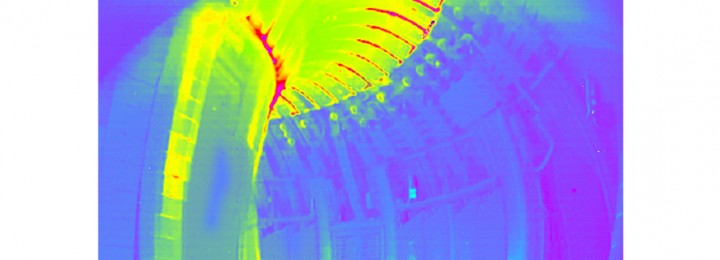 It is an exciting week for the fusion community – the Plasma Surface Interaction Conference – at which the much-anticipated results from JET's ITER-Like Wall have a starring role.
For Dr Guy Matthews, leader of the ITER-Like Wall project, delivering the very first talk of the conference will be the culmination of many years of hard work. "It's a moment I've looked forward to for a long time", he says, "and it's better than I could've hoped for. I have so many interesting and important new results, I'm spoiled for choice!"
"People thought it might be difficult to operate with the beryllium wall and tungsten divertor, and we might have trouble avoiding melt damage." he continues. In an environment where tiny irregularities in design can have a major impact on the heat load, the stringent manufacturing tolerances for the new wall components – a mere 40 micrometers – have paid off. "We have had H-mode plasmas up to the power levels we used with the carbon wall, and the new machine has been extremely clean. Its low residual carbon levels have made plasmas very reproducible with really low fuel retention."
The positive feelings are balanced by some new challenges – for example the plasma's radiation characteristics are very different with the new wall – so Dr Matthews is not planning to rest on his laurels. "There are some issues, such as tungsten accumulation, which restrict JET's operating conditions, but we are developing the tools to address them." he says with a smile. It might mean more work, but you get the feeling he wouldn't want it any other way.
About fifty papers on JET will be presented at the conference, which takes place in Aachen, Germany from May 21st to 25th. It is hosted by Forschungszentrum Julich, which is a signatory to the European Fusion Development Agency.
Source: EFDA


nsp_133.JPG)


nsp_133.JPG)


 |
 |
 |
 |
 |
 |
 |
 |
Media


Research projects carried out at the IPPLM are funded by the Polish Ministry of Education and Science, the National Science Centre and by the European Commission within the framework of EUROfusion Consortium under grant agreement No 101052200. Financial support comes also from the International Atomic Energy Agency, European Space Agency and LaserLab Consortium as well as from the Fusion for Energy Agency.