





Zestaw obrazów 2019
zdjecie1.jpg
zdjecie2.jpg
zdjecie3.jpg
zdjecie4.jpg
zdjecie5.jpg
zdjecie6.jpg
2019_1.JPG
2019_2.JPG
2019_4.JPG

Gallery
 Hans Jahreiss, a German national, will be appointed Acting Director bringing onboard a wealth of experience in management obtained in European and international agencies.
In parallel, he will continue as Head of Administration being responsible for F4E’s procurement policy and managing the organisation’s administrative workload ranging from human resources, budget and finance, IT, logistics, legal matters and business intelligence.
Prior to joining F4E, Hans Jahreiss was most recently the Administrative Director of Eurojust, the European Union’s judicial cooperation body. Before that, he was the Head of Administration at the European Organisation for Astronomical Research in the Southern Hemisphere (ESO) in Garching and Santiago de Chile, CEO and Managing Director at GSF – Forschungszentrum für Umwelt und Gesundheit (the National Research Centre for Environment and Health), and Head of Administration, Finance & Accounting, Contracts and Procurement at the Max Planck Institute for Plasmaphysics in Garching, Berlin, and Greifswald. From 1993 to 1995, he worked as a Legal Advisor to the Head of Personnel at the European Organization for Nuclear Research - CERN - in Geneva, Switzerland; prior to that, he was Head of Facility Management and Internal Auditor at the Max Planck Institute.
Hans Jahreiss holds a Doctorate in Law and Assessor Juris and has started an MBA. He also obtained a Certificate in Philosophy, a Certificat en Droit Comparé, a Pupillage with Barrister-at-Law, a Baccalaureate in Accounting and Economy, and qualified in the Special Programme in English Law.
In addition to his mother tongue he speaks English, French and some Spanish.
Source: F4E
 One of the great advances that ITER will make will be its ability to maintain plasma pulses for much longer than any previous experiment. ITER pulses will extend to around 480 seconds, an achievement made possible by superconducting electromagnets, which are able to carry extremely high current. On the other hand, JET, with its previous generation copper electromagnets, can only create plasma pulses around twenty seconds long. Nonetheless to test wall materials for ITER, a recent JET experiment emulated ITER operation by running 151 consecutive identical pulses, totalling around 900 seconds of stable ITER-Like operation.
The next stage of this experiment is to remove the tiles from the vessel and analyse how the materials have behaved – where has material been eroded from, and where has it ended up. This information will complement the measurements taken during pulses of how much gas is extracted from the vessel after a pulse compared with what was injected. These gas balance measurements indicated that the retention of fuel was around ten times lower than that observed with the prior carbon wall tiles – however, says E2 Task Force Leader Dr Sebastijan Brezinsek, the new measurements will be more accurate: “We think the fuel retention may be quite a lot lower than was measured by the gas balance. Also these measurements will show where the fuel is being retained, and which mechanism is responsible.”
In addition to information about retention, the prolonged campaign was a triumph for plasma stability with the new wall materials. “We have proved we can operate Type 1 ELMy H-mode with high reproduceability, low disruptivity, and no negative tungsten events at all, even though it is quite different to the carbon wall.” says Dr Brezinsek. “The operational window is quite narrow, but now we know how much fuelling and central heating is required to keep the divertor cool while still maintaining a minimum ELM frequency to flush the tungsten impurities.”
The current world record for the longest single pulse in a tokamak is six minutes and thirty seconds, held by Tore Supra in France. It seems likely that record will be smashed by ITER, but any trophies associated with the record will not have to move far – ITER and Tore Supra share the same CEA site in Cadarache.
Source: EFDA
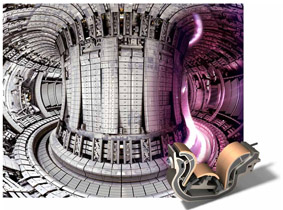 One of the biggest question marks hanging over the ITER fusion reactor project—a giant international collaboration currently under construction in France—is over what material to use for coating its interior wall. After all, the reactor has to withstand temperatures of 100,000°C and an intense particle bombardment.
Researchers have now answered that question by refitting the current world's largest fusion device, the Joint European Torus (JET) near Oxford, U.K., with a lining akin to the one planned for ITER. JET's new "ITER-like wall," a combination of tungsten and beryllium, is eroding more slowly and retaining less of the fuel than the lining used on earlier fusion reactors, the team reports. "This was very good news, because it means that our choice of materials for ITER was the right one," says physicist Peter de Vries, task force and session leader at JET.
Fusion is the process that powers the sun and stars, and, potentially, it's the perfect energy source. The necessary fuels are easily accessible and virtually inexhaustible, and the process doesn't produce any greenhouse gases or long-lived nuclear waste. For fuel, it requires deuterium and tritium (forms of hydrogen with one and two extra neutrons, respectively, in their nuclei). These have to be heated so that they form plasma—an ionized gas—and when they reach about 150 million°C, the nuclei collide with such force that they overcome their mutual repulsion and fuse into a new, larger nucleus. The products of the reaction are a helium nucleus and a very energetic neutron, whose energy is later harvested in the form of heat.
But the harsh truth is it's not at all easy to run this fusion process in a controlled way. The current favored technique is to use a reactor called a tokamak, which employs powerful electromagnets to confine the plasma inside a doughnut-shaped reactor vessel. The magnets aim to hold the plasma away from the walls of the vessel long enough for the nuclei to fuse but plasma can often shift around in unpredictable ways. If the plasma touches the wall, this can cool it to below reaction temperature and also scour off atoms of the lining material that poison the fusion reaction. And tritium is a radioactive isotope that reactor operators have to account for very carefully. Any tritium that embeds itself in the reactor wall has to be painstakingly extracted.
No fusion reactor has yet produced more energy than was put in to heat the plasma in the first place. But researchers have high hopes for ITER, the massive reactor with an estimated price tag of as much as $20 billion that is now being built in the south of France by China, the European Union, India, Japan, Russia, South Korea, and the United States.
The most common reactor lining, known as the first wall, in earlier fusion reactors was carbon because it is extremely resistant to high temperatures and erosion and doesn't pollute the plasma if atoms do get into it. Carbon's big drawback is that it's very happy to absorb deuterium and tritium. For ITER, the first reactor to use tritium on a regular basis, absorption of tritium has to be kept to a minimum, so carbon is out.
Since no perfect material exists, the plan is to compromise and use two different materials. Most of the first wall would be coated with beryllium, which is the least plasma-polluting metal but has a low melting point if it comes into contact with the plasma. At the bottom of the torus is a structure called the divertor, which is like the reactor’s exhaust pipe because it extracts helium from the plasma. The divertor is deliberately in contact with the plasma and so needs a tougher coating. For this, the plan is to use tungsten, which can withstand the heat in the divertor region—lower than in the bulk of the plasma—but if some does get eroded away, it poisons the plasma pretty badly.
The tungsten elements of the divertor "are designed to handle steady heat flows twice as large as those experienced by the nose cone of the Space Shuttle on reentry into the Earth’s atmosphere," says physicist Richard Pitts, leader of the Plasma-Wall Interaction and Divertor Physics Group at ITER. The reactor designers want the divertor to survive many years of plasma operation before replacement, which is a major operation. "Having to replace a divertor means that you'd have to stop making plasma and then send in robots, because the inside of the vessel has become radioactive. This remote handling is an arduous and slow process that will require 6 to 12 months on ITER," says Pitts, who was not involved in the new study.
This is why the ITER team wanted to make absolutely sure that their proposed lining would work. To do that, they enlisted the help of JET, a reactor built in the 1980s and the current fusion record-holder for energy production—16 megawatts. "As a matter of fact, JET is super important for ITER," Pitts says. It is a key experimental environment to test materials and processes for the reactor. During JET's most recent overhaul, which lasted from May 2010 to May 2011, the components for the inside wall of its vessel as well as the divertor—previously made mainly out of carbon—were replaced by those planned for ITER: thousands of beryllium tiles for the wall and tungsten elements for the divertor.
The results gained during operation of this upgraded JET machine have been very positive. The beryllium wall eroded much more slowly under the influence of the plasma than the previous carbon wall, the team reported at a conference last month. But even more important: It retained fuel at one-tenth the rate. "Fuel retention was a big problem. When tritium from the plasma was absorbed by the carbon it may be released later. This makes it very difficult to control the fuel in the plasma," says JET's de Vries. "Even more so, the total amount of tritium retained in ITER should be limited. Otherwise that can be a safety hazard and the reactor will have to be stopped."
There are, however, major differences of scale between JET and ITER, such as in the duration of each plasma pulse. In JET, the plasma is being sustained for only about 40 seconds—enough to gather loads of data. ITER will operate in pulses of at least 10 minutes, which means a bigger impact on the materials facing the plasma. Both the larger size of ITER as well as these longer pulses will inevitably lead to divertor materials being bombarded by many more particles during their lifetime. "The divertor in ITER will catch more particles in one day of operation than the same component in JET has in a decade," says ITER's Pitts. For this reason, the Dutch Institute For Fundamental Energy Research has built a device called Magnum-PSI. This is the only machine in the world in which one can expose a test surface to the continuous stream of particles expected in the ITER divertor, with the presence of a very strong magnetic field, like in ITER.
JET is now temporarily out of service while tiles of beryllium from the general lining and tungsten from the divertor are removed by a robot arm to be meticulously studied for erosion patterns. It will start up again in early 2013. Then researchers hope to try deliberately melting some of the tungsten to see what happens. "We hope that low levels of damage to the divertor can be tolerated by the plasma. This is our biggest unknown in planning to start ITER up with tungsten divertor targets," Pitts says.
Source: news.sciencemag.org
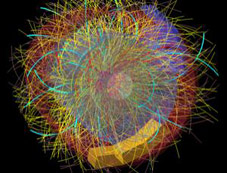 It was the ultimate phase change. Two particle smashers are homing in on what caused the seething primordial soup of the early universe to evolve into the protons and neutrons that make up ordinary matter today. In the process one has set a new record: the hottest temperature ever created by humans.
Microseconds after the big bang, the hot universe consisted of a kind of soup in which quarks roamed free instead of being bound together in atoms as they are today. This almost frictionless quark-gluon plasma has been recreated at the Relativistic Heavy Ion Collider (RHIC) at Brookhaven National Laboratory, New York, by smashing gold ions together. Their plasma reached 4 trillion °C.
Now a team at the Large Hadron Collider at CERN, which smashes lead ions together, have made a plasma almost 40 per cent hotter. At the Quark Matter 2012 conference in Washington DC on 13 August, they reported that their quark-gluon plasma had reached over 5 trillion °C, the hottest temperature ever created in an experiment.
Boundary emerging
"In this field records are made to be broken," says Jurgen Schukraft at CERN, near Geneva, Switzerland. The first hint of a record came in November 2010, when the LHC first collided lead ions, but it took two years to actually measure it, Schukraft says.
The RHIC researchers aren't out of the game, though. What they really want to know is at what energies the quark-gluon plasma switches to normal matter.
At the Quark Matter conference, RHIC's Steven Vigdor described how his team systematically varied the energy to create primordial plasma under a broad range of conditions.
He says initial measurements are delineating a boundary between ordinary matter and primordial stuff. "We are looking further back into the universe than ever before," says Vigdor.
Source: newscientist.com
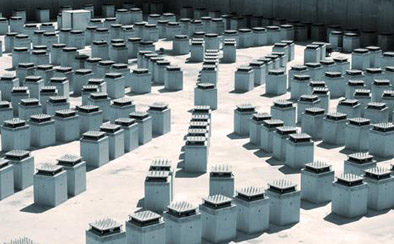 Gaia Vince watches the construction of the world’s biggest fusion energy reactor and wonders whether this ambitious and expensive project will actually work.
Cadarache: In the dusty highlands of Provence in southern France, workers have excavated a vast rectangular pit 17 metres (56 feet) down into the unforgiving rocks. From my raised vantage point, I can see bright yellow mechanical diggers and trucks buzzing around the edge of the pit, looking toy-like in the huge construction site. Above us, the fireball Sun dries the air at an unrelenting 37C.
These are embryonic stages to what is perhaps humankind's most ambitious scientific and engineering project: to replicate the Sun here on Earth.
When construction is complete, the pit will host a 73-metre-high machine(240 feet) that will attempt to create boundless energy by smashing hydrogen nuclei together, in much the same way as stars like our Sun do. Physicists have dreamed of being able to produce cheap, safe and plentiful energy through atomic fusion since the 1950s. Around the world, researchers continue to experiment with creating fusion energy using various methods. But as people within the field have said the dream has always been "30 years away" from realisation.
The need for a new energy source has never been more pressing. Global energy demand is expected to double by 2050, while the share coming from fossil fuels – currently 85% – needs to drop dramatically if we are to reduce carbon emissions and limit global warming.
Fusion, many believe, could be the answer. It works by forcing together two types, or isotopes, of hydrogen at such a high temperature that the positively charged atoms are able to overcome their mutual repulsion and fuse. The result of this fusion is an atom of helium plus a highly energetic neutron particle. Physicists aim to capture the energy released by these emitted neutrons, and use it to drive steam turbines and produce electricity.
When the reaction occurs in the core of the Sun, the giant ball of gas applies a strong gravitational pressure that helps force the hydrogen nuclei together. Here on Earth, any fusion reaction will have to take place at a tiny fraction of the scale of the Sun, without the benefit of its gravity. So to force hydrogen nuclei together on Earth, engineers need to build the reactor to withstand temperatures at least ten times that of the Sun – which means hundreds of millions of degrees.
Heated doughnuts
It's just one of the huge number of challenges facing the designers of this groundbreaking project. The concept was discussed and argued over for several decades before finally being agreed in 2007 as a multinational cooperation between the European Union, China, India, Japan, South Korea, Russia and the US – in total, 34 countries representing more than half of the world's population. Since then, the budget of 5 billion euros has trebled, the scale of the reactor has been halved, the completion date has been pushed back, and the project has somewhat lost its shine – which is somewhat ironic given the project is called Iter, meaning 'the way' in Latin.
But despite the difficulties, some progress is being made. The parts are being manufactured and tested by the participating nations, many of whom hope to develop the expertise to compete in any new fusion energy market that would be expected to follow a successful outcome at Iter.
Since they don't have access to the special conditions available in the Sun, physicists have designed a doughnut-shaped reaction chamber, called a tokamak. Hydrogen isotopes are heated to the point to which they lose electrons and form a plasma, and this is held in place for fusion but held away from the reactor walls, which could not withstand the heat. The tokamak deploys a powerful magnetic field to suspend and compress the hydrogen plasma using an electromagnet made of superconducting coils of a niobium tin alloy.
Once atomic fusion occurs, the heat produced will help to keep the core hot. But unlike a fission reaction that takes place in nuclear power stations and atomic bombs, the fusion reaction is not self perpetuating. It requires a constant input of material or else it quickly fizzles out, making the reaction far safer. And unlike what you might have seen in a recent Batman movie, the chamber cannot be transformed into a nuclear bomb. The neutrons will then be absorbed by the surrounding walls of the tokamak, transferring their energy to the walls as heat, and this in turn will be dissipated through cooling towers.
Because one of the hydrogen isotopes used, tritium, is radioactive (with a half-life of 12 years), the entire site must conform to France's strict nuclear safety laws. And to complicate matters further, the site is also moderately seismically active, meaning that the buildings are being supported on rubber pads to protect them from earthquakes.
These issues, plus the logistics of dealing with multiple nations with their own fluctuating domestic budget constraints, mean that the site won't be ready for the first experiments until 2020. Even then, they will just be testing the reactor and its equipment. The first proper fusion tests, reacting deuterium (a hydrogen isotope abundant in sea water) and tritium (which will be made from lithium), won't take place until 2028.
Power up
Those will be the key tests, though. If all goes to plan, the physicists hope to prove that they can produce ten times as much energy as the experiment requires. The plan is to use 50 megawatts (in heating the plasma and cooling the reactor), and get 500 MW out. Larger tokamaks should, theoretically, be able to deliver an even greater input to output power ratio, in the range of gigawatts.
And that is the big gamble. So far, the world's best and biggest tokamak, the JET experiment in the UK, hasn't even managed to break even, energy-wise. Its best ever result, in 1997, achieved a 16 MW output with a 25 MW input. Scale is an extremely important factor for tokamaks, though. Iter will be twice the size of JET, as well as featuring a number of design improvements.
If Iter is successful in its proof of principle mission, the first demonstration fusion plants will be built, capable of actually using and storing the energy generated for electricity production. These plants are slated to begin operation in about 2040 - around 30 years away, in fact...
Despite the seductive promise of finally getting a supply of electricity that's "too cheap to meter", the long wait to readiness and the fact that the technology remains unproven, means that many politicians are hesitant or even hostile to the expensive project. Additionally, because fusion energy won't be ready for decades, even if it works, other low-carbon energy sources must still be pursued in the short-term at least.
But if we do manage to replicate the Sun on Earth, the consequences would be spectacular. An era of genuinely cheap energy – both environmentally and financially, would have far reaching implications for everything from poverty reduction to conflict easement.
It’s exciting to think that the next generation could in some way be fusion powered – perhaps even within the lifetimes of the workman digging below me. But I can’t help but remember the 30-year rule.
Sourve: BBC


nsp_133.JPG)


nsp_133.JPG)


 |
 |
 |
 |
 |
 |
 |
 |
Media


Research projects carried out at the IPPLM are funded by the Polish Ministry of Education and Science, the National Science Centre and by the European Commission within the framework of EUROfusion Consortium under grant agreement No 101052200. Financial support comes also from the International Atomic Energy Agency, European Space Agency and LaserLab Consortium as well as from the Fusion for Energy Agency.