





Zestaw obrazów 2019
zdjecie1.jpg
zdjecie2.jpg
zdjecie3.jpg
zdjecie4.jpg
zdjecie5.jpg
zdjecie6.jpg
2019_1.JPG
2019_2.JPG
2019_4.JPG

Gallery
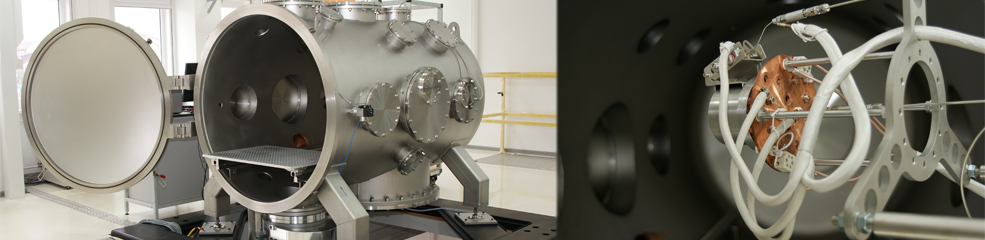
 Defrosting the freezer is one of those summer tasks that everyone has to do, and JET is no exception. Its “freezer” is set of panels that make up the cryo pump, a crucial part of the system that keeps the inside of the JET vessel at an extremely low vacuum. Over the course of 11 months of experiments quite a build up of frozen material forms, so one of the first jobs to perform now that experiments have finished is to warm up the cryo panels, and melt the frost deposits.
But it’s more than just a chore, the material that has accumulated on the panels tells a story about what has been going on in JET’s plasma chamber. This means that as soon as experiments ceased the Active Gas Handling team swung into action, working round-the-clock shifts to capture and analyse the gases being released as the cryo pumps warmed up. Most of it of course will be the deuterium fuel, but there will be other constituents used in the experiments, for example argon or nitrogen, or maybe even carbon or tritium from previous experimental campaigns.
There will also be combinations of all the above species. Hydrocarbons are well known at JET – in fact they are one of the reason that carbon was replaced in the vessel by the ITER-Like Wall. The recent experiments using nitrogen seeding may well lead to the formation of ammonia (a compound of nitrogen and hydrogen) so its collection will also be under scrutiny.
Every substance will have a story to tell about the processes that happen in a plasma at 100 million degrees, and so the analysis in the next couple of months will create another piece in the jigsaw of fusion energy research.
Source: EFDA
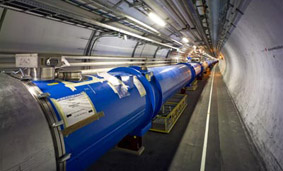 A group of physicists from Switzerland, Japan, Russia, US and the UK has proposed using the tunnel that currently houses the Large Hadron Collider (LHC) at the CERN particle-physics lab near Geneva for a dedicated machine to study the Higgs boson. The facility, dubbed LEP3, is named after CERN's previous accelerator, the Large Electron–Positron Collider (LEP), which used to exist in the LHC tunnel before being shut down in 2000. In a preliminary study submitted to the European Strategy Preparatory Group, LEP3's backers say that the machine could be constructed within the next 10 years.
The plans for LEP3 come just weeks after physicists working at CERN reported that they had discovered a new particle that bears a striking resemblance to a Higgs boson, as described by the Standard Model of particle physics. The ATLAS experiment measured its mass at around 125 GeV and the CMS experiment at 126 GeV.
LEP3 would operate at 240 GeV and comprise two separate accelerator rings that would smash electrons and positrons rather than protons and protons, as with the LHC. In their study, the 20 authors call the concept for LEP3 "highly interesting" and that it deserves more detailed study. "Now is the right moment to get this on the table," says theorist John Ellis from Kings College London in the UK, who is an author of the preliminary study and hopes that it will trigger debate among physicists as to how to study the new boson in detail.
Tunnel vision
LEP3 is designed to be installed in the LHC tunnel and serve the two LHC's general-purpose detectors – ATLAS and CMS. If LEP3 is to be built, it will have to fight off two rival proposals for a future collider to study the Higgs – the International Linear Collider (ILC) and the Compact Linear Collider (CLIC). But Ellis says that one advantage of LEP3 is that the tunnel to house it is already built and the collider would use the existing infrastructure, such as cryogenics equipment, thus making LEP3 more cost-effective. LEP3 would also use conventional electromagnets to accelerate particles rather than the accelerating superconducting cavities that will be employed by the ILC.
Which collider is built to succeed the LHC will depend on what the LHC discovers in the next couple of years after it has run at its full design energy of 14 TeV. If it turns out that the LHC finds only the Higgs, then Ellis says there would be a strong case for LEP3. But if more particles are discovered by the LHC – such as supersymmteric particles – it would make sense to consider the other two proposals. "LEP3 could be a more secure option than the ILC if only a Higgs is discovered," Ellis told physicsworld.com. "But, of course, it would be foolish to choose anything now, given that the LHC has not hit full energy yet."
CERN plans to run the LHC into the 2030s after it has undergone a major upgrade in energy and luminosity in the coming decade. However, Ellis thinks that it may even be possible for the LHC and LEP3 to cohabit for a short time. "It would not be ideal, but it could be something to think about," says Ellis. "If the LHC does not discover anything beyond the Higgs, then would you keep running it for years?"
"Little scope"
Yet some disagree that LEP3 represents the best way to study the Higgs, adding that a decision would have to be made between building LEP3 and running the high-luminosity upgrade to the LHC in the 2020s. "They both have an excellent physics case, but somehow LEP3 presents less chance of a huge breakthrough," says one leading CERN researcher who prefers not to be named. "[The LHC upgrade] has precision measurements as well as discovery reach to offer."
That view is shared by linear-collider director Lyn Evans, who toldphysicsworld.com that he thinks it is unlikely that the proposal for LEP3 will get very far. "The first job is to fully exploit the LHC and all its upgrades," says Evans, who led the construction of the LHC. "This is at least a 20 year programme of work, so I think that it is very unlikely that the LHC will be ripped out and replaced by a very modest machine with little scope apart from studying the Higgs."
Source: physicsworld.com
 Operating JET is like flying its namesake aeroplane. You need to take off and land safely – the part in the middle is comparatively easy. Ramping up the power too quickly can make for an unstable plasma, but too slow can allow contaminants to percolate into the plasma. And coming into land is tricky too, you can’t just turn off the system, you need to allow the power of the plasma to dissipate slowly and evenly. Getting the sequence of events just right is vital to the safe and productive operation of JET – at ITER with five times as much current in the plasma, even more will be at stake.
However, recent tests of JET operation have given the ITER team some encouraging results. To achieve ITER’s high level of fusion power, the proposal is to apply high-powered heating to the plasma a lot earlier in the pulse than is usually done at JET. This heating scenario was tested successfully four years ago at JET using carbon as first wall material.
However, carbon is not an ideal plasma-facing material, because it retains the fusion fuel. Recent experiments at JET have instead been testing tungsten as an alternative wall material for ITER – it is much less predisposed to bonding with hydrogen isotopes and has a very high melting point. However, because tungsten has many more electrons than carbon and therefore tends to radiate more, there were concerns that the tungsten impurities would lead to substantial energy loss from the plasma through radiation.
Hence, the experiments from four years ago were repeated with JET’s new tungsten divertor (area where the hot plasma interacts mostly with the wall). Much to the relief of the ITER team, JET successfully demonstrated the feasibility of using early heating. In fact it seems the change from carbon to tungsten in the divertor may even give the operators a little more flexibility with their scenarios as the power required to obtain good plasma confinement is somewhat lower, an unexpected bonus!
Source: EFDA
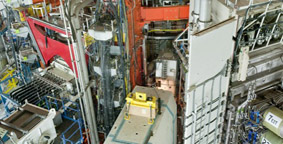
Last week marks the end of the first period of JET operations with the all-metal ‘ITER-Like Wall’. The machine is now going into a period of several months of maintenance, ready to restart operations early in 2013.
The last 11 months of machine operations have been a busy and challenging time. The scientists at JET have gathered a lot of valuable data which is certainly going to be prominently featured at coming conferences. More data will be gathered over the next few months during which some components of the ITER-Like Wall will be removed from the inside of the torus for detailed inspection and analysis.
Although there have been a number of operational difficulties on some of the JET facilities a lot has been learnt and a few of the highlights will be mentioned briefly here. As you will remember, many aspect
JET has never been operated in divertor configuration with an all-metal wall before and this has required development of some different operational strategies. The metal wall was intended to reduce the amount of fuel retention, but that affects operations more than expected. The protection systems for the plasma facing components have been brought into operation and many of them are now fully commissioned. Heating and current drive systems have been operating at high power. In particular, the neutral beam injection systems have reached a record power of 25.8MW, even though 2 of the 16 beams have not been available due to technical issues.s of the machine are new, and many challenges were associated with shaking down the new and highly modified systems. The majority of the difficulties were due to a total of only three single-point failures, which unfortunately affected critical facilities and resulted in lost operational time. Theses issues are now understood, and they are being addressed through procurement and installation of new components. A ‘Refurbishments Study Group’ has been set up by CCFE and is currently reviewing the JET facilities to identify where further refurbishments should be targeted.
High plasma current operation (at up to 3.5 MA) has also been demonstrated. This has required the operation of a device known as the ‘disruption mitigation valve’ which introduces a large puff of gas to spread the heat of the plasma more uniformly over the inner wall, preventing excessive heating of small areas. The DMV is now operating routinely and reliably.
Staff training has also been a big feature of operations, as key people learned the differences or were trained to implement the new systems. Covering 10 or 12 operational shifts per week has been quite a challenge.
Now the machine is going into a state called ‘intervention’ rather than a full shutdown. The differences are quite subtle to an external observer. During a full shutdown every system on the JET experiment is fully shut down, requiring a much more lengthy re-commissioning process. Under intervention conditions, some critical facilities remains operational in specific cases. As the intervention progresses we will describe purpose and progress of the work.
Source: EFDA
 Last week JET performed its last experiments until 2013. But, as JET shuts down and many of the scientists return to their homes across Europe and embark on summer holidays, the work does not stop.
“We’ve ticked all the boxes for the ITER-Like wall” says Task Force Leader Guy Matthews. JET Department Leader Lorne Horton agrees: “It wasn’t at all obvious that it would go this well! However the experiments have also thrown up a couple of surprises that we will need to look into.”
During the shutdown many of JET’s systems are being upgraded or refurbished. New systems are also being installed or calibrated, especially those that measure gamma rays and neutrons, as JET gears up for deuterium-tritium experiments in 2015. Also tiles will be extracted to examine in detail the wear and tear sustained during these experiments – vital information for evaluating the new ITER-Like wall.
Scientists will also continue analysing the large amounts of data accumulated during the eleven month campaign, checking calibrations and making careful comparisons with previous experiments conducted with the old carbon wall.
Then planning for next year’s campaign needs to be done. Initial meetings have happened, so the task force leaders will use the summer to make detailed plans for the campaign. Already staff from ITER have been involved, requesting certain experiments relevant to ITER be performed to give them more information on which to base their design decisions.
With all this going on, it’s clear every fusion scientist needs to find a good sized-beach to jot down their future research plans!
Source: EFDA


nsp_133.JPG)


nsp_133.JPG)


 |
 |
 |
 |
 |
 |
 |
 |
Media


Research projects carried out at the IPPLM are funded by the Polish Ministry of Education and Science, the National Science Centre and by the European Commission within the framework of EUROfusion Consortium under grant agreement No 101052200. Financial support comes also from the International Atomic Energy Agency, European Space Agency and LaserLab Consortium as well as from the Fusion for Energy Agency.