





 HITS astrophysicists discover a new heating source in cosmological structure formation
So far, astrophysicists thought that super-massive black holes can only influence their immediate surroundings. A collaboration of scientists at the Heidelberg Institute for Theoretical Studies (HITS) and in Canada and the US now discovered that diffuse gas in the universe can absorb luminous gamma-ray emission from black holes, heating it up strongly. This surprising result has important implications for the formation of structures in the universe. The results have just been published in "The Astrophysical Journal" and "Monthly Notices of the Royal Astronomical Society".
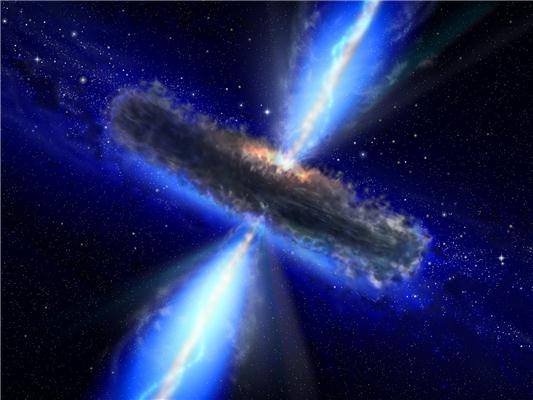
Every galaxy hosts a supermassive black hole at its center. Such black holes can emit high-energy gamma rays and are then called blazars. Whereas other radiation such as visible light and radio waves traverses the universe without problems, this is not the case for high-energy gamma rays. This particular radiation interacts with the optical light that is emitted by galaxies, transforming it into the elementary particles electrons and positrons. Initially, these elementary particles move almost at the speed of light. But as they are slowed down by the ambient diffuse gas, their energy is converted into heat, just like in other braking processes. As a result, the surrounding gas is heated efficiently. In fact, the temperature of the gas at mean density becomes ten times higher, and in underdense regions more than one hundred times higher than previously thought.
Source: AlphaGalileo


nsp_133.JPG)


nsp_133.JPG)


