





Zestaw obrazów 2019
zdjecie1.jpg
zdjecie2.jpg
zdjecie3.jpg
zdjecie4.jpg
zdjecie5.jpg
zdjecie6.jpg
2019_1.JPG
2019_2.JPG
2019_4.JPG


Światowe
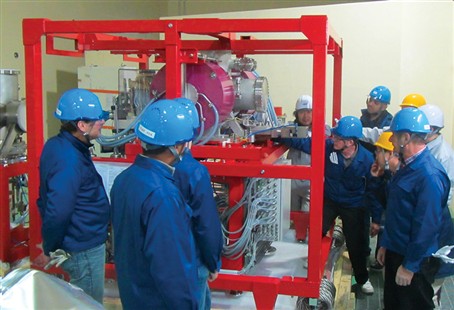 The International Fusion Materials Irradiation Facility (IFMIF) will count on a world leading accelerator to mimic the neutronic conditions of the first wall in future fusion demonstration and commercial power plants. The role of F4E is to coordinate the European activities supported by the voluntary contributions of Belgium, France, Germany, Italy, Spain and Switzerland. F4E’s main responsibilities are the integration and follow‐up of the activities conducted by the European groups working on the prototype accelerator, the test facility and the target facility. The prototype systems have to be designed, manufactured, installed, commissioned and tested in order to validate the newly developed features.
Following months of preparatory work, the installation activities for the Linear Prototype Accelerator (LIPAc) have now started with the set-up of the deuteron injector. This was designed and manufactured at CEA Saclay, one of the voluntary contributions from France to the IFMIF/EVEDA project. The injector, whose target was to generate a 140 mA deuteron beam at 100 keV, passed the acceptance tests and was then shipped to Rokkasho, Japan. In mid-November a joint team of European and Japanese engineers unpacked the injector components and proceeded with the pre-installation activities under the guidance of Raphael Gobin and Patrick Girardot, experts from CEA. The first phase was completed at the end of last year and the installation phase has been initiated under the monitoring of F4E’s Broader Fusion Development Department based Garching, Germany. The aim is to complete the assembly of the accelerator components and begin testing by early 2017.
Source: F4E
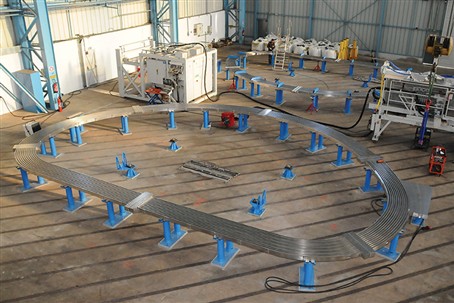 CNIM Industrial Systems and SIMIC Spa have started manufacturing the first of the 70 radial plates that will support the superconducting cables of ITER’s Toroidal Field coils. The components will essentially confine the hot plasma with the help of powerful magnets. Each company will have to manufacture 35 radial plates that measure 14m by 9m. We visited the facilities of the two companies to find out how works are advancing.
CNIM’s building at its Brégaillon industrial site has been renovated, and a brand new 3000m² production hall has been constructed close to the sea, to facilitate the transportation of large items that will be manufactured. The new building is fully air-conditioned to enable equipment to be kept at a constant temperature during its final machining. Inside the building, a 36m by 9m portal machining centre stands out “ready to machine two radial plates simultaneously to a precision of several tens of microns”, as Jean-Claude Cercassi, CNIM Commercial Development Manager, confirms. Work is progressing fast at CNIM after the first batches of raw materials were delivered. “The stainless steel segments have been machined and we are about to start with the electron beam welding,” Cercassi explains. This is now possible thanks to the installation of a dismountable vacuum chamber.
SIMIC Spa has also built a new industrial building in Porto Marghera to accommodate the production of the radial plate prototype, with brand new facilities and tooling, in order to support the production of the radial plates. A massive portal machine has been installed, which will operate in addition to the existing one that was used for the machining of the prototype, to manufacture the 35 radial plates. Marianna Ginola, SIMIC Spa, explains that “the manufacturing phase of the radial plates is the most exciting part of our contribution to the project. Our new building is ready, new tooling is in place. The production of the radial plates has started! This is a turning point for the project because the design starts taking shape and the impressive milling machine that SIMIC has invested into is put to operation. Our expertise will be fully deployed to deliver these key components”.
The first radial plates are scheduled to be completed in July, when they will be transported by sea to La Spezia (Italy) to be fitted inside the ITER Toroidal Field coils at a facility run by ASG Superconductors. After producing a second radial plate five weeks later, CNIM and SIMIC Spa are expected to accelerate production to a rate of one plate every four weeks.
Source: F4E
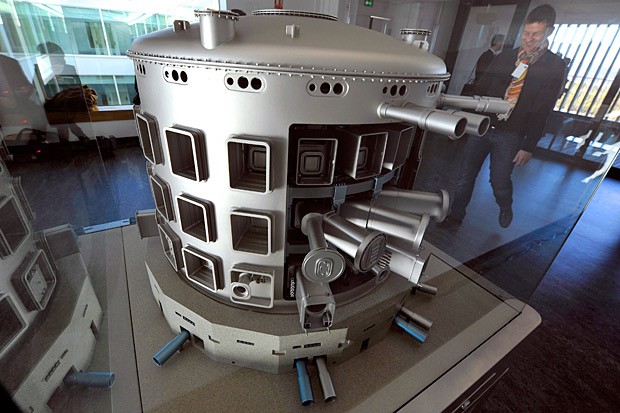
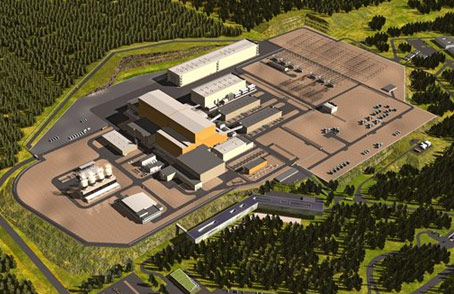 The world’s biggest energy research project, the $20bn ITER nuclear fusion reactor, entered a key construction phase last month, as contractors began to pour 15,000 cubic metres of concrete into a pit in the south of France. It will house a huge doughnut-shaped machine, where scientists hope to tame the fusion reaction that powers the sun as a source of clean energy on Earth.
ITER is the standard bearer in a quest to generate power by fusing together the nuclei of hydrogen atoms, which dates back to the years after the second world war. This turned out to be far harder than it was to exploit fusion in explosive form in the H-bomb.
Because the potential benefits of fusion power are so great – it produces far less radioactive waste than nuclear fission (splitting heavy atoms such as uranium) and its raw materials are almost inexhaustible – the industrialised world has persisted in the costly quest, in the face of sceptics who claim that its commercial application will always lie half a century in the future.
The ITER project was born at the Geneva Superpower Summit in 1985, when Mikhail Gorbachev of the Soviet Union and Ronald Reagan of the US agreed to launch an international initiative aimed at developing fusion energy for peaceful purposes. The initial signatories to what was originally known as the International Thermonuclear Energy Reactor – Russia, the US, EU and Japan – were joined later by China, South Korea and India.
Conceptual design work began in 1988, followed by increasingly detailed engineering design phases until members approved ITER’s basic design in 2001. But it was then a reactor without a site. A battle over its location finally ended in 2005 with agreement to build ITER at Cadarache, near Aix-en-Provence.
Since construction started in 2010, the project has fallen further behind the original schedule for a variety of technical, contractual and financial reasons. Now the organisation expects to begin experiments in 2020, though fusion fuel – the heavy isotopes of hydrogen: deuterium and tritium – will not be fed into the reactor until 2027.
The plan is then to have a superheated “plasma” of reactants, burning at 150m degrees and generating 500MW of energy – comparable to a medium-sized power station – for several minutes at a time.
David Campbell, the project’s head of plasma operation, says: “Although there are a lot of uncertainties in fusion plasma physics and it will take some time to optimise conditions in the reactor, the work already done [in smaller experiments and computer modelling] makes me confident there are no show-stoppers to prevent us producing a few hundred megawatts of fusion power.”
The latest design changes – adding more magnetic coils inside the reactor to control the plasma and lining the vessel with metal (tungsten and beryllium) instead of carbon – are intended to smooth the way to its successful production of fusion energy.
Meanwhile, tests elsewhere are contributing invaluable data. The Joint European Torus or JET, an EU facility hosted by the UK Atomic Energy Authority at Culham, Oxfordshire, is the most important, because it is the world’s largest existing fusion reactor and the closest to ITER in design.
JET has been running for more than 30 years, but still has several years working life. Its greatest moment so far came in 1997 when it created a world record 16MW of fusion power in short bursts of up to a second.
Since then, experiments at JET have used non-reactive hydrogen to test plasma physics, systems and materials for ITER. But Steven Cowley, UKAEA chief executive, is looking forward to another power-generating run with deuterium-tritium fuel in two or three years. “We are planning to break our world record by sustaining a fusion output of perhaps 20MW for six or seven seconds,” he says.
The next step beyond ITER will be DEMO, a similar sized machine likely to be built in Asia. Its job will be to demonstrate sustained large-scale production of electric power and self-sufficiency in tritium fuel. If all goes well – politically and financially as well as technically – DEMO will be designed as ITER is running, in the hope that it could begin operations in the 2030s and feed fusion power into an electric grid in the early 2040s.
The ITER approach of magnetic confinement, confining the D-T fuel within an extremely powerful magnetic field, is the most generously funded fusion technology but not the only one. An alternative approach, called inertial confinement, involves focusing an array of ultra-powerful lasers or ion beams on a small pellet of D-T fuel – though its showcase, the US National Ignition Facility in California, is making progress more slowly than expected.
It remains to be seen whether fusion will confound the sceptics and meet what is likely to be a desperate need for clean, affordable power in the late 21st century. But the world’s leading industrial powers judge the prospect of success to be high enough to justify many billions of dollars further investment.
Source: Peak Oil
 Physicists from France to California rejoiced this week over Congress's new spending bill, which would increase funding for fusion-energy research by more than $100 million over last year.
 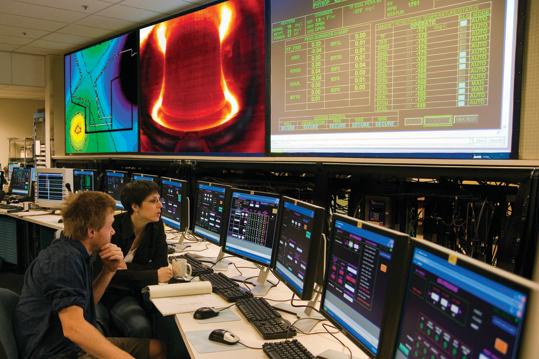 It’s a universal source of anxiety among scientists these days: the uncertainties about federal funding for research. Every time I speak to someone, whether they research cancer or the cosmos, the topic seems to come up. People are spending lots of time writing grants, and the competition is getting more intense for fewer funds. Scientists complain that the budget uncertainties mean they spend much of their time advocating for their research and scrambling for funds, instead of doing the thing they’re best at—science. Talented researchers are, they fear, avoiding science.
Nowhere was that conversation more stark than at a fusion experiment at the Massachusetts Institute of Technology, which was slated to be zeroed out altogether in the federal budget. The scientists began a spirited save-our-experiment campaign, but all appeared to be lost last year. The Alcator C-Mod experiment at MIT had stopped accepting new graduate students in 2012, and 70 employees were facing layoffs.
Those researchers, engineers, and technicians breathed a sigh of relief this week, with the unexpected news that the budget deal released by Congress Monday night included $22 million for the experiment, which had been slated to shut down completely. The goal of the experiment is to learn how to harness nuclear fusion—combining atoms—to produce energy.
With the flush of new funding, the experiment will run for its typical span, 12 to 14 weeks this year. No one will be laid off, according to Miklos Porkolab, director of the Plasma Science and Fusion Center where the project is housed. On Friday, the scientists will meet to talk about the experiments and the research schedule.
Porkolab said that the project had gone into survival mode. Layoffs that had been expected to take place in December were delayed when the Department of Energy gave MIT enough money for the researchers to maintain the experiment in a “warm shutdown” phase, at least until the budgetary situation was settled.
Although the funding announcement is great news for the project, it doesn’t resolve the larger problem—the project was treading water month-to-month. Even with the new funding, which ensures the experiment can continue until the end of the September, the reprieve is short on a scientific time scale.
“What we’d like to do is again resume bringing in more graduate students. At this funding level, we could do that. The only issue is what happens in 2015,” Porkolab said. “If we bring in students, they expect five years of support for a Ph.D.”
Porkolab said a significant number of new applicants for graduate school at MIT have expressed interest in plasma research, but that when the Obama Administration’s budget proposal for the next fiscal year is unveiled, it may not have set aside any money for the fusion experiment for next year.
“We may have to go through the same cycle again,” Porkolab said. The uncertainty, he said, takes its toll on the science, the ability to plan research projects, and the people who work on the experiment.
The United States has made investments in a giant international fusion experiment that will be much more powerful that the MIT project. The international investment is continuing in the current budget, but Porkolab says that it is equally important to keep up the domestic program running. Insights gained from the smaller experiment, he said, will ultimately help researchers run the larger one more efficiently.
Source: Boston.com
Local News
- 1
- 2
- 3
- 4
- 5
IPPLM joins the Enterprise Europe Network
31-03-2026
On 23 March 2026, the Institute of Plasma Physics and Laser Microfusion (IPPLM) joined, with its technological offer, the group of entities affiliated with the Enterprise Europe Network (EEN), interested...
Read moreIPPLM as a co-creator of the exhibition "E = mc² – the formula that changed the world" at the National…
18-02-2026

On 16 February 2026, the official opening of two new permanent exhibitions took place at the National Museum of Technology in Warsaw. The Institute of Plasma Physics and Laser Microfusion...
Read moreIPPLM supports children and young people at the TPD "Helenów" Centre
22-12-2025

The Sylwester Kaliski Institute of Plasma Physics and Laser Microfusion (IPPLM) has for many years been actively engaged in initiatives supporting children and young people supported by the TPD "Helenów"...
Read moreIPPLM researchers took part in an experimental campaign on the GEKKO XII laser
20-11-2025

On 10–14 November 2025, a research team from the Sylwester Kaliski Institute of Plasma Physics and Laser Microfusion (IPPLM) – Prof. Katarzyna Batani, Dr Hanna Marchenko and Dr Agnieszka Zaraś-Szydłowska...
Read moreRegister for the 18th Kudowa Summer School on Plasma Physics!
07-11-2025

We invite you to take part in the 18th Kudowa Summer School "Towards Fusion Energy", which will be held on 8–12 June 2026 in Kudowa-Zdrój, Poland. The event is organised...
Read moreIPPLM participated in the second technical meeting within the DONES Con-P1 project
17-10-2025
The Institute of Plasma Physics and Laser Microfusion (IPPLM) took part in the second technical meeting held as part of the DONES Consolidation Phase 1 (DONES ConP1) project, co-financed by...
Read moreProf. Jan Badziak from IPPLM among the World’s Top 2% Scientists
15-10-2025
Prof. Jan Badziak, from the Department of Laser Plasma and Magnetized Dense Plasma Physics at the Institute of Plasma Physics and Laser Microfusion (IPPLM), has been included in the prestigious...
Read more29th Science Festival with the participation of IPPLM
10-10-2025

During the 29th Science Festival in Warsaw, held on 19–28 September 2025, researchers from the Institute of Plasma Physics and Laser Microfusion (IPPLM) conducted lessons for upper-grade primary school students. The...
Read morePLASMA 2025 and the 20th Anniversary of the Euratom–IPPLM Association – event summary
26-09-2025

From 15 to 19 September 2025, Warsaw hosted the international scientific conference PLASMA 2025 – International Conference on Research and Application of Plasmas, dedicated to plasma research, diagnostics, and applications....
Read moreWe bid farewell with deep sorrow to Professor Jerzy Wołowski
25-09-2025

It is with great sadness that we have received the news of the passing of Professor Jerzy Wołowski (1936–2025) an outstanding physicist, long-time employee of the Institute of Plasma Physics...
Read more20th anniversary of the Euratom–IPPLM Association (CeNTE): Celebrating two decades of fusion research coordination
16-09-2025

On 19 September 2025, during the PLASMA 2025 International Conference on Research, Diagnostics and Applications of Plasma in Warsaw, the IPPLM will mark 20th anniversary of the coordination of research on nuclear fusion...
Read moreIPPLM at the 49th Congress of Polish Physicists in Katowice
13-09-2025
During the 49th Congress of Polish Physicists, held from September 5–11, 2025, in Katowice, the Institute of Plasma Physics and Laser Microfusion (IPPLM) was represented both among the speakers and...
Read moreProf. Agata Chomiczewska appointed Deputy Director for Scientific Affairs at the IPPLM
03-09-2025

We are pleased to announce that the Minister of Energy, Mr. Miłosz Motyka, has appointed Dr. hab. Agata Chomiczewska to the position of Deputy Director for Scientific Affairs at the...
Read moreA historic milestone – the Scientific Council of the Institute confers the degree of habilitated doctor
10-07-2025
For the first time in the history of the Institute of Plasma Physics and Laser Microfusion (IPPLM), the Scientific Council has adopted a resolution to confer the degree of habilitated...
Read moreNew Board of the Plasma Physics Division of the European Physical Society
04-07-2025

In the first quarter of 2025, elections were held for the Board of the Plasma Physics Division of the European Physical Society (EPS Plasma Physics Division). Six candidates who received...
Read moreIPPLM researchers bring fusion expertise to 10th Central & Eastern Europe Nuclear Industry Congress 2025
12-06-2025
Researchers from the Institute of Plasma Physics and Laser Microfusion (IPPLM), Dr. Natalia Wendler and Dr. Paweł Gąsior, recently participated in a panel discussion at the 10th Central & Eastern...
Read moreIPPLM at the 3rd edition of the "Science for Society" Congress
29-05-2025

On 25-26 May 2025, the 3rd edition of the "Science for Society" Congress took place in the Large Hall of the Warsaw University of Technology. The aim of the event...
Read moreInvitation to the 3rd edition of the "Science for Society" Congress with the participation of IPPLM
22-05-2025

The 3rd edition of the "Science for Society" Congress will take place on 25–26 May 2025 at the Warsaw University of Technology. This unique event demonstrates that science is not...
Read moreJoin the 28th Science Picnic!
07-05-2025

The Institute of Plasma Physics and Laser Microfusion (IPPLM) invites you to its stand on Saturday, 10 May, during the 28th Science Picnic, organized by Polish Radio and the Copernicus...
Read moreCooperation agreement between the IPPLM and the National Museum of Technology
18-04-2025

On 17 April 2025, a cooperation agreement was signed between the National Museum of Technology (NMT) and the Institute of Plasma Physics and Laser Microfusion (IPPLM). The ceremonial meeting, attended by...
Read morePolish and French researchers join forces in research on nuclear fusion
31-03-2025

On 24-25 March 2025, a Polish-French meeting was held at the headquarters of the Institute of Nuclear Physics of the Polish Academy of Sciences (IFJ PAN) and the French Institute...
Read moreJoin us for the International Conference on Research and Application of Plasmas – PLASMA 2025!
13-03-2025

The Institute of Plasma Physics and Laser Microfusion (IPPLM) invites you to attend the PLASMA 2025 – International Conference on Research and Application of Plasmas, which will be held from...
Read moreExperimental research session in the Plasma-Focus PF1000U laboratory as part of the ICDMP collaboration
27-02-2025

On February 10–21, 2025, an experimental session was held in the Plasma-Focus PF-1000U laboratory, in which, in addition to the IPPLM team, a three-person team of researchers from the Prague...
Read moreLaser demonstration on JET detects fusion fuels
11-02-2025

Scientists and engineers from eight nations, including Poland, have carried out a project using lasers on the Joint European Torus (JET) to study fusion fuel retention. Laser Induced Breakdown Spectroscopy (LIBS),...
Read moreIPPLM employee nominated for the Personality of the Year title in the Science category
24-01-2025
Research and technical employee Mr. Olgierd Cichorek, M.Sc., from the Laboratory of Plasma Nudge for Satellites at the IPPLM has been nominated for the title of Personality of the Year...
Read moreWorld News
- 1
- 2
- 3
- 4
- 5
In Memoriam — Professor Francesco Romanelli
24-03-2026

The world of fusion research mourns the loss of Professor Francesco Romanelli, a visionary scientist whose work helped bring humanity closer to clean, limitless energy. Over four decades, he explored...
Read moreIgniting the future: Breakthroughs in inertial confinement Fusion
25-07-2025

In December 2022, the National Ignition Facility (NIF) at Lawrence Livermore National Laboratory (USA) marked a historic milestone in fusion science: an experiment produced 3.15 MJ of fusion energy from 2.05 MJ of laser...
Read moreWendelstein 7-X sets new fusion performance records
04-06-2025

On May 22, 2025, the Wendelstein 7-X (W7-X) stellarator at the Max Planck Institute for Plasma Physics (IPP) in Greifswald concluded its latest experimental campaign with a major success: a...
Read moreEuropean tokamak sets new fusion plasma record
20-02-2025

On February 12, 2025, the WEST tokamak, located at CEA Cadarache in southern France, set a new world record by sustaining fusion plasma for 1,337 seconds, or over 22 minutes....
Read moreDr. Gianfranco Federici appointed as the new EUROfusion Programme Manager
17-12-2024
At the 49th General Assembly held in Barcelona, December 2024, Dr. Gianfranco Federici was elected as the new Programme Manager of EUROfusion. He succeeds Prof. Ambrogio Fasoli, who will return...
Read moreEUROfusion and F4E join forces for Europe’s fusion future
16-12-2024

EUROfusion and Fusion for Energy (F4E) have signed a Memorandum of Understanding (MoU) to advance fusion research and development in Europe. This agreement reinforces cooperation in...
Read moreJohn J. Hopfield and Geoffrey E. Hinton awarded the 2024 Nobel Prize in Physics
08-10-2024

John J. Hopfield and Geoffrey E. Hinton have been awarded the 2024 Nobel Prize in Physics "for foundational discoveries and inventions that enable machine learning with artificial neural networks." The Nobel...
Read moreWendelstein 7-X begins new experimental campaign
10-09-2024

The Wendelstein 7-X, the world’s most advanced stellarator, is launching a new experimental campaign after a year of intensive maintenance and upgrades. This phase, known as OP2.2, begins on 10...
Read moreITER's New Project Baseline: A Robust Path to Fusion Energy Research
04-07-2024

On 3 July, ITER Director-General Pietro Barabaschi presented the new project baseline, under evaluation by the ITER Organization's governing body. This plan aims to ensure a robust start to scientific...
Read moreITER Council Presents Updated Project Baseline
21-06-2024

The ITER Council convened this week for its 34th meeting, where nearly 100 attendees reviewed significant updates to the project baseline. The proposed changes aim to optimize the overall project...
Read moreEurope and Japan celebrate breakthrough in paving the way for fusion energy
01-12-2023

The prospect of harnessing fusion energy is closer. The successful operation of JT-60SA, the most powerful experimental device to date, built by Europe and Japan, is a landmark achievement for...
Read moreFirst plasma was successfully generated at JT-60SA
26-10-2023

A momentous achievement in the field of nuclear fusion has been accomplished by a collaborative team of engineers from Europe and Japan. They have successfully generated tokamak plasma for the...
Read moreThe Nobel Prize in Physics 2023
03-10-2023
Pierre Agostini, Ferenc Krausz and Anne L’Huillier are the winners of this year's Nobel Prize in Physics. It was awarded "for experimental methods that generate attosecond pulses of light for...
Read moreUS Lab Replicates Fusion Ignition Breakthrough
08-08-2023
The US National Ignition Facility (NIF) has achieved fusion ignition once again, building on its landmark 2022 success. This achievement, powered by hydrogen within a diamond capsule, signifies a major...
Read moreNew Programme Manager Elect announced by EUROfusion
20-07-2023
Professor Ambrogio Fasoli became the new EUROfusion Programme Manager Elect. The decision was made by EUROfusion General Assembly at the meeting on 18 July 2023. His tenure will officially commence...
Read moreEUROfusion stands in solidarity with research in Ukraine
24-02-2023

Today, as we commemorate the anniversary of the invasion of Ukraine by Russia, the EUROfusion consortium stands in solidarity with our Ukrainian member and research colleagues. EUROfusion remains committed to supporting...
Read moreEight-minute production of plasma with gigajoule energy turnover at Wendelstein 7-X
23-02-2023

Another target has been achieved only recently by the W7-X researchers, namely they managed to acquire an energy turnover of 1.3 gigajoules in the device, which is 17 times higher...
Read moreThe Nobel Prize in Physics 2022
04-10-2022

Alain Aspect, John F. Clauser and Anton Zeilinger are the winners of this year's Nobel Prize in Physics. It was awarded “for experiments with entangled photons, establishing the violation of...
Read moreNew experiments for fusion energy record breaker JET
27-09-2022

A new wave of fusion energy experiments on UK Atomic Energy Authority’s record-breaking Joint European Torus (JET) started this month. EUROfusion researchers are using the famous JET machine to conduct a...
Read moreITER appoints new Director-General
21-09-2022
Pietro Barabaschi has become the next Director-General of the ITER Organization as a result of the unanimous choice of the Council from among finalist candidates. In the transition period Dr....
Read moreStarting power plant design
07-07-2022

At a livestreamed Horizon EUROfusion event in Brussels on 5 July 2022, EUROfusion celebrated the start of conceptual design activities for Europe's first demonstration fusion power plant DEMO. This first-of-a-kind...
Read moreCelebration of achieving a crucial assembly milestone in the ITER Project
17-05-2022

This month, we have witnessed the successful lifting and lowering into the machine well of the first sub-section of the ITER plasma chamber. The weight of the component is the...
Read moreBurning plasma achieved in inertial fusion at the National Ignition Facility
15-02-2022
Obtaining a burning plasma is a critical step towards self-sustaining fusion energy. A burning plasma is one in which the fusion reactions themselves are the primary source of heating in...
Read moreHistoric milestone reached by JET scientists
20-01-2022

Iconic fusion energy machine JET – which reaches controlled temperatures 10 times hotter than the core of the sun – completed its 100,000th live pulse last night. Weighing 2,800 tonnes, the...
Read moreHorizon Europe Grant Agreement signed
20-12-2021

15 December 2021 saw the EUROfusion consortium signing the Grant Agreement under Horizon Europe, the European Framework Programme from 2021 – 2027, in an aim to launch comprehensive R&D approach...
Read more |
 |
 |
 |
 |
 |
 |
 |
What we do
Our laboratories
Online seminars
| Thursday, 30 Apr 2026, godz. 13.00 Seminarium instytutowe: "Equation of State of Shock Compressed BN in the Megabar Pressure Range", dr hab. Katarzyna Batani, IFPiLM |


Research projects carried out at the IPPLM are funded by the Polish Ministry of Education and Science, the National Science Centre and by the European Commission within the framework of EUROfusion Consortium under grant agreement No 101052200. Financial support comes also from the International Atomic Energy Agency, European Space Agency and LaserLab Consortium as well as from the Fusion for Energy Agency.