





Zestaw obrazów 2019
zdjecie1.jpg
zdjecie2.jpg
zdjecie3.jpg
zdjecie4.jpg
zdjecie5.jpg
zdjecie6.jpg
2019_1.JPG
2019_2.JPG
2019_4.JPG


Światowe
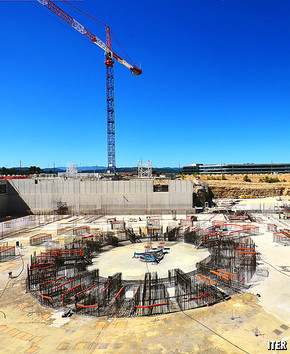 A big nuclear-fusion project attempts to move from design to construction.
HERE is one way to squeeze energy from nuclear fusion: create and contain a roiling soup of ionised hydrogen atoms known as a plasma, and heat it to ten times the temperature of the sun’s core. Some of the fast-moving atomic nuclei will bash together with enough oomph to fuse. Gather the energy from fast-moving particles created in these collisions and you have a limitless (for hydrogen is abundant), comparatively clean energy source. It is an idea conceived in the 1950s, but yet to be born in a laboratory.
Here is one way that might make it happen: gather an international consortium of the fusion-minded, including the European Union, America, China, India, Japan, Russia and South Korea. Conspire to build a 23,000-tonne doughnut-shaped vessel called a tokamak, that is wrapped with 80,000km of superconducting wire, all to contain the plasma magnetically and, for the first time, produce fusion energy continuously. Call it the International Thermonuclear Experimental Reactor; shorten the name to ITER for better PR. And farm out the design to the seven “domestic agency” partners, each completely in charge of the procurement and production of their bit (they will all have to agree to any changes, though, as the design of this technological beast inevitably evolves).
It sounds wonderfully egalitarian, in a technocratic sort of way. Timelines are slippery things, though, so delays will occur and costs will go up. That makes for more delays. Partners may drop out and come back as the political will to pay for the project comes and goes.
The story of ITER has become a tale of these shortcomings. The first of its components arrived at the reactor’s site in Cadarache, in the south of France, earlier this month, just as the foundations were finished. In the next week or so construction should start on the walls that will house its core: the doughnut-shaped vacuum vessel. Perhaps tellingly, no one can say exactly when even that will happen. There has already been a 30-month delay in the manufacture of the vacuum vessel. The most recently published schedule says the first plasma will be created in the vacuum vessel in 2020. That will now have to slip to 2023 or 2024, but the revised official schedule will not be published until mid-2015. The overall cost? Also unknown, but it is sure to surpass by a considerable sum the current official estimate of $20 billion.
The factors that have hobbled ITER from the start have not been concerns of nuclear physics or large-scale engineering. They have been problems of leadership and project management. Few would now argue that the initial design was adequate, or that the seven domestic agencies should have been allowed to have the absolute control they got over the bits of it they worked on. As delays and dissent cropped up within the domestic agencies, ITER’s management kept the other agencies in the dark, and stuck too long to timelines that were never feasible.
Most embarrassingly, a management assessment from last October that was leaked earlier this year derided the organisation along all these lines, and added that the project lacked a “nuclear safety culture”. America withheld 12% of its ITER funding this year, pending the implementation of every one of the assessment’s recommendations. A dissenting subcommittee of the Senate has proposed a budget that would see America pull out altogether next year, as it did in 1999 (it came back into the fold in 2003).
ITER’s core philosophy is to share between countries the risks, efforts and rewards of trying to crack the fusion-power problem—costs and delays be damned. The idea is that if the project proves successful, any of the domestic agencies involved should then be able to build its own version with the knowledge collaboratively gained.
Consensus among the ITER faithful is that it will accomplish its stated goal of extracting 500 megawatts of power from a continuously fusing plasma—about ten times as much power as is put in. Scientifically, nothing seems to stand in the way of this. But consider the National Ignition Facility, a star-crossed American effort to use lasers rather than magnetic fields to create fusion. It looked certain, on paper, that if engineers built a laser of a given size (the world’s largest, by some margin) and fired it at a target of a prescribed shape and composition, the result would be a net gain of energy. The laser and the targets were made; fusion “break-even”, however, was not. The facility has now switched its focus to “nuclear-stockpile stewardship” (modelling the behaviour of atom bombs).
What looks good according to the equations is thus not always—or even often—what works best in reality. But if ITER wants even the chance to test the science, it will first have to solve, in a comprehensive fashion, its human problems.
Source: economist.com
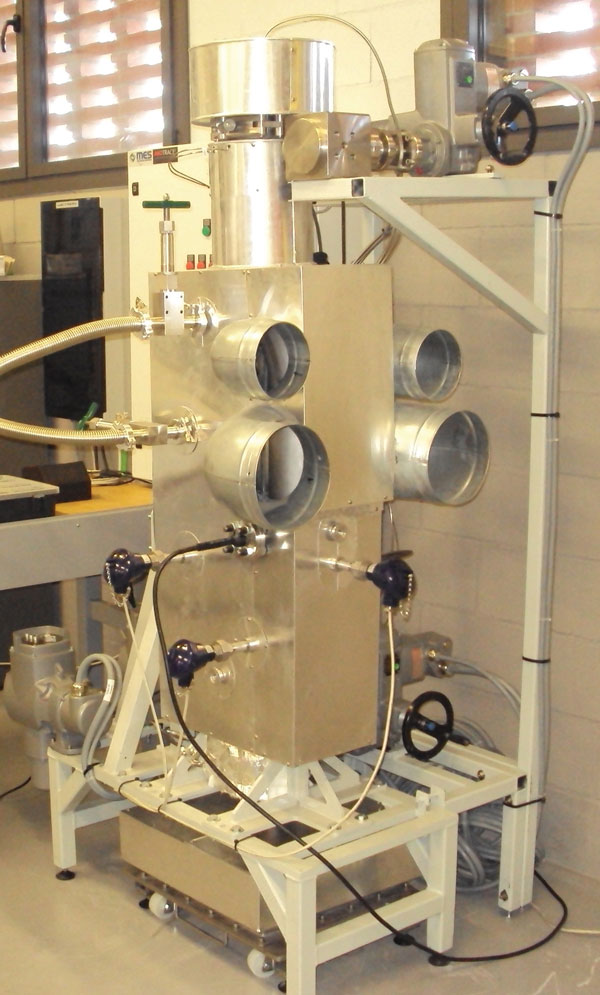 The project to build a demonstration fusion power reactor relies on hundreds of individual suppliers. It is the ITER Organization’s job to coordinate all of their contributions.
The seven members of the ITER project share the responsibility of building the ITER machine and facilities. It is the largest global research effort on nuclear fusion ever undertaken.
Ninety percent of contributions will be delivered in-kind. Members (China, EU, India, Japan, Russia, South Korea and the USA) will deliver components for the Tokamak and plant systems directly to the ITER Organization in France. Designing, manufacturing, transporting and assembling the 10 million components of the project, many of which are of exceptional size and weight, pose logistics and managerial challenges of colossal proportions.
ITER sought an off-the-shelf solution to manage the supply chain for components that are being manufactured and procured all over the world.
ITER also wanted cost-effective software that could bring in industry standards and best practices. Intergraph, engineering enterprise software provider for the power and nuclear sectors, among others, was awarded the contract to provide the software and services supporting the Assembly and Operation division of the ITER project. ITER contracted Intergraph to supply and implement off-the-shelf solutions to help manage construction, materials management, commissioning/testing, technical document and data management, as well as to bring industry best practice for these systems to ITER. These products also had to integrate seamlessly with existing ITER software, such as ITER Document Management,Engineering Data Base (EDB, including ITER's engineering tools) and SAP.
SmartPlant® Materials (SPMat) is able to track, trace and manage all components and parts of the ITER site in compliance with nuclear safety regulation. The tool will link on-site inventory management with construction planning to maximize cost-efficiency and avoid construction disruption.
SPMat will provide ITER Organization with central storage of logistics information and make possible effective management of logistics activities. The material catalogue specifications, bill of materials (BOM) and material take-off (MTO) requisitions, and procurement, tracing, warehousing and inspections information will all be centralized in SP Materials. This will enable each department or function to access whatever materials logistics data is needed for a task in the format most appropriate to that task. SP Materials configuration was delivered in May and is expected to continue acceptance testing until October, although in the meantime it is being used in a production environment for activities such as materials receiving.
All material deliveries to the ITER site will be loaded into SPMat. It will manage all materials for both domestic agency in-kind contracts and ITER Organization in-cash contracts with suppliers (see figures).
To help with these materials management processes in SPMat, interfaces have already been developed and tested between SPMat and EDB, SPMat and SAP as well as SPMat and the shipping data that will be provided by logistics provider Daher.
The data for all material deliverables that will arrive at the ITER site in Cadarache, France needs to be captured at the source (the supplier) and tracked through data received from Daher. When the delivery trucks arrive at site, the data in SPMat should match the delivery details and allow planning for final inspections and warehousing. A big focus of SPMat is on tracking and tracing of all materials from the source supplier to the ITER site.
This materials management process means that the materials in the SPMat warehouses are ready to interface with the next Intergraph product being implemented, SmartPlant Construction (SPC). SPC manages workface planning and interfaces to the project-assembly schedule in Primavera project management software. The Field Installation Work Packs in SPC (downloaded from Primavera) will interface with SPMat to determine the status of required materials and, when available, will automatically reserve the material, ready for automatic issuing to construction.
The main challenges for this part of the project were different states of design maturity in the components and an adequate 3D model for construction. Component and part numbering, BOM definition at each lifecycle stage, a central and common catalogue and specification are currently being defined and created. The tool will also be integrated with numerous other applications, including SAP.
As of April 2014, most of the project design and detailed design is ready and the first components are being manufactured. Component arrival will slowly ramp up during 2014 and 2015 and reach full speed from 2016. Initially, only two or three people will be trained to use SPMat, although technical staff, domestic agencies and IO suppliers will be able to access the information via a portal and by running specific reports in SPMat. As the shipping volume grows, new users will be properly trained by the core team as needed.
The next step is to proceed with the implementation of SmartPlant Construction and to integrate the systems.
Inventory management will be integrated with the construction planning before the first on-site installation and assembly start in 2015. SmartPlant Construction will be used to schedule, organize, track and report on assembly activities on-site (machine and systems) by browsing through the 3D model. The technical information and documentation will be centralized and managed using Intergraph product SmartPlant for Owner Operators.
Accurate and effective materials management and construction will pave the way for assembly activities, which have been carefully planned in a schedule that contains 40,000 lines for machine assembly alone. Assembly operations will require 1.5 million man hours extending over a period of four years, before arriving to the crucial point of testing the facilities and the Tokamak.
Surce: neimagazine.com
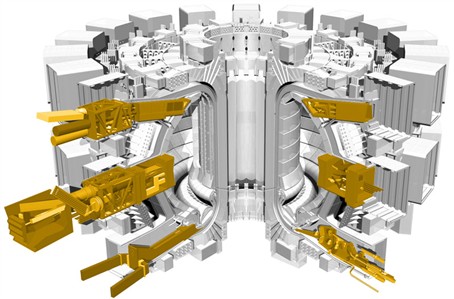 A multimillion contract for engineering integration of many state of the art instruments that will measure the biggest plasma generated by a fusion device has been signed between F4E and IDOM ADA, the Advanced Design and Analysis division of IDOM, a multinational company specialising in engineering, architecture and consultancy services based in Spain.
The value of the contract is in the range of 20 million EUR and is expected to run for at least four years. IDOM ADA will work with instrument designers in several public European fusion laboratories as well as experts in Japan, India, China and the US to deliver designs for the systems integration. Professor Henrik Bindslev, Director of F4E, emphasized that “through this contract we are seeing a clear example of knowledge transfer from laboratories to industry. Europe’s contribution to ITER, has been a catalyst encouraging the two poles of knowledge and competitiveness to work closer. A new chapter in the field of Diagnostics is opening that will help us analyse the ITER plasma, monitor it and improve our understanding of physics”. Mr. Fernando Querejeta, President of IDOM, stated that “we are very proud of the opportunity that we have been given to collaborate in what most likely will be the most important research project of the XXI century in the field of energy and engineering. This contract is another big step in our already important activity as science system providers for large scientific installations and instruments”.
The role of Diagnostics in ITER
The Diagnostics system will help us understand what exactly will be happening in the machine during the fusion reaction. Thanks to it we will able to study and control the plasma behaviour, measure its properties and extend our understanding of plasma physics. In simple terms, the system will act as the eyes and ears of the scientists offering them insight thanks to a vast range of cutting edge technologies. ITER will rely on approximately 50 diagnostic instruments that will offer experts an unparalleled view of the entire plasma and ensure the smooth operation of the machine. Given the duration of the plasma pulse, which will be 100 times longer than any fusion device currently in operation, the strong fluctuation levels and the extreme environment in the vessel, the diagnostic system will act as the guardian of the safe and sound operation of ITER.
Europe is responsible for roughly 25% of all Diagnostics in ITER.
The scope of this contract
This contract will deliver a comprehensive engineering design integrating around 20 diagnostics instruments into five of the ports giving access to the ITER plasma. In-vessel metallic containers will also be designed through this contract in order to protect the diagnostic equipment from the fierce plasma temperatures that may reach 150 million °C, and shield other parts of the machine from neutron radiation. The metallic shields will weigh between 5 tonnes and 20 tonnes each and will have to cope with extreme conditions like the high vacuum, colossal electromagnetic forces and high heat fluxes. In addition, other structures will be designed to house diagnostic instruments that will be mounted onto the Divertors cassettes of the machine, and even outside the vacuum vessel, as well as specialist flanges providing water and electrical connections to the diagnostic instruments whilst preserving the ITER vacuum.
Source: F4E
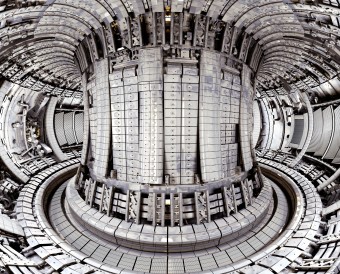 After months of preparation, the European Commission and the Culham Centre for Fusion Energy signed the operation contract for Europe’s largest fusion experiment.
Since 2000, JET operation was being carried out under the auspices of the European Fusion Development Agreement (EFDA). According to the in 2014 newly implemented EU fusion research structure, the Culham Centre for Fusion Energy (CCFE) will operate the JET facility under contract from the European Commission.
JET operation will be provided as an in-kind contribution to the EUROfusion Consortium, which is responsible for implementing the coordinated programme under a separate grant agreement with the Commission.
Lorne Horton, Head of the JET Exploitation Unit at JET, comments: ’I am pleased that we have been able to get this contract in place and expect that CCFE will continue to provide a first class facility for the community’s use. I am confident that JET will continue to provide crucial and unique input to ITER.’ ITER represents the next generation fusion experiment and will start operation in the early 2020’s.
The €283 million contract represents the largest in the history of JET with an unprecedented duration of five years. Tony Donné, Manager of the European Joint Programme is also satisfied with the finalisation of the contract: ’The fact that we can now rely on a five year contract until the end of 2018, makes it easier for us and CCFE to fulfil the goal defined in the new EU framework programme. That is to deliver what is agreed on in the ‘Roadmap to the realisation of fusion energy’.
Sourca: EFDA.org
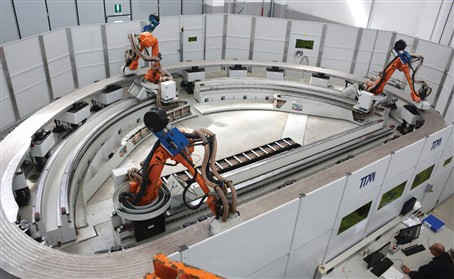 We traveled to the ASG facilites in La Spezia, Italy, to follow the progress of the TF coils and speak to the key technical people involved in the supervision of this complex component.
Alessandro Bonito-Oliva, F4E’s Project Manager for Magnets, explained the purpose TF coils serve in the machine. The temperature of ITER’s superhot plasma is expected to reach 150 million degrees Celsius. The challenge is to keep the plasma burning without touching the walls of the reactor’s vessel. The TF coils are “D” shaped gigantic superconducting magnets whose main task will be to create a magnetic cage where plasma will be confined. Europe is responsible for the manufacturing of 10 out of the 18 TF coils of the machine. The different steps involved in the production process were highlighted like the winding and bending tooling. The degree of precision underpinning these operations was particularly emphasized.
Jordi Cornella, TF Coils Technical Officer, guided us through the four different insulation layers of the conductor and offered us the possibility to capture an entire sequence of insulation as the trolleys worked in full speed. At the time, more than 450 metres of conductor had been wrapped for the Double Pancake prototype.
Marc Cornelis, TF Coils Technical Officer, invited us to take a peek inside the laser welding station, where three laser robots operated simultaneously on the cover plate of the first ever Double Pancake prototype. Laser welding has been chosen because of its low process input causing minimal deformation on the surface of the component. The synchronised manner the three robots operate offer some great viewing.
Source: F4E
Local News
- 1
- 2
- 3
- 4
- 5
IPPLM joins the Enterprise Europe Network
31-03-2026
On 23 March 2026, the Institute of Plasma Physics and Laser Microfusion (IPPLM) joined, with its technological offer, the group of entities affiliated with the Enterprise Europe Network (EEN), interested...
Read moreIPPLM as a co-creator of the exhibition "E = mc² – the formula that changed the world" at the National…
18-02-2026

On 16 February 2026, the official opening of two new permanent exhibitions took place at the National Museum of Technology in Warsaw. The Institute of Plasma Physics and Laser Microfusion...
Read moreIPPLM supports children and young people at the TPD "Helenów" Centre
22-12-2025

The Sylwester Kaliski Institute of Plasma Physics and Laser Microfusion (IPPLM) has for many years been actively engaged in initiatives supporting children and young people supported by the TPD "Helenów"...
Read moreIPPLM researchers took part in an experimental campaign on the GEKKO XII laser
20-11-2025

On 10–14 November 2025, a research team from the Sylwester Kaliski Institute of Plasma Physics and Laser Microfusion (IPPLM) – Prof. Katarzyna Batani, Dr Hanna Marchenko and Dr Agnieszka Zaraś-Szydłowska...
Read moreRegister for the 18th Kudowa Summer School on Plasma Physics!
07-11-2025

We invite you to take part in the 18th Kudowa Summer School "Towards Fusion Energy", which will be held on 8–12 June 2026 in Kudowa-Zdrój, Poland. The event is organised...
Read moreIPPLM participated in the second technical meeting within the DONES Con-P1 project
17-10-2025
The Institute of Plasma Physics and Laser Microfusion (IPPLM) took part in the second technical meeting held as part of the DONES Consolidation Phase 1 (DONES ConP1) project, co-financed by...
Read moreProf. Jan Badziak from IPPLM among the World’s Top 2% Scientists
15-10-2025
Prof. Jan Badziak, from the Department of Laser Plasma and Magnetized Dense Plasma Physics at the Institute of Plasma Physics and Laser Microfusion (IPPLM), has been included in the prestigious...
Read more29th Science Festival with the participation of IPPLM
10-10-2025

During the 29th Science Festival in Warsaw, held on 19–28 September 2025, researchers from the Institute of Plasma Physics and Laser Microfusion (IPPLM) conducted lessons for upper-grade primary school students. The...
Read morePLASMA 2025 and the 20th Anniversary of the Euratom–IPPLM Association – event summary
26-09-2025

From 15 to 19 September 2025, Warsaw hosted the international scientific conference PLASMA 2025 – International Conference on Research and Application of Plasmas, dedicated to plasma research, diagnostics, and applications....
Read moreWe bid farewell with deep sorrow to Professor Jerzy Wołowski
25-09-2025

It is with great sadness that we have received the news of the passing of Professor Jerzy Wołowski (1936–2025) an outstanding physicist, long-time employee of the Institute of Plasma Physics...
Read more20th anniversary of the Euratom–IPPLM Association (CeNTE): Celebrating two decades of fusion research coordination
16-09-2025

On 19 September 2025, during the PLASMA 2025 International Conference on Research, Diagnostics and Applications of Plasma in Warsaw, the IPPLM will mark 20th anniversary of the coordination of research on nuclear fusion...
Read moreIPPLM at the 49th Congress of Polish Physicists in Katowice
13-09-2025
During the 49th Congress of Polish Physicists, held from September 5–11, 2025, in Katowice, the Institute of Plasma Physics and Laser Microfusion (IPPLM) was represented both among the speakers and...
Read moreProf. Agata Chomiczewska appointed Deputy Director for Scientific Affairs at the IPPLM
03-09-2025

We are pleased to announce that the Minister of Energy, Mr. Miłosz Motyka, has appointed Dr. hab. Agata Chomiczewska to the position of Deputy Director for Scientific Affairs at the...
Read moreA historic milestone – the Scientific Council of the Institute confers the degree of habilitated doctor
10-07-2025
For the first time in the history of the Institute of Plasma Physics and Laser Microfusion (IPPLM), the Scientific Council has adopted a resolution to confer the degree of habilitated...
Read moreNew Board of the Plasma Physics Division of the European Physical Society
04-07-2025

In the first quarter of 2025, elections were held for the Board of the Plasma Physics Division of the European Physical Society (EPS Plasma Physics Division). Six candidates who received...
Read moreIPPLM researchers bring fusion expertise to 10th Central & Eastern Europe Nuclear Industry Congress 2025
12-06-2025
Researchers from the Institute of Plasma Physics and Laser Microfusion (IPPLM), Dr. Natalia Wendler and Dr. Paweł Gąsior, recently participated in a panel discussion at the 10th Central & Eastern...
Read moreIPPLM at the 3rd edition of the "Science for Society" Congress
29-05-2025

On 25-26 May 2025, the 3rd edition of the "Science for Society" Congress took place in the Large Hall of the Warsaw University of Technology. The aim of the event...
Read moreInvitation to the 3rd edition of the "Science for Society" Congress with the participation of IPPLM
22-05-2025

The 3rd edition of the "Science for Society" Congress will take place on 25–26 May 2025 at the Warsaw University of Technology. This unique event demonstrates that science is not...
Read moreJoin the 28th Science Picnic!
07-05-2025

The Institute of Plasma Physics and Laser Microfusion (IPPLM) invites you to its stand on Saturday, 10 May, during the 28th Science Picnic, organized by Polish Radio and the Copernicus...
Read moreCooperation agreement between the IPPLM and the National Museum of Technology
18-04-2025

On 17 April 2025, a cooperation agreement was signed between the National Museum of Technology (NMT) and the Institute of Plasma Physics and Laser Microfusion (IPPLM). The ceremonial meeting, attended by...
Read morePolish and French researchers join forces in research on nuclear fusion
31-03-2025

On 24-25 March 2025, a Polish-French meeting was held at the headquarters of the Institute of Nuclear Physics of the Polish Academy of Sciences (IFJ PAN) and the French Institute...
Read moreJoin us for the International Conference on Research and Application of Plasmas – PLASMA 2025!
13-03-2025

The Institute of Plasma Physics and Laser Microfusion (IPPLM) invites you to attend the PLASMA 2025 – International Conference on Research and Application of Plasmas, which will be held from...
Read moreExperimental research session in the Plasma-Focus PF1000U laboratory as part of the ICDMP collaboration
27-02-2025

On February 10–21, 2025, an experimental session was held in the Plasma-Focus PF-1000U laboratory, in which, in addition to the IPPLM team, a three-person team of researchers from the Prague...
Read moreLaser demonstration on JET detects fusion fuels
11-02-2025

Scientists and engineers from eight nations, including Poland, have carried out a project using lasers on the Joint European Torus (JET) to study fusion fuel retention. Laser Induced Breakdown Spectroscopy (LIBS),...
Read moreIPPLM employee nominated for the Personality of the Year title in the Science category
24-01-2025
Research and technical employee Mr. Olgierd Cichorek, M.Sc., from the Laboratory of Plasma Nudge for Satellites at the IPPLM has been nominated for the title of Personality of the Year...
Read moreWorld News
- 1
- 2
- 3
- 4
- 5
In Memoriam — Professor Francesco Romanelli
24-03-2026

The world of fusion research mourns the loss of Professor Francesco Romanelli, a visionary scientist whose work helped bring humanity closer to clean, limitless energy. Over four decades, he explored...
Read moreIgniting the future: Breakthroughs in inertial confinement Fusion
25-07-2025

In December 2022, the National Ignition Facility (NIF) at Lawrence Livermore National Laboratory (USA) marked a historic milestone in fusion science: an experiment produced 3.15 MJ of fusion energy from 2.05 MJ of laser...
Read moreWendelstein 7-X sets new fusion performance records
04-06-2025

On May 22, 2025, the Wendelstein 7-X (W7-X) stellarator at the Max Planck Institute for Plasma Physics (IPP) in Greifswald concluded its latest experimental campaign with a major success: a...
Read moreEuropean tokamak sets new fusion plasma record
20-02-2025

On February 12, 2025, the WEST tokamak, located at CEA Cadarache in southern France, set a new world record by sustaining fusion plasma for 1,337 seconds, or over 22 minutes....
Read moreDr. Gianfranco Federici appointed as the new EUROfusion Programme Manager
17-12-2024
At the 49th General Assembly held in Barcelona, December 2024, Dr. Gianfranco Federici was elected as the new Programme Manager of EUROfusion. He succeeds Prof. Ambrogio Fasoli, who will return...
Read moreEUROfusion and F4E join forces for Europe’s fusion future
16-12-2024

EUROfusion and Fusion for Energy (F4E) have signed a Memorandum of Understanding (MoU) to advance fusion research and development in Europe. This agreement reinforces cooperation in...
Read moreJohn J. Hopfield and Geoffrey E. Hinton awarded the 2024 Nobel Prize in Physics
08-10-2024

John J. Hopfield and Geoffrey E. Hinton have been awarded the 2024 Nobel Prize in Physics "for foundational discoveries and inventions that enable machine learning with artificial neural networks." The Nobel...
Read moreWendelstein 7-X begins new experimental campaign
10-09-2024

The Wendelstein 7-X, the world’s most advanced stellarator, is launching a new experimental campaign after a year of intensive maintenance and upgrades. This phase, known as OP2.2, begins on 10...
Read moreITER's New Project Baseline: A Robust Path to Fusion Energy Research
04-07-2024

On 3 July, ITER Director-General Pietro Barabaschi presented the new project baseline, under evaluation by the ITER Organization's governing body. This plan aims to ensure a robust start to scientific...
Read moreITER Council Presents Updated Project Baseline
21-06-2024

The ITER Council convened this week for its 34th meeting, where nearly 100 attendees reviewed significant updates to the project baseline. The proposed changes aim to optimize the overall project...
Read moreEurope and Japan celebrate breakthrough in paving the way for fusion energy
01-12-2023

The prospect of harnessing fusion energy is closer. The successful operation of JT-60SA, the most powerful experimental device to date, built by Europe and Japan, is a landmark achievement for...
Read moreFirst plasma was successfully generated at JT-60SA
26-10-2023

A momentous achievement in the field of nuclear fusion has been accomplished by a collaborative team of engineers from Europe and Japan. They have successfully generated tokamak plasma for the...
Read moreThe Nobel Prize in Physics 2023
03-10-2023
Pierre Agostini, Ferenc Krausz and Anne L’Huillier are the winners of this year's Nobel Prize in Physics. It was awarded "for experimental methods that generate attosecond pulses of light for...
Read moreUS Lab Replicates Fusion Ignition Breakthrough
08-08-2023
The US National Ignition Facility (NIF) has achieved fusion ignition once again, building on its landmark 2022 success. This achievement, powered by hydrogen within a diamond capsule, signifies a major...
Read moreNew Programme Manager Elect announced by EUROfusion
20-07-2023
Professor Ambrogio Fasoli became the new EUROfusion Programme Manager Elect. The decision was made by EUROfusion General Assembly at the meeting on 18 July 2023. His tenure will officially commence...
Read moreEUROfusion stands in solidarity with research in Ukraine
24-02-2023

Today, as we commemorate the anniversary of the invasion of Ukraine by Russia, the EUROfusion consortium stands in solidarity with our Ukrainian member and research colleagues. EUROfusion remains committed to supporting...
Read moreEight-minute production of plasma with gigajoule energy turnover at Wendelstein 7-X
23-02-2023

Another target has been achieved only recently by the W7-X researchers, namely they managed to acquire an energy turnover of 1.3 gigajoules in the device, which is 17 times higher...
Read moreThe Nobel Prize in Physics 2022
04-10-2022

Alain Aspect, John F. Clauser and Anton Zeilinger are the winners of this year's Nobel Prize in Physics. It was awarded “for experiments with entangled photons, establishing the violation of...
Read moreNew experiments for fusion energy record breaker JET
27-09-2022

A new wave of fusion energy experiments on UK Atomic Energy Authority’s record-breaking Joint European Torus (JET) started this month. EUROfusion researchers are using the famous JET machine to conduct a...
Read moreITER appoints new Director-General
21-09-2022
Pietro Barabaschi has become the next Director-General of the ITER Organization as a result of the unanimous choice of the Council from among finalist candidates. In the transition period Dr....
Read moreStarting power plant design
07-07-2022

At a livestreamed Horizon EUROfusion event in Brussels on 5 July 2022, EUROfusion celebrated the start of conceptual design activities for Europe's first demonstration fusion power plant DEMO. This first-of-a-kind...
Read moreCelebration of achieving a crucial assembly milestone in the ITER Project
17-05-2022

This month, we have witnessed the successful lifting and lowering into the machine well of the first sub-section of the ITER plasma chamber. The weight of the component is the...
Read moreBurning plasma achieved in inertial fusion at the National Ignition Facility
15-02-2022
Obtaining a burning plasma is a critical step towards self-sustaining fusion energy. A burning plasma is one in which the fusion reactions themselves are the primary source of heating in...
Read moreHistoric milestone reached by JET scientists
20-01-2022

Iconic fusion energy machine JET – which reaches controlled temperatures 10 times hotter than the core of the sun – completed its 100,000th live pulse last night. Weighing 2,800 tonnes, the...
Read moreHorizon Europe Grant Agreement signed
20-12-2021

15 December 2021 saw the EUROfusion consortium signing the Grant Agreement under Horizon Europe, the European Framework Programme from 2021 – 2027, in an aim to launch comprehensive R&D approach...
Read more |
 |
 |
 |
 |
 |
 |
 |
What we do
Our laboratories
Online seminars
| Thursday, 30 Apr 2026, godz. 13.00 Seminarium instytutowe: "Equation of State of Shock Compressed BN in the Megabar Pressure Range", dr hab. Katarzyna Batani, IFPiLM |


Research projects carried out at the IPPLM are funded by the Polish Ministry of Education and Science, the National Science Centre and by the European Commission within the framework of EUROfusion Consortium under grant agreement No 101052200. Financial support comes also from the International Atomic Energy Agency, European Space Agency and LaserLab Consortium as well as from the Fusion for Energy Agency.