





Zestaw obrazów 2019
zdjecie1.jpg
zdjecie2.jpg
zdjecie3.jpg
zdjecie4.jpg
zdjecie5.jpg
zdjecie6.jpg
2019_1.JPG
2019_2.JPG
2019_4.JPG


Światowe
 Synteza termojądrowa – reakcja łączenia jąder atomów najlżejszego pierwiastka, czyli wodoru, w wyniku czego powstają atomy cięższego pierwiastka, czyli helu – jest podstawą istnienia gwiazd, także Słońca. Wielka temperatura panująca w ich wnętrzach uruchamia proces łączenia jąder wodoru, przy czym towarzyszące temu potężne ciśnienie próbuje ujść na zewnątrz gwiazdy, jest jednak powstrzymywane jej grawitacją. To daje gwieździe równowagę, dzięki której istnieje i w której może dochodzić do łączenia oraz przemiany kolejnych pierwiastków z tablicy Mendelejewa. Tak powstaje hel, węgiel, następnie tlen, a potem azot i kolejne coraz cięższe pierwiastki – aż do żelaza. Oto tajemnica stworzenia.
Synteza jest łączeniem. Wymaga ogromnych energii kinetycznych cząstek, by zmusić zjonizowane, a więc naładowane dodatnio, jądra wodoru do fuzji – ale w rezultacie powstaje cięższy hel oraz wysokoenergetyczne cząstki (neutrony oraz cząstki alfa w przypadku syntezy deuter-tryt), z których można pozyskać ogromne ilości ciepła. Przebiegająca w sposób niekontrolowany reakcja jest podstawą działania bomby wodorowej – o wiele potężniejszej od bomby atomowej. Dziś wyzwaniem jest uzyskanie kontroli nad procesem syntezy jądrowej.
Tokamak: niezwykła idea
Na początku lat 50. XX w. dwaj fizycy radzieccy Igor Tamm i Andriej Sacharow, zaangażowani w prace nad budową radzieckiej bomby wodorowej, wpadli na pomysł, by reakcję syntezy jądrowej zastosować do produkcji energii. Uczeni zaproponowali projekt tokamaka – urządzenia, w którym synteza termojądrowa mogłaby być wykorzystana w sposób kontrolowany i tym samym otworzyć dostęp do nieograniczonego, niezwykle wydajnego i stosunkowo bezpiecznego źródła energii.
Tokamak to komora w kształcie torusa (obwarzanka), w którym plazma (a więc zjonizowana mieszanina np. izotopów wodoru, deuteru i trytu) utrzymywana jest polami magnetycznymi, zapewniającymi izolację gorącej materii od ścian komory, by się nie ochłodziła i nie wygasła. Okazało się, że do fuzji termojądrowej łatwiej doprowadzić, łącząc ze sobą nie atomy zwykłego wodoru (protu), lecz jego cięższych izotopów – a więc deuteru otrzymywanego z wody oraz trytu otrzymywanego z litu, który powszechnie występuje w skałach ziemskich. Tokamaki zaczęto budować i badać w ZSRR w drugiej połowie lat 50. XX w. A potem w wielu innych krajach.
Szybko się okazało, że utrzymanie plazmy w stabilnym stanie i podgrzanie jej do temperatury kilkudziesięciu lub nawet 100 mln stopni, by mogło dojść do syntezy termojądrowej, nie jest łatwym zadaniem. W tokamakach głównym źródłem energii jest przepływający przez plazmę prąd elektryczny o bardzo wysokim natężeniu, sięgającym milionów amperów. W efekcie urządzenia te wytwarzają supergorącą plazmę w sposób impulsowy, a nie ciągły. Do dzisiaj problemy te nie zostały w pełni rozwiązane, mimo że we Francji wysiłkiem wielu państw – w tym Unii Europejskiej – powstaje ITER, gigantyczny eksperymentalny reaktor termojądrowy typu tokamak. To w nim, zdaniem uczonych, ma dojść za jakiś czas do pierwszej kontrolowanej i wydajnej reakcji termojądrowej.
Stellarator: gwiezdna ósemka
Nieco inny pomysł na uwięzienie plazmy w magnetycznej pułapce (by potem doprowadzić w niej do reakcji syntezy) miał amerykański fizyk plazmy Lyman Spitzer z Princeton Plasma Physics Laboratory, który w latach 50. XX w. zaproponował rozwiązanie zwane stellaratorem (od stellar, czyli gwiezdny). Spitzer najpierw rozciągnął nieco kształt torusa, po czym skręcił go, tworząc coś w rodzaju położonej ósemki. Chodziło o osiągnięcie takiego kształtu komory, by plazma stabilizowała się w niej sama, bez płynącego w niej prądu. Potem pomysł ten został udoskonalony: komora stellaratora – po przywróceniu jej kształtu torusa – została kilkukrotnie skręcona dookoła osi biegnącej wzdłuż obiektu, ale tak, by strumień plazmy nie przecinał się w żadnym miejscu.
Stellaratory były popularne w badaniach kontrolowanej fuzji termojądrowej w latach 50. i 60. ubiegłego wieku, jednak znacznie lepsze rezultaty uzyskiwane w tokamakach spowodowały, że ograniczono nad nimi badania. Występujący wciąż – i póki co nieusuwalny – problem z impulsowym trybem pracy tokamaka, jak również rosnąca moc obliczeniowa komputerów spowodowały, że w latach 90. odżyło zainteresowanie stellaratorami. Obecnie koncepcja stellaratora jest traktowana jako drugie, niezależne od tokamaków, ale równie ważne rozwiązanie. I tak narodził się pomysł zbudowania potężnego urządzenia w Instytucie Fizyki Plazmy Maxa Plancka w Greifswaldzie w Niemczech.
Król Wendelstein 7-X
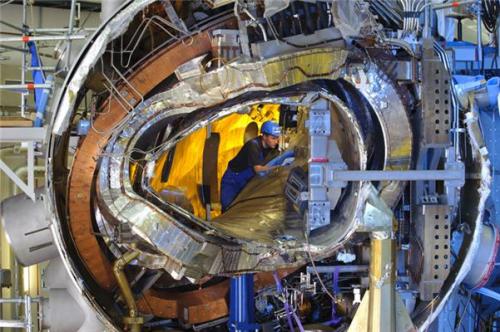
Niedawno świat obiegła informacja, że największy stellarator świata jest gotowy. Nazywa się Wendelstein 7-X i kosztował ok. 400 mln euro. Powstawał ponad 15 lat, składa się z ponad miliona części i wygląda jak jakaś pozaziemska instalacja, służąca bardzo tajemniczym celom, zrzucona do Greifswaldu przez obcą cywilizację.
Stellarator ma średnicę 16 m, a jego sercem jest stalowa komora próżniowa, w której plazma ma być podgrzewana do ok. 100 mln stopni. Komora ma kształt torusa, tyle że skręconego pięciokrotnie. Gdyby przeciąć samochodową dętkę w jednym miejscu, a następnie jeden jej koniec unieruchomić, drugi zaś przekręcić pięć razy, a potem oba końce skleić, powstałby podobny kształt. Całą komorę oplatają potężne cewki magnesów – jest ich w sumie 70, z czego 50 ma kształt dokładnie dopasowany do krzywizn komory. Każdy z tych magnesów waży ok. 6 ton. Obleka je płaszcz próżniowy.
Ponieważ cewki zostaną schłodzone przez ciekły hel do temperatury bliskiej zera bezwzględnego – staną się wówczas nadprzewodzące i będą mogły utrzymywać pole magnetyczne, praktycznie nie zużywając energii elektrycznej – muszą działać w próżni; bez niej w tak niskiej temperaturze wszystko natychmiast by zamarzło. Całość przykrywa jeszcze zewnętrzna powłoka, w której umieszczono tysiące czujników, detektorów i terminali rozmaitych systemów monitorowania, analizowania i kontroli. Wszystko to waży 725 ton.
Wstrzyknięty do próżniowej komory Wendelsteina 7-X wodór lub deuter – o gęstości 10 tys. razy niższej niż gęstość powietrza – zostanie najpierw ogrzany silną wiązką mikrofali o mocy 10 MW, a następnie dodatkowo strumieniem neutralnych cząstek (pozbawionych ładunku atomów wodoru lub deuteru) o podobnej mocy. Oplatające komorę cewki magnesów wytworzą pole magnetyczne o indukcji 3 tesli (100 tys. razy silniejsze od ziemskiego pola magnetycznego), które utrzyma plazmę w odpowiednim skupieniu, czyli ustabilizuje ją, nie dopuszczając, by ta – rozgrzana do temperatury 100 mln stopni – zetknęła się ze ścianami komory. Gdyby tak się stało, reakcja termojądrowa nie mogłaby być kontynuowana (plazma wygasa natychmiast po kontakcie z „obcym” materiałem), poza tym komora mogłaby zostać uszkodzona w miejscu kontaktu z gorącą plazmą. Stellarator, w przeciwieństwie do tokamaka, może podtrzymywać warunki konieczne dla reakcji termojądrowej w sposób ciągły – na przykład przez pół godziny, co ma właśnie zademonstrować Wendelstein 7-X – a nie impulsowy. To jego główna przewaga i zaleta.
– W stellaratorze – wyjaśnia dr Maciej Krychowiak, polski fizyk na stałe pracujący w instytucie w Greifswaldzie – symulujemy warunki istniejące wewnątrz gwiazdy, na przykład wewnątrz Słońca. Ale musimy mieć znacznie wyższe temperatury niż te panujące w Słońcu. Tam sięgają one kilkunastu milionów stopni, my planujemy 100 mln stopni. To dlatego, że Słońce jest ogromne i może podtrzymywać reakcję syntezy z małą wydajnością. Wydajność przyszłego reaktora, ze względu na jego rozmiary, musi być znacznie wyższa.
Tania energia
Zjawiska kontrolowanej reakcji syntezy termojądrowej nie da się obecnie dokładnie przewidzieć i obliczyć. Stąd potrzebne są urządzenia eksperymentalne (tokamaki lub stellaratory), w których przez lata będą prowadzone skomplikowane doświadczenia, a potem analizowane krok po kroku, i to, być może, w przyszłości pozwoli stworzyć pierwszą prototypową instalację energetyczną. Trzeba jednak ogromu pracy, wielkich pieniędzy i wielu lat, by ten cel osiągnąć.
Prof. Robert Wolf, jeden z dyrektorów Instytutu Fizyki Plazmy w Grefswaldzie, mówi: –Teraz gdy urządzenie jest gotowe, zaczniemy wytwarzać w jego komorze plazmowej próżnię. Gdy to osiągniemy, zaczniemy powoli uruchamiać i testować system cewek magnetycznych. To potrwa jakiś czas, ponieważ pośpiech jest tu bardzo niewskazany. Następnie przetestujemy system grzania plazmy i chłodzenia całości. Myślę, że pierwsza plazma zapłonie w urządzeniu dopiero za rok. Wtedy zaczną się wstępne testy całego stellaratora.
Wydaje się jednak, że ta kosztowna i pracochłonna gra jest warta zachodu. Wydajność energetyczna reakcji syntezy termojądrowej nie ma sobie równych. Synteza mieszaniny deuteru i trytu, uzyskanej z 40 litrów morskiej wody (dającej deuter) i 5 gramów litu (dającego tryt), jest równoważna energetycznie spaleniu 40 ton węgla. 40 litrów wody to nie jest dużo, a 5 g litu znajduje się w typowej baterii laptopa. Niezły wynik.
Poza tym surowiec jest dostępny w każdych ilościach (deuteru i litu mamy na Ziemi pod dostatkiem), reakcja syntezy jest czysta i bezpieczna (reaktor w sytuacji awaryjnej po prostu się wyłącza, nie trzeba go specjalnie chłodzić i neutralizować). Problem tylko w tym, że reakcję tę trzeba opanować i doprowadzić do tego, by energia włożona w jej zainicjowanie była mniejsza od energii uzyskanej.
Kontrolowana synteza jądrowa usunęłaby problemy energetyczne świata na zawsze. Energia stałaby się w końcu powszechnie dostępna za niewielką cenę, a oparte na syntezie siłownie zastąpiłyby wszystkie inne źródła energii. Jest więc o co walczyć i cieszy, że w zmaganiach tych aktywnie uczestniczy Polska. Podczas uroczystości inauguracji stellaratora w Instytucie Fizyki Plazmy w Greifswaldzie Polaków niemal noszono na rękach. W trakcie wszystkich publicznych wystąpień, ale też w rozmowach mniej oficjalnych i prywatnych, Niemcy na każdym kroku podkreślali znaczenie udziału polskich uczonych, polskich instytutów badawczych i firm w projekcie. Uczestniczą w nim od 2006 r. i pojawili się w kluczowym momencie, kiedy przedsięwzięcie ze względów finansowych wisiało na włosku.
Problemy szczęśliwie udało się przezwyciężyć i projekt znów szybko ruszył do przodu. Największy wkład w budowę stellaratora Wendelstein 7-X ze strony polskiej mają: Instytut Fizyki Jądrowej PAN z Krakowa, Narodowe Centrum Badań Jądrowych z Warszawy (Świerku), Politechnika Warszawska, Instytut Fizyki Plazmy i Laserowej Mikrosyntezy z Warszawy oraz Uniwersytet Opolski. W pracach uczestniczyło też kilka prywatnych polskich firm. Jest więc szansa, że i my będziemy mieli swój kawałek Słońca na Ziemi.
Żródło: polityka.pl
This year’s edition of the Kudowa Summer School took place in the period 9-13 June traditionally in Kudowa Zdrój, Poland. The School was organized by the Institute of Plasma Physics and Laser Microfusion, the International Centre for Dense Magnetised Plasmas and COST Action MP1208 “Developing the physics and the scientific community for Inertial Confinement Fusion”. The event was sponsored by Amplitude Technologies.
As the fusion scientific community knows perfectly well, Kudowa Summer School “Towards Fusion Energy” takes place biannually and aims at young scientists (PhD and master students) from different countries and provides courses on various aspects of the fusion energy, plasma experiments and technology.
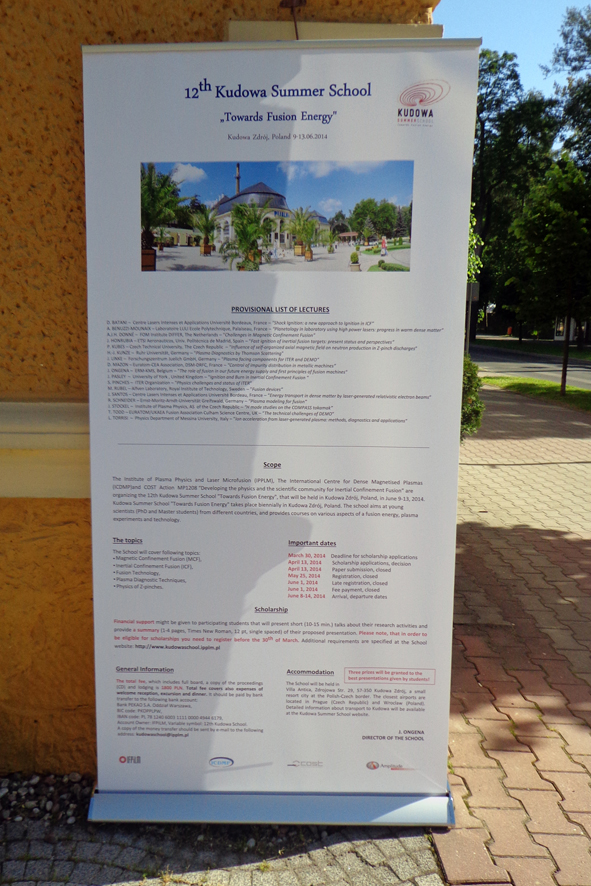 We had enormous pleasure to welcome around 40 young scientists from all over the world as well as almost 20 distinguished invited speakers who took us up the learning curve on subjects such as a new approach to ignition in ICF, planetology in laboratory using high power lasers, challenges in magnetic confinement fusion and many others. Students who had the best presentations were awarded prizes for their performance. The list of invited lecturers and their topics includes:
J. Ongena: The role of fusion in our future energy supply and first principles of fusion machines
A.J.H. Donné: Challenges in Magnetic Confinement Fusion
J. Pasley: Ignition and burn in inertial confinement fusion
J. Honrubia: Fast ignition of inertial fusion targets: present
M. Rubel: Controlled Fusion Devices
S. Pinches: Physics challenges and status of ITER
L. Torrisi: Ion acceleration from laser-generated plasma: methods, diagnostics and applications
J. Santos: Energy transport of laser-generated relativistic electron beams in dense matter: an experimental approach
H.-J. Kunze: Plasma Diagnostics by Thomson Scattering
D. Batani: Shock Ignition: a new approach to Ignition in ICF
M. Sadowski: Selected methods of electron- and ion- diagnostics in tokamak scrape-off layer
D. Mazon: A practical example of diagnostic design: soft- Xray tomographic system in WEST using GEM detectors
A. Benuzzi-Mounaix: Planetology in laboratory using high power lasers: progress in warm dense matter
P. Kubes: Influence of external magnetic field and admixtures on neutron production in z-pinches
T. Todd: The technical challenges of DEMO
J. Linke: Plasma facing components
J. Linke: Plasma facing materials
F. Belli: Neutron diagnostics in tokamak plasmas: the ITER radial neutron camera
R. Schneider: Plasma modeling for fusion
J. Stockel: H mode studies on the COMPASS tokamak
Science, however, did not dominate the week spent in Kudowa Zdrój. Participants, after lectures, had a chance to visit the Trail of the Vanishing Professions, the Museum of Gold Mine in Złoty Stok and the Middle Age Park of Technology.
We hope that all our guests will remember Polish hospitality and our efforts to foster the international scientific cooperation among young scientists.
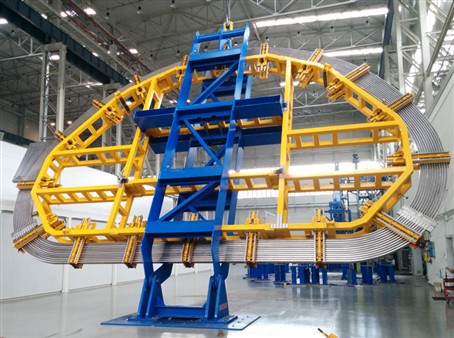 A landmark multimillion contract has been signed between F4E and SIMIC S.p.A, an Italian company specialised in high-tech engineering and manufacturing, marking the successful completion of Europe’s strategy in the domain of the Toroidal Field (TF) coils, part of ITER’s impressive magnet system.
The Director of F4E, Professor Henrik Bindslev, explained that “thanks to this contract the last and most decisive chapter of the TF coils manufacturing is about to be written. We will produce magnets of unprecedented size and power following extremely complex techniques. This final procurement is a clear demonstration of Europe’s commitment to the project and its capacity to be competitive and meet high technical standards”. For Marianna Ginola, Commercial Manager of SIMIC S.p.A this milestone “is an impressive achievement that enhances the proven track record of our company and associates Italian manufacturing amongst the most skilled in the world. ITER has given us the opportunity to build international collaborations. In this contract for instance, we will collaborate with Babcock Noell Gmbh. This project has given us the possibility to access new markets and grow both in size and expertise”.
The contract is expected to run for approximately five years and its budget will exceed the amount of 100 million EUR. Through this contract, the TF coils will be tested at extremely low temperatures reaching nearly -200 degrees Celsius/80 Kelvin and subsequently will be inserted within their cases in order to be finally assembled in the ITER machine.
What is the role of TF coils and their specifications?
ITER will demonstrate the feasibility of fusion energy. The temperature of ITER’s superhot plasma is expected to reach 150 million degrees Celsius. The challenge is to keep the plasma burning without touching the walls of the vessel of the reactor. The TF coils are “D” shaped gigantic superconducting magnets whose main task will be to create a magnetic cage where the plasma will be confined. Europe is responsible for the manufacturing of 10 out of the 18 TF coils of the machine.
Magnets of unprecedented size, weight, power and technique
The TF coils are composed of a winding pack and its stainless steel coil case. Each TF coil is 15m high, 9m wide and has a cross section of about 1m2. It weighs approximately 340 tonnes, which compares to six Boeing 737-800 planes! These will be the biggest Nb3Sn magnets ever manufactured, which once powered with 68000 A, they will generate a magnetic field that will reach 11.8 Tesla- about one million times stronger the magnetic fields of the earth.
The scope of this contract
First, the winding packs will be cold tested at -200 degrees Celsius/80 K using a combined cycle of nitrogen and helium. Next, they will be inserted into the TF coil cases, which will require sophisticated laser dimensional controlled technology and complex tooling in order to move and fit hundreds of tonnes with millimetric precision.
Then, the cases will be welded in compliance with the stringent ISO standard 5817 in order to close the metallic structure. Two important characteristics will add to the complexity: the thickness of the weld which will reach 130mm and the fact that welding will have to be carried out only from one side. For these reasons, ultrasonic technology will be deployed to inspect the quality of welding.
The gap between the winding pack and the TF coil case will have to be filled with reinforced resin to mechanically link the components. The high density of the resin makes this task particularly challenging. Try and imagine filling a tight gap of 4mm thick and 35m long gap with 1m3 of resin that has the thickness of honey.
ITER is a puzzle of many different interfaces that will need to be managed in a seamless way. Most TF coil components, like the winding packs and the radial plates are manufactured in Europe. The TF coil cases however, are manufactured in Japan while the thermal shields of the Vacuum Vessel that will be ultimately welded on the TF coils, in Korea. In other words, the multiple interfaces and their careful management will be fundamentally important for the successful execution of this contract.
Background information
MEMO: Europe signs its final contract for the ITER Toroidal Field coils: EN - IT
F4E film clip: View the interview of Marianna Ginola, Commercial Manager of SIMIC S.p.A
Source: F4E
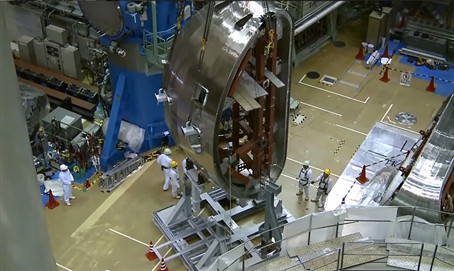 See the progress of the JT-60SA project – one of the three projects being developed under the Broader Approach Agreement – in this new clip filmed on-site in Naka, Japan. The clip shows that the six year assembly of JT-60SA is moving forward: the heart of the machine, the vacuum vessel, is now being built.
Implemented by the Japan Atomic Energy Agency (JAEA) and F4E, the advanced superconducting JT-60SA tokamak (SA stands for super advanced) will be used to quickly identify how to optimise plasma performance for ITER and will study advanced modes of plasma operation suitable for DEMO. A first plasma is foreseen for March 2019.
The JT-60SA vacuum vessel consists of 10 sectors made of 316 L stainless steel, 6.6 m high and 3.5 m wide, each weighing around 17 tonnes. The clip shows the placing of the first two sectors which will now be welded together. It is foreseen that the remaining sectors will be added to the structure at the rate of one per month, although before the placing and welding of the last sector, the 18 Toloidal Field coils (magnets which will keep the plasma in place during the fusion process) produced in Europe will be threaded over the vessel and fixed in place.
To learn more about the Broader Approach agreement and its projects, visit theBroader Approach website or download the Broader Approach brochure.
Source: F4E
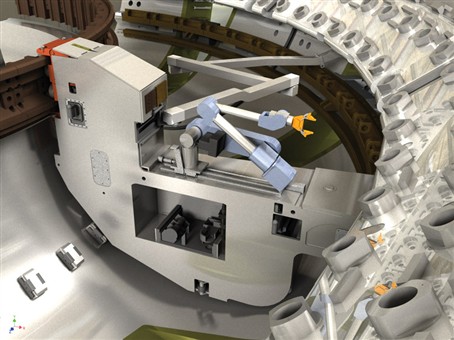 ITER’s high tech remote handling system has entered its most decisive phase so far thanks to a multimillion deal signed between F4E and Assystem, a leader in innovation and engineering consultancy. All activities ranging from design, manufacturing, delivery, on-site integration, commissioning and final acceptance tests for ITER’s divertor will be covered through this contract as it unfolds progressively. Its value is estimated in the range of 40 million EUR and it will involve some of the pioneers from the area of remote handling in Europe such as the UK’s Culham Centre for Fusion Energy (CCFE) and Soil Machine Dynamics Ltd (SMD)together with Finland’s Technical Research Centre (VTT) and theTampere University of Technology (TUT). Through this contract, two multifunctional movers and two toroidal movers will be manufactured.
F4E Director, Professor Henrik Bindslev, explained that “this contract is a turning point for ITER’s remote handling system because it will lead us to production mode. We have managed to bring together industry, fusion laboratories, SMEs and research centres under one contract that will unleash their potential and help them advance further in their domain”. Commenting on the award, Peter Higton, Assystem’s Energy and Nuclear UK Managing Director who has led the team effort, said: “We are very pleased to have been selected for this prestigious project. This contract is recognition that our capabilities and reputation for delivering high standards of innovative engineering, quality and safety are valued by our customers. We look forward to working with F4E and our partners to deliver these high tech components”.
What is remote handling?
Remote handling helps us to perform manually a task without being physically present at the location it is carried out. It is widely used in space exploration missions, underwater or ground operations. The system brings together high tech robotics, advanced technological tools, powerful computers and virtual reality platforms. A high level of intuition and intelligence are inbuilt within the system which is handled by a human operator with extreme dexterity because of the degree of millimetric precision that is required.
Why ITER needs a remote handling system for the divertor?
When the ITER machine is operational some of the components in the vessel will be exposed to radioactivity. Therefore, any maintenance, inspection and repair will be conducted through remote handling. The ITER divertor, located in the lower part of the ITER machine, will consist of 54 divertor casettes measuring 3,4m x 1,2 m x 0,6m and weighing 10 tonnes each. It is in this part of the machine that the superhot plasma temperature will be most felt. The divertor casettes will form the machine’s massive ashtray where the hot ashes and impurities will fall in. It is foreseen that these components will be replaced three times during the lifetime of the ITER machine.
How will the ITER divertor remote handling work?
The 54 divertor cassettes will be installed by movers through three entry points, known as ports. If they need to be removed, they will be detached, unlocked from the ITER vessel, placed into a container and get transported.
Source: F4E
Local News
- 1
- 2
- 3
- 4
- 5
IPPLM joins the Enterprise Europe Network
31-03-2026
On 23 March 2026, the Institute of Plasma Physics and Laser Microfusion (IPPLM) joined, with its technological offer, the group of entities affiliated with the Enterprise Europe Network (EEN), interested...
Read moreIPPLM as a co-creator of the exhibition "E = mc² – the formula that changed the world" at the National…
18-02-2026

On 16 February 2026, the official opening of two new permanent exhibitions took place at the National Museum of Technology in Warsaw. The Institute of Plasma Physics and Laser Microfusion...
Read moreIPPLM supports children and young people at the TPD "Helenów" Centre
22-12-2025

The Sylwester Kaliski Institute of Plasma Physics and Laser Microfusion (IPPLM) has for many years been actively engaged in initiatives supporting children and young people supported by the TPD "Helenów"...
Read moreIPPLM researchers took part in an experimental campaign on the GEKKO XII laser
20-11-2025

On 10–14 November 2025, a research team from the Sylwester Kaliski Institute of Plasma Physics and Laser Microfusion (IPPLM) – Prof. Katarzyna Batani, Dr Hanna Marchenko and Dr Agnieszka Zaraś-Szydłowska...
Read moreRegister for the 18th Kudowa Summer School on Plasma Physics!
07-11-2025

We invite you to take part in the 18th Kudowa Summer School "Towards Fusion Energy", which will be held on 8–12 June 2026 in Kudowa-Zdrój, Poland. The event is organised...
Read moreIPPLM participated in the second technical meeting within the DONES Con-P1 project
17-10-2025
The Institute of Plasma Physics and Laser Microfusion (IPPLM) took part in the second technical meeting held as part of the DONES Consolidation Phase 1 (DONES ConP1) project, co-financed by...
Read moreProf. Jan Badziak from IPPLM among the World’s Top 2% Scientists
15-10-2025
Prof. Jan Badziak, from the Department of Laser Plasma and Magnetized Dense Plasma Physics at the Institute of Plasma Physics and Laser Microfusion (IPPLM), has been included in the prestigious...
Read more29th Science Festival with the participation of IPPLM
10-10-2025

During the 29th Science Festival in Warsaw, held on 19–28 September 2025, researchers from the Institute of Plasma Physics and Laser Microfusion (IPPLM) conducted lessons for upper-grade primary school students. The...
Read morePLASMA 2025 and the 20th Anniversary of the Euratom–IPPLM Association – event summary
26-09-2025

From 15 to 19 September 2025, Warsaw hosted the international scientific conference PLASMA 2025 – International Conference on Research and Application of Plasmas, dedicated to plasma research, diagnostics, and applications....
Read moreWe bid farewell with deep sorrow to Professor Jerzy Wołowski
25-09-2025

It is with great sadness that we have received the news of the passing of Professor Jerzy Wołowski (1936–2025) an outstanding physicist, long-time employee of the Institute of Plasma Physics...
Read more20th anniversary of the Euratom–IPPLM Association (CeNTE): Celebrating two decades of fusion research coordination
16-09-2025

On 19 September 2025, during the PLASMA 2025 International Conference on Research, Diagnostics and Applications of Plasma in Warsaw, the IPPLM will mark 20th anniversary of the coordination of research on nuclear fusion...
Read moreIPPLM at the 49th Congress of Polish Physicists in Katowice
13-09-2025
During the 49th Congress of Polish Physicists, held from September 5–11, 2025, in Katowice, the Institute of Plasma Physics and Laser Microfusion (IPPLM) was represented both among the speakers and...
Read moreProf. Agata Chomiczewska appointed Deputy Director for Scientific Affairs at the IPPLM
03-09-2025

We are pleased to announce that the Minister of Energy, Mr. Miłosz Motyka, has appointed Dr. hab. Agata Chomiczewska to the position of Deputy Director for Scientific Affairs at the...
Read moreA historic milestone – the Scientific Council of the Institute confers the degree of habilitated doctor
10-07-2025
For the first time in the history of the Institute of Plasma Physics and Laser Microfusion (IPPLM), the Scientific Council has adopted a resolution to confer the degree of habilitated...
Read moreNew Board of the Plasma Physics Division of the European Physical Society
04-07-2025

In the first quarter of 2025, elections were held for the Board of the Plasma Physics Division of the European Physical Society (EPS Plasma Physics Division). Six candidates who received...
Read moreIPPLM researchers bring fusion expertise to 10th Central & Eastern Europe Nuclear Industry Congress 2025
12-06-2025
Researchers from the Institute of Plasma Physics and Laser Microfusion (IPPLM), Dr. Natalia Wendler and Dr. Paweł Gąsior, recently participated in a panel discussion at the 10th Central & Eastern...
Read moreIPPLM at the 3rd edition of the "Science for Society" Congress
29-05-2025

On 25-26 May 2025, the 3rd edition of the "Science for Society" Congress took place in the Large Hall of the Warsaw University of Technology. The aim of the event...
Read moreInvitation to the 3rd edition of the "Science for Society" Congress with the participation of IPPLM
22-05-2025

The 3rd edition of the "Science for Society" Congress will take place on 25–26 May 2025 at the Warsaw University of Technology. This unique event demonstrates that science is not...
Read moreJoin the 28th Science Picnic!
07-05-2025

The Institute of Plasma Physics and Laser Microfusion (IPPLM) invites you to its stand on Saturday, 10 May, during the 28th Science Picnic, organized by Polish Radio and the Copernicus...
Read moreCooperation agreement between the IPPLM and the National Museum of Technology
18-04-2025

On 17 April 2025, a cooperation agreement was signed between the National Museum of Technology (NMT) and the Institute of Plasma Physics and Laser Microfusion (IPPLM). The ceremonial meeting, attended by...
Read morePolish and French researchers join forces in research on nuclear fusion
31-03-2025

On 24-25 March 2025, a Polish-French meeting was held at the headquarters of the Institute of Nuclear Physics of the Polish Academy of Sciences (IFJ PAN) and the French Institute...
Read moreJoin us for the International Conference on Research and Application of Plasmas – PLASMA 2025!
13-03-2025

The Institute of Plasma Physics and Laser Microfusion (IPPLM) invites you to attend the PLASMA 2025 – International Conference on Research and Application of Plasmas, which will be held from...
Read moreExperimental research session in the Plasma-Focus PF1000U laboratory as part of the ICDMP collaboration
27-02-2025

On February 10–21, 2025, an experimental session was held in the Plasma-Focus PF-1000U laboratory, in which, in addition to the IPPLM team, a three-person team of researchers from the Prague...
Read moreLaser demonstration on JET detects fusion fuels
11-02-2025

Scientists and engineers from eight nations, including Poland, have carried out a project using lasers on the Joint European Torus (JET) to study fusion fuel retention. Laser Induced Breakdown Spectroscopy (LIBS),...
Read moreIPPLM employee nominated for the Personality of the Year title in the Science category
24-01-2025
Research and technical employee Mr. Olgierd Cichorek, M.Sc., from the Laboratory of Plasma Nudge for Satellites at the IPPLM has been nominated for the title of Personality of the Year...
Read moreWorld News
- 1
- 2
- 3
- 4
- 5
In Memoriam — Professor Francesco Romanelli
24-03-2026

The world of fusion research mourns the loss of Professor Francesco Romanelli, a visionary scientist whose work helped bring humanity closer to clean, limitless energy. Over four decades, he explored...
Read moreIgniting the future: Breakthroughs in inertial confinement Fusion
25-07-2025

In December 2022, the National Ignition Facility (NIF) at Lawrence Livermore National Laboratory (USA) marked a historic milestone in fusion science: an experiment produced 3.15 MJ of fusion energy from 2.05 MJ of laser...
Read moreWendelstein 7-X sets new fusion performance records
04-06-2025

On May 22, 2025, the Wendelstein 7-X (W7-X) stellarator at the Max Planck Institute for Plasma Physics (IPP) in Greifswald concluded its latest experimental campaign with a major success: a...
Read moreEuropean tokamak sets new fusion plasma record
20-02-2025

On February 12, 2025, the WEST tokamak, located at CEA Cadarache in southern France, set a new world record by sustaining fusion plasma for 1,337 seconds, or over 22 minutes....
Read moreDr. Gianfranco Federici appointed as the new EUROfusion Programme Manager
17-12-2024
At the 49th General Assembly held in Barcelona, December 2024, Dr. Gianfranco Federici was elected as the new Programme Manager of EUROfusion. He succeeds Prof. Ambrogio Fasoli, who will return...
Read moreEUROfusion and F4E join forces for Europe’s fusion future
16-12-2024

EUROfusion and Fusion for Energy (F4E) have signed a Memorandum of Understanding (MoU) to advance fusion research and development in Europe. This agreement reinforces cooperation in...
Read moreJohn J. Hopfield and Geoffrey E. Hinton awarded the 2024 Nobel Prize in Physics
08-10-2024

John J. Hopfield and Geoffrey E. Hinton have been awarded the 2024 Nobel Prize in Physics "for foundational discoveries and inventions that enable machine learning with artificial neural networks." The Nobel...
Read moreWendelstein 7-X begins new experimental campaign
10-09-2024

The Wendelstein 7-X, the world’s most advanced stellarator, is launching a new experimental campaign after a year of intensive maintenance and upgrades. This phase, known as OP2.2, begins on 10...
Read moreITER's New Project Baseline: A Robust Path to Fusion Energy Research
04-07-2024

On 3 July, ITER Director-General Pietro Barabaschi presented the new project baseline, under evaluation by the ITER Organization's governing body. This plan aims to ensure a robust start to scientific...
Read moreITER Council Presents Updated Project Baseline
21-06-2024

The ITER Council convened this week for its 34th meeting, where nearly 100 attendees reviewed significant updates to the project baseline. The proposed changes aim to optimize the overall project...
Read moreEurope and Japan celebrate breakthrough in paving the way for fusion energy
01-12-2023

The prospect of harnessing fusion energy is closer. The successful operation of JT-60SA, the most powerful experimental device to date, built by Europe and Japan, is a landmark achievement for...
Read moreFirst plasma was successfully generated at JT-60SA
26-10-2023

A momentous achievement in the field of nuclear fusion has been accomplished by a collaborative team of engineers from Europe and Japan. They have successfully generated tokamak plasma for the...
Read moreThe Nobel Prize in Physics 2023
03-10-2023
Pierre Agostini, Ferenc Krausz and Anne L’Huillier are the winners of this year's Nobel Prize in Physics. It was awarded "for experimental methods that generate attosecond pulses of light for...
Read moreUS Lab Replicates Fusion Ignition Breakthrough
08-08-2023
The US National Ignition Facility (NIF) has achieved fusion ignition once again, building on its landmark 2022 success. This achievement, powered by hydrogen within a diamond capsule, signifies a major...
Read moreNew Programme Manager Elect announced by EUROfusion
20-07-2023
Professor Ambrogio Fasoli became the new EUROfusion Programme Manager Elect. The decision was made by EUROfusion General Assembly at the meeting on 18 July 2023. His tenure will officially commence...
Read moreEUROfusion stands in solidarity with research in Ukraine
24-02-2023

Today, as we commemorate the anniversary of the invasion of Ukraine by Russia, the EUROfusion consortium stands in solidarity with our Ukrainian member and research colleagues. EUROfusion remains committed to supporting...
Read moreEight-minute production of plasma with gigajoule energy turnover at Wendelstein 7-X
23-02-2023

Another target has been achieved only recently by the W7-X researchers, namely they managed to acquire an energy turnover of 1.3 gigajoules in the device, which is 17 times higher...
Read moreThe Nobel Prize in Physics 2022
04-10-2022

Alain Aspect, John F. Clauser and Anton Zeilinger are the winners of this year's Nobel Prize in Physics. It was awarded “for experiments with entangled photons, establishing the violation of...
Read moreNew experiments for fusion energy record breaker JET
27-09-2022

A new wave of fusion energy experiments on UK Atomic Energy Authority’s record-breaking Joint European Torus (JET) started this month. EUROfusion researchers are using the famous JET machine to conduct a...
Read moreITER appoints new Director-General
21-09-2022
Pietro Barabaschi has become the next Director-General of the ITER Organization as a result of the unanimous choice of the Council from among finalist candidates. In the transition period Dr....
Read moreStarting power plant design
07-07-2022

At a livestreamed Horizon EUROfusion event in Brussels on 5 July 2022, EUROfusion celebrated the start of conceptual design activities for Europe's first demonstration fusion power plant DEMO. This first-of-a-kind...
Read moreCelebration of achieving a crucial assembly milestone in the ITER Project
17-05-2022

This month, we have witnessed the successful lifting and lowering into the machine well of the first sub-section of the ITER plasma chamber. The weight of the component is the...
Read moreBurning plasma achieved in inertial fusion at the National Ignition Facility
15-02-2022
Obtaining a burning plasma is a critical step towards self-sustaining fusion energy. A burning plasma is one in which the fusion reactions themselves are the primary source of heating in...
Read moreHistoric milestone reached by JET scientists
20-01-2022

Iconic fusion energy machine JET – which reaches controlled temperatures 10 times hotter than the core of the sun – completed its 100,000th live pulse last night. Weighing 2,800 tonnes, the...
Read moreHorizon Europe Grant Agreement signed
20-12-2021

15 December 2021 saw the EUROfusion consortium signing the Grant Agreement under Horizon Europe, the European Framework Programme from 2021 – 2027, in an aim to launch comprehensive R&D approach...
Read more |
 |
 |
 |
 |
 |
 |
 |
What we do
Our laboratories
Online seminars
| Thursday, 30 Apr 2026, godz. 13.00 Seminarium instytutowe: "Equation of State of Shock Compressed BN in the Megabar Pressure Range", dr hab. Katarzyna Batani, IFPiLM |


Research projects carried out at the IPPLM are funded by the Polish Ministry of Education and Science, the National Science Centre and by the European Commission within the framework of EUROfusion Consortium under grant agreement No 101052200. Financial support comes also from the International Atomic Energy Agency, European Space Agency and LaserLab Consortium as well as from the Fusion for Energy Agency.