





Zestaw obrazów 2019
zdjecie1.jpg
zdjecie2.jpg
zdjecie3.jpg
zdjecie4.jpg
zdjecie5.jpg
zdjecie6.jpg
2019_1.JPG
2019_2.JPG
2019_4.JPG


Światowe
 On the 17th of April 2014 a group of students and PhD students from Groningen University („T.F.V. ‘Professor Francken’”) visited IPPLM. Young people, students of applied physics, were welcomed by Prof. Jerzy Wołowski, deputy director for research. A short introduction to nuclear fusion and works performed at IPPLM were presented by Dr. Piotr Rączka. During and after the presentation many questions were asked and the discussion turned into a very fruitful one. Our guests learnt more about magnetic confinement fusion as well as inertial confinement fusion. Dr. P. Rączka focused also on the IPPLM involvement in the European projects related to fusion and tasks performed by the local researchers.
We could also listen to two lectures, namely “Enhancing molecular switching efficiency by co-tunnelling in Coulomb blockaded molecule-nanoparticle networks” by Sander Block, PhD at the University of Leiden at the Department of Condensed Matter Physics, and “Switchable self-cleaning surfaces: a computational approach” by Edwin de Jong, PhD at the University of Groningen at the Department of Micro Mechanics. After the lectures, the guests had a chance to visit IPPLM’s laboratories, that is DPF1000U, PlanS, and 10TW Laser Laboratory. It was pleasure to host a group of passionate physics students who came in white and red ties on the occasion of their stay in Poland.
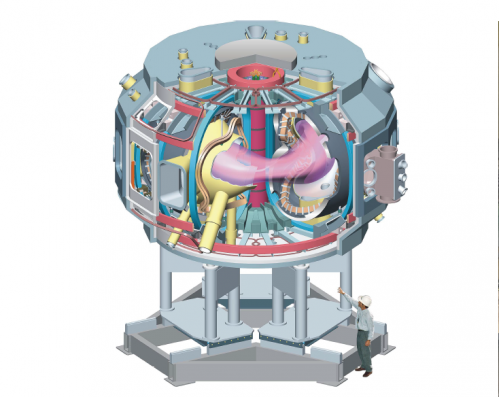 Completion of a promising experimental facility at the U.S. Department of Energy's Princeton Plasma Laboratory (PPPL) could advance the development of fusion as a clean and abundant source of energy for generating electricity, according to a PPPL paper published this month in the journal IEEE Transactions on Plasma Science.
The facility, called the Quasi-Axisymmetric Stellarator Research (QUASAR) experiment, represents the first of a new class of fusion reactors based on the innovative theory of quasi-axisymmetry, which makes it possible to design a magnetic bottle that combines the advantages of the stellarator with the more widely used tokamak design. Experiments in QUASAR would test this theory. Construction of QUASAR—originally known as the National Compact Stellarator Experiment—was begun in 2004 and halted in 2008 when costs exceeded projections after some 80 percent of the machine's major components had been built or procured.
"This type of facility must have a place on the roadmap to fusion," said physicist George "Hutch" Neilson, the head of the Advanced Projects Department at PPPL.
Both stellarators and tokamaks use magnetic fields to control the hot, charged plasma gas that fuels fusion reactions. While tokamaks put electric current into the plasma to complete the magnetic confinement and hold the gas together, stellarators don't require such a current to keep the plasma bottled up. Stellarators rely instead on twisting—or 3D —magnetic fields to contain the plasma in a controlled "steady state."
Stellarator plasmas thus run little risk of disrupting—or falling apart—as can happen in tokamaks if the internal current abruptly shuts off. Developing systems to suppress or mitigate such disruptions is a challenge that builders of tokamaks like ITER, the international fusion experiment under construction in France, must face.
Stellarators had been the main line of fusion development in the 1950s and early 1960s before taking a back seat to tokamaks, whose symmetrical, doughnut-shaped magnetic field geometry produced good plasma confinement and proved easier to create. But breakthroughs in computing and physics understanding have revitalized interest in the twisty, cruller-shaped stellarator design and made it the subject of major experiments in Japan and Germany.
PPPL developed the QUASAR facility with both stellarators and tokamaks in mind. Tokamaks produce magnetic fields and a plasma shape that are the same all the way around the axis of the machine—a feature known as "axisymmetry." QUASAR is symmetrical too, but in a different way. While QUASAR was designed to produce a twisting and curving magnetic field, the strength of that field varies gently as in a tokamak—hence the name "quasi-symmetry" (QS) for the design. This property of the field strength was to produce plasma confinement properties identical to those of tokamaks.
"If the predicted near-equivalence in the confinement physics can be validated experimentally," Neilson said, "then the development of the QS line may be able to continue as essentially a '3D tokamak.'"
Such development would test whether a QUASAR-like design could be a candidate for a demonstration—or DEMO —fusion facility that would pave the way for construction of a commercial fusion reactor that would generate electricity for the power grid.
Source: phys.org
 The new App ‘Operation Tokamak’ invites gamers to have a go at realising fusion power. Being the operator of a fusion machine, players have to control the plasma by shaping the magnetic field, bring up the heat with the help of powerful microwaves and blast harmful magnetic islands away.
It goes without saying that the script of a game has different requirements than a fusion device. Therefore some simplifications were necessary to develop the gameplay of ‘Operation Tokamak’. Despite that the motivation of this game has been to give the player a sense of the essential requirements that make fusion happen. The biggest difference between the game and reality is certainly that in ‘Operation Tokamak’ fusion energy is produced regularly and widely in many countries. In reality about 40 fusion laboratories do research on how this goal can be achieved.
Operation Tokamak in the control room
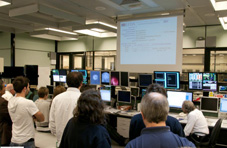
In a real control room there is more than one actor to run an experiment which is carefully planned in advanced. For a start, there are two main players working hand in hand: The Session Leader and the Engineer-in-Charge. The Session Leader is in charge of the scientific aims of the experiment while the Engineer-in-Charge makes sure that the systems are functioning properly and are used safely – he or she will hit the stop button if the scientists are getting too creative.
The Session Leaders’ job starts some days ahead of their duty in the control room: They design the plasma pulses to achieve the experimental goals as defined by the Scientific Coordinator. This means setting the plasma parameters such as magnetic field, plasma current, or gas, planning the sequence of steps from the start through to the end of the pulse and defining the required heating power. Together with the Additional Heating Pilots, the Session Leader discusses the best strategy for when and how to apply the heating systems – for instance, the powerful microwave systems also featured in ‘Operation Tokamak’. The Diagnostic Coordinators request all the measurement systems that are necessary to monitor the plasma and to record the experimental data.
The countdown begins
To begin a plasma pulse, the Power Supply Engineer starts JET’s two flywheel generators to build up hundreds of megawatts of power. Two nine meter wide steel wheels are set into a horizontal rotation and reach 225 rounds per minute – a spinning rate at which their edges rotate at a speed of 380 km/h. At the same time, The CODAS Duty Officers make sure that the computers and software are ready. A two and a half minute long countdown begins, urging all coordinators to ensure that their systems are ready. Once that is confirmed, the Engineer in Charge starts the pulse and the experiment is on. The magnetic field builds up. The heating pilots make sure that the microwave and particle beam systems to heat the plasma function correctly. The diagnostic coordinators monitor their systems to ensure the best quality of the experimental data.
Sorry, no shooting of instabilities in the control room
And the magnetic islands which players blast away in the game? Fusion scientists investigate various ways to mitigate these plasma instabilities. One of them is an automated feedback system. It picks up the magnetic islands thanks to their emission of tiny amounts of microwaves, automatically directs powerful microwaves at their spot and shrinks them to harmless size. Just like the players in ‘Operation Tokamak’.
You find lots of general and more in-depth information on our web site to get a better understanding of the real science is pursued in a mutual European effort.
But you are already prepared to run your own session in the ‘Operation Tokamak’ game. Find out how much energy you produced and how much CO2 you saved. And do not forget to share your score with your friends on the Leaderboard on the EFDA website or on your private Facebook account. Tweet about it using #optok. Good luck!
Source: EFDA
 ANN ARBOR—Inspired by the space physics behind solar flares and the aurora, a team of researchers from the University of Michigan and Princeton has uncovered a new kind of magnetic behavior that could help make nuclear fusion reactions easier to start.
Fusion is widely considered the ultimate goal of nuclear energy. While fission leaves behind radioactive waste that must be stored safely, fusion generates helium, a harmless element that is becoming scarce. Just 250 kilograms of fusion fuel can match the energy production of 2.7 million tons of coal.
Unfortunately, it is very difficult to get a fusion reaction going.
"We have to compress the fuel to a temperature and density similar to the core of a star," said Alexander Thomas, assistant professor of nuclear engineering and radiological sciences.
Once those conditions are reached, the hydrogen fuel begins to fuse into helium. This is how young stars burn, compressed by their own gravity.
On Earth, it takes so much power to push the fuel atoms together that researchers end up putting in more energy than they get out. But by understanding a newly discovered magnetic phenomenon, the team suggests that the ignition of nuclear fusion could be made more efficient.
Two methods dominate for confining the fuel, made of hydrogen atoms with extra neutrons, so that fusion can begin. Magnetic confinement fusion uses magnetic fields to trap the fuel in a magnetic 'bottle,' and inertial confinement fusion heats the surface of the fuel pellet until it blows off in a way that causes the remaining pellet to implode. The team explored an aspect of the latter method through computer simulations.
"One of the concerns with nuclear fusion is to squeeze this very spherical fuel pellet perfectly into a very small spherical pellet," said Archis Joglekar, a doctoral student in nuclear engineering and radiological sciences.
To avoid pushing the ball of fuel into an irregular shape that won't ignite, the fuel must be exposed to uniform heat that will cause its surface layer to evaporate all at once. As this layer pushes off at high speed, it applies equal pressure to all sides of the pellet and causes it to shrink to one thousandth of its original volume. When that happens, the fuel begins to fuse.
Joglekar calls even heating "the biggest concern in terms of achieving inertial confinement fusion."
The heat comes from about 200 laser beams hitting the inside of a hollow metal cylinder with the fuel pellet sitting at its heart. The trouble is that the light energy from the laser is converted to heat in the metal by way of electrons, and the electrons can get trapped in magnetic fields created by the laser spots.
When the laser light hits the metal, it turns some of the surface metal into plasma, or a soup of electrons and free atomic nuclei. The laser and the heat drive the electrons to move in a way that sets up a magnetic field circling the laser spot.
The magnetic field acts as a boundary for the electrons—they can't cross it. But until now, researchers didn't know that the hot electrons, in an effort to get to cooler areas, are able to push the magnetic fence outward.
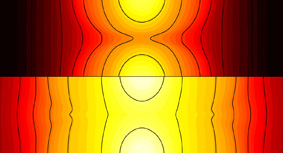
The team showed that the flow of hot electrons could drive the magnetic fields around neighboring laser spots together, causing them to join up. Instead of forming a barrier between the laser spots, the joined fields open a channel between them.
"Now there's a clear path for the electrons to move into what would otherwise be the cold region," Joglekar said.
Designers of inertial fusion ignition systems may be able to use this newly discovered feature to place the laser spots so that they heat the cylinder more quickly and efficiently.
"Essentially, what we found is a completely new magnetic reconnection mechanism," Thomas said. "Though we're studying it in an inertial confinement fusion process, it might be relevant to the surface of the sun and magnetic confinement fusion."
For instance, knowing that the flow of hot, charged particles on the sun can push magnetic fields around could inspire new theories about how solar flares occur.
A paper on this work, titled "Magnetic reconnection in plasma under inertial confinement fusion conditions driven by heat flux effects in Ohm's law," is published in Physical Review Letters. It was carried out in collaboration with Amativa Bhattacharjee and William Fox of the Princeton Plasma Physics Laboratory.
Source: www.ns.umich.edu
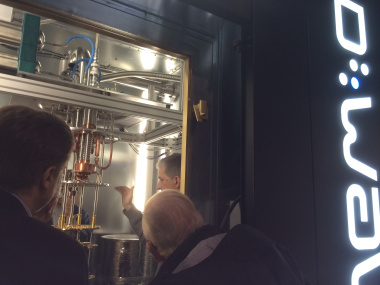 Vancouver is a land of scenic harbors, tall mountains and startups trying to harness the limits of physics.
In town for the TED conference, I had the occasion to visit two such companies yesterday:D-Wave and General Fusion. D-Wave, a quantum computing company, is all about the very cold and the rather tiny. It has built enormous refrigerators that each house a single chip, laced with “qubits” that can be in the superposition of both 1 and 0 at the same time and can carry an electric current with no resistance at low temperatures.
Meanwhile, General Fusion is all about huge and hot. The company is putting together the pieces for an alpha version of a nuclear reactor plant that would use magnetized target fusion. That is, it slams together hydrogen atoms by shooting donut-shaped electrified plasma into a chamber where it’s squished by synchronized pistons from all angles. This happens at a temperature of 150 million degrees. The point: To create clean and cheap energy.
Both of the companies say their products are on the verge of a breakthrough. Over about a decade of research and development, they have each acquired their own posse of doubters, who say they are designing expensive, impractical systems that don’t really work yet.
That may well be true, but people at both D-Wave and General Fusion like to compare their cost of development — and the broader investment in their respective spaces — to the estimated trillion dollars of investment over the past decades that have fueled the rise of traditional computing and its generational leaps forward associated with Moore’s Law.
Fusion always seems like a far-away prospect, but it’s closer than you might think, said General Fusion founder Michel Laberge in a talk at TED. “Very soon, somebody will crack that nut,” he said.
In fact, plotted against the curve of Moore’s Law, progress in fusion performance looks pretty parallel, according to Laberge.
The difference is, fusion doesn’t really work at all until it crosses a threshold on that chart — one Laberge and General Fusion think they are very close to achieving, if they can only create a system that is 150 million degrees, dense and long-lasting.
Over at D-Wave, which is headquartered about a 20-minute drive from the Vancouver Convention Centre, a 512-qubit quantum computer is already in the hands of customers and research partners, who have demonstrated that these machines can match the state of the art in classical computing.
What that means is, for certain problems — generally where someone is trying to optimize something — the D-Wave machine can already compute something just as fast as a state-of-the art classical set-up by considering multiple options simultaneously.
But that’s not enough. At this point there’s no big advantage to quantum computing because it’s not cost effective. The big leap is when quantum computers can do things demonstrably better than classical computers so they justify the big fridge and the big price.
D-Wave hopes and believes that will happen later this year, upon the arrival of a 1024-qubit quantum computer that’s close to being ready.
The promise of quantum computing is the possibility of solving problems that would require massive quantities of computers — perhaps more than are available in the world.
Because the combination of computing capacity and big data has been so effective in machine learning, it’s quite possible that this work will aid leaps forward in artificial intelligence. In fact, Google has a D-Wave machine and is working on that now. So is D-Wave co-founder Geordie Rose, who emphasized in an interview yesterday, “Whether or not it’s quantum is not important. It’s what it does.”
Meanwhile, a 15-minute drive away, General Fusion, which shares investors with D-Wave, is about two to three years out from creating its own power plant. Today, the pistons work well, and the plasma is hot enough and dense enough. Within the last month, the gas donut has started lasting long enough for the system to work, so now the company is turning its focus to compression and timing, according to Michael Delage, VP of strategy and corporate development.
Similar to D-Wave, General Fusion is at a point where it needs to get its system working and cost effective. “We expect to be at break-even energy in a couple of years,” said CEO Nathan Gilliland.
When this is built out, General Fusion thinks it can provide power at a cost of seven cents per kilowatt, comparable to the cost of coal.
Why this is important? As Laberge said, “It could solve all our energy problems cleanly for the next billion years.”
So why are both of these companies in Vancouver? Part of it is the investment climate. D-Wave founder Rose called out Haig Farris of Ventures West and Mike Brown of Chrysalix as “gunslinger types” who invest for the long term. D-Wave has raised $130 million, while General Fusion has raised $50 million.
Or maybe it’s the mountains meeting the sea. “There’s something around competency in hardware and pushing boundaries,” said General Fusion’s Delage.
And especially during the week of TED, it’s a place of optimism. “With AI, or quantum computing, or fusion, there are these things the world should have — and the fact they don’t is a travesty,” said Rose. “We’ve created tremendous wealth on this planet, and we should be using it on our sense of wonder.”
Source: recode.net
Local News
- 1
- 2
- 3
- 4
- 5
IPPLM joins the Enterprise Europe Network
31-03-2026
On 23 March 2026, the Institute of Plasma Physics and Laser Microfusion (IPPLM) joined, with its technological offer, the group of entities affiliated with the Enterprise Europe Network (EEN), interested...
Read moreIPPLM as a co-creator of the exhibition "E = mc² – the formula that changed the world" at the National…
18-02-2026

On 16 February 2026, the official opening of two new permanent exhibitions took place at the National Museum of Technology in Warsaw. The Institute of Plasma Physics and Laser Microfusion...
Read moreIPPLM supports children and young people at the TPD "Helenów" Centre
22-12-2025

The Sylwester Kaliski Institute of Plasma Physics and Laser Microfusion (IPPLM) has for many years been actively engaged in initiatives supporting children and young people supported by the TPD "Helenów"...
Read moreIPPLM researchers took part in an experimental campaign on the GEKKO XII laser
20-11-2025

On 10–14 November 2025, a research team from the Sylwester Kaliski Institute of Plasma Physics and Laser Microfusion (IPPLM) – Prof. Katarzyna Batani, Dr Hanna Marchenko and Dr Agnieszka Zaraś-Szydłowska...
Read moreRegister for the 18th Kudowa Summer School on Plasma Physics!
07-11-2025

We invite you to take part in the 18th Kudowa Summer School "Towards Fusion Energy", which will be held on 8–12 June 2026 in Kudowa-Zdrój, Poland. The event is organised...
Read moreIPPLM participated in the second technical meeting within the DONES Con-P1 project
17-10-2025
The Institute of Plasma Physics and Laser Microfusion (IPPLM) took part in the second technical meeting held as part of the DONES Consolidation Phase 1 (DONES ConP1) project, co-financed by...
Read moreProf. Jan Badziak from IPPLM among the World’s Top 2% Scientists
15-10-2025
Prof. Jan Badziak, from the Department of Laser Plasma and Magnetized Dense Plasma Physics at the Institute of Plasma Physics and Laser Microfusion (IPPLM), has been included in the prestigious...
Read more29th Science Festival with the participation of IPPLM
10-10-2025

During the 29th Science Festival in Warsaw, held on 19–28 September 2025, researchers from the Institute of Plasma Physics and Laser Microfusion (IPPLM) conducted lessons for upper-grade primary school students. The...
Read morePLASMA 2025 and the 20th Anniversary of the Euratom–IPPLM Association – event summary
26-09-2025

From 15 to 19 September 2025, Warsaw hosted the international scientific conference PLASMA 2025 – International Conference on Research and Application of Plasmas, dedicated to plasma research, diagnostics, and applications....
Read moreWe bid farewell with deep sorrow to Professor Jerzy Wołowski
25-09-2025

It is with great sadness that we have received the news of the passing of Professor Jerzy Wołowski (1936–2025) an outstanding physicist, long-time employee of the Institute of Plasma Physics...
Read more20th anniversary of the Euratom–IPPLM Association (CeNTE): Celebrating two decades of fusion research coordination
16-09-2025

On 19 September 2025, during the PLASMA 2025 International Conference on Research, Diagnostics and Applications of Plasma in Warsaw, the IPPLM will mark 20th anniversary of the coordination of research on nuclear fusion...
Read moreIPPLM at the 49th Congress of Polish Physicists in Katowice
13-09-2025
During the 49th Congress of Polish Physicists, held from September 5–11, 2025, in Katowice, the Institute of Plasma Physics and Laser Microfusion (IPPLM) was represented both among the speakers and...
Read moreProf. Agata Chomiczewska appointed Deputy Director for Scientific Affairs at the IPPLM
03-09-2025

We are pleased to announce that the Minister of Energy, Mr. Miłosz Motyka, has appointed Dr. hab. Agata Chomiczewska to the position of Deputy Director for Scientific Affairs at the...
Read moreA historic milestone – the Scientific Council of the Institute confers the degree of habilitated doctor
10-07-2025
For the first time in the history of the Institute of Plasma Physics and Laser Microfusion (IPPLM), the Scientific Council has adopted a resolution to confer the degree of habilitated...
Read moreNew Board of the Plasma Physics Division of the European Physical Society
04-07-2025

In the first quarter of 2025, elections were held for the Board of the Plasma Physics Division of the European Physical Society (EPS Plasma Physics Division). Six candidates who received...
Read moreIPPLM researchers bring fusion expertise to 10th Central & Eastern Europe Nuclear Industry Congress 2025
12-06-2025
Researchers from the Institute of Plasma Physics and Laser Microfusion (IPPLM), Dr. Natalia Wendler and Dr. Paweł Gąsior, recently participated in a panel discussion at the 10th Central & Eastern...
Read moreIPPLM at the 3rd edition of the "Science for Society" Congress
29-05-2025

On 25-26 May 2025, the 3rd edition of the "Science for Society" Congress took place in the Large Hall of the Warsaw University of Technology. The aim of the event...
Read moreInvitation to the 3rd edition of the "Science for Society" Congress with the participation of IPPLM
22-05-2025

The 3rd edition of the "Science for Society" Congress will take place on 25–26 May 2025 at the Warsaw University of Technology. This unique event demonstrates that science is not...
Read moreJoin the 28th Science Picnic!
07-05-2025

The Institute of Plasma Physics and Laser Microfusion (IPPLM) invites you to its stand on Saturday, 10 May, during the 28th Science Picnic, organized by Polish Radio and the Copernicus...
Read moreCooperation agreement between the IPPLM and the National Museum of Technology
18-04-2025

On 17 April 2025, a cooperation agreement was signed between the National Museum of Technology (NMT) and the Institute of Plasma Physics and Laser Microfusion (IPPLM). The ceremonial meeting, attended by...
Read morePolish and French researchers join forces in research on nuclear fusion
31-03-2025

On 24-25 March 2025, a Polish-French meeting was held at the headquarters of the Institute of Nuclear Physics of the Polish Academy of Sciences (IFJ PAN) and the French Institute...
Read moreJoin us for the International Conference on Research and Application of Plasmas – PLASMA 2025!
13-03-2025

The Institute of Plasma Physics and Laser Microfusion (IPPLM) invites you to attend the PLASMA 2025 – International Conference on Research and Application of Plasmas, which will be held from...
Read moreExperimental research session in the Plasma-Focus PF1000U laboratory as part of the ICDMP collaboration
27-02-2025

On February 10–21, 2025, an experimental session was held in the Plasma-Focus PF-1000U laboratory, in which, in addition to the IPPLM team, a three-person team of researchers from the Prague...
Read moreLaser demonstration on JET detects fusion fuels
11-02-2025

Scientists and engineers from eight nations, including Poland, have carried out a project using lasers on the Joint European Torus (JET) to study fusion fuel retention. Laser Induced Breakdown Spectroscopy (LIBS),...
Read moreIPPLM employee nominated for the Personality of the Year title in the Science category
24-01-2025
Research and technical employee Mr. Olgierd Cichorek, M.Sc., from the Laboratory of Plasma Nudge for Satellites at the IPPLM has been nominated for the title of Personality of the Year...
Read moreWorld News
- 1
- 2
- 3
- 4
- 5
In Memoriam — Professor Francesco Romanelli
24-03-2026

The world of fusion research mourns the loss of Professor Francesco Romanelli, a visionary scientist whose work helped bring humanity closer to clean, limitless energy. Over four decades, he explored...
Read moreIgniting the future: Breakthroughs in inertial confinement Fusion
25-07-2025

In December 2022, the National Ignition Facility (NIF) at Lawrence Livermore National Laboratory (USA) marked a historic milestone in fusion science: an experiment produced 3.15 MJ of fusion energy from 2.05 MJ of laser...
Read moreWendelstein 7-X sets new fusion performance records
04-06-2025

On May 22, 2025, the Wendelstein 7-X (W7-X) stellarator at the Max Planck Institute for Plasma Physics (IPP) in Greifswald concluded its latest experimental campaign with a major success: a...
Read moreEuropean tokamak sets new fusion plasma record
20-02-2025

On February 12, 2025, the WEST tokamak, located at CEA Cadarache in southern France, set a new world record by sustaining fusion plasma for 1,337 seconds, or over 22 minutes....
Read moreDr. Gianfranco Federici appointed as the new EUROfusion Programme Manager
17-12-2024
At the 49th General Assembly held in Barcelona, December 2024, Dr. Gianfranco Federici was elected as the new Programme Manager of EUROfusion. He succeeds Prof. Ambrogio Fasoli, who will return...
Read moreEUROfusion and F4E join forces for Europe’s fusion future
16-12-2024

EUROfusion and Fusion for Energy (F4E) have signed a Memorandum of Understanding (MoU) to advance fusion research and development in Europe. This agreement reinforces cooperation in...
Read moreJohn J. Hopfield and Geoffrey E. Hinton awarded the 2024 Nobel Prize in Physics
08-10-2024

John J. Hopfield and Geoffrey E. Hinton have been awarded the 2024 Nobel Prize in Physics "for foundational discoveries and inventions that enable machine learning with artificial neural networks." The Nobel...
Read moreWendelstein 7-X begins new experimental campaign
10-09-2024

The Wendelstein 7-X, the world’s most advanced stellarator, is launching a new experimental campaign after a year of intensive maintenance and upgrades. This phase, known as OP2.2, begins on 10...
Read moreITER's New Project Baseline: A Robust Path to Fusion Energy Research
04-07-2024

On 3 July, ITER Director-General Pietro Barabaschi presented the new project baseline, under evaluation by the ITER Organization's governing body. This plan aims to ensure a robust start to scientific...
Read moreITER Council Presents Updated Project Baseline
21-06-2024

The ITER Council convened this week for its 34th meeting, where nearly 100 attendees reviewed significant updates to the project baseline. The proposed changes aim to optimize the overall project...
Read moreEurope and Japan celebrate breakthrough in paving the way for fusion energy
01-12-2023

The prospect of harnessing fusion energy is closer. The successful operation of JT-60SA, the most powerful experimental device to date, built by Europe and Japan, is a landmark achievement for...
Read moreFirst plasma was successfully generated at JT-60SA
26-10-2023

A momentous achievement in the field of nuclear fusion has been accomplished by a collaborative team of engineers from Europe and Japan. They have successfully generated tokamak plasma for the...
Read moreThe Nobel Prize in Physics 2023
03-10-2023
Pierre Agostini, Ferenc Krausz and Anne L’Huillier are the winners of this year's Nobel Prize in Physics. It was awarded "for experimental methods that generate attosecond pulses of light for...
Read moreUS Lab Replicates Fusion Ignition Breakthrough
08-08-2023
The US National Ignition Facility (NIF) has achieved fusion ignition once again, building on its landmark 2022 success. This achievement, powered by hydrogen within a diamond capsule, signifies a major...
Read moreNew Programme Manager Elect announced by EUROfusion
20-07-2023
Professor Ambrogio Fasoli became the new EUROfusion Programme Manager Elect. The decision was made by EUROfusion General Assembly at the meeting on 18 July 2023. His tenure will officially commence...
Read moreEUROfusion stands in solidarity with research in Ukraine
24-02-2023

Today, as we commemorate the anniversary of the invasion of Ukraine by Russia, the EUROfusion consortium stands in solidarity with our Ukrainian member and research colleagues. EUROfusion remains committed to supporting...
Read moreEight-minute production of plasma with gigajoule energy turnover at Wendelstein 7-X
23-02-2023

Another target has been achieved only recently by the W7-X researchers, namely they managed to acquire an energy turnover of 1.3 gigajoules in the device, which is 17 times higher...
Read moreThe Nobel Prize in Physics 2022
04-10-2022

Alain Aspect, John F. Clauser and Anton Zeilinger are the winners of this year's Nobel Prize in Physics. It was awarded “for experiments with entangled photons, establishing the violation of...
Read moreNew experiments for fusion energy record breaker JET
27-09-2022

A new wave of fusion energy experiments on UK Atomic Energy Authority’s record-breaking Joint European Torus (JET) started this month. EUROfusion researchers are using the famous JET machine to conduct a...
Read moreITER appoints new Director-General
21-09-2022
Pietro Barabaschi has become the next Director-General of the ITER Organization as a result of the unanimous choice of the Council from among finalist candidates. In the transition period Dr....
Read moreStarting power plant design
07-07-2022

At a livestreamed Horizon EUROfusion event in Brussels on 5 July 2022, EUROfusion celebrated the start of conceptual design activities for Europe's first demonstration fusion power plant DEMO. This first-of-a-kind...
Read moreCelebration of achieving a crucial assembly milestone in the ITER Project
17-05-2022

This month, we have witnessed the successful lifting and lowering into the machine well of the first sub-section of the ITER plasma chamber. The weight of the component is the...
Read moreBurning plasma achieved in inertial fusion at the National Ignition Facility
15-02-2022
Obtaining a burning plasma is a critical step towards self-sustaining fusion energy. A burning plasma is one in which the fusion reactions themselves are the primary source of heating in...
Read moreHistoric milestone reached by JET scientists
20-01-2022

Iconic fusion energy machine JET – which reaches controlled temperatures 10 times hotter than the core of the sun – completed its 100,000th live pulse last night. Weighing 2,800 tonnes, the...
Read moreHorizon Europe Grant Agreement signed
20-12-2021

15 December 2021 saw the EUROfusion consortium signing the Grant Agreement under Horizon Europe, the European Framework Programme from 2021 – 2027, in an aim to launch comprehensive R&D approach...
Read more |
 |
 |
 |
 |
 |
 |
 |
What we do
Our laboratories
Online seminars
| Thursday, 30 Apr 2026, godz. 13.00 Seminarium instytutowe: "Equation of State of Shock Compressed BN in the Megabar Pressure Range", dr hab. Katarzyna Batani, IFPiLM |


Research projects carried out at the IPPLM are funded by the Polish Ministry of Education and Science, the National Science Centre and by the European Commission within the framework of EUROfusion Consortium under grant agreement No 101052200. Financial support comes also from the International Atomic Energy Agency, European Space Agency and LaserLab Consortium as well as from the Fusion for Energy Agency.