





Zestaw obrazów 2019
zdjecie1.jpg
zdjecie2.jpg
zdjecie3.jpg
zdjecie4.jpg
zdjecie5.jpg
zdjecie6.jpg
2019_1.JPG
2019_2.JPG
2019_4.JPG


Światowe
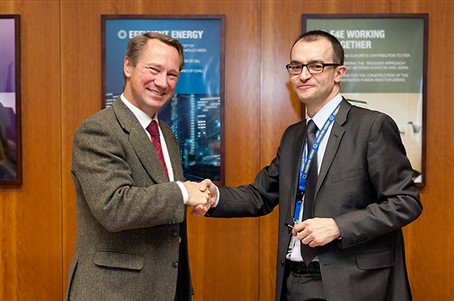 A major technological deal has been reached between Fusion for Energy and Air Liquide, gas technology global leader, in order to equip the world’s biggest cryoplant that will cool down the ITER machine to temperatures as low as -269˚ C. The works will be completed in five years and the budget foreseen is in the range of 65 million EUR. The contract covers the engineering, procurement, installation and testing of the facility and auxiliary systems.
Professor Henrik Bindslev, Director of Fusion for Energy, explained that “thanks to ITER, the frontiers of science and technology are pushed further and Europe’s industry is becoming more competitive. To be part of the biggest international energy project means being confident enough to put your expertise to the test and brave enough to take it a step further”. Cristiano Tortelli, Vice-President, Global Air Liquide E&C Solutions, commented: “Our participation to ITER is driven by technological innovation, underpinned by the recognition our of expertise and in line with our committment to invest in tomorrow’s energy mix.”
What is the function of the cryoplant?
Think of the cryoplant as ITER’s massive fridge that will produce and distribute the cooling power in the machine through different networks. The most advanced cryogenic technologies will be deployed to generate extremely low tempratures needed for the ITER magnets, thermal shields and cryopumps. For example, the magnets will be cooled with super critical helium to reach a superconducting state at 4,5 K, close to absolute zero, in order to confine the hot plasma.
What is the European contribution to ITER’s cryoplant?
Europe will provide the Liquid Nitrogen Plant and and auxiliary systems that will cool down, process, store, transfer and recover the cryogenic fluids of the machine. Two nitrogen refrigetarors will be manufactured along with two 80 K helium loop boxes, warm and cold helium storage tanks, dryers, heaters and the helium purification system. The high performance requirements will be underpinned by high safety standards and a sophisticated operational system.
What are the main elements of the Liquid Nitrogen Plant and auxiliary systems?
Two nitrogen refregirators with a cooling power of 1 200 kW at 80K will cool down ITER’s Liquid Helium Plant and the 80K helium loop boxes. In addtion, they will supply the purification system, quench tanks, heaters and dryers with nitrogen in liquid or gaseous form.
The two 80K helium loops will cool down the thermal shields of the cryostat, vacuum vessel, and regenerate the cryopumps. It is estimated that 8 kg of helium per second will be processed.
A helium purification system is planned to recover and clean helium gas from any impurities. The largest components are two quench tanks that each weigh 160 tonnes and meaure 37m by 4.4 m.
Watch the interview with Xavier Vigor, Head of Air Liquide advanced Technologies (AL-aT), explaining their contribution to the ITER project.
Source: F4E
 W dniu 20 maja b.r. w Instytucie Fizyki Plazmy (IFP) im. Maxa Plancka w Greifswaldzie (północne Niemcy) otwarto wielkie urządzenie termojądrowe - stellarator Wendelstein W7-X. Polskiej delegacji biorącej udział w tej uroczystości przewodził podsekretarz stanu w Ministerstwie Nauki i Szkolnictwa Wyższego, prof. Wodzisław Duch. W skład tej delegacji wchodzili także dyrektor Instytutu Fizyki Plazmy i Laserowej Mikrosyntezy dr hab. prof. Andrzej Gałkowski i jego zastępca ds. europejskiego programu fuzji termojądrowej dr hab. prof. Roman Zagórski. Prof. R. Zagórski przedstawił na spotkaniu w Greifswaldzie wkład Polski do programu budowy i wyposażenia stellaratora W7-X. Dyrektor IFPiLM prof. A. Gałkowski udzielił redaktorkom D. Truszczak z Polskiego Radia i K. Głowackiej z TOK-FM wywiadu na temat tego programu.
Układ Wendelstein W7-X będzie służył do optymalizacji procesu fuzji w plazmie ograniczanej polem magnetycznym w toroidalnej pułapce i dogrzewanej mikrofalami oraz wiązkami atomowymi. W gorącej plazmie w stellaratorze W7-X będą zachodzić reakcje syntezy jąder izotopu wodoru (deuteru) z uwalnianiem energii. Celem badań będzie stworzenie warunków dla uzyskania maksymalnej energii fuzji. Wyniki badań mogą posłużyć do opracowania w przyszłości stellaratora – reaktora termojądrowego, w którym energia fuzji będzie dużo większa od energii dostarczonej do tego urządzenia. Równolegle z badaniami fuzyjnymi w stellaratorze prowadzone są prace dotyczące budowy we Francji eksperymentalnego reaktora ITER, w którym wykorzystano pułapkę magnetyczną typu tokamak.
Budowa i przygotowanie badań stellaratora W7-X, rozpoczęte przez Niemców, od kilku lat stały się projektem międzynarodowym. Duży udział w tym przedsięwzięciu mają polskie zespoły konstruktorów i naukowców z Instytutu Fizyki Plazmy i Laserowej Mikrosyntezy, Narodowego Centrum Badań Jądrowych w Świerku, Instytutu Fizyki Jądrowej PAN w Krakowie, Politechniki Warszawskiej i Uniwersytetu Opolskiego. Prace polskich zespołów były finansowane przez Wspólnotę EURATOM, Narodowe Centrum Badań i Rozwoju i IFP w Geifswaldzie.
W Instytucie Fizyki Plazmy i Laserowej Mikrosyntezy opracowano i zbudowano dwa kompletne układy diagnostyczne do badania promieniowania rentgenowskiego emitowanego z plazmy w układzie W7-X. Urządzenia te, poczynając od koncepcji fizycznej wspartej symulacjami numerycznymi, poprzez projekt techniczny, aż do budowy ostatecznych wersji układów pomiarowego, zostały wykonane w IFPiLM. Jedno z tych urządzeń, nazwane PHA (ang. pulse height analysis), będzie instalowane w tym roku na stellaratorze w IFP w Greifswaldzie. Drugi układ nazwany MFS (ang. multi foil system) trafi do Greifswaldu w przyszłym roku *). Obie diagnostyki będą stosowane do badań w układzie W7-X przez naukowców z IFPiLM przy współpracy z zespołami z innych ośrodków. Zespół teoretyków z IFPiLM realizował badania właściwości plazmy w komorze stellaratora W7-X metodami symulacji numerycznych.
*) Więcej informacji na temat tych diagnostyk można znaleźć na str. www IFPILM w Annual Report IPPLM 2013, str. 74.
Informacje o otwarciu stellaratora Wendelstein W7-X w Greifswaldzie (Niemcy) można znaleźć także na stronach:
 Nobody said it was going to be easy. After years of delays, work has finally begun on key components of ITER, the ambitious international project to build a revolutionary nuclear fusion reactor. ITER remains dogged by its own complexity, however, and its director-general says that it may not now fire up until 2023 – three years later than the most recent official deadline.
ITER's ultimate aim is to generate energy in the same way that the sun does, by fusing hydrogen nuclei to form helium. It will do this by using a magnetic field to confine a superheated hydrogen plasma inside a doughnut-shaped reactor called a tokamak.
A collaboration between China, Russia, India, Japan Korea, the US and the EU, ITER's reactor will be larger and far more intricate than any previous tokamak. It will have as many as 10 million parts – its builders call it the puzzle with 10 million pieces – and will sit at the centre of a vast support system. The result will rival the Large Hadron Collider for the title of most complex machine on earth.
Progress on ITER has been slow – it was first conceived during diplomatic talks between US president Ronald Reagan and Soviet leader Mikhail Gorbachev in 1985. Now, at last, the pieces of the puzzle are falling into place, although most of the ITER site, at Cadarache in southern France, is still barren. That is because the real action is taking place elsewhere.
Sun, sea and steel
The French Riviera is more generally associated with sun and sea than with mega engineering projects. When I visit the facility in La Seyne-sur-Mer where some of ITER's biggest components are being prepared, a fierce mistral is blowing off the land to the Mediterranean. CNIM, the contractor that owns the facility, started out as a shipbuilder before turning to precision engineering. Its maritime location is an advantage: many of ITER's components are so heavy that they have to be transported by sea.
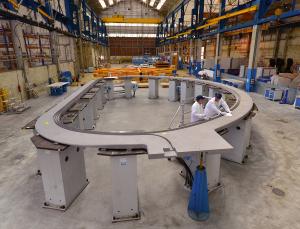
In one of the facility's climate-controlled warehouses, a huge drill is carving channels into a D-shaped loop of high-grade stainless steel- so large that it takes me nearly a minute to walk its circumference. The steel, chosen for its strength at low temperatures, is so tough that the carbide bits milling it must be replaced every eight minutes. It needs to be: seven of these loops will be stacked on top of each other to form one of the many magnets that will confine and direct hydrogen plasma at up to 100 million °C in the reactor vessel.
Before that, though, a complicated journey lies ahead. The loops' next stop will be La Spezia, Italy, where a contractor will fit up to 700 metres of superconducting cable to each one; then they will travel to Venice, where another firm, Simic, will complete their assembly into structures called toroidal field coils, each weighing about the same as a fully laden Boeing 747. Simic is also milling some of the loops, so those will have to make a round trip to La Spezia and back.
The coils will then voyage to a French port, where they will be loaded onto a 800-tonne, 352-wheeled crawler that inches through 104 kilometres of countryside, crossing specially strengthened bridges and squeezing through carefully widened roads, to Cadarache. If all goes to plan, the first coils will arrive at the ITER site in about three years' time.
Deadline implausible
Still, progress on the toroidal coils seems faster than on the second of the reactor's key magnetic arrays, the so-called poloidal field coils. The building specially built for their construction is impressively large but mostly empty, save for half a dozen crates and a circular crane that hangs from the roof like a vast yellow spider, as it has been since 2012 when New Scientist last visited.
Following mounting criticism of ITER's progress, director-general Osamu Motojima is striving to put the monumental project on "a more realistic schedule". He told New Scientist that the difficulty of integrating the parts supplied by ITER's myriad partners made the current deadline of 2020 for "first plasma" implausible; 2022 or 2023 are more likely.
Even once first plasma has been achieved, the reactor will spend years running experimentally before switching to the deuterium-tritium mix needed to generate substantial power. Motojima hopes this second milestone, scheduled for 2027, will still be achievable.
All this is taking its toll on morale. Several of the senior ITER figures I spoke to felt that ITER's politics - with member states jostling for contracts, and supposedly identical parts often made by different manufacturers on different continents - together with the technical challenges, made even Motojima's revised timeframe unworkable. They are quietly banking on 2025 or beyond. "I hope I see first plasma while I'm still on the project," says Neil Mitchell, head of ITER's magnets division.
Others are enjoying the ride. "ITER is not the first mega project: it's a great challenge, but it's also great fun," says Ken Blackler, who will have the job of fitting together the giant components inside the tightly confined wall of the reactor, Tetris-style.
The most impassioned advocate I hear from is Mark Henderson, who runs the microwave system that will help heat the plasma. He argues forcefully that fusion is the only adequate response to climate change. "Grasping the sun and bringing it to earth is greater than going to the moon and decoding DNA," he says. But he too agrees that the rate of development needs to accelerate, and the road to practical fusion power may be a long one.
Those working on ITER today may have to live in the knowledge that the fruit of their labours will be reaped by others.
Source: newscientist.com
 After years of calculation, planning, component production and installation the Wendelstein 7-X project is now entering a new phase: Max Planck Institute for Plasma Physics (IPP) in Greifswald in May started the preparations for operation of this the world's largest fusion device of the stellarator type.
Assembly began in April 2005: A special grab hoisted the first of 70 more than man-sized magnet coils carefully over a just finger-wide slit onto a bizarrely shaped steel vessel. The coil, weighing six tons, and the vessel part were the first components of the Wendelstein 7-X fusion device to arrive at Greifswald from their production facilities throughout Europe. Here, more than 800 kilometres from the home institute at Garching in Bavaria, IPP had opened a second site in 1994 within the framework of a special programme "Aufbau Ost" to support the eastern part of Germany.
The two sites are pursuing the same objective: copying on earth the energy production of the sun. A fusion power plant is to produce energy from fusion of atomic nuclei. As the fusion fire does not ignite till a temperature of over 100 million degrees is attained, the fuel, viz. a low-density hydrogen plasma, ought not to come into contact with the cold walls. Confined by magnetic fields, the fuel is suspended inside a vacuum chamber almost without contact. The two types of configuration for the magnetic cage are being investigated by IPP at the two separate sites: the ASDEX Upgrade tokamak is being operated at Garching, the Wendelstein 7-X stellarator is being built at Greifswald.
The more simply designed tokamaks are still to the fore. Today only a tokamak such as the ITER international test reactor has the confidence to produce an energy-supplying plasma. "But", states Project Head Professor Dr. Thomas Klinger, "the stellarator principle promises strengths where its fellow campaigner shows weaknesses." Unlike tokamaks, which work in pulsed mode, stellarators are suitable for continuous operation, by virtue of their specially configured magnetic system.
Proving this makes Wendelstein 7-X the key experiment. The structure of its magnetic field is the result of sophisticated optimisation calculations made by the Stellarator Theory division and of its more than ten years of searching for a particularly stable and thermally insulating magnetic cage. Professor Klinger states: "Wendelstein 7-X is expected to put, for the first time, the quality of its plasma equilibrium and confinement on an equal footing with those of a tokamak. The experiment is to show that stellarators are also suitable for power plants." And with discharges lasting 30 minutes, it is to demonstrate its essential superiority, viz. continuous operation. This does not require Wendelstein 7-X to produce energy: Many properties of an ignited plasma can be transferred to stellarators from the ITER tokamak.
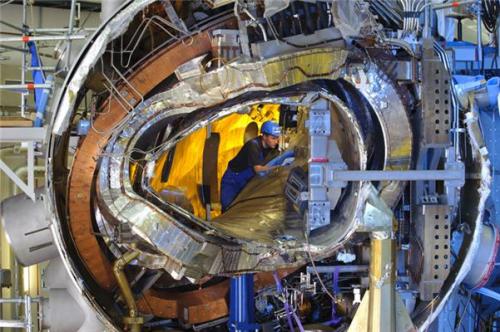
The device comprises five almost identical modules preinstalled and assembled in a circle in the experimentation hall: 70 superconducting coils strung along a steel plasma vessel are enclosed in a ring-shaped shell. In their vacuum-pumped interior the magnets are later cooled with liquid helium to superconduction temperature at nearly absolute zero. They then need hardly any energy. Besides the major components, miles of cooling ducts, current leads, measuring cables, numerous observation ports and sensors were installed, always in conjunction with control measurements and tightness testing of the many thousands of brazing seams.
"The industrial production and assembly were already an experiment in itself", states Professor Klinger, "a task that we at first underestimated: The superconduction technology coupled with the elaborate geometry of the components presented us with exacting quality requirements." In fact, construction did not take six years as planned, but nine years. Design and production, measurement and calculation – the complex shaping called for new methods that had first to be developed by the institute and industry during construction. A new basis plan was therefore drawn up in 2007. Since then assembly of Wendelstein 7-X is within schedule and the budget plan, and since 2009 – as first research project in Germany – it is even certified in accordance with industry standard ISO 9001.
Companies from the whole of Europe produced the components for Wendelstein 7-X. The investment costs met by the Federal Government, the State of Mecklenburg-Western Pomerania and the EU came to 370 million euros. Contracts worth more than 80 million were awarded to regional companies. Numerous research facilities at home and abroad were involved in construction of the device: Within the framework of Helmholtz Association Karlsruhe Institute of Technology was responsible for the entire microwave plasma heating, Jülich Research Centre built diagnostics and produced the elaborate connections of the superconducting magnet coils. Installation of these required 160 person-years of work time by superconduction technology specialists from the Polish Academy of Sciences in Krakow. The US fusion institutes at Princeton, Oak Ridge and Los Alamos made contributions that included auxiliary coils and measuring instruments worth 7.5 million dollars for equipping Wendelstein 7-X.
At the beginning of May the shell of the device was closed and the first pumps started up. The inauguration ceremony on 20 May 2014 will mark entry into the next work phase, viz. preparation of operation. This will involve testing all technical systems: the vacuum in the vessels, the cooling system, the superconducting coils and the magnetic field produced by them. Professor Klinger: "If all goes well, we can produce the first plasma in about a year."
Source: phys.org
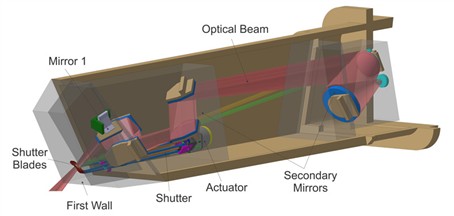 A Framework Partnership Agreement (FPA) for the design of the ITER Core Plasma Charge Exchange Recombination Spectroscopy diagnostic system (CP CXRS) has been signed by F4E and a consortium consisting of Forschung Zentrum Jülich (FZJ), Karlsruhe Institute of Technology (KIT); universities of technology in Budapest (BME) and Eindhoven (TU/e); the Dutch Institute for Fundamental Energy Research (DIFFER); and Culham Centre for Fusion Energy (CCFE) in the UK. Contributing third parties include the Spanish CIEMAT centre and the Hungarian Wigner-RCP institute. The FPA will run for four years with an F4E contribution of 4.9 million EUR.
The CP CXRS diagnostic will view a region of the ITER plasma illuminated by a high-energy beam of neutral hydrogen particles injected by a companion device (the Diagnostic Neutral Beam) being constructed by ITER’s Indian partners. Collisions of particles in this beam with particles in the fusion plasma will produce visible light. Measurement by the CP CXRS of the wavelength and spatial distribution of this light will allow conclusions to be drawn on various properties of the plasma. This includes the density of helium, which is formed during the fusion reaction and must be removed from the combustion chamber in order for the fusion reaction to be sustained. Other important parameters such as the concentration, temperature and velocity of different plasma species can also be determined using the diagnostic.
Once the CP CXRS diagnostic is designed, it will be procured by F4E and assembled into an ITER port plug to be installed in an inset at the upper edge of the vacuum vessel.
Source: F4E
Local News
- 1
- 2
- 3
- 4
- 5
IPPLM joins the Enterprise Europe Network
31-03-2026
On 23 March 2026, the Institute of Plasma Physics and Laser Microfusion (IPPLM) joined, with its technological offer, the group of entities affiliated with the Enterprise Europe Network (EEN), interested...
Read moreIPPLM as a co-creator of the exhibition "E = mc² – the formula that changed the world" at the National…
18-02-2026

On 16 February 2026, the official opening of two new permanent exhibitions took place at the National Museum of Technology in Warsaw. The Institute of Plasma Physics and Laser Microfusion...
Read moreIPPLM supports children and young people at the TPD "Helenów" Centre
22-12-2025

The Sylwester Kaliski Institute of Plasma Physics and Laser Microfusion (IPPLM) has for many years been actively engaged in initiatives supporting children and young people supported by the TPD "Helenów"...
Read moreIPPLM researchers took part in an experimental campaign on the GEKKO XII laser
20-11-2025

On 10–14 November 2025, a research team from the Sylwester Kaliski Institute of Plasma Physics and Laser Microfusion (IPPLM) – Prof. Katarzyna Batani, Dr Hanna Marchenko and Dr Agnieszka Zaraś-Szydłowska...
Read moreRegister for the 18th Kudowa Summer School on Plasma Physics!
07-11-2025

We invite you to take part in the 18th Kudowa Summer School "Towards Fusion Energy", which will be held on 8–12 June 2026 in Kudowa-Zdrój, Poland. The event is organised...
Read moreIPPLM participated in the second technical meeting within the DONES Con-P1 project
17-10-2025
The Institute of Plasma Physics and Laser Microfusion (IPPLM) took part in the second technical meeting held as part of the DONES Consolidation Phase 1 (DONES ConP1) project, co-financed by...
Read moreProf. Jan Badziak from IPPLM among the World’s Top 2% Scientists
15-10-2025
Prof. Jan Badziak, from the Department of Laser Plasma and Magnetized Dense Plasma Physics at the Institute of Plasma Physics and Laser Microfusion (IPPLM), has been included in the prestigious...
Read more29th Science Festival with the participation of IPPLM
10-10-2025

During the 29th Science Festival in Warsaw, held on 19–28 September 2025, researchers from the Institute of Plasma Physics and Laser Microfusion (IPPLM) conducted lessons for upper-grade primary school students. The...
Read morePLASMA 2025 and the 20th Anniversary of the Euratom–IPPLM Association – event summary
26-09-2025

From 15 to 19 September 2025, Warsaw hosted the international scientific conference PLASMA 2025 – International Conference on Research and Application of Plasmas, dedicated to plasma research, diagnostics, and applications....
Read moreWe bid farewell with deep sorrow to Professor Jerzy Wołowski
25-09-2025

It is with great sadness that we have received the news of the passing of Professor Jerzy Wołowski (1936–2025) an outstanding physicist, long-time employee of the Institute of Plasma Physics...
Read more20th anniversary of the Euratom–IPPLM Association (CeNTE): Celebrating two decades of fusion research coordination
16-09-2025

On 19 September 2025, during the PLASMA 2025 International Conference on Research, Diagnostics and Applications of Plasma in Warsaw, the IPPLM will mark 20th anniversary of the coordination of research on nuclear fusion...
Read moreIPPLM at the 49th Congress of Polish Physicists in Katowice
13-09-2025
During the 49th Congress of Polish Physicists, held from September 5–11, 2025, in Katowice, the Institute of Plasma Physics and Laser Microfusion (IPPLM) was represented both among the speakers and...
Read moreProf. Agata Chomiczewska appointed Deputy Director for Scientific Affairs at the IPPLM
03-09-2025

We are pleased to announce that the Minister of Energy, Mr. Miłosz Motyka, has appointed Dr. hab. Agata Chomiczewska to the position of Deputy Director for Scientific Affairs at the...
Read moreA historic milestone – the Scientific Council of the Institute confers the degree of habilitated doctor
10-07-2025
For the first time in the history of the Institute of Plasma Physics and Laser Microfusion (IPPLM), the Scientific Council has adopted a resolution to confer the degree of habilitated...
Read moreNew Board of the Plasma Physics Division of the European Physical Society
04-07-2025

In the first quarter of 2025, elections were held for the Board of the Plasma Physics Division of the European Physical Society (EPS Plasma Physics Division). Six candidates who received...
Read moreIPPLM researchers bring fusion expertise to 10th Central & Eastern Europe Nuclear Industry Congress 2025
12-06-2025
Researchers from the Institute of Plasma Physics and Laser Microfusion (IPPLM), Dr. Natalia Wendler and Dr. Paweł Gąsior, recently participated in a panel discussion at the 10th Central & Eastern...
Read moreIPPLM at the 3rd edition of the "Science for Society" Congress
29-05-2025

On 25-26 May 2025, the 3rd edition of the "Science for Society" Congress took place in the Large Hall of the Warsaw University of Technology. The aim of the event...
Read moreInvitation to the 3rd edition of the "Science for Society" Congress with the participation of IPPLM
22-05-2025

The 3rd edition of the "Science for Society" Congress will take place on 25–26 May 2025 at the Warsaw University of Technology. This unique event demonstrates that science is not...
Read moreJoin the 28th Science Picnic!
07-05-2025

The Institute of Plasma Physics and Laser Microfusion (IPPLM) invites you to its stand on Saturday, 10 May, during the 28th Science Picnic, organized by Polish Radio and the Copernicus...
Read moreCooperation agreement between the IPPLM and the National Museum of Technology
18-04-2025

On 17 April 2025, a cooperation agreement was signed between the National Museum of Technology (NMT) and the Institute of Plasma Physics and Laser Microfusion (IPPLM). The ceremonial meeting, attended by...
Read morePolish and French researchers join forces in research on nuclear fusion
31-03-2025

On 24-25 March 2025, a Polish-French meeting was held at the headquarters of the Institute of Nuclear Physics of the Polish Academy of Sciences (IFJ PAN) and the French Institute...
Read moreJoin us for the International Conference on Research and Application of Plasmas – PLASMA 2025!
13-03-2025

The Institute of Plasma Physics and Laser Microfusion (IPPLM) invites you to attend the PLASMA 2025 – International Conference on Research and Application of Plasmas, which will be held from...
Read moreExperimental research session in the Plasma-Focus PF1000U laboratory as part of the ICDMP collaboration
27-02-2025

On February 10–21, 2025, an experimental session was held in the Plasma-Focus PF-1000U laboratory, in which, in addition to the IPPLM team, a three-person team of researchers from the Prague...
Read moreLaser demonstration on JET detects fusion fuels
11-02-2025

Scientists and engineers from eight nations, including Poland, have carried out a project using lasers on the Joint European Torus (JET) to study fusion fuel retention. Laser Induced Breakdown Spectroscopy (LIBS),...
Read moreIPPLM employee nominated for the Personality of the Year title in the Science category
24-01-2025
Research and technical employee Mr. Olgierd Cichorek, M.Sc., from the Laboratory of Plasma Nudge for Satellites at the IPPLM has been nominated for the title of Personality of the Year...
Read moreWorld News
- 1
- 2
- 3
- 4
- 5
In Memoriam — Professor Francesco Romanelli
24-03-2026

The world of fusion research mourns the loss of Professor Francesco Romanelli, a visionary scientist whose work helped bring humanity closer to clean, limitless energy. Over four decades, he explored...
Read moreIgniting the future: Breakthroughs in inertial confinement Fusion
25-07-2025

In December 2022, the National Ignition Facility (NIF) at Lawrence Livermore National Laboratory (USA) marked a historic milestone in fusion science: an experiment produced 3.15 MJ of fusion energy from 2.05 MJ of laser...
Read moreWendelstein 7-X sets new fusion performance records
04-06-2025

On May 22, 2025, the Wendelstein 7-X (W7-X) stellarator at the Max Planck Institute for Plasma Physics (IPP) in Greifswald concluded its latest experimental campaign with a major success: a...
Read moreEuropean tokamak sets new fusion plasma record
20-02-2025

On February 12, 2025, the WEST tokamak, located at CEA Cadarache in southern France, set a new world record by sustaining fusion plasma for 1,337 seconds, or over 22 minutes....
Read moreDr. Gianfranco Federici appointed as the new EUROfusion Programme Manager
17-12-2024
At the 49th General Assembly held in Barcelona, December 2024, Dr. Gianfranco Federici was elected as the new Programme Manager of EUROfusion. He succeeds Prof. Ambrogio Fasoli, who will return...
Read moreEUROfusion and F4E join forces for Europe’s fusion future
16-12-2024

EUROfusion and Fusion for Energy (F4E) have signed a Memorandum of Understanding (MoU) to advance fusion research and development in Europe. This agreement reinforces cooperation in...
Read moreJohn J. Hopfield and Geoffrey E. Hinton awarded the 2024 Nobel Prize in Physics
08-10-2024

John J. Hopfield and Geoffrey E. Hinton have been awarded the 2024 Nobel Prize in Physics "for foundational discoveries and inventions that enable machine learning with artificial neural networks." The Nobel...
Read moreWendelstein 7-X begins new experimental campaign
10-09-2024

The Wendelstein 7-X, the world’s most advanced stellarator, is launching a new experimental campaign after a year of intensive maintenance and upgrades. This phase, known as OP2.2, begins on 10...
Read moreITER's New Project Baseline: A Robust Path to Fusion Energy Research
04-07-2024

On 3 July, ITER Director-General Pietro Barabaschi presented the new project baseline, under evaluation by the ITER Organization's governing body. This plan aims to ensure a robust start to scientific...
Read moreITER Council Presents Updated Project Baseline
21-06-2024

The ITER Council convened this week for its 34th meeting, where nearly 100 attendees reviewed significant updates to the project baseline. The proposed changes aim to optimize the overall project...
Read moreEurope and Japan celebrate breakthrough in paving the way for fusion energy
01-12-2023

The prospect of harnessing fusion energy is closer. The successful operation of JT-60SA, the most powerful experimental device to date, built by Europe and Japan, is a landmark achievement for...
Read moreFirst plasma was successfully generated at JT-60SA
26-10-2023

A momentous achievement in the field of nuclear fusion has been accomplished by a collaborative team of engineers from Europe and Japan. They have successfully generated tokamak plasma for the...
Read moreThe Nobel Prize in Physics 2023
03-10-2023
Pierre Agostini, Ferenc Krausz and Anne L’Huillier are the winners of this year's Nobel Prize in Physics. It was awarded "for experimental methods that generate attosecond pulses of light for...
Read moreUS Lab Replicates Fusion Ignition Breakthrough
08-08-2023
The US National Ignition Facility (NIF) has achieved fusion ignition once again, building on its landmark 2022 success. This achievement, powered by hydrogen within a diamond capsule, signifies a major...
Read moreNew Programme Manager Elect announced by EUROfusion
20-07-2023
Professor Ambrogio Fasoli became the new EUROfusion Programme Manager Elect. The decision was made by EUROfusion General Assembly at the meeting on 18 July 2023. His tenure will officially commence...
Read moreEUROfusion stands in solidarity with research in Ukraine
24-02-2023

Today, as we commemorate the anniversary of the invasion of Ukraine by Russia, the EUROfusion consortium stands in solidarity with our Ukrainian member and research colleagues. EUROfusion remains committed to supporting...
Read moreEight-minute production of plasma with gigajoule energy turnover at Wendelstein 7-X
23-02-2023

Another target has been achieved only recently by the W7-X researchers, namely they managed to acquire an energy turnover of 1.3 gigajoules in the device, which is 17 times higher...
Read moreThe Nobel Prize in Physics 2022
04-10-2022

Alain Aspect, John F. Clauser and Anton Zeilinger are the winners of this year's Nobel Prize in Physics. It was awarded “for experiments with entangled photons, establishing the violation of...
Read moreNew experiments for fusion energy record breaker JET
27-09-2022

A new wave of fusion energy experiments on UK Atomic Energy Authority’s record-breaking Joint European Torus (JET) started this month. EUROfusion researchers are using the famous JET machine to conduct a...
Read moreITER appoints new Director-General
21-09-2022
Pietro Barabaschi has become the next Director-General of the ITER Organization as a result of the unanimous choice of the Council from among finalist candidates. In the transition period Dr....
Read moreStarting power plant design
07-07-2022

At a livestreamed Horizon EUROfusion event in Brussels on 5 July 2022, EUROfusion celebrated the start of conceptual design activities for Europe's first demonstration fusion power plant DEMO. This first-of-a-kind...
Read moreCelebration of achieving a crucial assembly milestone in the ITER Project
17-05-2022

This month, we have witnessed the successful lifting and lowering into the machine well of the first sub-section of the ITER plasma chamber. The weight of the component is the...
Read moreBurning plasma achieved in inertial fusion at the National Ignition Facility
15-02-2022
Obtaining a burning plasma is a critical step towards self-sustaining fusion energy. A burning plasma is one in which the fusion reactions themselves are the primary source of heating in...
Read moreHistoric milestone reached by JET scientists
20-01-2022

Iconic fusion energy machine JET – which reaches controlled temperatures 10 times hotter than the core of the sun – completed its 100,000th live pulse last night. Weighing 2,800 tonnes, the...
Read moreHorizon Europe Grant Agreement signed
20-12-2021

15 December 2021 saw the EUROfusion consortium signing the Grant Agreement under Horizon Europe, the European Framework Programme from 2021 – 2027, in an aim to launch comprehensive R&D approach...
Read more |
 |
 |
 |
 |
 |
 |
 |
What we do
Our laboratories
Online seminars
| Thursday, 30 Apr 2026, godz. 13.00 Seminarium instytutowe: "Equation of State of Shock Compressed BN in the Megabar Pressure Range", dr hab. Katarzyna Batani, IFPiLM |


Research projects carried out at the IPPLM are funded by the Polish Ministry of Education and Science, the National Science Centre and by the European Commission within the framework of EUROfusion Consortium under grant agreement No 101052200. Financial support comes also from the International Atomic Energy Agency, European Space Agency and LaserLab Consortium as well as from the Fusion for Energy Agency.