





Zestaw obrazów 2019
zdjecie1.jpg
zdjecie2.jpg
zdjecie3.jpg
zdjecie4.jpg
zdjecie5.jpg
zdjecie6.jpg
2019_1.JPG
2019_2.JPG
2019_4.JPG


Światowe
 From 20-22 May 2015 the ENERGY, SCIENCE & TECHNOLOGY Conference and Exhibition (EST-Energy) will be taking place at the Karlsruhe Convention Center in Germany.
The conference will focus on all energy-related topics with an emphasis on renewable and CO2-free forms of energy.
The establishment of a sustainable, reliable and achievable energy system needs a worldwide cross-linked effort. Research, development and implementation of innovations by both the scientific community as well as industry is necessary. EST-Energy 2015 aims to provide a platform for the most recent research findings and allow participants to network with other researchers and engineers from all over the world.
Fusion is one of the themes of the conference. A call for abstracts has been launched for topics that fall in the following categories: ITER- and DEMO-related issues, the development strategies of new fusion devices (W7-X, JT-60 SA... ), and technical issues that may be of interest to others.
The deadline for paper abstracts is 1 December 2014. All information can be found on the conference website.
source: ITER.org, Energy Science Technology
 Some 135 researchers, graduate students, and staff members from PPPL joined 1,500 research scientists from around the world at the 56th annual meeting of the American Physical Society Division of Plasma Physics Conference from Oct. 27 to Oct. 31 in New Orleans. Topics in the sessions ranged from waves in plasma to the physics of ITER, the international physics experiment in Cadarache, France; to women in plasma physics. Dozens of PPPL scientists presented the results of their cutting-edge research into magnetic fusion and plasma science. There were about 100 invited speakers at the conference, more than a dozen of whom were from PPPL.
How magnetic reconnection goes “Boom!” MRX research reveals how magnetic energy turns into explosive particle energy.
Paper by: M. Yamada, J. Yoo
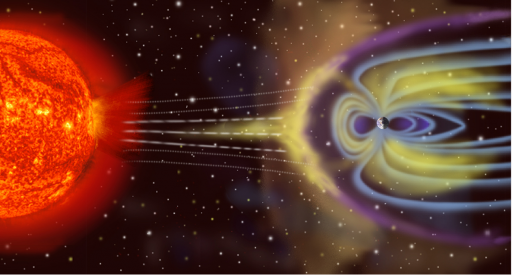
Magnetic reconnection, in which the magnetic field lines in plasma snap apart and violently reconnect, creates massive eruptions of plasma from the sun. But how reconnection transforms magnetic energy into explosive particle energy has been a major mystery.
Now research conducted on the Magnetic Reconnection Experiment (MRX) at PPPL has taken a key step toward identifying how the transformation takes place, and measuring experimentally the amount of magnetic energy that turns into particle energy. The investigation showed that reconnection in a prototypical reconnection layer converts about 50 percent of the magnetic energy, with one-third of the conversion heating the electrons and two-thirds accelerating the ion in the plasma. “This is a major milestone for our research,” said Masaaki Yamada, the principal investigator for the MRX. “We can now see the entire picture of how much of the energy goes to the electrons and how much to the ions in a prototypical reconnection layer.”
What a Difference a Magnetic Field Makes. Experiments on MRX confirm the lack of symmetry in converging space plasmas.
Paper by: J. Yoo
Spacecraft observing magnetic reconnection have noted a fundamental gap between most theoretical studies of the phenomenon and what happens in space. While the studies assume that the converging plasmas share symmetrical characteristics such as temperature, density and magnetic strength, observations have shown that this is hardly the case
PPPL researchers have now found the disparity in plasma density in experiments conducted on the MRX. The work, done in collaboration with the Space Science Center at the University of New Hampshire, marks the first laboratory confirmation of the disparity and deepens understanding of the mechanisms involved.
Data from the MRX findings could help to inform a four-satellite mission—the Magnetospheric Multiscale Mission, or MMS—that NASA plans to launch next year to study reconnection in the magnetosphere. The probes could produce a better understanding of geomagnetic storms and lead to advanced warning of the disturbances and an improved ability to cope with them.
Using radio waves to control density in fusion plasma. Experiments show how heating electrons in the center of hot fusion plasma can increase turbulence, reducing the density in the inner core.
Paper by: D. Ernst, K. Burrell, W. Guttenfelder, T. Rhodes, A. Dimits
Recent fusion experiments on the DIII-D tokamak at General Atomics in San Diego and the Alcator C-Mod tokamak at MIT show that beaming microwaves into the center of the plasma can be used to control the density in the center of the plasma. The experiments and analysis were conducted by a team of researchers as part of a National Fusion Science Campaign.
The new experiments reveal that turbulent density fluctuations in the inner core intensify when most of the heat goes to electrons instead of plasma ions, as would happen in the center of a self-sustaining fusion reaction. Supercomputer simulations closely reproduce the experiments, showing that the electrons become more turbulent as they are more strongly heated, and this transports both particles and heat out of the plasma. “As we approached conditions where mainly the electrons are heated, pure trapped electrons begin to dominate,” said Walter Guttenfelder, who did the supercomputer simulations for the DIII-D experiments along with Andris Dimits of Lawrence Livermore National Laboratory. Guttenfelder was a co-leader of the experiments and simulations with Keith Burrell of General Atomics and Terry Rhoades of UCLA. Darin Ernst of MIT led the overall research.
Calming the Plasma Edge: The Tail that Wags the Dog. Lithium injections show promise for optimizing the performance of fusion plasmas.
Paper by: G.L. Jackson, R. Maingi, T. Osborne, Z. Yan, D. Mansfield, S.L. Allen
Experiments on the DIII-D tokamak fusion reactor that General Atomics operates for the U.S. Department of Energy have demonstrated the ability of lithium injections to transiently double the temperature and pressure at the edge of the plasma and delay the onset of instabilities and other transients. Researchers conducted the experiments using a lithium-injection device developed at PPPL.
Lithium can play an important role in controlling the edge region and hence the evolution of the entire plasma. In the present work, lithium diminished the frequency of instabilities known as “edge localized modes” (ELMs), which have associated heat pulses that can damage the section of the vessel wall used to exhaust heat in fusion devices.
The tailored injections produced ELM-free periods of up to 0.35 seconds, while reference discharges without lithium showed no ELM-free periods above 0.03 sec. The lithium rapidly increased the width of the pedestal region—the edge of the plasma where temperature drops off sharply—by up to 100 percent and raised the electron pressure and total pressure in the edge by up to 100 percent and 60 percent respectively. These dramatic effects produced a 60 percent increase in total energy-confinement time.
Scratching the surface of a material mystery. Scientists shed new light on how lithium conditions the volatile edge of fusion plasmas.
Paper by: Angela Capece
For fusion energy to fuel future power plants, scientists must find ways to control the interactions that take place between the volatile edge of fusion plasma and the physical walls that surround it in fusion facilities. Such interactions can profoundly affect conditions at the superhot core of the plasma in ways that include kicking up impurities that cool down the core and halt fusion reactions. Among the puzzles is how temperature affects the ability of lithium to absorb and retain the deuterium particles that stray from the fuel that creates fusion reactions.
Answers are now emerging from a new surface-science laboratory at PPPL that can probe lithium coatings that are just three atoms thick. The experiments showed that the ability of ultrathin lithium films to retain deuterium drops as the temperature of the molybdenum substrate rises—a result that provides insight into how lithium affects the performance of tokamaks. Experiments further showed that exposing the lithium to oxygen improved deuterium retention at temperatures below about 400 degrees Kelvin. But without exposure to oxygen, lithium films could retain deuterium at higher temperatures as a result of lithium-deuterium bonding during a PPPL experiment.
Putting Plasma to Work Upgrading the U.S. Power Grid. PPPL lends GE a hand in developing an advanced power-conversion switch.
Paper by: Johan Carlsson, Alex Khrabrov, Igor Kaganovich, Timothy Summerer
When researchers at General Electric sought help in designing a plasma-based power switch, they turned to PPPL. The proposed switch, which GE is developing under contract with the DOE’s Advanced Research Projects Agency-Energy, could contribute to a more advanced and reliable electric grid and help lower utility bills. The switch would consist of a plasma-filled tube that turns current on and off in systems that convert the direct current coming from long-distance power lines to the alternating current that lights homes and businesses; such systems are used to reverse the process as well.
To assist GE, PPPL used a pair of computer codes to model the properties of plasma under different magnetic configurations and gas pressures. GE also studied PPPL’s use of liquid lithium, which the laboratory employs to prevent damage to the divertor that exhausts heat in a fusion facility. The information could help GE develop a method for protecting the liquid-metal cathode—the negative terminal inside the tube—from damage from the ions carrying the current flowing through the plasma.
Laser experiments mimic cosmic explosions. Scientists bring plasma tsunamis into the lab.
Researchers are finding ways to understand some of the mysteries of space without leaving earth. Using high-intensity lasers at the University of Rochester’s OMEGA EP Facility focused on targets smaller than a pencil’s eraser, they conducted experiments to create colliding jets of plasma knotted by plasma filaments and self-generated magnetic fields.
In two related experiments, researchers used powerful lasers to recreate a tiny laboratory version of what happens at the beginning of solar flares and stellar explosions, creating something like a gigantic plasma tsunami in space. Much of what happens in those situations is related to magnetic reconnection, which can accelerate particles to high energy and is the force driving solar flares towards earth.
Laboratory experiment aims to identify how tsunamis of plasma called “shock waves” form in space.
By W. Fox, G. Fisksel (LLE), A. Bhattacharjee
William Fox, a researcher at the U.S. Department of Energy’s Princeton Plasma Physics Laboratory, and his colleague Gennady Fiksel, of the University of Rochester, got an unexpected result when they used lasers in the Laboratory to recreate a tiny version of a gigantic plasma tsunami called a “shock wave.” The shock wave is a thin area found at the boundary between a supernova and the colder material around it that has a turbulent magnetic field that sweeps up plasma into a steep tsunami-like wave of plasma.
Fox and Fiksel used two very powerful lasers to zap two tiny pieces of plastic in a vacuum chamber to 10 million degrees and create two colliding plumes of extremely hot plasma. The researchers found something they had not anticipated that had not previously been seen in the laboratory: When the two plasmas merged they broke into clumps of long thin filaments due to a process called the “Weibel instability.” This instability could be causing the turbulent magnetic fields that form the shock waves in space. Their research could shed light on the origin of primordial magnetic fields that formed when galaxies were created and could help researchers understand how cosmic rays are accelerated to high energies.
Magnetic reconnection in the laboratory.
By: G. Fiksel (LLE), W. Fox, A. Bhattacharjee
Many plasmas in space already contain a strong magnetic field, so colliding plasmas there behave somewhat differently. Gennady Fiksel, of the University of Rochester, and William Fox continued their previous research by adding a magnetic field by pulsing current through very small wires. They then created the two colliding plumes of plasma as they did in an earlier experiment. When the two plasmas collided it compressed and stretched the magnetic field and a tremendous amount of energy accumulated in the field like a stretched rubber band. As the magnetic field lines pushed close together, the long lines broke apart and reformed like a single stretched rubber band, forming a slingshot that propels the plasma and releases the energy into the plasma, accelerating the plasma and heating it.
The experiment showed that the reconnection process happens faster than theorists had previously predicted. This could help shed light on solar flares and coronal mass ejections, which also happen extremely quickly. Coronal mass ejections can trigger geomagnetic storms that can interfere with satellites and wreak havoc with cellphone service.
The laser technique the scientists are using is new in the area of high energy density plasma and allows scientists to control the magnetic field to manipulate it in various ways.
Source: Princeton Plasma Physics Laboratory
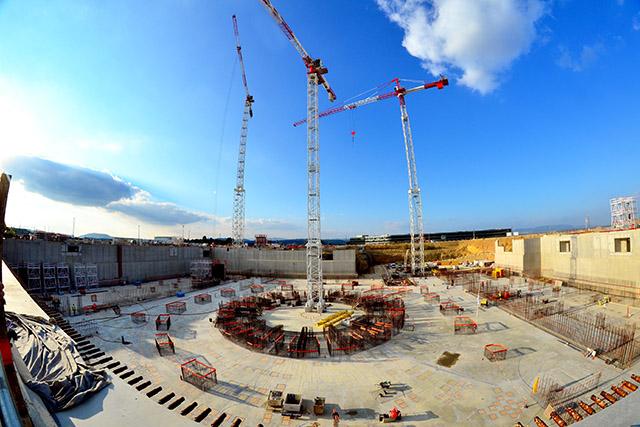 The foundations of the building that will house the world’s largest experimental tokamak fusion reactor ITER have been completed with work entering the second phase of construction.
Workers at the Cadarache nuclear research facility in the south of France have started building walls around the large excavated area where a seven-storey building housing the ambitious project and related facilities will stand – another major milestone after the completion of the Tokamak Complex basement in August. "The start of pouring activities for the massive Tokamak Complex is an important and exciting moment for the ITER Project," said ITER director-general Osamu Motojima. "Years of hard work by all ITER members are bearing fruit as the ITER facility takes shape in France and as the manufacturing of the systems and components advances. ITER is progressing on all fronts."
The first phase of construction, involving the creation of the ground support structure for the Tokamak Complex, took four years to finish. Between August 2010 and 2014, workers dug the 17m-deep Tokamak Complex Seismic Pit, created a ground-level basement and retaining walls, installed 493 seismic columns and pads and created the B2 foundation slab that will support some 400,000 tonnes of building equipment including the 23,000-ton tokamak.
"Europe is taking ITER construction to the next level,” said Henrik Bindslev, director of Fusion for Energy – the agency overseeing the project. “The basemat is where scientific work and industrial know-how will come together and be deployed to seize the power of fusion energy." The seven-storey Tokamak Complex will house not only the ITER Tokamak itslef, but also more than 30 different plant systems including cooling systems and electrical power supplies. Eighty metres tall, 120m long and 80m wide, the construction of the Tokamak Complex will require 16,000 tonnes of rebar, 150,000 cubic metres of concrete and 7,500 tonnes of steel.
French-Spanish consortium VFR is responsible for the construction as part of a €300m contract, signed in December 2012. As part of the deal, VFR will also build the ITER Assembly Building and facilities to house heating, ventilation and air-conditioning systems, as well as cryoplant compressor and a coldbox.
Three-hundred workers are currently employed on the construction site but the number is expected to increase to 2,000 in the upcoming years.
ITER is scheduled for completion in 2019 with first attempts to produce plasma in a nuclear fusion reaction to take place in 2020. However, regular operations are not expected to commence before 2027, 11 years behind the original schedule.
The programme was initiated in 1985 and formally approved in 2006 with an estimated budget of €10bn.
Source: Engineering and Technology Magazine
 General Atomics’ DIII-D Tokamak has been a critical part of the nation’s magnetic fusion energy research since it was built in the 1980s.
Over the years, wear and tear has taken its toll. However, it was impossible for researchers to see inside the San Diego company’s highly complicated machine to assess damage - until now.
Lawrence Livermore National Laboratory researchers, in collaboration with General Atomics and the University of Arizona, have developed an infrared and visible camera viewing system that’s able to produce wide-angle, tangential views of full poloidal (north-south direction of the magnetic field) cross-sections inside the tokamak.
The camera’s images provide researchers with data about the interior conditions of the DIII-D, which was built under contract for the Department of Energy. DOE provides funding for its operation.
“We wanted to look inside the tokamak’s chamber to see where things were heating up on the walls,” said Kevin Morris, a designer with LLNL’s National Security Engineer Division, who was part of the research team that developed the camera system. “There are a lot of critical areas that are heated by the plasma, and researchers want to understand them better.”
Tokamaks are devices that use a magnetic field to confine plasma in the shape of a torus, which looks like doughnut. The plasma is produced by heating a mixture of deuterium and tritium – two isotopes of hydrogen – to temperatures greater than 150 million degrees Celsius.
In order to keep the hot electrically charged plasma particles away from the machine’s walls, strong magnetic field lines cause them to move around the torus in a helical shape.
A rendering of the inside of the DIII-D Tokamak. Image credit: LLNL“The plasma can be unstable,” Morris said. “This can result in heating of the wall in new places.”
The camera system consists of a commercially available infrared camera, a fast visible camera and an optical system designed by a collaboration of physicists, engineers, optical designers and mechanical designers.
Their design will be used as a prototype for a set of larger cameras that will be built for the International Thermonuclear Experimental Reactor project. The international nuclear fusion megaproject seeks to build the world’s largest experimental tokamak in France.
DIII-D’s camera system, which looks like a periscope, has three polished stainless steel mirrors in a vacuum that view the tokamak through an aperture in the first mirror. It views the machine’s lower divertor, upper divertor, inner wall and outer wall in infrared and visible light.
Experiments with the infrared camera have produced results including surface temperatures measurements, surface heat flux profiles and heat distribution along the wall, both in latitude and longitude.
The research team’s findings were published in the American Institute of Physics Review of Scientific Instruments.
Team members include LLNL's Lynn Seppala, Dean Urone, Kevin Morris, Shannon Ayers and Bill Meyer; General Atomics: Charles Lasnier, Steve Allen and Ron Ellis.
Source: Product Design&Development
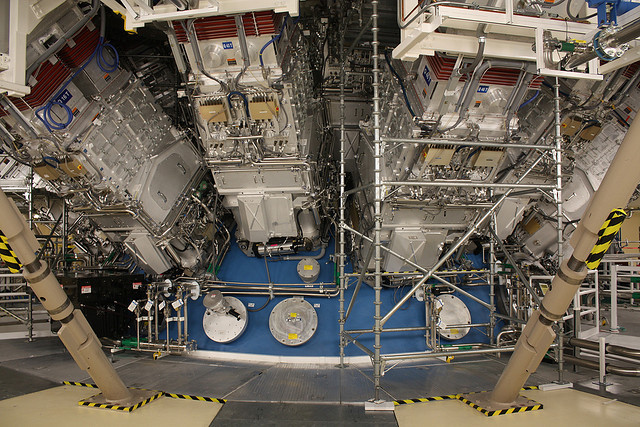 A crucial milestone has been reached by US lab researchers in their quest towards cracking self-sustaining nuclear fusion.
Harnessing fusion, the process powering the sun, has the potential to create an abundant source of low-cost energy. Despite being the object of significant study, it has so far remained elusive, as artificial fusion reactions created here on earth consume more energy than they produce. Following a breakthrough by the $35bn National Ignition Facility (NIF) in Livermore, California, there are new hopes of achieving a self-sustaining reaction, or ignition where the power output exceeds the power required to start the reaction.
Scientists at NIF reached the point of nuclear fusion by heating and compressing a small pellet of hydrogen fuel using 192 beams from the world’s most powerful laser. According to a recent update, one NIF experiment in late September resulted in the amount of energy being produced through the fusion reaction exceeding the amount of energy consumed by the fuel for the first time in any facility in the world.
‘Promising’ breakthrough demonstration
NIF is yet to reach the point of ‘ignition’, a self-sustaining reaction where the amount of energy produced exceeds the energy supplied to the laser. This delay in research is known to be due to inefficiencies in the system, meaning that most of the energy delivered by the lasers is lost in the effort to achieve the temperatures required for fusion, rather than on the reaction itself. However, this latest breakthrough in fusion is the most promising in recent years, moving fusion research forward significantly.
It has been hoped that the NIF would make a breakthrough after almost half a century of striving towards this goal. The NIF team announced a plan in 2009 to demonstrate nuclear fusion providing net energy by the 30th September 2012. However, this deadline was unmet due to technical errors, and the output was less than that predicted by mathematical models. Later, the facility shifted its focus from fusion to nuclear weapons, part of its original purpose.
Nevertheless, the latest experiment’s results are in keeping with output predictions, which is encouraging both for future ignition research at NIF, and for general advocates of nuclear fusion.
Current nuclear power operates on the concept of nuclear fission, which is the splitting of the atom, rather than the fusing of the atom. NIF is one of several fusion research projects worldwide that are conducting research into nuclear fusion. One such project is the multi-billion pound ITER facility which is being constructed in Cadarache, France. In contrast with the NIFs approach to fusion, ITER aims to use the concept of ‘magnetic confinement’ to contain fusion fuel within a magnetic field. The Nuclear Power Plant Generation The Fukushima Daiichi Nuclear Power Plant is an example of the current use of nuclear power. Located in the Futaba District of Fukushima Prefecture, Japan. This plant has been disabled since it was hit by the magnitude 9.0 earthquake and tsunami on the 11th March in 2011.
Recently, an isotope ratio analysis of 235U and 238U in the soil was performed using ICP-MS, which you can read in this article: Soil Survey Related to the Fukushima Daiichi Nuclear Power Plant Accident. After the disaster, the Japanese government had planned to gradually reduce its dependence on nuclear power. However, Japan has since revised their nuclear power plan and a new energy policy has been approved which will see nuclear generation continue.
Source: Pollution Solutions
Local News
- 1
- 2
- 3
- 4
- 5
IPPLM joins the Enterprise Europe Network
31-03-2026
On 23 March 2026, the Institute of Plasma Physics and Laser Microfusion (IPPLM) joined, with its technological offer, the group of entities affiliated with the Enterprise Europe Network (EEN), interested...
Read moreIPPLM as a co-creator of the exhibition "E = mc² – the formula that changed the world" at the National…
18-02-2026

On 16 February 2026, the official opening of two new permanent exhibitions took place at the National Museum of Technology in Warsaw. The Institute of Plasma Physics and Laser Microfusion...
Read moreIPPLM supports children and young people at the TPD "Helenów" Centre
22-12-2025

The Sylwester Kaliski Institute of Plasma Physics and Laser Microfusion (IPPLM) has for many years been actively engaged in initiatives supporting children and young people supported by the TPD "Helenów"...
Read moreIPPLM researchers took part in an experimental campaign on the GEKKO XII laser
20-11-2025

On 10–14 November 2025, a research team from the Sylwester Kaliski Institute of Plasma Physics and Laser Microfusion (IPPLM) – Prof. Katarzyna Batani, Dr Hanna Marchenko and Dr Agnieszka Zaraś-Szydłowska...
Read moreRegister for the 18th Kudowa Summer School on Plasma Physics!
07-11-2025

We invite you to take part in the 18th Kudowa Summer School "Towards Fusion Energy", which will be held on 8–12 June 2026 in Kudowa-Zdrój, Poland. The event is organised...
Read moreIPPLM participated in the second technical meeting within the DONES Con-P1 project
17-10-2025
The Institute of Plasma Physics and Laser Microfusion (IPPLM) took part in the second technical meeting held as part of the DONES Consolidation Phase 1 (DONES ConP1) project, co-financed by...
Read moreProf. Jan Badziak from IPPLM among the World’s Top 2% Scientists
15-10-2025
Prof. Jan Badziak, from the Department of Laser Plasma and Magnetized Dense Plasma Physics at the Institute of Plasma Physics and Laser Microfusion (IPPLM), has been included in the prestigious...
Read more29th Science Festival with the participation of IPPLM
10-10-2025

During the 29th Science Festival in Warsaw, held on 19–28 September 2025, researchers from the Institute of Plasma Physics and Laser Microfusion (IPPLM) conducted lessons for upper-grade primary school students. The...
Read morePLASMA 2025 and the 20th Anniversary of the Euratom–IPPLM Association – event summary
26-09-2025

From 15 to 19 September 2025, Warsaw hosted the international scientific conference PLASMA 2025 – International Conference on Research and Application of Plasmas, dedicated to plasma research, diagnostics, and applications....
Read moreWe bid farewell with deep sorrow to Professor Jerzy Wołowski
25-09-2025

It is with great sadness that we have received the news of the passing of Professor Jerzy Wołowski (1936–2025) an outstanding physicist, long-time employee of the Institute of Plasma Physics...
Read more20th anniversary of the Euratom–IPPLM Association (CeNTE): Celebrating two decades of fusion research coordination
16-09-2025

On 19 September 2025, during the PLASMA 2025 International Conference on Research, Diagnostics and Applications of Plasma in Warsaw, the IPPLM will mark 20th anniversary of the coordination of research on nuclear fusion...
Read moreIPPLM at the 49th Congress of Polish Physicists in Katowice
13-09-2025
During the 49th Congress of Polish Physicists, held from September 5–11, 2025, in Katowice, the Institute of Plasma Physics and Laser Microfusion (IPPLM) was represented both among the speakers and...
Read moreProf. Agata Chomiczewska appointed Deputy Director for Scientific Affairs at the IPPLM
03-09-2025

We are pleased to announce that the Minister of Energy, Mr. Miłosz Motyka, has appointed Dr. hab. Agata Chomiczewska to the position of Deputy Director for Scientific Affairs at the...
Read moreA historic milestone – the Scientific Council of the Institute confers the degree of habilitated doctor
10-07-2025
For the first time in the history of the Institute of Plasma Physics and Laser Microfusion (IPPLM), the Scientific Council has adopted a resolution to confer the degree of habilitated...
Read moreNew Board of the Plasma Physics Division of the European Physical Society
04-07-2025

In the first quarter of 2025, elections were held for the Board of the Plasma Physics Division of the European Physical Society (EPS Plasma Physics Division). Six candidates who received...
Read moreIPPLM researchers bring fusion expertise to 10th Central & Eastern Europe Nuclear Industry Congress 2025
12-06-2025
Researchers from the Institute of Plasma Physics and Laser Microfusion (IPPLM), Dr. Natalia Wendler and Dr. Paweł Gąsior, recently participated in a panel discussion at the 10th Central & Eastern...
Read moreIPPLM at the 3rd edition of the "Science for Society" Congress
29-05-2025

On 25-26 May 2025, the 3rd edition of the "Science for Society" Congress took place in the Large Hall of the Warsaw University of Technology. The aim of the event...
Read moreInvitation to the 3rd edition of the "Science for Society" Congress with the participation of IPPLM
22-05-2025

The 3rd edition of the "Science for Society" Congress will take place on 25–26 May 2025 at the Warsaw University of Technology. This unique event demonstrates that science is not...
Read moreJoin the 28th Science Picnic!
07-05-2025

The Institute of Plasma Physics and Laser Microfusion (IPPLM) invites you to its stand on Saturday, 10 May, during the 28th Science Picnic, organized by Polish Radio and the Copernicus...
Read moreCooperation agreement between the IPPLM and the National Museum of Technology
18-04-2025

On 17 April 2025, a cooperation agreement was signed between the National Museum of Technology (NMT) and the Institute of Plasma Physics and Laser Microfusion (IPPLM). The ceremonial meeting, attended by...
Read morePolish and French researchers join forces in research on nuclear fusion
31-03-2025

On 24-25 March 2025, a Polish-French meeting was held at the headquarters of the Institute of Nuclear Physics of the Polish Academy of Sciences (IFJ PAN) and the French Institute...
Read moreJoin us for the International Conference on Research and Application of Plasmas – PLASMA 2025!
13-03-2025

The Institute of Plasma Physics and Laser Microfusion (IPPLM) invites you to attend the PLASMA 2025 – International Conference on Research and Application of Plasmas, which will be held from...
Read moreExperimental research session in the Plasma-Focus PF1000U laboratory as part of the ICDMP collaboration
27-02-2025

On February 10–21, 2025, an experimental session was held in the Plasma-Focus PF-1000U laboratory, in which, in addition to the IPPLM team, a three-person team of researchers from the Prague...
Read moreLaser demonstration on JET detects fusion fuels
11-02-2025

Scientists and engineers from eight nations, including Poland, have carried out a project using lasers on the Joint European Torus (JET) to study fusion fuel retention. Laser Induced Breakdown Spectroscopy (LIBS),...
Read moreIPPLM employee nominated for the Personality of the Year title in the Science category
24-01-2025
Research and technical employee Mr. Olgierd Cichorek, M.Sc., from the Laboratory of Plasma Nudge for Satellites at the IPPLM has been nominated for the title of Personality of the Year...
Read moreWorld News
- 1
- 2
- 3
- 4
- 5
In Memoriam — Professor Francesco Romanelli
24-03-2026

The world of fusion research mourns the loss of Professor Francesco Romanelli, a visionary scientist whose work helped bring humanity closer to clean, limitless energy. Over four decades, he explored...
Read moreIgniting the future: Breakthroughs in inertial confinement Fusion
25-07-2025

In December 2022, the National Ignition Facility (NIF) at Lawrence Livermore National Laboratory (USA) marked a historic milestone in fusion science: an experiment produced 3.15 MJ of fusion energy from 2.05 MJ of laser...
Read moreWendelstein 7-X sets new fusion performance records
04-06-2025

On May 22, 2025, the Wendelstein 7-X (W7-X) stellarator at the Max Planck Institute for Plasma Physics (IPP) in Greifswald concluded its latest experimental campaign with a major success: a...
Read moreEuropean tokamak sets new fusion plasma record
20-02-2025

On February 12, 2025, the WEST tokamak, located at CEA Cadarache in southern France, set a new world record by sustaining fusion plasma for 1,337 seconds, or over 22 minutes....
Read moreDr. Gianfranco Federici appointed as the new EUROfusion Programme Manager
17-12-2024
At the 49th General Assembly held in Barcelona, December 2024, Dr. Gianfranco Federici was elected as the new Programme Manager of EUROfusion. He succeeds Prof. Ambrogio Fasoli, who will return...
Read moreEUROfusion and F4E join forces for Europe’s fusion future
16-12-2024

EUROfusion and Fusion for Energy (F4E) have signed a Memorandum of Understanding (MoU) to advance fusion research and development in Europe. This agreement reinforces cooperation in...
Read moreJohn J. Hopfield and Geoffrey E. Hinton awarded the 2024 Nobel Prize in Physics
08-10-2024

John J. Hopfield and Geoffrey E. Hinton have been awarded the 2024 Nobel Prize in Physics "for foundational discoveries and inventions that enable machine learning with artificial neural networks." The Nobel...
Read moreWendelstein 7-X begins new experimental campaign
10-09-2024

The Wendelstein 7-X, the world’s most advanced stellarator, is launching a new experimental campaign after a year of intensive maintenance and upgrades. This phase, known as OP2.2, begins on 10...
Read moreITER's New Project Baseline: A Robust Path to Fusion Energy Research
04-07-2024

On 3 July, ITER Director-General Pietro Barabaschi presented the new project baseline, under evaluation by the ITER Organization's governing body. This plan aims to ensure a robust start to scientific...
Read moreITER Council Presents Updated Project Baseline
21-06-2024

The ITER Council convened this week for its 34th meeting, where nearly 100 attendees reviewed significant updates to the project baseline. The proposed changes aim to optimize the overall project...
Read moreEurope and Japan celebrate breakthrough in paving the way for fusion energy
01-12-2023

The prospect of harnessing fusion energy is closer. The successful operation of JT-60SA, the most powerful experimental device to date, built by Europe and Japan, is a landmark achievement for...
Read moreFirst plasma was successfully generated at JT-60SA
26-10-2023

A momentous achievement in the field of nuclear fusion has been accomplished by a collaborative team of engineers from Europe and Japan. They have successfully generated tokamak plasma for the...
Read moreThe Nobel Prize in Physics 2023
03-10-2023
Pierre Agostini, Ferenc Krausz and Anne L’Huillier are the winners of this year's Nobel Prize in Physics. It was awarded "for experimental methods that generate attosecond pulses of light for...
Read moreUS Lab Replicates Fusion Ignition Breakthrough
08-08-2023
The US National Ignition Facility (NIF) has achieved fusion ignition once again, building on its landmark 2022 success. This achievement, powered by hydrogen within a diamond capsule, signifies a major...
Read moreNew Programme Manager Elect announced by EUROfusion
20-07-2023
Professor Ambrogio Fasoli became the new EUROfusion Programme Manager Elect. The decision was made by EUROfusion General Assembly at the meeting on 18 July 2023. His tenure will officially commence...
Read moreEUROfusion stands in solidarity with research in Ukraine
24-02-2023

Today, as we commemorate the anniversary of the invasion of Ukraine by Russia, the EUROfusion consortium stands in solidarity with our Ukrainian member and research colleagues. EUROfusion remains committed to supporting...
Read moreEight-minute production of plasma with gigajoule energy turnover at Wendelstein 7-X
23-02-2023

Another target has been achieved only recently by the W7-X researchers, namely they managed to acquire an energy turnover of 1.3 gigajoules in the device, which is 17 times higher...
Read moreThe Nobel Prize in Physics 2022
04-10-2022

Alain Aspect, John F. Clauser and Anton Zeilinger are the winners of this year's Nobel Prize in Physics. It was awarded “for experiments with entangled photons, establishing the violation of...
Read moreNew experiments for fusion energy record breaker JET
27-09-2022

A new wave of fusion energy experiments on UK Atomic Energy Authority’s record-breaking Joint European Torus (JET) started this month. EUROfusion researchers are using the famous JET machine to conduct a...
Read moreITER appoints new Director-General
21-09-2022
Pietro Barabaschi has become the next Director-General of the ITER Organization as a result of the unanimous choice of the Council from among finalist candidates. In the transition period Dr....
Read moreStarting power plant design
07-07-2022

At a livestreamed Horizon EUROfusion event in Brussels on 5 July 2022, EUROfusion celebrated the start of conceptual design activities for Europe's first demonstration fusion power plant DEMO. This first-of-a-kind...
Read moreCelebration of achieving a crucial assembly milestone in the ITER Project
17-05-2022

This month, we have witnessed the successful lifting and lowering into the machine well of the first sub-section of the ITER plasma chamber. The weight of the component is the...
Read moreBurning plasma achieved in inertial fusion at the National Ignition Facility
15-02-2022
Obtaining a burning plasma is a critical step towards self-sustaining fusion energy. A burning plasma is one in which the fusion reactions themselves are the primary source of heating in...
Read moreHistoric milestone reached by JET scientists
20-01-2022

Iconic fusion energy machine JET – which reaches controlled temperatures 10 times hotter than the core of the sun – completed its 100,000th live pulse last night. Weighing 2,800 tonnes, the...
Read moreHorizon Europe Grant Agreement signed
20-12-2021

15 December 2021 saw the EUROfusion consortium signing the Grant Agreement under Horizon Europe, the European Framework Programme from 2021 – 2027, in an aim to launch comprehensive R&D approach...
Read more |
 |
 |
 |
 |
 |
 |
 |
What we do
Our laboratories
Online seminars
| Thursday, 30 Apr 2026, godz. 13.00 Seminarium instytutowe: "Equation of State of Shock Compressed BN in the Megabar Pressure Range", dr hab. Katarzyna Batani, IFPiLM |


Research projects carried out at the IPPLM are funded by the Polish Ministry of Education and Science, the National Science Centre and by the European Commission within the framework of EUROfusion Consortium under grant agreement No 101052200. Financial support comes also from the International Atomic Energy Agency, European Space Agency and LaserLab Consortium as well as from the Fusion for Energy Agency.