





Zestaw obrazów 2019
zdjecie1.jpg
zdjecie2.jpg
zdjecie3.jpg
zdjecie4.jpg
zdjecie5.jpg
zdjecie6.jpg
2019_1.JPG
2019_2.JPG
2019_4.JPG


Światowe
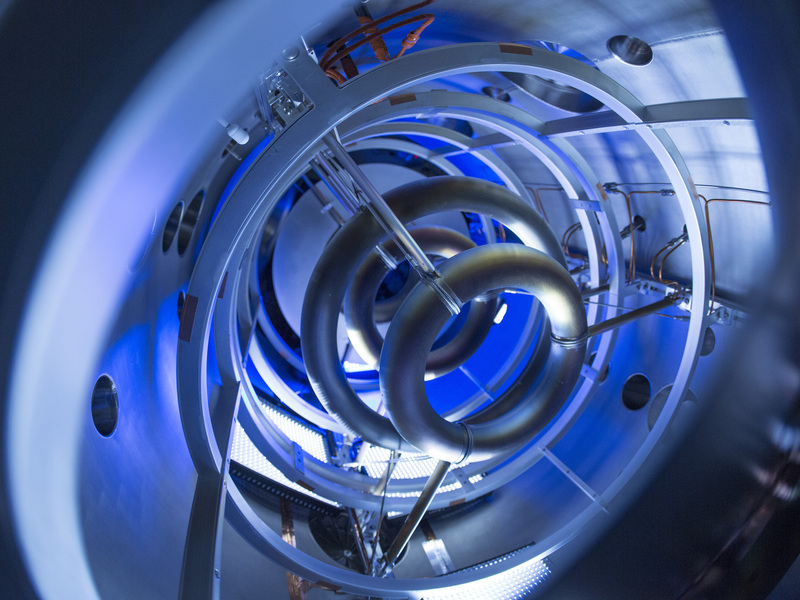 Lockheed Martin’s compact reactor concept / fusion drives for aircraft and trucks?
Building a small, transportable fusion power plant has long been a dream of fusion researchers. In the course of their research, however, it became clear that a functioning power plant has to be of a certain minimum size. Nevertheless, there are occasionally renewed attempts (see “The fusion upstarts”, in Nature, Vol. 511, 14/7/2014, p. 398 ff.). IPP scientists Professor Sibylle Günter and Professor Karl Lackner explain why also the latest version proposed by US technology concern Lockheed Martin might well remain a dream:
The patent applications for the device proposed by Lockheed Martin do not involve a really new concept, but combine the known concepts of a magnetic cusp and a magnetic mirror. Both are impaired by the fact that charged particles can escape along the magnetic field lines out of the confinement region. This leads to an intolerable energy loss, because it is primarily the fast, hot particles that get lost first. Nor does it help here, as proposed, to link several cusps behind one another or combine them with magnetic mirrors.
What is envisaged is incorporating coils in the vessel, i.e. inside the plasma. This needs connections to the outside and fixtures in the plasma vessel. Hot plasma particles from the core of the device would thus come into direct contact with these fixtures. The fundamental idea of magnetic confinement, however, is precisely to keep the high-energy plasma particles in the core moving along the magnetic field lines at always the same volume without impinging on material walls. Otherwise the plasma cools down very fast. One solution here would be superconducting coils levitating in the vessel without support, this leaving, however, the above energy loss problem: The configuration proposed is not suitable for confining hot plasmas.
Furthermore, the coils inside the plasma vessel have to be shielded not only from the surrounding hot plasma, but also from the neutrons produced in the fusion process. With superconducting coils, at least 80 centimetres of shielding around each coil is needed. This does not accord with the power plant size envisaged.
All of these problems have been resolved by the tokamak and stellarator concepts pursued today. Nevertheless, it is not possible to build small, transportable power plants. This is because attaining a positive energy balance, i.e. producing more fusion power than needed for heating the plasma, calls for extremely good thermal insulation of the plasma, viz. about 50 times better than styropor. In a power plant a temperature in the plasma core of 100 to 200 million degrees is needed, while at the walls no more than 1,000 degrees is tolerable. Such large temperature differences in the plasma drive turbulent flows that mix hot and cold regions with one another, i.e. impair the thermally insulating effect of the magnetic field. This has to be compensated with a larger volume. Here it is the size of the temperature gradient that determines the turbulent flows and hence the minimum size of a power plant. How a positive energy balance is to be achieved with the compact version propagated by Lockheed Martin is not even remotely mentioned in the patent applications.
Source: Max-Planck-Institut für Plasmaphysik
 Lockheed Martin's project to create a compact fusion reactor could provide a boost for other ventures aiming to harness nuclear fusion energy on a small scale — or at least they hope so.
"I'm glad to see them pursuing high-pressure plasma, because it's the only logical way to have an economical fusion reactor," Jaeyoung Park, president and chief scientist at New Mexico-based EMC2 Fusion Development Corp., told NBC News on 16 October. "Life is lonely if you're the only one doing it."
EMC2 Fusion has been working on a concept similar to Lockheed Martin's for years, as a follow-up to decades' worth of research by physicist Robert Bussard. The company is just one of a myriad of ventures aiming to turn nuclear fusion, the reaction that powers the sun as well as hydrogen bombs, into a commercial power-generating technology.
If fusion could be commercialized, it would offer a new kind of always-on power source that's cleaner than nuclear fission and fossil fuels, and potentially be cheaper than coal.
Some fusion research efforts are getting millions or even billions of dollars in government support — including the Z Machine at Sandia National Laboratories in New Mexico; the $3.5 billion laser-blasting National Ignition Facility in California; and the international ITER experimental project in France, which has a price tag that estimates say could rise as high as $50 billion over the next decade.
Other ventures, such as EMC2 Fusion and Lockheed Martin's newly revealed T4 project, aim to commercialize fusion for far less, using far less orthodox technological approaches.
Fusion reactor on a truck?
Over the past few years, the Navy spent $12 million to support EMC2 Fusion's research — and now EMC2 Fusion, like Lockheed, is looking for support from investors and other partners to take their experiments to the next level. In EMC2 Fusion's case, that means finding roughly $30 million for a demonstration reactor that shows how its Polywell concept could scale up to a net energy gain, and eventually commercial-scale reactors.
"We are getting decent exposure," Park said in an email. "This has helped us to make progress in our fundraising. It is moving forward, and I am cautiously optimistic about the chance of getting funded for the next phase, though everything takes a lot longer than expected. It is certainly an exciting roller coaster ride for a scientist." Another couple of months could tell the tale, Park said. And it doesn't hurt that the leader of Lockheed Martin's compact fusion research team, Tom McGuire, said his concept has some similarities to EMC2 Fusion's Polywell, which involves shooting positive ions into a powerful electromagnetic field. "I am happy to see the core principle of the Polywell concept is being adopted by others for their efforts for economical fusion power," Park said.
'The race is on'
Park's not the only one: Lockheed Martin's news was also cheered on the Talk-Polywell discussion forum, where members delve into the nitty-gritty of unorthodox fusion physics. "The race is on to achieve major funding for this general approach," one commenter wrote.
Lockheed Martin is by far the biggest company to reveal its interest in creating compact fusion reactors, and the fact that it's looking for partners should add to the already-percolating interest in commercial fusion research. Amazon.com billionaire Jeff Bezos, for instance, is one of the investors in Canada-based General Fusion. Meanwhile, Microsoft co-founder Paul Allen has invested in California-based Tri-Alpha Energy.
Other ventures such as Lawrenceville Plasma Physics are flying relatively under the radar but aiming for big breakthroughs in fusion physics.
Helion Energy, a start-up that was spun off from a University of Washington fusion research project, is working on its own demonstration fusion reactor — and recently announced a $1.5 million venture capital infusion.
Lockheed Martin's McGuire said his team would build a prototype compact fusion reactor within five years, but Helion's schedule is even more ambitious: The company's CEO, David Kirtley, hopes to get to the break-even point — that is, a fusion reaction where the energy output exceeds the input — within three years. In a recent email, Kirtley said Helion was making good progress toward that goal. "We have increased our demonstrated plasma temperatures to over 5 KeV [5,000 electron volts] and continue work on the engineering hardware of our next, break-even machine," he said.
So who'll win the commercial fusion race? Will anyone ever cross the break-even line and turn fusion into a cheap power source? Stay tuned ... at least it's good to know there's a race.
Source: NBC News
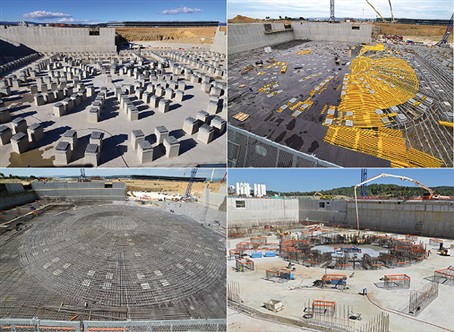 The floor upon which the biggest fusion machine in the world will rely on has been constructed.
This landmark achievement marks the conclusion of the works that started in August 2010 and represent an investment of around 100 million EUR for F4E, the European Union’s organisation responsible for Europe’s contribution to ITER. The construction has been carried out by a group of companies led by GTM SUD and under the supervision of F4E and the ENGAGE consortium consisting of Assystem, Atkins, Empresarios Agrupados and Egis. The floor will be able to support more than 400,000 tonnes of buildings infrastructure and equipment, including the ITER machine weighing 23,000 tonnes.
Professor Henrik Bindslev, Director of Fusion for Energy (F4E), explained that “Europe is taking the ITER construction to the next level. The basemat is the test bed of the biggest international collaboration in the field of energy. It’s where the scientific work and industrial know-how will come together and be deployed to seize the power of fusion energy”. Professor Osamu Motojima, Director General of ITER International Organization (ITER IO) stated that “the conclusion of this task is a historical moment for the project. Years of hard work by all ITER parties are bearing fruit as the facility takes shape and makes progress on all fronts”.
The ITER basemat in figures:
The basemat is far more complex that it seems. It has a surface of 9,600m2 and a thickness of 1,5 m of reinforced concrete consisting of four successive layers - two of 50cm, one of 30cm and one of 20cm. The first of the fifteen plots of concrete was poured in December 2013. Following the approval of the French Nuclear Authority in July 2014, regarding the robustness of the building design, nine central sections of the slab were poured within seven weeks leading to a successful completion of the works in late August 2014. In total 150 workers were involved in this operation, using 14,000m3 of concrete, 3,600 tonnes of steel and 2,500 embedded plates.
A web of 493 plinths coated with pads, lies beneath the upper slab, able to absorb the effect of an intense seismic shock. More concrete and thick steel rebars form a mesh to keep the foundations stable and lift the immense load of the machine. The design and validation process have been extremely challenging because the basemat will be the floor of the Tokamak building that will house the machine and shield it. For this reason it is has been subjected to heavy scrutiny from ITER IO and the French Nuclear Regulator. The infrastructure fully complies with the set of nuclear safety requirements branding ITER as the biggest nuclear facility in France and the first ever nuclear fusion facility in the world.
How will the ITER site evolve?
With the ITER basemat now completed, the construction of the complex that will house the core buildings of the machine has started. The VFR consortium, consisting of VINCI Construction Grands Projets, Ferrovial Agroman, Razel-Bec, Dodin Campenon Bernard, Campenon Bernard Sud-Est, GTM Sud and Chantiers Modernes Sud are responsible for carrying out the works. The building will be 80 metres tall, 120 metres long and 80 metres wide. It will require 16,000 tonnes of steel rebars and 150,000 m3 of concrete.
There has also been progress at the Assembly Hall building, where the massive ITER components will be put together. The steel structure of the building has become visible and so far the lower sections of the eight first columns have been erected. They weigh around 15 tonnes and are currently 12 metres high (once fully erected they will be 60 metres high).
The temporary road network, infirmary and restaurant have also completed making it possible for the contractors to set up their company offices on the site.
Source: Fusion for Energy
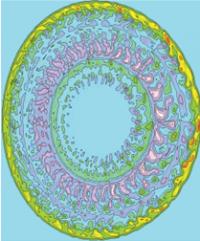 Recent fusion experiments on the DIII-D tokamak at General Atomics (San Diego) and the Alcator C-Mod tokamak at MIT (Cambridge, Massachusetts), show that beaming microwaves into the center of the plasma can be used to control the density in the center of the plasma, where a fusion reactor would produce most of its power. Several megawatts of microwaves mimic the way fusion reactions would supply heat to plasma electrons to keep the "fusion burn" going.
The new experiments reveal that turbulent density fluctuations in the inner core intensify when most of the heat goes to electrons instead of plasma ions, as would happen in the center of a self-sustaining fusion reaction. Supercomputer simulations closely reproduce the experiments, showing that the electrons become more turbulent as they are more strongly heated, and this transports both particles and heat out of the plasma.
"We are beginning to uncover the fundamental mechanisms that control the density, under conditions relevant to a real fusion reactor," says Dr. Darin Ernst, a physicist at the Massachusetts Institute of Technology, who led the experiments and simulations, together with co-leaders Dr. Keith Burrell (General Atomics), Dr. Walter Guttenfelder (Princeton Plasma Physics Laboratory), and Dr. Terry Rhodes (UCLA).
The experiments were conducted by a team of researchers as part of a National Fusion Science Campaign. This new program enables research on one fusion experiment to be expanded to device another with complementary instrumentation and capabilities. "The National Campaign has increased the impact of our work, with added benefit to the fusion program," says Dr. Ernst. "Comparing Alcator C-Mod and DIII-D tests our new predictions that particle collisions strongly reduce this type of turbulence. The collision rate varies by a factor of ten between the two machines," says Ernst.
The experiments and simulations suggest that trapped electron turbulence becomes more important under the conditions expected in self-heated fusion reactors. The structure of the simulated turbulence during the electron heating is shown at right. The simulations closely matched detailed measurements of the actual turbulence in the 20cm diameter inner core. "We discovered sheared flows also drive turbulence in the inner plasma core, but as we approached conditions where mainly the electrons are heated, the usual plasma flow is reduced and pure trapped electron turbulence begins to dominate," says Dr. Guttenfelder, who did the supercomputer simulations for the DIII-D experiments, along with Dr. Andris Dimits (LLNL). Measurements revealed a band of fluctuations, separated by a constant frequency interval, like harmonics in a musical note. "These new coherent fluctuations appear to be consistent with the basic trapped electron instability that grows stronger during heating, " says Dr. Rhodes.
In a self-heated fusion reactor, fusion reactions produce very energetic alpha particles that collide with electrons as they move through the plasma. The collisions heat the electrons by imparting random thermal motion. The electrons in turn collide with and heat cooler deuterium and tritium fuel ions to fusion temperatures. However, turbulent eddies can swirl the particles and energy away from the hot core toward the cooler edge, where they eventually are lost to the walls of the chamber.
These experiments are part of a larger systematic study of turbulent energy and particle loss under fusion-relevant conditions. "It's important to understand what drives the turbulence, and how it can be controlled and minimized, to find new ways of operating tokamaks that exploit that knowledge," says Dr. Burrell. By comparing detailed turbulence measurements with simulations, researchers hope to understand how turbulence controls the core temperature under fusion conditions.
Source: EurekAlert
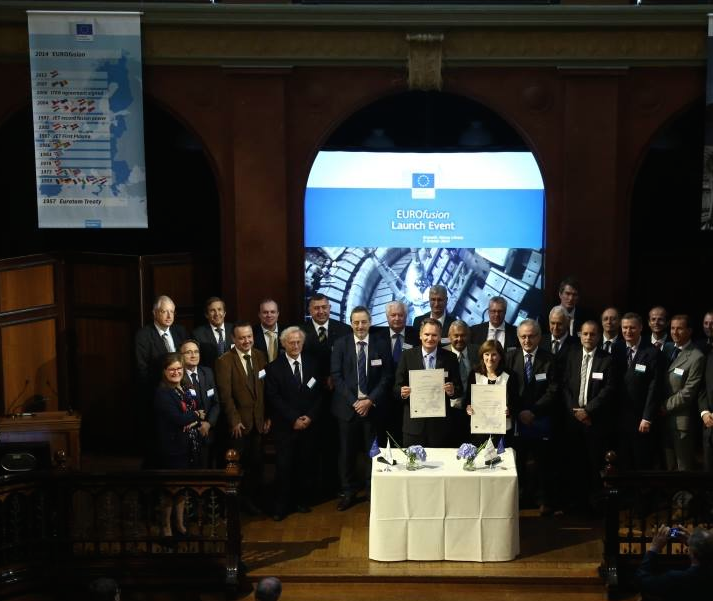
On 9 October 2014 the European Commission officially launched the European Consortium for the Development of Fusion Energy, EUROfusion for short. EUROfusion manages the European fusion research activities on behalf of Euratom, which awards the appropriate grant to the consortium. The new consortium agreement will substitute the fourteen year-old European Fusion Development Agreement (EFDA), as well as 29 bilateral Association agreements between the Commission and research institutions in 27 countries. The Grant Agreement (contract) provides €424M in funding from the Euratom Horizon 2020 programme 2014-18 and the same amount from Member States, adding up to an overall budget of €850 million for 5 years.
The launch of EUROfusion was celebrated with Europe’s fusion research community in the heart of the European Quarter, the Solvay Library. Robert-Jan Smits, Director-General DG Research & Innovation, opened the event in the presence of the Heads of EUROfusion Research Units, Members of the European Parliament and representatives of the European Commission. In his welcome address, Vice-President and European Commissioner for Energy, Günther Oettinger noted that “Europe sets the path to commercialization of fusion energy.” Prof. Sibylle Günter, Scientific Director of Max-Planck-Institute for Plasmaphysics, Germany, and Chair of the EUROfusion General Assembly, introduced the EUROfusion consortium and its research programme. She also thanked everybody who contributed to the sucess. Günter presented the roadmap to the realisation of fusion energy, which forms the basis for all EUROfusion activities. “The EUROfusion work plan is designed to exploit synergies and ensure excellence in the best possible way,” she pointed out. In his keynote address about fusion energy and fusion research in general, Prof. Steve Cowley, Director of Culham Centre for Fusion Energy (CCFE), UK, said: “It it is a wonderful time to work in fusion and the most important”.
At mid-day, Robert-Jan Smits and Sibylle Günter signed the grant agreement between EUROfusion and the European Commission, thus marking the official start of the Consortium. “It is an historic event as this is the European research organisation with the most member states, “ said EUROfusion Programme Manager Prof. Tony Donné. “For the first time we are bringing together 27 countries to work on a common scientific goal – fusion electricity by 2050.”
Dr. András Siegler, Director for Energy Research, DG Research & Innovation, opened the afternoon session. “Now that all contracts are signed we can focus on the research,” he said. Former EFDA Leader Prof. Francesco Romanelli looked both back and forward in this talk about the transition from EFDA to the Joint Programme under EUROfusion. He pointed out the pragmatic approach of Fusion Roadmap. “My advice,” he said, “don’t look for the ultimate solution.” A panel discussion between Tony Donné, Dr. Thomas Mull, AREVA and member of the Fusion Industry Innovation Forum, Dr. Catherine Cesarksy, former Chair of CCE-FU (Consultative Committee for the EURATOM specific research and training in the field of nuclear energy (fusion)), Prof. Niek-Lopes Cardozo, Chair of the Fusion Education Network FuseNet and Dr. Sandor Zoletnik, Head of the RMI-Institute for Particle and Nuclear Physics, Budapest, completed the event.
Background:
The formation of EUROfusion marks a big step forward for Europe’s quest to develop fusion power as a climate-friendly energy source that will contribute to meet a growing global energy demand. The EUROfusion Consortium enables Europe’s national laboratories to pool their resources even more efficiently – a measure which became necessary to meet the challenge of increasingly complex and large-scale projects such as ITER and DEMO. The preparation for such a joint fusion programme started in 2012. All EU research laboratories jointly drafted a detailed goal-oriented programme to realise fusion energy by 2050. This programme, known as the ‘Roadmap to the Realisation of Fusion Electricity’ outlines the most efficient path to fusion power. The roadmap has two main aims: Preparing for ITER experiments in order to ensure that Europe makes best possible use of ITER and to develop concepts for a fusion power demonstration plant DEMO. The necessary research towards reaching these aims is carried out by universities and research centres within the current European Framework Programme Horizon 2020. More than before does the programme involve industries in the process of designing components and finding technical solutions.
Source: euro-fusion.org
Local News
- 1
- 2
- 3
- 4
- 5
IPPLM joins the Enterprise Europe Network
31-03-2026
On 23 March 2026, the Institute of Plasma Physics and Laser Microfusion (IPPLM) joined, with its technological offer, the group of entities affiliated with the Enterprise Europe Network (EEN), interested...
Read moreIPPLM as a co-creator of the exhibition "E = mc² – the formula that changed the world" at the National…
18-02-2026

On 16 February 2026, the official opening of two new permanent exhibitions took place at the National Museum of Technology in Warsaw. The Institute of Plasma Physics and Laser Microfusion...
Read moreIPPLM supports children and young people at the TPD "Helenów" Centre
22-12-2025

The Sylwester Kaliski Institute of Plasma Physics and Laser Microfusion (IPPLM) has for many years been actively engaged in initiatives supporting children and young people supported by the TPD "Helenów"...
Read moreIPPLM researchers took part in an experimental campaign on the GEKKO XII laser
20-11-2025

On 10–14 November 2025, a research team from the Sylwester Kaliski Institute of Plasma Physics and Laser Microfusion (IPPLM) – Prof. Katarzyna Batani, Dr Hanna Marchenko and Dr Agnieszka Zaraś-Szydłowska...
Read moreRegister for the 18th Kudowa Summer School on Plasma Physics!
07-11-2025

We invite you to take part in the 18th Kudowa Summer School "Towards Fusion Energy", which will be held on 8–12 June 2026 in Kudowa-Zdrój, Poland. The event is organised...
Read moreIPPLM participated in the second technical meeting within the DONES Con-P1 project
17-10-2025
The Institute of Plasma Physics and Laser Microfusion (IPPLM) took part in the second technical meeting held as part of the DONES Consolidation Phase 1 (DONES ConP1) project, co-financed by...
Read moreProf. Jan Badziak from IPPLM among the World’s Top 2% Scientists
15-10-2025
Prof. Jan Badziak, from the Department of Laser Plasma and Magnetized Dense Plasma Physics at the Institute of Plasma Physics and Laser Microfusion (IPPLM), has been included in the prestigious...
Read more29th Science Festival with the participation of IPPLM
10-10-2025

During the 29th Science Festival in Warsaw, held on 19–28 September 2025, researchers from the Institute of Plasma Physics and Laser Microfusion (IPPLM) conducted lessons for upper-grade primary school students. The...
Read morePLASMA 2025 and the 20th Anniversary of the Euratom–IPPLM Association – event summary
26-09-2025

From 15 to 19 September 2025, Warsaw hosted the international scientific conference PLASMA 2025 – International Conference on Research and Application of Plasmas, dedicated to plasma research, diagnostics, and applications....
Read moreWe bid farewell with deep sorrow to Professor Jerzy Wołowski
25-09-2025

It is with great sadness that we have received the news of the passing of Professor Jerzy Wołowski (1936–2025) an outstanding physicist, long-time employee of the Institute of Plasma Physics...
Read more20th anniversary of the Euratom–IPPLM Association (CeNTE): Celebrating two decades of fusion research coordination
16-09-2025

On 19 September 2025, during the PLASMA 2025 International Conference on Research, Diagnostics and Applications of Plasma in Warsaw, the IPPLM will mark 20th anniversary of the coordination of research on nuclear fusion...
Read moreIPPLM at the 49th Congress of Polish Physicists in Katowice
13-09-2025
During the 49th Congress of Polish Physicists, held from September 5–11, 2025, in Katowice, the Institute of Plasma Physics and Laser Microfusion (IPPLM) was represented both among the speakers and...
Read moreProf. Agata Chomiczewska appointed Deputy Director for Scientific Affairs at the IPPLM
03-09-2025

We are pleased to announce that the Minister of Energy, Mr. Miłosz Motyka, has appointed Dr. hab. Agata Chomiczewska to the position of Deputy Director for Scientific Affairs at the...
Read moreA historic milestone – the Scientific Council of the Institute confers the degree of habilitated doctor
10-07-2025
For the first time in the history of the Institute of Plasma Physics and Laser Microfusion (IPPLM), the Scientific Council has adopted a resolution to confer the degree of habilitated...
Read moreNew Board of the Plasma Physics Division of the European Physical Society
04-07-2025

In the first quarter of 2025, elections were held for the Board of the Plasma Physics Division of the European Physical Society (EPS Plasma Physics Division). Six candidates who received...
Read moreIPPLM researchers bring fusion expertise to 10th Central & Eastern Europe Nuclear Industry Congress 2025
12-06-2025
Researchers from the Institute of Plasma Physics and Laser Microfusion (IPPLM), Dr. Natalia Wendler and Dr. Paweł Gąsior, recently participated in a panel discussion at the 10th Central & Eastern...
Read moreIPPLM at the 3rd edition of the "Science for Society" Congress
29-05-2025

On 25-26 May 2025, the 3rd edition of the "Science for Society" Congress took place in the Large Hall of the Warsaw University of Technology. The aim of the event...
Read moreInvitation to the 3rd edition of the "Science for Society" Congress with the participation of IPPLM
22-05-2025

The 3rd edition of the "Science for Society" Congress will take place on 25–26 May 2025 at the Warsaw University of Technology. This unique event demonstrates that science is not...
Read moreJoin the 28th Science Picnic!
07-05-2025

The Institute of Plasma Physics and Laser Microfusion (IPPLM) invites you to its stand on Saturday, 10 May, during the 28th Science Picnic, organized by Polish Radio and the Copernicus...
Read moreCooperation agreement between the IPPLM and the National Museum of Technology
18-04-2025

On 17 April 2025, a cooperation agreement was signed between the National Museum of Technology (NMT) and the Institute of Plasma Physics and Laser Microfusion (IPPLM). The ceremonial meeting, attended by...
Read morePolish and French researchers join forces in research on nuclear fusion
31-03-2025

On 24-25 March 2025, a Polish-French meeting was held at the headquarters of the Institute of Nuclear Physics of the Polish Academy of Sciences (IFJ PAN) and the French Institute...
Read moreJoin us for the International Conference on Research and Application of Plasmas – PLASMA 2025!
13-03-2025

The Institute of Plasma Physics and Laser Microfusion (IPPLM) invites you to attend the PLASMA 2025 – International Conference on Research and Application of Plasmas, which will be held from...
Read moreExperimental research session in the Plasma-Focus PF1000U laboratory as part of the ICDMP collaboration
27-02-2025

On February 10–21, 2025, an experimental session was held in the Plasma-Focus PF-1000U laboratory, in which, in addition to the IPPLM team, a three-person team of researchers from the Prague...
Read moreLaser demonstration on JET detects fusion fuels
11-02-2025

Scientists and engineers from eight nations, including Poland, have carried out a project using lasers on the Joint European Torus (JET) to study fusion fuel retention. Laser Induced Breakdown Spectroscopy (LIBS),...
Read moreIPPLM employee nominated for the Personality of the Year title in the Science category
24-01-2025
Research and technical employee Mr. Olgierd Cichorek, M.Sc., from the Laboratory of Plasma Nudge for Satellites at the IPPLM has been nominated for the title of Personality of the Year...
Read moreWorld News
- 1
- 2
- 3
- 4
- 5
In Memoriam — Professor Francesco Romanelli
24-03-2026

The world of fusion research mourns the loss of Professor Francesco Romanelli, a visionary scientist whose work helped bring humanity closer to clean, limitless energy. Over four decades, he explored...
Read moreIgniting the future: Breakthroughs in inertial confinement Fusion
25-07-2025

In December 2022, the National Ignition Facility (NIF) at Lawrence Livermore National Laboratory (USA) marked a historic milestone in fusion science: an experiment produced 3.15 MJ of fusion energy from 2.05 MJ of laser...
Read moreWendelstein 7-X sets new fusion performance records
04-06-2025

On May 22, 2025, the Wendelstein 7-X (W7-X) stellarator at the Max Planck Institute for Plasma Physics (IPP) in Greifswald concluded its latest experimental campaign with a major success: a...
Read moreEuropean tokamak sets new fusion plasma record
20-02-2025

On February 12, 2025, the WEST tokamak, located at CEA Cadarache in southern France, set a new world record by sustaining fusion plasma for 1,337 seconds, or over 22 minutes....
Read moreDr. Gianfranco Federici appointed as the new EUROfusion Programme Manager
17-12-2024
At the 49th General Assembly held in Barcelona, December 2024, Dr. Gianfranco Federici was elected as the new Programme Manager of EUROfusion. He succeeds Prof. Ambrogio Fasoli, who will return...
Read moreEUROfusion and F4E join forces for Europe’s fusion future
16-12-2024

EUROfusion and Fusion for Energy (F4E) have signed a Memorandum of Understanding (MoU) to advance fusion research and development in Europe. This agreement reinforces cooperation in...
Read moreJohn J. Hopfield and Geoffrey E. Hinton awarded the 2024 Nobel Prize in Physics
08-10-2024

John J. Hopfield and Geoffrey E. Hinton have been awarded the 2024 Nobel Prize in Physics "for foundational discoveries and inventions that enable machine learning with artificial neural networks." The Nobel...
Read moreWendelstein 7-X begins new experimental campaign
10-09-2024

The Wendelstein 7-X, the world’s most advanced stellarator, is launching a new experimental campaign after a year of intensive maintenance and upgrades. This phase, known as OP2.2, begins on 10...
Read moreITER's New Project Baseline: A Robust Path to Fusion Energy Research
04-07-2024

On 3 July, ITER Director-General Pietro Barabaschi presented the new project baseline, under evaluation by the ITER Organization's governing body. This plan aims to ensure a robust start to scientific...
Read moreITER Council Presents Updated Project Baseline
21-06-2024

The ITER Council convened this week for its 34th meeting, where nearly 100 attendees reviewed significant updates to the project baseline. The proposed changes aim to optimize the overall project...
Read moreEurope and Japan celebrate breakthrough in paving the way for fusion energy
01-12-2023

The prospect of harnessing fusion energy is closer. The successful operation of JT-60SA, the most powerful experimental device to date, built by Europe and Japan, is a landmark achievement for...
Read moreFirst plasma was successfully generated at JT-60SA
26-10-2023

A momentous achievement in the field of nuclear fusion has been accomplished by a collaborative team of engineers from Europe and Japan. They have successfully generated tokamak plasma for the...
Read moreThe Nobel Prize in Physics 2023
03-10-2023
Pierre Agostini, Ferenc Krausz and Anne L’Huillier are the winners of this year's Nobel Prize in Physics. It was awarded "for experimental methods that generate attosecond pulses of light for...
Read moreUS Lab Replicates Fusion Ignition Breakthrough
08-08-2023
The US National Ignition Facility (NIF) has achieved fusion ignition once again, building on its landmark 2022 success. This achievement, powered by hydrogen within a diamond capsule, signifies a major...
Read moreNew Programme Manager Elect announced by EUROfusion
20-07-2023
Professor Ambrogio Fasoli became the new EUROfusion Programme Manager Elect. The decision was made by EUROfusion General Assembly at the meeting on 18 July 2023. His tenure will officially commence...
Read moreEUROfusion stands in solidarity with research in Ukraine
24-02-2023

Today, as we commemorate the anniversary of the invasion of Ukraine by Russia, the EUROfusion consortium stands in solidarity with our Ukrainian member and research colleagues. EUROfusion remains committed to supporting...
Read moreEight-minute production of plasma with gigajoule energy turnover at Wendelstein 7-X
23-02-2023

Another target has been achieved only recently by the W7-X researchers, namely they managed to acquire an energy turnover of 1.3 gigajoules in the device, which is 17 times higher...
Read moreThe Nobel Prize in Physics 2022
04-10-2022

Alain Aspect, John F. Clauser and Anton Zeilinger are the winners of this year's Nobel Prize in Physics. It was awarded “for experiments with entangled photons, establishing the violation of...
Read moreNew experiments for fusion energy record breaker JET
27-09-2022

A new wave of fusion energy experiments on UK Atomic Energy Authority’s record-breaking Joint European Torus (JET) started this month. EUROfusion researchers are using the famous JET machine to conduct a...
Read moreITER appoints new Director-General
21-09-2022
Pietro Barabaschi has become the next Director-General of the ITER Organization as a result of the unanimous choice of the Council from among finalist candidates. In the transition period Dr....
Read moreStarting power plant design
07-07-2022

At a livestreamed Horizon EUROfusion event in Brussels on 5 July 2022, EUROfusion celebrated the start of conceptual design activities for Europe's first demonstration fusion power plant DEMO. This first-of-a-kind...
Read moreCelebration of achieving a crucial assembly milestone in the ITER Project
17-05-2022

This month, we have witnessed the successful lifting and lowering into the machine well of the first sub-section of the ITER plasma chamber. The weight of the component is the...
Read moreBurning plasma achieved in inertial fusion at the National Ignition Facility
15-02-2022
Obtaining a burning plasma is a critical step towards self-sustaining fusion energy. A burning plasma is one in which the fusion reactions themselves are the primary source of heating in...
Read moreHistoric milestone reached by JET scientists
20-01-2022

Iconic fusion energy machine JET – which reaches controlled temperatures 10 times hotter than the core of the sun – completed its 100,000th live pulse last night. Weighing 2,800 tonnes, the...
Read moreHorizon Europe Grant Agreement signed
20-12-2021

15 December 2021 saw the EUROfusion consortium signing the Grant Agreement under Horizon Europe, the European Framework Programme from 2021 – 2027, in an aim to launch comprehensive R&D approach...
Read more |
 |
 |
 |
 |
 |
 |
 |
What we do
Our laboratories
Online seminars
| Thursday, 30 Apr 2026, godz. 13.00 Seminarium instytutowe: "Equation of State of Shock Compressed BN in the Megabar Pressure Range", dr hab. Katarzyna Batani, IFPiLM |


Research projects carried out at the IPPLM are funded by the Polish Ministry of Education and Science, the National Science Centre and by the European Commission within the framework of EUROfusion Consortium under grant agreement No 101052200. Financial support comes also from the International Atomic Energy Agency, European Space Agency and LaserLab Consortium as well as from the Fusion for Energy Agency.