





Zestaw obrazów 2019
zdjecie1.jpg
zdjecie2.jpg
zdjecie3.jpg
zdjecie4.jpg
zdjecie5.jpg
zdjecie6.jpg
2019_1.JPG
2019_2.JPG
2019_4.JPG

Galeria
ASDEX Upgrade features in “Magnetar” music video
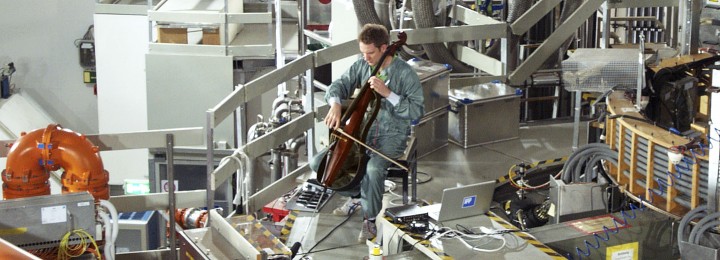
Magnetars are a rare type of neutron star. They have the highest known magnetic fields in the universe, which inspired Mexican composer Enrico Chapela to write a piece about them for electric cello.
New Head of Research Unit in Polish Association EURATOM-IFPiLM, Roman Zagórski
 "I plan to focus my efforts on further integrating the research teams of the Polish Association with activities closely related to priorities of EFDA programme, in particular JET and DEMO. Special attention will be devoted to fostering the involvement of Poland in ITER construction through participation in F4E grants."
Ready for a record
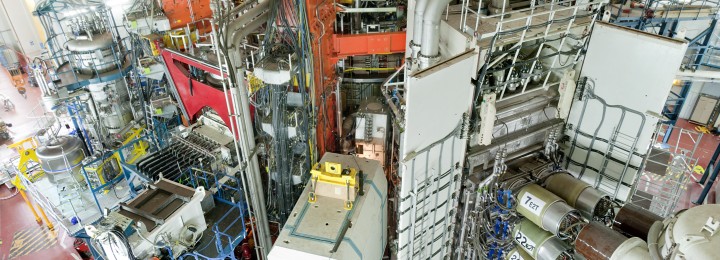
The principal 'additional heating' system on JET is the Neutral Beam Injection (NBI) system. During the last experimental campaign, this heating system routinely delivered over 20MW of power to the plasma. As you might remember, one of the tasks during the 2009/10 shutdown was to upgrade this system and install water-cooled duct liners to protect the walls of the narrow port through which the beams are injected.
The power is provided by two Neutral Injection Boxes, (NIBs), each of which has eight beam sources called 'PINI's. (Note the distinction between the two confusing terms, NBI and NIB!) Each NIB on JET was originally designed, over 20 years ago, to provide 7.5 MW for up to 10 seconds. Long ago that performance has been exceeded, with the current design aiming for 17MW for 20 seconds.
You might say that we have been telling you this for the last two years, but at last we can report that the dream is becoming reality. As of this week all eight PINIs on the octant 8 NIB are commissioned and they are nearly at full power. Five of the eight on the Octant 4 NIB are also in regular operation, and we now have an 'available power' of 25MW from NBI, which is already a record for JET. Within a month, two more of the Octant 4 PINIs should be working and with further conditioning and tuning, we will have more than 30MW of neutral beam power ready for use.
This is not to say that we are ready to use all of this power in experiments immediately, but steady progress is being made every day. The ITER-like wall protection systems are being commissioned systematically as the power levels rise. Without this protection working, there would be a significant risk of over-heating a few sensitive areas on plasma facing components, notably the 'inner wall guard limiters' and the 'divertor'. Measurements of temperatures are being confirmed to be consistent with the calculations as we progress. The new 'PEWS2′ protection has just been commissioned. PEWS2 is the new version of the 'Plant Enable Window System' which calculates the parameters for safe operation and ensures that the safe limits are not exceeded. It supplements the older, more conservative, PEWS system.
Last week a mini-record was achieved almost un-noticed. 14.3MW was delivered to the JET plasma from one NIB, beating the previous record of 13.7MW, and approaching double the value of the original design. A new record pulse length has also been achieved, at 15 seconds with four beams running simultaneously from Octant 8 NIB. Previously the longest beam pulse duration was 10 seconds. In doing this, it has also been demonstrated that the water cooled duct liners are working as expected. They reach equilibrium at an acceptable temperature as predicted, to the delight of everyone involved.
All in all, the NBI system looks as though it is ready to deliver the power needed for the high-power experiments that are planned for May 2012. This is a new and exciting phase in the life of JET, and we expect to be able to report more progress next week.
Source: EFDA
Fast action on fast ions kills instabilities
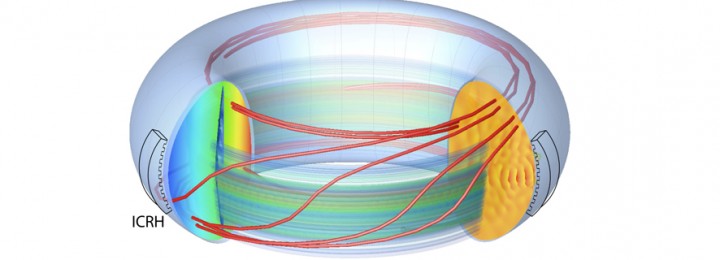 This captivating image is from the latest issue of EFDA's newsletter, Fusion in Europe. It shows calculations of the tracks of fast ions circulating through the JET plasma, which theories suggested were involved in the development of serious instabilities in the plasma known as neo-classical tearing modes (NTMs).
F4E Summer Studentships 2012 now open for applications
 EU or Swiss nationals, aged between 18-25 years, following university studies, with a good knowledge of at least two Community languages (one of which should be English) can now apply for a place on the F4E summer studentship programme. The programme, which will be running for the third year, provides short-term training at the F4E offices in Barcelona in order to promote awareness, knowledge and understanding of F4E's role in the ITER project and within the European context.


nsp_154.JPG)


nsp_154.JPG)


 |
 |
 |
 |
 |
 |
 |
 |
Media


Projekty badawcze realizowane przez IFPiLM są finansowane ze środków Ministerstwa Edukacji i Nauki i Narodowego Centrum Nauki oraz ze środków Komisji Europejskiej na podstawie umowy grantowej No 101052200, w ramach Konsorcjum EUROfusion. Wsparcia finansowego udzielają także: Międzynarodowa Agencja Energii Atomowej, Agencja Fusion for Energy, Europejska Agencja Kosmiczna i Konsorcjum LaserLab.