




Zestaw obrazów 2019
zdjecie1.jpg
zdjecie2.jpg
zdjecie3.jpg
zdjecie4.jpg
zdjecie5.jpg
zdjecie6.jpg
2019_1.JPG
2019_2.JPG
2019_4.JPG

Galeria
HSH Prince Albert II of Monaco meets ITER postdocs
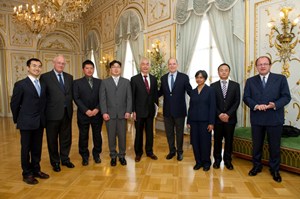 His Serene Highness Prince Albert II of Monaco met with the five researchers who were awarded postdoctoral fellowships from the Principality of Monaco last year to work at ITER Organization in 2011-2012. This was the second group of ITER postdoctoral fellows funded by Monaco under a Partnership Arrangement with the ITER Organization.
During a reception at the Prince's Palace, Sun Hee Kim (Korea), Shimpei Futatani (Japan), Debasmita Samaddar (India), Jing Na (China) and Ian Pong (UK) gave short presentations on their research, which the Prince received with great interest. The topics ranged from advanced simulation codes and modelling, to the performance of ITER superconductor strands and advanced control of the cryogenic system. (See Newsline 206 for more information on the Fellows' research.)
Like his father before him, HSH Prince Albert II shows a deep interest in science and environment. During the reception, he reiterated his wish to contribute to the fusion project that will benefit mankind, and to support a young generation of fusion scientists and engineers.
ITER Director-General Osamu Motojima said, "It is a great honour for me to meet His Serene Highness alongside the Monaco postdoctoral researchers. I wish to sincerely thank him for his strong interest in fusion research and for his support and encouragement." The Director-General also underlined the high quality of the Monaco Fellows who have been selected from across the ITER Members' communities (five in October 2008, five in September 2010).
Source: ITERnewsline
The ITER-Like Wall in the limelight
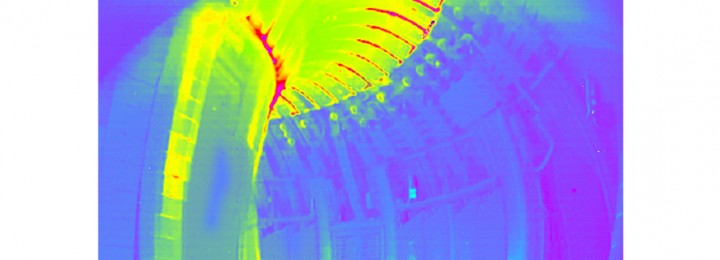 It is an exciting week for the fusion community – the Plasma Surface Interaction Conference – at which the much-anticipated results from JET's ITER-Like Wall have a starring role.
For Dr Guy Matthews, leader of the ITER-Like Wall project, delivering the very first talk of the conference will be the culmination of many years of hard work. "It's a moment I've looked forward to for a long time", he says, "and it's better than I could've hoped for. I have so many interesting and important new results, I'm spoiled for choice!"
"People thought it might be difficult to operate with the beryllium wall and tungsten divertor, and we might have trouble avoiding melt damage." he continues. In an environment where tiny irregularities in design can have a major impact on the heat load, the stringent manufacturing tolerances for the new wall components – a mere 40 micrometers – have paid off. "We have had H-mode plasmas up to the power levels we used with the carbon wall, and the new machine has been extremely clean. Its low residual carbon levels have made plasmas very reproducible with really low fuel retention."
The positive feelings are balanced by some new challenges – for example the plasma's radiation characteristics are very different with the new wall – so Dr Matthews is not planning to rest on his laurels. "There are some issues, such as tungsten accumulation, which restrict JET's operating conditions, but we are developing the tools to address them." he says with a smile. It might mean more work, but you get the feeling he wouldn't want it any other way.
About fifty papers on JET will be presented at the conference, which takes place in Aachen, Germany from May 21st to 25th. It is hosted by Forschungszentrum Julich, which is a signatory to the European Fusion Development Agency.
Source: EFDA
Difference between fission and fusion
 In an energy-hungry world, nuclear fission and fusion are often mentioned as alternatives to fossil fuels. But which one is better? In this episode, Scientific American's Michael Moyer melts down the facts to get at the core of the issue.
Source: ScientificAmerican
A global fusion experiment
 The JET project represents all of Europe, ITER represents over half of the world's population, but the Golem project in the Czech Republic goes even further. It is a fusion experiment for everyone in the world! Golem is a training tokamak in the Czech Technical University that has been set up to allow students to learn how to run a fusion experiment from anywhere in the world, over the internet.
Agreement on cooperation between IPPLM, Warsaw (Poland) and ENEA Energy Research Centre, Frascati (Italy)
 A group of six Italian scientists from the ENEA Institutes of Plasma Physics in Milano and Frascati arrived in the Institute of Plasma Physics and Laser Microfusion in Warsaw, Poland for a two-day-visit (9th and 10th May 2012 ) to discuss details of the future cooperation in plasma and fusion related scientific research. A few days before the visit a bilateral contract on cooperation between IPPLM and ENEA had been agreed. The Institute of Plasma Physics and Laser Microfusion signed the agreement on behalf of itself and eight other Polish institutions engaged in plasma and fusion research in Poland, there are as follow: Warsaw University of Technology (WUT), National Centre for Nuclear Research, Otwock-Świerk (NCNR), Wrocław University of Technology (WrUT), Institute of Nuclear Physics PAS (IFJ PAN), Opole University (OU), AGH University of Science and Technology, Cracow (AGH), Institute of Bioorganic Chemistry PAS – Poznań Supercomputing and Networking Centre (PSNC), West Pomerania University of Technology, Szczecin (WPUT), Maritime University of Szczecin (MUS).
After two days of fruitful discusion, the participants concluded that the possible fields of future scientific cooperation range from plasma modelling, diagnostics, inertial fusion, materials for ITER and DEMO.


nsp_154.JPG)


nsp_154.JPG)


 |
 |
 |
 |
 |
 |
 |
 |
Media


Projekty badawcze realizowane przez IFPiLM są finansowane ze środków Ministerstwa Edukacji i Nauki i Narodowego Centrum Nauki oraz ze środków Komisji Europejskiej na podstawie umowy grantowej No 101052200, w ramach Konsorcjum EUROfusion. Wsparcia finansowego udzielają także: Międzynarodowa Agencja Energii Atomowej, Agencja Fusion for Energy, Europejska Agencja Kosmiczna i Konsorcjum LaserLab.