





Zestaw obrazów 2019
zdjecie1.jpg
zdjecie2.jpg
zdjecie3.jpg
zdjecie4.jpg
zdjecie5.jpg
zdjecie6.jpg
2019_1.JPG
2019_2.JPG
2019_4.JPG

Galeria
Beams set record at 25 megawatts
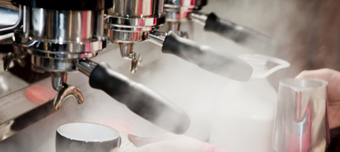 It was a landmark day on the 26th June, as the neutral beam injection heating system broke its previous record for input power, reaching 25 megawatts during four separate pulses. It is the culmination of three years work upgrading the beam system during the 2009 – 2011 shutdown and then commissioning the new system in parallel with a protection system to ensure the new power levels do not damage the vessel.
The neutral beam injection system is the most powerful of JET’s four heating systems. The concept is similar to the way that a steam jet in a cappuccino maker heats milk: high energy deuterium beams are injected into the vessel, which collide with the plasma particles, thereby heating them. The JET cappuccino maker however has 8 beam lines on each side of the torus, which accelerate particles with voltages over 100 kilovolts. Although only 14 of the 16 beams were used, the resulting power was enough to heat milk for 350 cappuccinos per second!
JET’s barista on the day was of course Italian – session leader Dr Domenico Frigione from the Italian Association ENEA, He was in charge of experiments investigating instabilities at the edge of the plasma known as edge localised modes (ELMs), which expel bursts of energy out of the plasma. The experiments used infrared cameras to measure the heating effect on the wall of the vessel ELMs, especially in the lower part of the vessel, known as the divertor, where the plasma touches the tiles for the purpose of removing waste and contaminants. “The heat load in the divertor is an important consideration for ITER,” said Dr Frigione, “and so special permission was granted to push the wall temperatures to higher levels, around 1200 degrees Celsius.” Experiments explored methods for spreading the heat load, by changing or moving the area of the plasma that contacts the wall, or seeding this area of the plasma with impurities such as nitrogen.
“Experiments like this are a planned risk” said Dr Frigione. “It is difficult to come out of these pulses, the beam power needs to be reduced in steps to prevent us landing too suddenly, but we achieved it safely.”
Source: EFDA
IAEA Chief Visits International Fusion Project and Addresses Economic Meeting
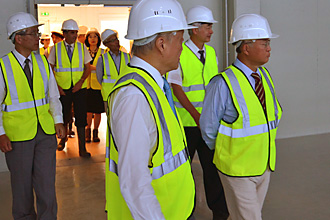 At the ITER headquarters in Cadarache, France, where the world's largest fusion reactor experiment is being constructed to demonstrate fusion's commercial viability, IAEA Director General Yukiya Amano received a briefing on the project's progress on Friday, 6 July 2012.
The briefing included a tour of the on-going construction site, including the poloidal field coils winding facility, the tokamak pit and the anti-seismic pads. The IAEA has supported ITER since its inception in 1985 as a collaborative research project between the European Union, Japan, the former Soviet Union and the United States.
New Source of Energy
Fusion is the process that powers the stars and occurs when atoms are heated until they fuse into new elements, releasing large amounts of energy. Fusion requires no fossil fuels, emits no greenhouse gases and generates no long-lived nuclear waste. Fusion power promises to be an abundant, safe and environmentally sustainable energy source.
A detailed explanation of the ITER project and photos of the IAEA Director General's tour are available on the ITER Website.
Nuclear Power After Fukushima
The future of energy production was also the topic of a session of the Les Rencontres Économiques d'Aix-en-Provence 2012, in which the Director General participated on Saturday, 7 July 2012. The session considered the global changes in energy use and production, especially since the accident at the Fukushima Daiichi Nuclear Power Plant in March 2011.
The Director General said that the Fukushima accident, the most severe accident since Chernobyl, caused deep public anxiety and damaged confidence in nuclear power. In contrast to the aftermath of the Chernobyl accident, nuclear power plant construction is continuing, a trend the Director General attributed to the increasing global demand for energy, as well as concerns about climate change, volatile fossil fuel prices and security of energy supply.
Wake-up Call
"Fukushima was a wake-up call for all countries with nuclear power and governments have responded with a new focus on nuclear safety," said Director General Amano. He noted that the goal of the IAEA Action Plan on Nuclear Safety, adopted by the IAEA Member States in September 2011, is to "make nuclear power as safe as humanly possible by doing everything to prevent a severe accident", which includes undertaking nuclear power plants stress tests to assess how well plants are likely to withstand severe natural hazards, including earthquakes and tsunamis.
Strengthening Safety
Following the Fukushima nuclear accident, the Director General said that new defensive structures are being built at many nuclear facilities throughout the world and backup electrical power sources are being given better protection. In addition, measures are being taken to assure that water is available for cooling even under severe accident conditions, while emergency preparedness and response capabilities are being strengthened. The IAEA's programme of peer reviews - under which multinational expert teams led by the Agency assess the operational safety of a country's nuclear power reactors, the effectiveness of its nuclear regulators, or its emergency preparedness - has also been significantly strengthened.
Key Lesson Learned
The Director General emphasized that one of the internationally recognized lessons of the Fukushima Daiichi accident was "the vital importance of an effective, independent nuclear regulatory body." He noted that the IAEA is helping countries to review their regulatory effectiveness and make changes where necessary.
International Cooperation
The Director General said that "the global response to the Fukushima Daiichi accident reflects a deeper realization by governments that nuclear safety transcends borders and that more effective international cooperation is vital. The IAEA will play the leading role in shaping a safer nuclear future throughout the world."
Background
ITER
ITER, initially named the International Thermonuclear Experimental Reactor, is a fusion research "mega-project" supported by China, the European Union, India, Japan, Korea, Russia and the United States.
Source: iaea.org
The winding line for the superconducting TF coils is ready
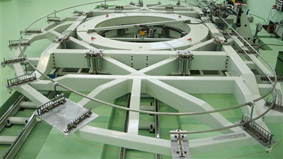 The winding line, to be used for winding the superconducting Toroidal Field (TF) coils which produce the magnetic field that confines the plasma in the ITER tokamak, is now ready. It is the first time a winding line with such impressive dimensions – 40 metres long, 20 metres wide, 5 metres high – has been built and it gives the opportunity to carry out winding trials which have never been undertaken before: it is the first time a full-size trial winding turn of a large dummy conductor has been carried out.
Located in F4E supplier ASG premises in Italy (ASG is part of a consortium which also includes Iberdrola and Elytt), the winding line will have the task of winding the superconducting coil cables into a D-shaped double spiral called a double pancake. The 7-tonne heavy superconductor coil will be delivered to ASG on spool in a single 760 metre length, so the first task of the winding line will be to unspool and straighten the cable, after which the cable will be cleaned and sandblasted. A continuous length of around 760 metres of superconductor cable will be used and shaped into the 12 metres long and 9 metres wide double pancake, which will then be heat treated at over 650 °C in a specially constructed inert atmosphere oven. After electrical insulation, the double pancake will finally be transferred into the grooves of the stainless steel radial plates, thus forming the double pancake module. As it is necessary that the double pancake fits precisely into the radial plate groove, it is vital to control that the trajectory of the conductor in the double pancakes is very accurate. This is why the winding line is required to achieve a precision on the bending of the conductor of a few tens of parts per million: a very demanding target considering its large dimensions (although the successful result during winding of the trial full size turn has demonstrated the capability of the winding line to achieve the required precisions). After insertion into the radial plates, each double pancake module will be impregnated with epoxy resin, stacked in groups of seven and jointed electrically to form the so-called winding packs. These winding packs will be inserted into stainless steel cases which will be welded in order to form the crucial TF coils.
For the moment, the winding line will however continue to be tested. In total, 70 superconductor lengths are needed to produce the ten TF coils to be procured by F4E (Japan will contribute an additional nine TF coils). They will be produced by five different suppliers, so each type of superconductor will have a slightly different mechanical behavior and therefore, individual tests with prototypes of each superconductor type will have to be carried out in the winding line during the next few months before starting the real production. The final qualification, to take place in the Autumn, will consist of winding a real superconducting cable into a full size double pancake prototype.
Another large machine, a large inert atmosphere oven, which measures 48x20x5 metres and which will be used to carry out the heat treatment of the double pancakes, is also in its final installation phase in ASG premises. The oven will be able to heat-treat up to three double pancakes at a time. After the successful completion of the leak test, carried out in order to verify the capability of the furnace to keep the concentration of impurities during the heat treatment below the required threshold of tens of parts per million, the oven is now in the final phase of the installation. The assembly of external components (electrical connections, sensors, piping, fans and vacuum pumps) is currently being completed and the final testing should start at the end of July.
With the winding line and the oven ready to be used, the main and most complex machinery for the production of the superconductors has been completed.
Source: fusionforenergy.europa.eu
Plasma startup creates high-energy light to make smaller microchips
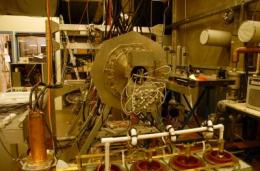 A University of Washington lab has been working for more than a decade on fusion energy, harnessing the energy-generating mechanism of the sun. But in one of the twists of scientific discovery, on the way the researchers found a potential solution to a looming problem in the electronics industry.To bring their solution to market two UW engineers have launched a startup, Zplasma, that aims to produce the high-energy light needed to etch the next generation of microchips. "In order to get smaller feature sizes on silicon, the industry has to go to shorter wavelength light," said Uri Shumlak, a UW professor of aeronautics and astronautics. "We're able to produce that light with enough power that it can be used to manufacture microchips." The UW beam lasts up to 1,000 times longer than competing technologies and provides more control over the million-degree plasma that produces the light. For more than four decades the technology industry has kept up with Moore's Law, a prediction that the number of transistors on a computer chip will double every two years. This trend has allowed ever-smaller, faster, lighter and less energy-intensive electronics. But it's hit a roadblock: the 193-nanometer ultraviolet light now being used cannot etch circuits any smaller.
Keeping it clean
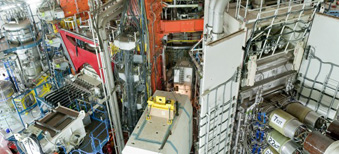 Cleanliness is the key to many aspects of operation of a tokamak like JET, in common with other ultra-high vacuum systems. Since you can not gain access to the inside of the torus, a technique called ‘glow discharge cleaning‘ is used in most machines to clean the walls of the vacuum vessel.


nsp_154.JPG)


nsp_154.JPG)


 |
 |
 |
 |
 |
 |
 |
 |
Media


Projekty badawcze realizowane przez IFPiLM są finansowane ze środków Ministerstwa Edukacji i Nauki i Narodowego Centrum Nauki oraz ze środków Komisji Europejskiej na podstawie umowy grantowej No 101052200, w ramach Konsorcjum EUROfusion. Wsparcia finansowego udzielają także: Międzynarodowa Agencja Energii Atomowej, Agencja Fusion for Energy, Europejska Agencja Kosmiczna i Konsorcjum LaserLab.