





Zestaw obrazów 2019
zdjecie1.jpg
zdjecie2.jpg
zdjecie3.jpg
zdjecie4.jpg
zdjecie5.jpg
zdjecie6.jpg
2019_1.JPG
2019_2.JPG
2019_4.JPG

Galeria
Preparing the next experiments in 2013
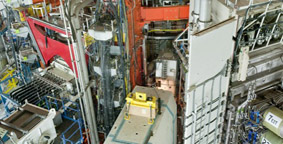
Last week marks the end of the first period of JET operations with the all-metal ‘ITER-Like Wall’. The machine is now going into a period of several months of maintenance, ready to restart operations early in 2013.
The last 11 months of machine operations have been a busy and challenging time. The scientists at JET have gathered a lot of valuable data which is certainly going to be prominently featured at coming conferences. More data will be gathered over the next few months during which some components of the ITER-Like Wall will be removed from the inside of the torus for detailed inspection and analysis.
Although there have been a number of operational difficulties on some of the JET facilities a lot has been learnt and a few of the highlights will be mentioned briefly here. As you will remember, many aspect
JET has never been operated in divertor configuration with an all-metal wall before and this has required development of some different operational strategies. The metal wall was intended to reduce the amount of fuel retention, but that affects operations more than expected. The protection systems for the plasma facing components have been brought into operation and many of them are now fully commissioned. Heating and current drive systems have been operating at high power. In particular, the neutral beam injection systems have reached a record power of 25.8MW, even though 2 of the 16 beams have not been available due to technical issues.s of the machine are new, and many challenges were associated with shaking down the new and highly modified systems. The majority of the difficulties were due to a total of only three single-point failures, which unfortunately affected critical facilities and resulted in lost operational time. Theses issues are now understood, and they are being addressed through procurement and installation of new components. A ‘Refurbishments Study Group’ has been set up by CCFE and is currently reviewing the JET facilities to identify where further refurbishments should be targeted.
High plasma current operation (at up to 3.5 MA) has also been demonstrated. This has required the operation of a device known as the ‘disruption mitigation valve’ which introduces a large puff of gas to spread the heat of the plasma more uniformly over the inner wall, preventing excessive heating of small areas. The DMV is now operating routinely and reliably.
Staff training has also been a big feature of operations, as key people learned the differences or were trained to implement the new systems. Covering 10 or 12 operational shifts per week has been quite a challenge.
Now the machine is going into a state called ‘intervention’ rather than a full shutdown. The differences are quite subtle to an external observer. During a full shutdown every system on the JET experiment is fully shut down, requiring a much more lengthy re-commissioning process. Under intervention conditions, some critical facilities remains operational in specific cases. As the intervention progresses we will describe purpose and progress of the work.
Source: EFDA
Successful experimental campaign closes
 Last week JET performed its last experiments until 2013. But, as JET shuts down and many of the scientists return to their homes across Europe and embark on summer holidays, the work does not stop.
“We’ve ticked all the boxes for the ITER-Like wall” says Task Force Leader Guy Matthews. JET Department Leader Lorne Horton agrees: “It wasn’t at all obvious that it would go this well! However the experiments have also thrown up a couple of surprises that we will need to look into.”
During the shutdown many of JET’s systems are being upgraded or refurbished. New systems are also being installed or calibrated, especially those that measure gamma rays and neutrons, as JET gears up for deuterium-tritium experiments in 2015. Also tiles will be extracted to examine in detail the wear and tear sustained during these experiments – vital information for evaluating the new ITER-Like wall.
Scientists will also continue analysing the large amounts of data accumulated during the eleven month campaign, checking calibrations and making careful comparisons with previous experiments conducted with the old carbon wall.
Then planning for next year’s campaign needs to be done. Initial meetings have happened, so the task force leaders will use the summer to make detailed plans for the campaign. Already staff from ITER have been involved, requesting certain experiments relevant to ITER be performed to give them more information on which to base their design decisions.
With all this going on, it’s clear every fusion scientist needs to find a good sized-beach to jot down their future research plans!
Source: EFDA
Six orders of magnitude
 To create fusion, you need a very different world to the one we live in. It needs to be six orders of magnitude hotter and six orders of magnitude less dense – and the result is six orders of magnitude more energy than most everyday processes.
The temperature required for fusion is over 100 million degrees. In the heat of Oxfordshire summer outside JET it might even reach 25 degrees Celsius, or 298 degrees Kelvin – which some people find hot – but it is still 6 orders of magnitude colder than the core of a fusion plasma.
One might expect that the pressure in a fusion tokamak must be very high – similar to the core of the sun. In fact it’s the opposite: the optimum density for fusion is about 106 times less than that of our atmosphere. The reason for this surprising fact is that higher density means more collisions between particles. Of course collisions between ions are good, because they are what leads to fusion. However when the ions in the plasma collide with electrons, energy is lost. This is because of a process known as bremsstrahlung, or “braking radiation”, which refers to radiation that is caused by charged particles changing direction – for example during a collision. In a plasma at the extreme temperatures required for fusion, the high speed of the electrons means they emit X-rays when they collide with a nucleus; if the density gets too high, there are so many collisions that the energy of the plasma is lost due to all the resulting X-rays.
Having created an environment six orders of magnitude hotter and six orders of magnitude less dense than our everyday world, the result is energy in quantities six orders of magnitude greater than most common processes. Plasma physicists measure energy in electron volts – in other words the energy that one electron would acquire if powered by a one volt battery. Batteries are powered by chemical processes – by combining a number of electrochemical cells we can create powerful batteries such as those in a car, which have a voltage of 12 volts. Burning coal creates about four electron volts. But the products of the fusion, powered by nuclear processes, have a staggering 17.6 million electron volts. In other words you would need to connect well over a million car batteries to give particles the same amount of energy as that released when deuterium and tritium fuse.
So it seems the conclusion to draw is that, although achieving fusion sometime seems six orders of magnitude harder than burning fossil fuel, it will be a milliion times better in the long run!
Source: EFDA
ITER Director General praises JET
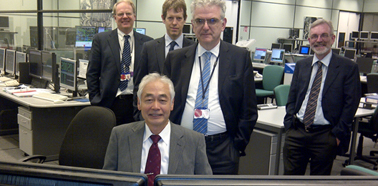
The Director General of ITER, Osamu Motojima has praised work done at JET during a visit there on Wednesday the 11th of July. “It’s encouraging to see the results from JET’s ITER-Like Wall that have been achieved in such a short space of time” he said during a presentation to staff, continuing that “ITER is dependent on the success of JET.”
Motojima-san visited JET with two senior staff, Director of Plasma Operation, David Campbell, and Senior Scientist in Plasma Confinement Alberto Loarte. To a packed lecture hall Motojima-san outlined ambitious plans to keep the ITER project on schedule, while Dr Campbell spoke of the science challenges for ITER. “We are keen to work very closely with the JET team on issues such as disruptions, ELMs and melting studies” he said. “The work JET is producing is of a high level. It is extremely impressive and will be important for the exploitation of ITER. I encourage you to carry on along the same path.”
An objective for the visit was to discuss possible future collaborations between ITER and JET. At the last ITER Council meeting, it was agreed that ITER should join the IEA implementing agreement on Cooperation on Tokamak Programs. The agreement provides a legal framework for participation of ITER Organisation staff in experiments on JET that are targeted at addressing specific issues of interest to ITER. Thus, the Director General’s visit allowed timely discussions on how to deepen collaborations between JET and ITER.
Source: EFDA
New Jersey firm creates jobs and vital components for world-leading experiment
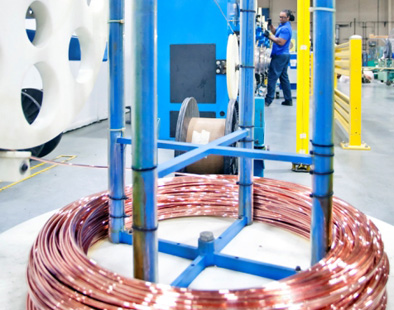
The U.S. ITER project office has thus far awarded funding and subcontracts with a total value, including options, of up to $767 million to U.S. companies, universities and DOE laboratories. Funding for the U.S. portion of the ITER project comes from the DOE’s Office of Science through U.S. ITER at the DOE’s Oak Ridge National Laboratory in Oak Ridge, Tenn.“These funds support manufacturing, engineering, and other high tech jobs in the United States,” said Ned Sauthoff, who leads the team executing the U.S. contributions to ITER. “U.S. companies are also winning contracts from other ITER members—about $75 million so far, with more opportunities in the near future.”


nsp_154.JPG)


nsp_154.JPG)


 |
 |
 |
 |
 |
 |
 |
 |
Media


Projekty badawcze realizowane przez IFPiLM są finansowane ze środków Ministerstwa Edukacji i Nauki i Narodowego Centrum Nauki oraz ze środków Komisji Europejskiej na podstawie umowy grantowej No 101052200, w ramach Konsorcjum EUROfusion. Wsparcia finansowego udzielają także: Międzynarodowa Agencja Energii Atomowej, Agencja Fusion for Energy, Europejska Agencja Kosmiczna i Konsorcjum LaserLab.