





Zestaw obrazów 2019
zdjecie1.jpg
zdjecie2.jpg
zdjecie3.jpg
zdjecie4.jpg
zdjecie5.jpg
zdjecie6.jpg
2019_1.JPG
2019_2.JPG
2019_4.JPG

Galeria
Launching the exploration of the unknown
 "The method works ... nowhere else in the world." Metres of black velvet, clouds of dry ice and the melodramatic Bachianas brasileiras by Brazilian composer Heitor Villa-Lobos were part of the spectacular opening show for the Magnum-PSI facility at the Dutch Institute for Fundamental Energy Research (DIFFER) in Rijnhuisen on Thursday 22 March.
Giving materials hell
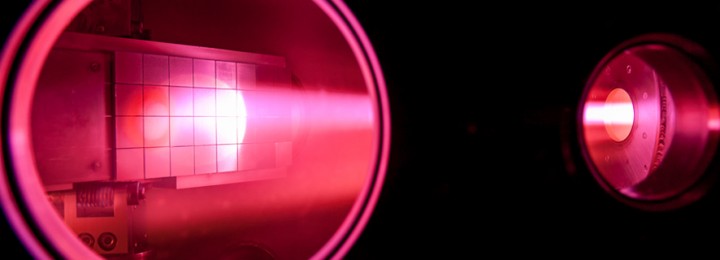
"Sending materials to hell", quips Magnum-PSI programme leader Greg De Temmerman. The comparison isn't far off: the fifteen meter long plasma experiment at the Dutch fusion research centre DIFFER creates punishing conditions to investigate how proposed reactor wall materials will fare in future fusion reactor divertors.
Graphene in new ‘battery’ breakthrough?
 Researchers at Hong Kong Polytechnic University claim to have invented a new kind of graphene-based "battery" that runs solely on ambient heat. The device is said to capture the thermal energy of ions in a solution and convert it into electricity. The results are in the process of being peer reviewed, but if confirmed, such a device might find use in a range of applications, including powering artificial organs from body heat, generating renewable energy and powering electronics.
Department of Energy boost for small nuclear reactors
 The US Department of Energy (DOE) will support the construction of three small nuclear reactors at its Savannah River Site in South Carolina. The reactors are designed to generate heat and electricity for use at remote facilities such as mines, oil fields or isolated communities. The three companies involved are Gen4 Energy (formerly Hyperion), Holtec International and NuScale Power.
More powerful than the sun
 The sun pours out an amazing amount of energy. Only a small fraction of the sun's total output reaches us, yet it powers our entire ecosystem. All the plants and animals on planet earth rely on this warmth for light and food. Surprisingly, though, the sun is not a terribly good fusion reactor, for its size. In terms of energy output per volume, JET at its best is over 700 times better, and ITER will be a staggering 2150 times more efficient fusion reactor than the sun.


nsp_154.JPG)


nsp_154.JPG)


 |
 |
 |
 |
 |
 |
 |
 |
Media


Projekty badawcze realizowane przez IFPiLM są finansowane ze środków Ministerstwa Edukacji i Nauki i Narodowego Centrum Nauki oraz ze środków Komisji Europejskiej na podstawie umowy grantowej No 101052200, w ramach Konsorcjum EUROfusion. Wsparcia finansowego udzielają także: Międzynarodowa Agencja Energii Atomowej, Agencja Fusion for Energy, Europejska Agencja Kosmiczna i Konsorcjum LaserLab.