





Zestaw obrazów 2019
zdjecie1.jpg
zdjecie2.jpg
zdjecie3.jpg
zdjecie4.jpg
zdjecie5.jpg
zdjecie6.jpg
2019_1.JPG
2019_2.JPG
2019_4.JPG


Światowe
 Henrik Bindslev has been appointed today as the new Director of the European Joint Undertaking for ITER and the Development of Fusion Energy (Fusion for Energy). He is currently the Vice Dean for Research at Aarhus University, Faculty of Science and Technology.
Stuart Ward, Chair of the Fusion for Energy Governing Board, took the opportunity to congratulate Henrik Bindslev on his new position and thanked all members of the Board for their collaboration taking together this important decision.
"I am honoured to have been appointed Director of Fusion for Energy at a time that Europe’s contribution to ITER enters a decisive stage and rapid progress will be made on all fronts. It is the moment to engage actively with Europe’s industry and fusion community to honour our commitment to this prestigious international project" said Bindslev.
Henrik Bindslev has been engaged in energy research for more than 20 years and has considerable experience in research management, both in Denmark and internationally. He is currently Vice Dean for research at Aarhus University, Faculty of Science and Technology and past Chair of the European Energy Research Alliance (EERA). He is a delegate to the European Strategy Forum on Research Infrastructures (ESFRI) and Chairman of ESFRI’s Energy Strategy Working Group. Previously, he was the Director of Risø DTU, the Danish National Laboratory for Sustainable Energy, managing 700 members of staff.
He was educated at Denmark’s Technical University and completed a DPhil in Plasma Physics at the University of Oxford. He worked as a fusion researcher at different facilities including ten years at the Joint European Torus (JET), Europe’s biggest fusion research device, and has published more than 150 papers.
The Director is appointed by Fusion for Energy’s Governing Board for a period of five years, once renewable up to five years. The appointment is made on the basis of a list of candidates proposed by the European Commission after an open competition, following a publication in the Official Journal of the European Communities.
Source: F4E
 One of the most interesting refurbishment tasks for JET this year is costing over half a million euros, extending the lifetime of JET and reducing operating costs.
The original construction of JET’s site cooling water system was carried out under two separate contracts. The pipework in the immediate area of the cooling towers passed its original design lifetime long ago and continued to work successfully. However, for the last four or five years it has been plagued with a series of chronic water leaks. This has not been enough to interrupt operations, but it was certainly sufficient to have a noticeable impact on running costs. Water leaking from the system has to be replaced with fresh water, which has to be specially treated before it can be used.
Remarkably, the pipes around the rest of the site are still in good condition, thanks to the choice of cast iron as opposed to mild steel in the corroded sections. It was originally hoped that the leaking pipes could be repaired using ‘trenchless technology’ where a leak-tight lining is installed inside the pipes without disturbing the ground. Several companies expressed an interest in the task, but in the end none of them tendered. Consequently a contract has been placed with a company to design, fabricate install and test about 200m of pipe as large as 700mm in diameter. Since August, trenches have been dug and much of the old pipework has been removed. It is being replaced by new pipes of the same material, carbon steel with a bitumen coating. These are likely to be serviceable for at least 20 years. This large operation has progressed according to plan, and by early November the task should be complete, pressure tests will have been carried out, and the performance of the system demonstrated against benchmark measurements that were taken on the old system.
Source: EFDA
 In the high-stakes race to realize fusion energy, a smaller lab may be putting the squeeze on the big boys. Worldwide efforts to harness fusion—the power source of the sun and stars—for energy on Earth currently focus on two multibillion dollar facilities: the ITER fusion reactor in France and the National Ignition Facility (NIF) in California. But other, cheaper approaches exist—and one of them may have a chance to be the first to reach “break-even,” a key milestone in which a process produces more energy than needed to trigger the fusion reaction.
Researchers at the Sandia National Laboratory in Albuquerque, New Mexico, will announce in a Physical Review Letters (PRL) paper accepted for publication that their process, known as magnetized liner inertial fusion (MagLIF) and first proposed 2 years ago, has passed the first of three tests, putting it on track for an attempt at the coveted break-even. Tests of the remaining components of the process will continue next year, and the team expects to take its first shot at fusion before the end of 2013.
Fusion reactors heat and squeeze a plasma—an ionized gas—composed of the hydrogen isotopes deuterium and tritium, compressing the isotopes until their nuclei overcome their mutual repulsion and fuse together. Out of this pressure-cooker emerge helium nuclei, neutrons, and a lot of energy. The temperature required for fusion is more than 100 million°C—so you have to put a lot of energy in before you start to get anything out. ITER and NIF are planning to attack this problem in different ways. ITER, which will be finished in 2019 or 2020, will attempt fusion by containing a plasma with enormous magnetic fields and heating it with particle beams and radio waves. NIF, in contrast, takes a tiny capsule filled with hydrogen fuel and crushes it with a powerful laser pulse. NIF has been operating for a few years but has yet to achieve break-even.
Sandia’s MagLIF technique is similar to NIF’s in that it rapidly crushes its fuel—a process known as inertial confinement fusion. But to do it, MagLIF uses a magnetic pulse rather than lasers. The target in MagLIF is a tiny cylinder about 7 millimeters in diameter; it’s made of beryllium and filled with deuterium and tritium. The cylinder, known as a liner, is connected to Sandia’s vast electrical pulse generator (called the Z machine), which can deliver 26 million amps in a pulse lasting milliseconds or less. That much current passing down the walls of the cylinder creates a magnetic field that exerts an inward force on the liner’s walls, instantly crushing it—and compressing and heating the fusion fuel.
Researchers have known about this technique of crushing a liner to heat the fusion fuel for some time. But the MagLIF-Z machine setup on its own didn’t produce quite enough heat; something extra was needed to make the process capable of reaching break-even. Sandia researcher Steve Slutz led a team that investigated various enhancements through computer simulations of the process. In a paper published in Physics of Plasmas in 2010, the team predicted that break-even could be reached with three enhancements.
First, they needed to apply the current pulse much more quickly, in just 100 nanoseconds, to increase the implosion velocity. They would also preheat the hydrogen fuel inside the liner with a laser pulse just before the Z machine kicks in. And finally, they would position two electrical coils around the liner, one at each end. These coils produce a magnetic field that links the two coils, wrapping the liner in a magnetic blanket. The magnetic blanket prevents charged particles, such as electrons and helium nuclei, from escaping and cooling the plasma—so the temperature stays hot.
Sandia plasma physicist Ryan McBride is leading the effort to see if the simulations are correct. The first item on the list is testing the rapid compression of the liner. One critical parameter is the thickness of the liner wall: The thinner the wall, the faster it will be accelerated by the magnetic pulse. But the wall material also starts to evaporate away during the pulse, and if it breaks up too early, it will spoil the compression. On the other hand, if the wall is too thick, it won’t reach a high enough velocity. “There’s a sweet spot in the middle where it stays intact and you still get a pretty good implosion velocity,” McBride says.
To test the predicted sweet spot, McBride and his team set up an elaborate imaging system that involved blasting a sample of manganese with a high-powered laser (actually a NIF prototype moved to Sandia) to produce x-rays. By shining the x-rays through the liner at various stages in its implosion, the researchers could image what was going on. They found that at the sweet-spot thickness, the liner held its shape right through the implosion. “It performed as predicted,” McBride says. The team aims to test the other two enhancements—the laser preheating and the magnetic blanket—in the coming year, and then put it all together to take a shot at break-even before the end of 2013.
Earlier this year, Slutz and his team published other simulations in PRL that showed that if a more powerful pulse generator was built to produce higher currents—say, 60 million amps—the system could achieve not just break-even, but high gain. In other words, the MagLIF could produce the kind of energy needed for a commercial fusion power plant.
“I am excited about Sandia discovering that magnetized target fusion … is a pathway to significant gain on the Z machine. We agree, and hope that their experiments get a chance to try it out,” says Glen Wurden, the magnetized plasma team leader at Los Alamos National Laboratory in New Mexico.
Daniel Clery, ScienceNOW
For more information visit: www.wired.com
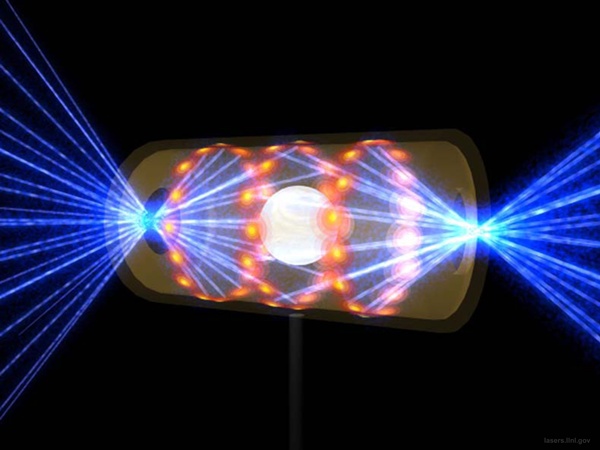 Ignition research continues at the giant laser facility, but the end of the calendar year looks like a more significant date than that set by Congress.
Staff at the National Ignition Facility (NIF) say that work to generate inertial confinement fusion with energy gain will continue as planned, despite the end of the official “ignition campaign” last week.
September 30 saw the expiration of an arbitrary “deadline” for achieving ignition that was set by US Congress, prompting speculation about the future of the laboratory, whose primary function is to simulate the physics of nuclear weapons, but for which fusion energy has become another long-term development target.
Just before that date, which marked the end of the US government’s financial year rather than anything of more scientific significance, a New York Times article suggested that the failure to meet the ignition goal could have “serious repercussions” for not only the giant Lawrence Livermore National Laboratory project (estimated cost so far: $5 billion), but federal financing of “big science” in general. A follow-up editorial in the same newspaper added that Congress would need to look hard at whether either of the “stockpile stewardship” or long-term energy goals could be pursued on a smaller budget.
NIF officials have long expressed their confidence that the system will eventually succeed in “bringing star power to Earth”, as a giant banner at the facility puts it, and told optics.org earlier this year that it was “tantalizingly close” to that goal. But others, including those working on the rival magnetic confinement approach to fusion, are more skeptical, doubting that the laser technique will ever work on a scale that makes for a practical energy source.
A memorandum to the Department of Energy dated July 19 added fuel to that skepticism, even though advisor and memo author David Crandall wrote that the functionality of the laser, its diagnostics, optics and targets – as well as the laser operations performed by the NIF team - were all “outstanding”.
The problem was that the same memo also noted that “considerable hurdles” must still be overcome to reach the ignition goal, or to observe unequivocally the phenomenon of alpha heating – a key element of the fusion process. Given those issues, Crandall and his fellow reviewers said that the probability of demonstrating ignition before the end of this year was now “extremely low”, and that even the less ambitious goal of showing unambiguous alpha heating would be “challenging”.
“While no reviewer thought ignition likely before December 31, 2012, some thought the intermediate goal of measurable alpha heating (increasing the neutron yield) might be achieved within that time, and several expressed optimism about achieving ignition at NIF within a few years,” concluded the memo.
Model problems
According to the same document, the reason has nothing to do with NIF not working to its specifications – on the contrary, the 192-beam system is actually outperforming expectations in many areas. The key problem seems to be that the “hohlraum” ignition target and its interaction with the laser is not behaving in the way that physical models had predicted.
“The coupling of the laser through the radiation inside the hohlraum to the capsule is less efficient than expected and the physical ablation process is somewhat different than expected - resulting in a lower implosion velocity than is predicted to be required for ignition,” the review panel wrote.
NIF told optics.org that it was working to resolve what it called the “remaining few issues” towards achieving ignition in its current campaign. According to officials, that campaign has so far been able to demonstrate the fundamental conditions required to achieve ignition – though, crucially, not all at the same time.
“Achieving ignition conditions requires four things,” the lab explained. “An implosion velocity of 370 km/second, creating a symmetrical hot spot at the center of the target, proper plasma mix and uniform compression.”
On the question of alpha heating, NIF says that alpha particles have been produced from fusion reactions, and have compressed fuel to a sufficient density to re-deposit energy.
However, the lab concedes that its experiments have not yet produced the kind of results that had been predicted in its models, and said that it was continually refining these as more experimental data was collected. It is also working to produce even higher laser energy pulses (of 2 MJ, compared with the 1.8 MJ thought to be sufficient) as one way to overcome the less efficient coupling between the laser and hohlraum than was initially expected.
In demand
“September 30 marked the end of the National Ignition Campaign, but does not mark the end of ignition research or an expiration of the value of the facility,” said officials. Highlighting the scientific value of the system, they added: “As a measure of its success, there are now requests from its user communities for more than 500 experiment days in 2013, about twice the NIF capacity. Requests for use of NIF extend for many years into the future.”
As things stand, NIF will be able to continue operations as planned through fiscal year 2013, though its funding beyond that remains to be determined by future government budget cycles.
Responding to the reaction to the expiration of the Congress “deadline” in some quarters, the lab stressed the unpredictable nature of the work, saying: “Ignition experiments on NIF are continuing steps in a well-managed and deliberate scientific program, not the ‘pass/fail’ event that it has become - and one that should be tied to the process of discovery science and the expansion of knowledge, not fiscal year boundaries.”
In fact, it looks like the end of this calendar year could turn out to be a much more significant date than September 30, in terms of NIF’s future direction and the ambitious goal of harnessing “star power” on Earth. Crandall’s memo raises the prospect that NIF will take on a quite different role if experimental results and computer models for ignition continue to contradict each other.
The memo states that if alpha heating and “further substantial progress” towards ignition is not demonstrated before the end of December, the ignition program should be redirected to a “broader and more balanced research program” – suggesting that the pursuit of fusion power will take a back seat.
Mike Hatcher
Editor in Chief of optics.org
For more information visit: www.optics.org
 Good news, denizens of Earth: If the findings from two premier research labs are to be believed, commercial nuclear fusion is feasible — and could arrive sooner than expected.
The first breakthrough comes from Sandia National Laboratories (the same engineers who brought us the fanless heatsink). At SNL, a research team has been working on a new way of creating fusion called magnetized liner inertial fusion (MagLIF). This approach is quite similar to the National Ignition Facility at the LLNL in California, where they fuse deuterium and tritium (hydrogen isotopes) by crushing and heating the fuel with 500 trillion watts of laser power. Instead of lasers, MagLIF uses a massive magnetic pulse (26 million amps), created by Sandia’s Z Machine (a huge X-ray generator), to crush a small cylinder containing the hydrogen fuel. Through various optimizations, the researchers discovered a MagLIF setup that almost breaks even (i.e. it almost produces more thermal energy than the electrical energy required to begin the fusion reaction).
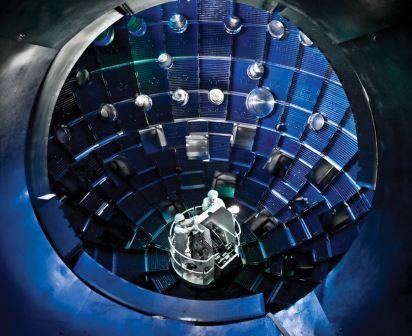
Probably more significant is news from the Joint European Torus (JET), a magnetic confinement fusion facility in the UK. JET is very similar to the ITER nuclear fusion reactor, an international project which is being built in the south of France. Whereas NIF and Sandia create an instantaneous fusion reaction using heat and pressure, ITER and JET confine the fusing plasma for a much longer duration using strong magnetic fields, and are thus more inclined towards the steady production of electricity. JET’s breakthrough was the installation of a new beryllium-lined wall and tungsten floor inside the tokamak — the doughnut-shaped inner vessel that confines 11-million-degrees-Celsius plasma (pictured above).
Carbon is the conventional tokamak lining (and the lining that had been chosen for the first iteration of ITER) but now it seems the beryllium-tungsten combo significantly improves the quality of the plasma. Hopefully this information will allow ITER to skip the carbon tokamak and jump straight to beryllium-tungsten, shaving years and millions of dollars off the project.
Moving forward, JET will actually try full-blown fusion with the optimum mix of deuterium and tritium (16 megawatts, for less than a second). At this point, JET is practically an ITER testbed, so its results from the next year or two will have a large impact on the construction of ITER’s tokamak, which should be completed by 2019.
Before today, magnetic confinement fusion was generally considered to be more mature and efficient than inertial confinement fusion — but Sandia’s new approach might change that. ITER is one of the world’s largest ongoing engineering projects (it’s expected to cost around $20 billion), and yet critics are quick to point out that we still don’t know if it will actually work. ITER isn’t expected to fuse D-T fuel until 2027 (producing 500 megawatts for up to 1,000 seconds) — and an awful lot can happen in 15 years. Still, the main thing is that we’re actually working on fusion power — when we’re talking about limitless, clean power, it’s probably worth investing a few billion dollars, even if it doesn’t work out.
Fusion reactors are some of the most beautiful constructions you’ll ever see, so be sure to check out our galleries of the National Ignition Facility and the Princeton Plasma Physics Lab.
For more information visit: www.peakoil.com
Local News
- 1
- 2
- 3
- 4
- 5
IPPLM joins the Enterprise Europe Network
31-03-2026
On 23 March 2026, the Institute of Plasma Physics and Laser Microfusion (IPPLM) joined, with its technological offer, the group of entities affiliated with the Enterprise Europe Network (EEN), interested...
Read moreIPPLM as a co-creator of the exhibition "E = mc² – the formula that changed the world" at the National…
18-02-2026

On 16 February 2026, the official opening of two new permanent exhibitions took place at the National Museum of Technology in Warsaw. The Institute of Plasma Physics and Laser Microfusion...
Read moreIPPLM supports children and young people at the TPD "Helenów" Centre
22-12-2025

The Sylwester Kaliski Institute of Plasma Physics and Laser Microfusion (IPPLM) has for many years been actively engaged in initiatives supporting children and young people supported by the TPD "Helenów"...
Read moreIPPLM researchers took part in an experimental campaign on the GEKKO XII laser
20-11-2025

On 10–14 November 2025, a research team from the Sylwester Kaliski Institute of Plasma Physics and Laser Microfusion (IPPLM) – Prof. Katarzyna Batani, Dr Hanna Marchenko and Dr Agnieszka Zaraś-Szydłowska...
Read moreRegister for the 18th Kudowa Summer School on Plasma Physics!
07-11-2025

We invite you to take part in the 18th Kudowa Summer School "Towards Fusion Energy", which will be held on 8–12 June 2026 in Kudowa-Zdrój, Poland. The event is organised...
Read moreIPPLM participated in the second technical meeting within the DONES Con-P1 project
17-10-2025
The Institute of Plasma Physics and Laser Microfusion (IPPLM) took part in the second technical meeting held as part of the DONES Consolidation Phase 1 (DONES ConP1) project, co-financed by...
Read moreProf. Jan Badziak from IPPLM among the World’s Top 2% Scientists
15-10-2025
Prof. Jan Badziak, from the Department of Laser Plasma and Magnetized Dense Plasma Physics at the Institute of Plasma Physics and Laser Microfusion (IPPLM), has been included in the prestigious...
Read more29th Science Festival with the participation of IPPLM
10-10-2025

During the 29th Science Festival in Warsaw, held on 19–28 September 2025, researchers from the Institute of Plasma Physics and Laser Microfusion (IPPLM) conducted lessons for upper-grade primary school students. The...
Read morePLASMA 2025 and the 20th Anniversary of the Euratom–IPPLM Association – event summary
26-09-2025

From 15 to 19 September 2025, Warsaw hosted the international scientific conference PLASMA 2025 – International Conference on Research and Application of Plasmas, dedicated to plasma research, diagnostics, and applications....
Read moreWe bid farewell with deep sorrow to Professor Jerzy Wołowski
25-09-2025

It is with great sadness that we have received the news of the passing of Professor Jerzy Wołowski (1936–2025) an outstanding physicist, long-time employee of the Institute of Plasma Physics...
Read more20th anniversary of the Euratom–IPPLM Association (CeNTE): Celebrating two decades of fusion research coordination
16-09-2025

On 19 September 2025, during the PLASMA 2025 International Conference on Research, Diagnostics and Applications of Plasma in Warsaw, the IPPLM will mark 20th anniversary of the coordination of research on nuclear fusion...
Read moreIPPLM at the 49th Congress of Polish Physicists in Katowice
13-09-2025
During the 49th Congress of Polish Physicists, held from September 5–11, 2025, in Katowice, the Institute of Plasma Physics and Laser Microfusion (IPPLM) was represented both among the speakers and...
Read moreProf. Agata Chomiczewska appointed Deputy Director for Scientific Affairs at the IPPLM
03-09-2025

We are pleased to announce that the Minister of Energy, Mr. Miłosz Motyka, has appointed Dr. hab. Agata Chomiczewska to the position of Deputy Director for Scientific Affairs at the...
Read moreA historic milestone – the Scientific Council of the Institute confers the degree of habilitated doctor
10-07-2025
For the first time in the history of the Institute of Plasma Physics and Laser Microfusion (IPPLM), the Scientific Council has adopted a resolution to confer the degree of habilitated...
Read moreNew Board of the Plasma Physics Division of the European Physical Society
04-07-2025

In the first quarter of 2025, elections were held for the Board of the Plasma Physics Division of the European Physical Society (EPS Plasma Physics Division). Six candidates who received...
Read moreIPPLM researchers bring fusion expertise to 10th Central & Eastern Europe Nuclear Industry Congress 2025
12-06-2025
Researchers from the Institute of Plasma Physics and Laser Microfusion (IPPLM), Dr. Natalia Wendler and Dr. Paweł Gąsior, recently participated in a panel discussion at the 10th Central & Eastern...
Read moreIPPLM at the 3rd edition of the "Science for Society" Congress
29-05-2025

On 25-26 May 2025, the 3rd edition of the "Science for Society" Congress took place in the Large Hall of the Warsaw University of Technology. The aim of the event...
Read moreInvitation to the 3rd edition of the "Science for Society" Congress with the participation of IPPLM
22-05-2025

The 3rd edition of the "Science for Society" Congress will take place on 25–26 May 2025 at the Warsaw University of Technology. This unique event demonstrates that science is not...
Read moreJoin the 28th Science Picnic!
07-05-2025

The Institute of Plasma Physics and Laser Microfusion (IPPLM) invites you to its stand on Saturday, 10 May, during the 28th Science Picnic, organized by Polish Radio and the Copernicus...
Read moreCooperation agreement between the IPPLM and the National Museum of Technology
18-04-2025

On 17 April 2025, a cooperation agreement was signed between the National Museum of Technology (NMT) and the Institute of Plasma Physics and Laser Microfusion (IPPLM). The ceremonial meeting, attended by...
Read morePolish and French researchers join forces in research on nuclear fusion
31-03-2025

On 24-25 March 2025, a Polish-French meeting was held at the headquarters of the Institute of Nuclear Physics of the Polish Academy of Sciences (IFJ PAN) and the French Institute...
Read moreJoin us for the International Conference on Research and Application of Plasmas – PLASMA 2025!
13-03-2025

The Institute of Plasma Physics and Laser Microfusion (IPPLM) invites you to attend the PLASMA 2025 – International Conference on Research and Application of Plasmas, which will be held from...
Read moreExperimental research session in the Plasma-Focus PF1000U laboratory as part of the ICDMP collaboration
27-02-2025

On February 10–21, 2025, an experimental session was held in the Plasma-Focus PF-1000U laboratory, in which, in addition to the IPPLM team, a three-person team of researchers from the Prague...
Read moreLaser demonstration on JET detects fusion fuels
11-02-2025

Scientists and engineers from eight nations, including Poland, have carried out a project using lasers on the Joint European Torus (JET) to study fusion fuel retention. Laser Induced Breakdown Spectroscopy (LIBS),...
Read moreIPPLM employee nominated for the Personality of the Year title in the Science category
24-01-2025
Research and technical employee Mr. Olgierd Cichorek, M.Sc., from the Laboratory of Plasma Nudge for Satellites at the IPPLM has been nominated for the title of Personality of the Year...
Read moreWorld News
- 1
- 2
- 3
- 4
- 5
In Memoriam — Professor Francesco Romanelli
24-03-2026

The world of fusion research mourns the loss of Professor Francesco Romanelli, a visionary scientist whose work helped bring humanity closer to clean, limitless energy. Over four decades, he explored...
Read moreIgniting the future: Breakthroughs in inertial confinement Fusion
25-07-2025

In December 2022, the National Ignition Facility (NIF) at Lawrence Livermore National Laboratory (USA) marked a historic milestone in fusion science: an experiment produced 3.15 MJ of fusion energy from 2.05 MJ of laser...
Read moreWendelstein 7-X sets new fusion performance records
04-06-2025

On May 22, 2025, the Wendelstein 7-X (W7-X) stellarator at the Max Planck Institute for Plasma Physics (IPP) in Greifswald concluded its latest experimental campaign with a major success: a...
Read moreEuropean tokamak sets new fusion plasma record
20-02-2025

On February 12, 2025, the WEST tokamak, located at CEA Cadarache in southern France, set a new world record by sustaining fusion plasma for 1,337 seconds, or over 22 minutes....
Read moreDr. Gianfranco Federici appointed as the new EUROfusion Programme Manager
17-12-2024
At the 49th General Assembly held in Barcelona, December 2024, Dr. Gianfranco Federici was elected as the new Programme Manager of EUROfusion. He succeeds Prof. Ambrogio Fasoli, who will return...
Read moreEUROfusion and F4E join forces for Europe’s fusion future
16-12-2024

EUROfusion and Fusion for Energy (F4E) have signed a Memorandum of Understanding (MoU) to advance fusion research and development in Europe. This agreement reinforces cooperation in...
Read moreJohn J. Hopfield and Geoffrey E. Hinton awarded the 2024 Nobel Prize in Physics
08-10-2024

John J. Hopfield and Geoffrey E. Hinton have been awarded the 2024 Nobel Prize in Physics "for foundational discoveries and inventions that enable machine learning with artificial neural networks." The Nobel...
Read moreWendelstein 7-X begins new experimental campaign
10-09-2024

The Wendelstein 7-X, the world’s most advanced stellarator, is launching a new experimental campaign after a year of intensive maintenance and upgrades. This phase, known as OP2.2, begins on 10...
Read moreITER's New Project Baseline: A Robust Path to Fusion Energy Research
04-07-2024

On 3 July, ITER Director-General Pietro Barabaschi presented the new project baseline, under evaluation by the ITER Organization's governing body. This plan aims to ensure a robust start to scientific...
Read moreITER Council Presents Updated Project Baseline
21-06-2024

The ITER Council convened this week for its 34th meeting, where nearly 100 attendees reviewed significant updates to the project baseline. The proposed changes aim to optimize the overall project...
Read moreEurope and Japan celebrate breakthrough in paving the way for fusion energy
01-12-2023

The prospect of harnessing fusion energy is closer. The successful operation of JT-60SA, the most powerful experimental device to date, built by Europe and Japan, is a landmark achievement for...
Read moreFirst plasma was successfully generated at JT-60SA
26-10-2023

A momentous achievement in the field of nuclear fusion has been accomplished by a collaborative team of engineers from Europe and Japan. They have successfully generated tokamak plasma for the...
Read moreThe Nobel Prize in Physics 2023
03-10-2023
Pierre Agostini, Ferenc Krausz and Anne L’Huillier are the winners of this year's Nobel Prize in Physics. It was awarded "for experimental methods that generate attosecond pulses of light for...
Read moreUS Lab Replicates Fusion Ignition Breakthrough
08-08-2023
The US National Ignition Facility (NIF) has achieved fusion ignition once again, building on its landmark 2022 success. This achievement, powered by hydrogen within a diamond capsule, signifies a major...
Read moreNew Programme Manager Elect announced by EUROfusion
20-07-2023
Professor Ambrogio Fasoli became the new EUROfusion Programme Manager Elect. The decision was made by EUROfusion General Assembly at the meeting on 18 July 2023. His tenure will officially commence...
Read moreEUROfusion stands in solidarity with research in Ukraine
24-02-2023

Today, as we commemorate the anniversary of the invasion of Ukraine by Russia, the EUROfusion consortium stands in solidarity with our Ukrainian member and research colleagues. EUROfusion remains committed to supporting...
Read moreEight-minute production of plasma with gigajoule energy turnover at Wendelstein 7-X
23-02-2023

Another target has been achieved only recently by the W7-X researchers, namely they managed to acquire an energy turnover of 1.3 gigajoules in the device, which is 17 times higher...
Read moreThe Nobel Prize in Physics 2022
04-10-2022

Alain Aspect, John F. Clauser and Anton Zeilinger are the winners of this year's Nobel Prize in Physics. It was awarded “for experiments with entangled photons, establishing the violation of...
Read moreNew experiments for fusion energy record breaker JET
27-09-2022

A new wave of fusion energy experiments on UK Atomic Energy Authority’s record-breaking Joint European Torus (JET) started this month. EUROfusion researchers are using the famous JET machine to conduct a...
Read moreITER appoints new Director-General
21-09-2022
Pietro Barabaschi has become the next Director-General of the ITER Organization as a result of the unanimous choice of the Council from among finalist candidates. In the transition period Dr....
Read moreStarting power plant design
07-07-2022

At a livestreamed Horizon EUROfusion event in Brussels on 5 July 2022, EUROfusion celebrated the start of conceptual design activities for Europe's first demonstration fusion power plant DEMO. This first-of-a-kind...
Read moreCelebration of achieving a crucial assembly milestone in the ITER Project
17-05-2022

This month, we have witnessed the successful lifting and lowering into the machine well of the first sub-section of the ITER plasma chamber. The weight of the component is the...
Read moreBurning plasma achieved in inertial fusion at the National Ignition Facility
15-02-2022
Obtaining a burning plasma is a critical step towards self-sustaining fusion energy. A burning plasma is one in which the fusion reactions themselves are the primary source of heating in...
Read moreHistoric milestone reached by JET scientists
20-01-2022

Iconic fusion energy machine JET – which reaches controlled temperatures 10 times hotter than the core of the sun – completed its 100,000th live pulse last night. Weighing 2,800 tonnes, the...
Read moreHorizon Europe Grant Agreement signed
20-12-2021

15 December 2021 saw the EUROfusion consortium signing the Grant Agreement under Horizon Europe, the European Framework Programme from 2021 – 2027, in an aim to launch comprehensive R&D approach...
Read more |
 |
 |
 |
 |
 |
 |
 |
What we do
Our laboratories
Online seminars
| Thursday, 30 Apr 2026, godz. 13.00 Seminarium instytutowe: "Equation of State of Shock Compressed BN in the Megabar Pressure Range", dr hab. Katarzyna Batani, IFPiLM |


Research projects carried out at the IPPLM are funded by the Polish Ministry of Education and Science, the National Science Centre and by the European Commission within the framework of EUROfusion Consortium under grant agreement No 101052200. Financial support comes also from the International Atomic Energy Agency, European Space Agency and LaserLab Consortium as well as from the Fusion for Energy Agency.