





Zestaw obrazów 2019
zdjecie1.jpg
zdjecie2.jpg
zdjecie3.jpg
zdjecie4.jpg
zdjecie5.jpg
zdjecie6.jpg
2019_1.JPG
2019_2.JPG
2019_4.JPG


Światowe
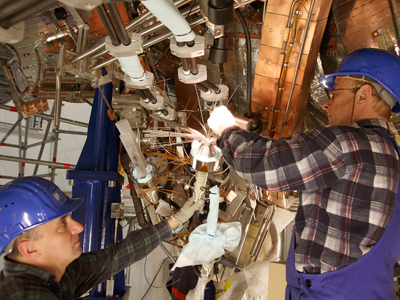 When the new Wendelstein 7-X facility for researching nuclear fusion as a future energy source becomes operational in 2014, it will also incorporate high-precision work and scientific expertise from Poland.
Although scientists from the Max Planck Institute for Plasma Physics (IPP) will play a leading role in the construction of the research facility in Greifswald, quite a few partners will also participate. After the USA, Poland will provide the largest contribution through two cooperative projects. The close of 2012 saw completion of a key six-year project: superconduction technology experts from the Institute of Nuclear Physics of the Polish Academy of Sciences in Cracow connected the 50 superconducting electromagnets – the technical centrepiece of the facility – together in a ring. Around 45 technicians and engineers assembled 121 superconductors up to 14 m long, as well as 240 connectors and 400 supports that had been manufactured at the Forschungszentrum Jülich. When the research facility is operational, current flows through the ring and creates a magnetic cage. This magnetic cage - when hydrogen nuclei are to ignite the fire of fusion and melt into helium nuclei at 100 million degrees Celsius in a future power plant – is prerequisite for containing the plasma to maintain stable, continuous energy production.
After the departure of the technical staff from Cracow, cooperative efforts will continue with the National Centre for Nuclear Research in Swierk, Poland: The accelerator experts there will take care of production of components for neutral particle heating at Wendelstein 7-X. High-speed particles will be fired into the plasma to help heat it. Manufacturing orders have already been placed with Polish and other European industrial companies.
Around two-thirds of the costs for both projects are being carried by the Polish Ministry of Science, which made available a total of 6.5 million euros and wants to build its fusion research programme around Wendelstein 7-X. In addition, IPP is funding plasma diagnostics in the form of cooperative projects with universities in Warsaw and Opole. In future, Polish scientists will also carry out research projects directly at Wendelstein 7-X.
Source: Max Planck Institutes
 The JET shutdown is progressing steadily. Remote Handling Group has been working in-vessel since December. The first task was to conduct a full photographic survey of the inside of the vessel, so that the effects of a year of plasma operations on the ITER-like wall can be assessed. Scientists are now poring over the photographs in detail.
Meanwhile various components have been removed from the torus for closer examination. The tiles in the divertor region (at the bottom of the torus) are fixed to ‘carriers’, and around 20 of these carriers have been removed. They have been transferred to the Beryllium Handling Facility for maintenance of some of the embedded diagnostic systems and removal of a few tiles.
About 600 individual tiles and components have also been removed. Most of these will be replaced without modification, but it was necessary to remove this number in order to gain access to about 50 in particular regions of interest. The 50 will be analysed in laboratories around Europe to look for evidence of erosion and deposition. As many of the tests will be destructive, they will be replaced by brand new tiles as the 600 are re-assembled. Already more than half the tiles taken from the poloidal limiters are back in place.
The next instalment will cover calibration of some diagnostic systems.
Source: EFDA
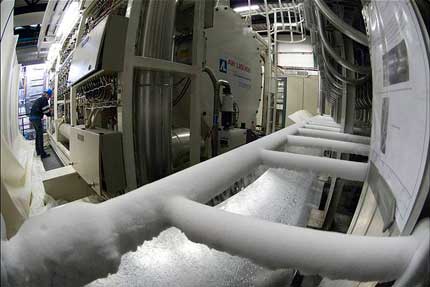 ENGINEERINGNET.EU – The engineering company Air Liquide has secured two contracts to build extreme cryogenic systems for the ITER and the related JT-60SA research projects on fusion. The total value of these equipment sales contracts will reach over €100million.
Based near Marseille, in France, the ITER project plans the creation of an experimental reactor intended to illustrate the scientific and technical feasibility of fusion. This process generates little waste and eliminates any risk of reactor runaway.
To obtain the very powerful electromagnetic fields necessary to confine fusion, superconducting magnets must be used, which only work at extremely low temperatures.
For this project, Air Liquide will provide the biggest centralized refrigeration system ever built. This cryogenic equipment is essential for maintaining an extremely cold temperature for the 10,000 tonnes of superconducting magnets used on the Tokamak.
This sophisticated scientific instrument confines the plasma that makes it possible to achieve the conditions necessary for controlled fusion. The closed circuit refrigeration system is based on the properties of liquefied helium, whose temperature is close to the lowest possible temperature 0 K, or -273°C, called "absolute zero".
Between the end of 2015 and the beginning of 2017, Air Liquide will install three refrigerators for a global cooling capacity of 75 kW at 4.5 K, or - 269 °C.
The purpose of another project, JT-60SA, is to support the ITER project's research activities by working on the capacity to control and maintain the plasma for several hours.
JT-60SA, based in Japan, is designed to optimize plasma configurations for the ITER project. It is led by the Japanese Atomic Energy Agency in collaboration with the French organisation CEA. For this project, Air Liquide will commission, in 2015, a helium refrigeration system, intended to cool the Tokamak.
François Darchis, Senior Vice-President: "After the CERN's LHC and Kstar in Korea, these projects once again prove our capacity to meet major scientific challenges by supplying very high tech systems." << (BB) (photo: Air Liquide, cryogenic system at CERN)
Source: engineeringnet.eu
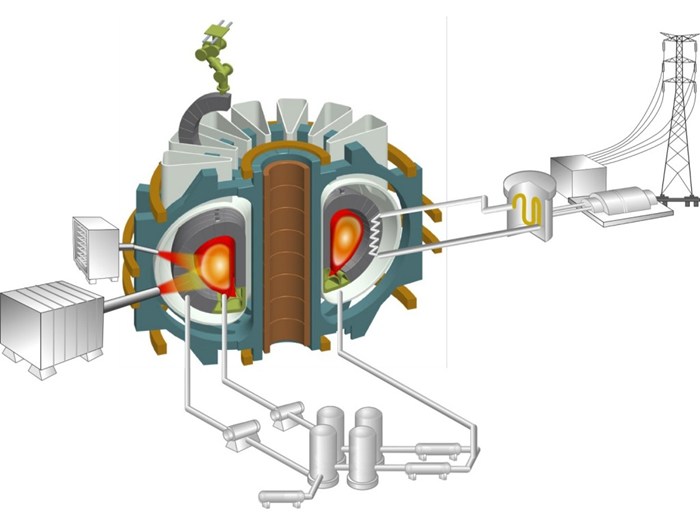 Harnessing fusion energy in the 21st century is a lot like going to the Moon in the 1970s. At that time, as each manned flight project unfolded, another one was already in the plans. One half-century ago, the Mercury, Gemini and Apollo programs were the space equivalent of the fusion projects JET, ITER and DEMO.
 A five year quest has borne fruit with the COMPASS tokamak in Prague’s Institute of Plasma Physics (IPP) achieving H-mode performance. The milestone marks a new era for fusion research in the Czech Republic, which began in 2007 when the COMPASS tokamak was transferred from the CCFE in UK.
“We have historical links which made us a regional centre for scientists from Hungary, Bulgaria and Poland, but now scientists from West Europe have also been visiting COMPASS – it’s another meeting point for the fusion community.” says fusion scientist Dr Jan Mlynář from IPP.
“It is very important that we can now do H-mode operation as this is the standard ITER scenario. We have invested lots of money into making an “ITER-like” operation scenario, in particular we purchased new heating neutral beams to achieve relevant ion temperatures and thus hopefully create Type I ELMs.”
Now the ITER-like mode of operation has been established, COMPASS can be used as a small scale test bed for ITER performance: combining COMPASS’s results with similar tests in ASDEX Upgrade (three times larger) and JET (six times larger) gives excellent extrapolation to ITER (ten times larger).
However, for some studies the overall size does not matter, and in these areas COMPASS really comes into its own. H-mode’s high confinement stems from a sharp increase in the pressure at the edge of the plasma, known as the edge transport barrier or pedestal; COMPASS’s ability to reproduce H-mode makes it arguably as useful a device as the bigger machines in studying this plasma edge phenomenon, says Dr Mlynář.
“We can now measure and detail properties of this pedestal. All machines that have H-mode have this edge pedestal, however nobody really understands the details of physics behind this pedestal… Our advantage is that we are not so expensive and so “heavy” in operation. It is simpler to test different ideas or different new hardware.”
“Also, big machines are usually overbooked – scientists need a really good reference to get research time at ASDEX or JET, and promising results from smaller tokamaks is a very good reference.”
With the result in Prague coinciding with the recent release of EFDA’s road map to fusion, it’s clear that COMPASS will have a significant part to play in the navigation towards the goal of fusion energy!
The Institute of Plasma Physics is the Czech Republic’s signatory to the European Fusion Development Agreement.
Source: EFDA
Local News
- 1
- 2
- 3
- 4
- 5
IPPLM joins the Enterprise Europe Network
31-03-2026
On 23 March 2026, the Institute of Plasma Physics and Laser Microfusion (IPPLM) joined, with its technological offer, the group of entities affiliated with the Enterprise Europe Network (EEN), interested...
Read moreIPPLM as a co-creator of the exhibition "E = mc² – the formula that changed the world" at the National…
18-02-2026

On 16 February 2026, the official opening of two new permanent exhibitions took place at the National Museum of Technology in Warsaw. The Institute of Plasma Physics and Laser Microfusion...
Read moreIPPLM supports children and young people at the TPD "Helenów" Centre
22-12-2025

The Sylwester Kaliski Institute of Plasma Physics and Laser Microfusion (IPPLM) has for many years been actively engaged in initiatives supporting children and young people supported by the TPD "Helenów"...
Read moreIPPLM researchers took part in an experimental campaign on the GEKKO XII laser
20-11-2025

On 10–14 November 2025, a research team from the Sylwester Kaliski Institute of Plasma Physics and Laser Microfusion (IPPLM) – Prof. Katarzyna Batani, Dr Hanna Marchenko and Dr Agnieszka Zaraś-Szydłowska...
Read moreRegister for the 18th Kudowa Summer School on Plasma Physics!
07-11-2025

We invite you to take part in the 18th Kudowa Summer School "Towards Fusion Energy", which will be held on 8–12 June 2026 in Kudowa-Zdrój, Poland. The event is organised...
Read moreIPPLM participated in the second technical meeting within the DONES Con-P1 project
17-10-2025
The Institute of Plasma Physics and Laser Microfusion (IPPLM) took part in the second technical meeting held as part of the DONES Consolidation Phase 1 (DONES ConP1) project, co-financed by...
Read moreProf. Jan Badziak from IPPLM among the World’s Top 2% Scientists
15-10-2025
Prof. Jan Badziak, from the Department of Laser Plasma and Magnetized Dense Plasma Physics at the Institute of Plasma Physics and Laser Microfusion (IPPLM), has been included in the prestigious...
Read more29th Science Festival with the participation of IPPLM
10-10-2025

During the 29th Science Festival in Warsaw, held on 19–28 September 2025, researchers from the Institute of Plasma Physics and Laser Microfusion (IPPLM) conducted lessons for upper-grade primary school students. The...
Read morePLASMA 2025 and the 20th Anniversary of the Euratom–IPPLM Association – event summary
26-09-2025

From 15 to 19 September 2025, Warsaw hosted the international scientific conference PLASMA 2025 – International Conference on Research and Application of Plasmas, dedicated to plasma research, diagnostics, and applications....
Read moreWe bid farewell with deep sorrow to Professor Jerzy Wołowski
25-09-2025

It is with great sadness that we have received the news of the passing of Professor Jerzy Wołowski (1936–2025) an outstanding physicist, long-time employee of the Institute of Plasma Physics...
Read more20th anniversary of the Euratom–IPPLM Association (CeNTE): Celebrating two decades of fusion research coordination
16-09-2025

On 19 September 2025, during the PLASMA 2025 International Conference on Research, Diagnostics and Applications of Plasma in Warsaw, the IPPLM will mark 20th anniversary of the coordination of research on nuclear fusion...
Read moreIPPLM at the 49th Congress of Polish Physicists in Katowice
13-09-2025
During the 49th Congress of Polish Physicists, held from September 5–11, 2025, in Katowice, the Institute of Plasma Physics and Laser Microfusion (IPPLM) was represented both among the speakers and...
Read moreProf. Agata Chomiczewska appointed Deputy Director for Scientific Affairs at the IPPLM
03-09-2025

We are pleased to announce that the Minister of Energy, Mr. Miłosz Motyka, has appointed Dr. hab. Agata Chomiczewska to the position of Deputy Director for Scientific Affairs at the...
Read moreA historic milestone – the Scientific Council of the Institute confers the degree of habilitated doctor
10-07-2025
For the first time in the history of the Institute of Plasma Physics and Laser Microfusion (IPPLM), the Scientific Council has adopted a resolution to confer the degree of habilitated...
Read moreNew Board of the Plasma Physics Division of the European Physical Society
04-07-2025

In the first quarter of 2025, elections were held for the Board of the Plasma Physics Division of the European Physical Society (EPS Plasma Physics Division). Six candidates who received...
Read moreIPPLM researchers bring fusion expertise to 10th Central & Eastern Europe Nuclear Industry Congress 2025
12-06-2025
Researchers from the Institute of Plasma Physics and Laser Microfusion (IPPLM), Dr. Natalia Wendler and Dr. Paweł Gąsior, recently participated in a panel discussion at the 10th Central & Eastern...
Read moreIPPLM at the 3rd edition of the "Science for Society" Congress
29-05-2025

On 25-26 May 2025, the 3rd edition of the "Science for Society" Congress took place in the Large Hall of the Warsaw University of Technology. The aim of the event...
Read moreInvitation to the 3rd edition of the "Science for Society" Congress with the participation of IPPLM
22-05-2025

The 3rd edition of the "Science for Society" Congress will take place on 25–26 May 2025 at the Warsaw University of Technology. This unique event demonstrates that science is not...
Read moreJoin the 28th Science Picnic!
07-05-2025

The Institute of Plasma Physics and Laser Microfusion (IPPLM) invites you to its stand on Saturday, 10 May, during the 28th Science Picnic, organized by Polish Radio and the Copernicus...
Read moreCooperation agreement between the IPPLM and the National Museum of Technology
18-04-2025

On 17 April 2025, a cooperation agreement was signed between the National Museum of Technology (NMT) and the Institute of Plasma Physics and Laser Microfusion (IPPLM). The ceremonial meeting, attended by...
Read morePolish and French researchers join forces in research on nuclear fusion
31-03-2025

On 24-25 March 2025, a Polish-French meeting was held at the headquarters of the Institute of Nuclear Physics of the Polish Academy of Sciences (IFJ PAN) and the French Institute...
Read moreJoin us for the International Conference on Research and Application of Plasmas – PLASMA 2025!
13-03-2025

The Institute of Plasma Physics and Laser Microfusion (IPPLM) invites you to attend the PLASMA 2025 – International Conference on Research and Application of Plasmas, which will be held from...
Read moreExperimental research session in the Plasma-Focus PF1000U laboratory as part of the ICDMP collaboration
27-02-2025

On February 10–21, 2025, an experimental session was held in the Plasma-Focus PF-1000U laboratory, in which, in addition to the IPPLM team, a three-person team of researchers from the Prague...
Read moreLaser demonstration on JET detects fusion fuels
11-02-2025

Scientists and engineers from eight nations, including Poland, have carried out a project using lasers on the Joint European Torus (JET) to study fusion fuel retention. Laser Induced Breakdown Spectroscopy (LIBS),...
Read moreIPPLM employee nominated for the Personality of the Year title in the Science category
24-01-2025
Research and technical employee Mr. Olgierd Cichorek, M.Sc., from the Laboratory of Plasma Nudge for Satellites at the IPPLM has been nominated for the title of Personality of the Year...
Read moreWorld News
- 1
- 2
- 3
- 4
- 5
In Memoriam — Professor Francesco Romanelli
24-03-2026

The world of fusion research mourns the loss of Professor Francesco Romanelli, a visionary scientist whose work helped bring humanity closer to clean, limitless energy. Over four decades, he explored...
Read moreIgniting the future: Breakthroughs in inertial confinement Fusion
25-07-2025

In December 2022, the National Ignition Facility (NIF) at Lawrence Livermore National Laboratory (USA) marked a historic milestone in fusion science: an experiment produced 3.15 MJ of fusion energy from 2.05 MJ of laser...
Read moreWendelstein 7-X sets new fusion performance records
04-06-2025

On May 22, 2025, the Wendelstein 7-X (W7-X) stellarator at the Max Planck Institute for Plasma Physics (IPP) in Greifswald concluded its latest experimental campaign with a major success: a...
Read moreEuropean tokamak sets new fusion plasma record
20-02-2025

On February 12, 2025, the WEST tokamak, located at CEA Cadarache in southern France, set a new world record by sustaining fusion plasma for 1,337 seconds, or over 22 minutes....
Read moreDr. Gianfranco Federici appointed as the new EUROfusion Programme Manager
17-12-2024
At the 49th General Assembly held in Barcelona, December 2024, Dr. Gianfranco Federici was elected as the new Programme Manager of EUROfusion. He succeeds Prof. Ambrogio Fasoli, who will return...
Read moreEUROfusion and F4E join forces for Europe’s fusion future
16-12-2024

EUROfusion and Fusion for Energy (F4E) have signed a Memorandum of Understanding (MoU) to advance fusion research and development in Europe. This agreement reinforces cooperation in...
Read moreJohn J. Hopfield and Geoffrey E. Hinton awarded the 2024 Nobel Prize in Physics
08-10-2024

John J. Hopfield and Geoffrey E. Hinton have been awarded the 2024 Nobel Prize in Physics "for foundational discoveries and inventions that enable machine learning with artificial neural networks." The Nobel...
Read moreWendelstein 7-X begins new experimental campaign
10-09-2024

The Wendelstein 7-X, the world’s most advanced stellarator, is launching a new experimental campaign after a year of intensive maintenance and upgrades. This phase, known as OP2.2, begins on 10...
Read moreITER's New Project Baseline: A Robust Path to Fusion Energy Research
04-07-2024

On 3 July, ITER Director-General Pietro Barabaschi presented the new project baseline, under evaluation by the ITER Organization's governing body. This plan aims to ensure a robust start to scientific...
Read moreITER Council Presents Updated Project Baseline
21-06-2024

The ITER Council convened this week for its 34th meeting, where nearly 100 attendees reviewed significant updates to the project baseline. The proposed changes aim to optimize the overall project...
Read moreEurope and Japan celebrate breakthrough in paving the way for fusion energy
01-12-2023

The prospect of harnessing fusion energy is closer. The successful operation of JT-60SA, the most powerful experimental device to date, built by Europe and Japan, is a landmark achievement for...
Read moreFirst plasma was successfully generated at JT-60SA
26-10-2023

A momentous achievement in the field of nuclear fusion has been accomplished by a collaborative team of engineers from Europe and Japan. They have successfully generated tokamak plasma for the...
Read moreThe Nobel Prize in Physics 2023
03-10-2023
Pierre Agostini, Ferenc Krausz and Anne L’Huillier are the winners of this year's Nobel Prize in Physics. It was awarded "for experimental methods that generate attosecond pulses of light for...
Read moreUS Lab Replicates Fusion Ignition Breakthrough
08-08-2023
The US National Ignition Facility (NIF) has achieved fusion ignition once again, building on its landmark 2022 success. This achievement, powered by hydrogen within a diamond capsule, signifies a major...
Read moreNew Programme Manager Elect announced by EUROfusion
20-07-2023
Professor Ambrogio Fasoli became the new EUROfusion Programme Manager Elect. The decision was made by EUROfusion General Assembly at the meeting on 18 July 2023. His tenure will officially commence...
Read moreEUROfusion stands in solidarity with research in Ukraine
24-02-2023

Today, as we commemorate the anniversary of the invasion of Ukraine by Russia, the EUROfusion consortium stands in solidarity with our Ukrainian member and research colleagues. EUROfusion remains committed to supporting...
Read moreEight-minute production of plasma with gigajoule energy turnover at Wendelstein 7-X
23-02-2023

Another target has been achieved only recently by the W7-X researchers, namely they managed to acquire an energy turnover of 1.3 gigajoules in the device, which is 17 times higher...
Read moreThe Nobel Prize in Physics 2022
04-10-2022

Alain Aspect, John F. Clauser and Anton Zeilinger are the winners of this year's Nobel Prize in Physics. It was awarded “for experiments with entangled photons, establishing the violation of...
Read moreNew experiments for fusion energy record breaker JET
27-09-2022

A new wave of fusion energy experiments on UK Atomic Energy Authority’s record-breaking Joint European Torus (JET) started this month. EUROfusion researchers are using the famous JET machine to conduct a...
Read moreITER appoints new Director-General
21-09-2022
Pietro Barabaschi has become the next Director-General of the ITER Organization as a result of the unanimous choice of the Council from among finalist candidates. In the transition period Dr....
Read moreStarting power plant design
07-07-2022

At a livestreamed Horizon EUROfusion event in Brussels on 5 July 2022, EUROfusion celebrated the start of conceptual design activities for Europe's first demonstration fusion power plant DEMO. This first-of-a-kind...
Read moreCelebration of achieving a crucial assembly milestone in the ITER Project
17-05-2022

This month, we have witnessed the successful lifting and lowering into the machine well of the first sub-section of the ITER plasma chamber. The weight of the component is the...
Read moreBurning plasma achieved in inertial fusion at the National Ignition Facility
15-02-2022
Obtaining a burning plasma is a critical step towards self-sustaining fusion energy. A burning plasma is one in which the fusion reactions themselves are the primary source of heating in...
Read moreHistoric milestone reached by JET scientists
20-01-2022

Iconic fusion energy machine JET – which reaches controlled temperatures 10 times hotter than the core of the sun – completed its 100,000th live pulse last night. Weighing 2,800 tonnes, the...
Read moreHorizon Europe Grant Agreement signed
20-12-2021

15 December 2021 saw the EUROfusion consortium signing the Grant Agreement under Horizon Europe, the European Framework Programme from 2021 – 2027, in an aim to launch comprehensive R&D approach...
Read more |
 |
 |
 |
 |
 |
 |
 |
What we do
Our laboratories
Online seminars
| Thursday, 30 Apr 2026, godz. 13.00 Seminarium instytutowe: "Equation of State of Shock Compressed BN in the Megabar Pressure Range", dr hab. Katarzyna Batani, IFPiLM |


Research projects carried out at the IPPLM are funded by the Polish Ministry of Education and Science, the National Science Centre and by the European Commission within the framework of EUROfusion Consortium under grant agreement No 101052200. Financial support comes also from the International Atomic Energy Agency, European Space Agency and LaserLab Consortium as well as from the Fusion for Energy Agency.