



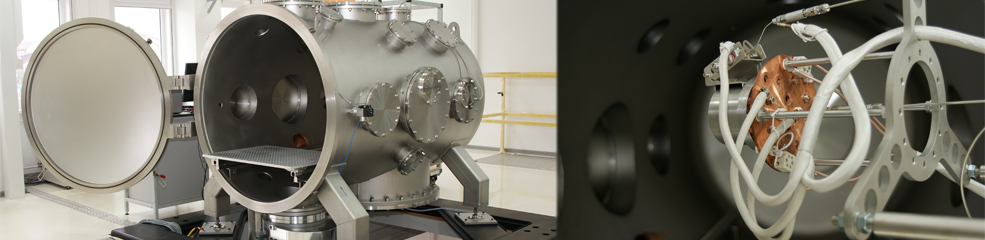


Zestaw obrazów 2019
zdjecie1.jpg
zdjecie2.jpg
zdjecie3.jpg
zdjecie4.jpg
zdjecie5.jpg
zdjecie6.jpg
2019_1.JPG
2019_2.JPG
2019_4.JPG


Światowe
 At the heart of deuterium-tritium fusion is the neutron. Each fusion event produces neutrons with an enormous amount of energy – 14.1 megaelectron volts. This is a million times more energy than is produced by burning coal, and manifests itself in the speed of the neutrons, which leave the reaction at about 50 000 kilometres per second.
These neutrons have more energy than those produced by fission, which typically have only a few megaelectron volts. This enormous amount of energy seems to be a goldmine for our future energy needs, however neutrons are a bit tricky to catch. Because they are uncharged they pass through the electron shells of atoms unhindered; it is only when they get close to nuclei that they interact – the charge of the quarks in the neutron interacts with the charge of protons and neutrons in the nuclei. At this range neutrons often trigger nuclear reaction with their interaction, thereby changing the nature of the material – the large numbers of neutrons of this energy produced by a fusion reactor would damage most conventional structural materials beyond repair within weeks. Furthermore the blanket around a fusion reactor needs to be able to use these neutrons to breed tritium from lithium, and convert the energy of the neutrons to heat that can generate steam to drive turbines.
These multiple material science challenges are being met by a number of research groups across Europe, who are examining the effects of neutrons, both in simulations and with small experiments that produce fast neutrons. These groups have come up with a number of possible designs for the lithium blanket, for example in ceramic pebbles, or as a layer of liquid lithium-lead, which will be tested in ITER. “Neutronics simulations suggest producing tritium in sufficient amounts in a fusion power plant is feasible,” says Dr Lee Packer of CCFE.
However research into the activation of the fusion-facing components is not as advanced. Neutronics experts such as Dr Packer are developing detailed understanding of the defects that neutrons cause in material structures. They have already whittled down the possible 66 000 reactions that neutrons could cause to a ‘mere’ 5096 important reactions, but more remains to be done, says Dr Packer. “We need a large scale neutron source, such as the proposed IFMIF or CTF, to qualify materials. We have simulations, but there is no substitute for experimental data. Of those 5096 reactions, only 470 have complete experimental data, so there is a lot to do!”
Source: EFDA
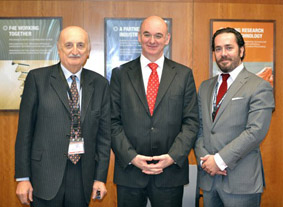 The contract for the supply of 70 radial plates to the ITER magnets system has been signed between Fusion for Energy (F4E) and the Consortium of SIMIC S.p.A and Constructions Industrielles de la Méditerranée (CNIM). This is one of the largest industrial contracts signed by F4E approximately in the range of 160 million EUR and is expected to run for a period of approximately four years. Given the fact that Europe is responsible for the supply of 10 out the 18 Toroidal Field (TF) coils of the ITER device, 70 radial plates will need to be manufactured in order to host in their grooves the circular superconducting conductors of the TF coils. The signature of this contract is an important milestone for Europe’s in-kind contribution to ITER following the successful manufacturing of two European prototypes, known for their unprecedented size and high tolerance. The production of the components will take place in Italy (SIMIC S.p.A) and France (CNIM) in state of the art facilities.
The function and characteristics of the radial plates in the ITER device:
The ITER device will operate with a system of superconducting magnets which relies on the Toroidal Field coils, the Central Solenoid, the Poloidal Field coils and the Correction coils.
Toroidal Field (TF) coils are “D” shaped coils whose core task in the ITER device is the confinement of plasma.
The radial plate is one of the components of the TF coils. This D-shaped stainless steel plate measures 13.4 m x 8.7 m x 0.12 m. The radial plate has on each side spiral round-shaped grooves which are closed by cover plates.
The superconducting conductor of the TF coils, once heat treated and electrically insulated, is inserted into the grooves of the radial plates. In order to successfully fit the superconductor into the radial plate grooves, its trajectory must match that of the radial plate. It is for this reason that all grooves of the radial plates are machined according to the as-built trajectory of the double pancake conductor. Afterwards, the radial plate is electrically insulated and impregnated with epoxy resin, forming a so-called double pancake module. Then, seven double pancake modules are stacked, electrically connected and impregnated together to form a winding pack, the core structure of the TF coil. Finally, the winding pack is inserted in a welded stainless steel shell, known as the coil case, to form the TF coil.
Each TF coil is composed of five regular and two side double pancakes.
A total of 70 radial plates will be supplied by F4E (50 regular and 20 side radial plates) for the 10 TF coils to be supplied by Europe.
Source: EFDA
PARIS – France’s culture and cuisine have long made it the most popular tourist destination on the planet, but French authorities face a more difficult task when it comes to attracting non-European companies and investors.
Faced with stagnant growth and near-record unemployment of 10.6 percent, the government of the world’s fifth-largest economy is introducing new measures that it hopes will improve its reputation and entice foreign firms – including Israeli ones – to establish operations there.
Around 100 Israeli companies operate in France, employing more than 2,400 locals, according to Serge Boscher, managing director of the Invest in France Agency, which is responsible for “job-creating investment.” These companies cover agriculture, plastics, transport, logistics and other industries, and are seen as just the tip of the potential iceberg.
“The challenge for us is to attract Israeli start-ups,” Boscher says, referring to hi-tech pioneers in biotech and clean-tech. “Israeli companies are very innovative, and we need this high level of innovation.”
Moody’s recent announcement that it was stripping France of its AAA credit rating seemed to underpin international sentiment over the country’s economic performance.
The agency said a number of factors influenced the decision, including France’s sustained loss of competitiveness and the rigidness of its labor, goods and service markets.
Boscher is confident that the international market will ignore Moody’s decision. However, he points out that it provides an incentive for France to push ahead with reforms, including the “competitiveness pact” announced earlier this month.
The Socialist government of President Francois Hollande promised 20 billion euros in tax credits to companies over a three-year period, beginning in 2013.
Its announcement came one day after a government-commissioned report by Louis Gallois, former chief of Airbus parent company EADS, recommended that tax breaks be implemented over one or two years for immediate effect. Gallois warned that high labor costs were reducing the profit margins of businesses, leaving them little to invest in product innovation.
The second key element to improving France’s combativeness, according to Boscher, is a successful conclusion to the “Social Conference” – negotiations between unions and business leaders that the government hopes will usher in a new era of compromise.
France, long famed for labor strikes that paralyze entire industries, is looking to neighboring Germany’s “social dialogue” for inspiration.
An anemic auto industry
France’s all-important auto industry has been hard hit by Europe’s economic crisis, as shown by Peugeot Citroen’s decision earlier this year to layoff 10% of its domestic workforce of 80,000 employees.
Officials at Renault, France’s other famous car-maker, say their company has managed to soften the blow from falling European demand through its 13-year old cross-continental alliance with Nissan (joined recently by a third partner, Germany’s Daimler Group).
Renault holds a 43.4% stake in Nissan, while its Japanese counterpart holds a 15% stake in Renault, ensuring that both partners have a mutual self-interest – and more importantly, enabling them to manufacture almost one-tenth of their vehicles in their partner’s plants.
“For the European auto sector, the biggest problem is overcapacity,” Renault Nissan Alliance communications director Rachel Konrad explains.
“Depending who you talk to, there is 20-30% more production than purchases. The way the laws are set, you have to continue paying workers, so it’s incredibly inefficient if they’re not producing anything. The fact that our Normandy plant cannot only produce Renault’s engines, but also Nissan’s and Daimler’s, is beneficial and increases job security. No other company can do this.”
The alliance also helps boost sales, according to Jacques Verdonck, Alliance Director in charge of coordination with Daimler.
“What we have achieved is to be less dependent on the European market,” Verdonck says, pointing out that more than 50% of Renault vehicles are sold outside the continent – including Russia, where the alliance has 32.9% market share, and Brazil, where is has 7.7% market share.
On the production side, Renault has been a pioneer in Zero Emission vehicles. Its Fluence ZE electric cars hit Israeli and Danish roads this year, thanks to a partnership with Israel’s Better Place – which operates dozens of battery-replacement stations for the vehicles in both countries.
Renault officials declined to comment on the performance of their partner – which removed founder Shai Agassi as CEO in October and has lost around $500 million since its establishment in 2007. However, they point out that electric vehicles are an earlystage technology, which means they are reliant on customer feedback and on differences in regulations between countries.
“We have gotten more than 50,000 electric vehicles on the road [in total]. I don’t think anybody, internally, thought it would be easy,” Konrad says.
“I have been working in electric vehicles since 2008, and if you read the media four years ago, they said, ‘everybody will switch to electric vehicles.’ Internally, people were saying, “no, this is a gradual shift, a significant, important segment for our industry and for our planet, but it’s not going to be immediate.’”
ITER: Fostering fusion
France is literally miles ahead of its neighbors in at least one form of transportation: long-distance trains.
The TGV high-speed rail service completes the 750-kilometer journey between Paris and Marseille in just over three hours. It departs the capital’s Gare du Nord station, moves southeast through the green pastures of Burgundy and the foothills of the Alps, arriving at Marseille’s Saint Charles Station.
From there it is a short metro ride to the city’s ancient Mediterranean port.
The port area is changing dramatically thanks to Euroméditerranée, Europe’s biggest urban renewal project. Backed by funding from the European Union and ANIMA Investment Network – a group of government development agencies in the Mediterranean basin – some 500,000 sqm. is already built or under construction, with expectations this will double by 2020.
Marseille will be thrust into the spotlight when the city assumes the revolving title of European Capital of Culture in 2013. But it is 60km. away, in Cadarache, that the region’s most ambitious project is being conducted – at the International Thermonuclear Experimental Reactor (ITER).
Funded and run by seven members – the EU, US, China, Japan, South Korea, India and Russia – ITER is the largest experiment ever conducted to demonstrate the scientific and technological feasibility of fusion energy. Construction on the Tokamak reactor began in August 2010, with completion expected this decade.
Once operational, the reactor will produce electricity via several steps: it will heat deuterium and tritium plasma to more than 100 million °C; keep hot plasma away from walls by strong magnetic fields; use high energy helium nuclei to sustain burning plasma; neutrons will transfer their energy to what is known as a “blanket”; and finally, in a fusion power plant, a conventional steam generator, turbine and alternator will transform the heat into electricity.
This will not be the first time nuclear fusion is used to produce electricity; JET, located in Britain, achieved its first plasma in 1983.
But if everything goes to plan, ITER will generate 500 megawatts of energy for just 50 megawatts invested – and that will be a first, explains spokesman Robert Arnoux.
“ITER will not produce electricity; it will just demonstrate that we can do it. It will demonstrate that we can do it for a rather long duration, and it will demonstrate that we can amplify the action,” he says.
Proponents of nuclear fusion point out that it produces no CO2 or other greenhouse gases, leaves no long-lasting radioactive waste, and provides an almost limitless supply of fuel that can be widely distributed around the globe.
Additionally, Arnoux points out, it cannot be used in the proliferation of weapons – as it lacks the heavy elements that go into an atomic or hydrogen bomb.
“This explains why the US and the Soviet Union cooperated on nuclear fusion in the late 1950s, during the hottest period of the Cold War,” he says. “Everyone has realized that there were no military implications, because there was no proliferation issue.”
Right now, all that can be seen of the reactor are its foundations – one level of several hundred seismic pads, enclosed by thick retaining walls, which will isolate the reactor from ground motion in the event of an earthquake. Most of the reactor’s components are being constructed abroad, by the member states.
The largest and heaviest loads will arrive at the harbor of Fos-sur- Mer, and transported along a specially created 104km.-long route to Cadarache.
When completed, the Tokamak will weigh 23,000 tons, and reach a height of 73 meters – slightly taller than the Arc de Triomphe.
If all of this sounds like a distant, almost utopian vision – it is, admits Arnoux. He estimates that an industrial prototype is achievable by the year 2050, but that there is no certainty it will prove commercially viable.
“We know that it will work, but the problem is whether it will work very well, or just average,” he says.
“Our industrial blueprint is crazy; no industry builds a machine this way, but this is inherent to the project.
“This project is not only about science and technology; it is about teaching the world how to build this fabulous machine.”
The writer visited France as a guest of the Invest in France Agency.
Source: The Jerusalem Post
 The contract for the supply of nine Pre-Compression Rings (PCRs), among which three spares, that will support the ITER machine’s magnet system, has been signed between Fusion for Energy (F4E) and EADS CASA Espacio. The total budget of the contract is in the range of 12 million EUR and it is expected to run for approximately four years.
The key function of PCRs is to reduce the fatigue of the ITER machine’s magnet structures from the powerful electro-magnetic forces and consequently prolong their operation from ten to over twenty years. The signature of the PCRS contract marks another European milestone that will deliver the largest composite structures ever built for operation in a cryogenic environment. The work will be carried out in a centre of excellence located in Spain, which has a proven track record in field of composites for space applications.
The function of PRCs in the ITER machine:
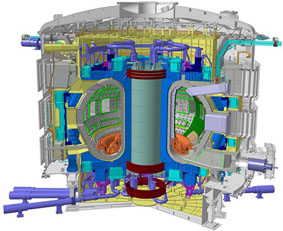
The ITER machine will operate with a system of superconducting magnets which relies on the Toroidal Field coils, the Central Solenoid, the Poloidal Field coils and the Correction coils (see ITER image).
Toroidal Field (TF) coils are “D” shaped coils whose core task in the ITER device is the confinement of plasma. PRCs are the keystones of the TF coils system and will be assembled to the top and bottom of TF coils in order to prevent them from deforming when the powerful magnetic field is created.
The size of the PCRs, their assembly and maintenance:
The basic design relies on 5 m diameter fibreglass composite rings with a cross section of about 300 mm x 300 mm at top and three at the bottom of the TF coil system. Three PCRs will be installed and loaded at the top and three at the bottom of the TF coil system and will apply a centripetal force equivalent to that of 3,000 tonnes on the top and bottom of each TF coil reducing their overall constraints.
In order to avoid the circulation of electrical currents and withstand high loads, the PCRs will be manufactured of fibreglass composite, where in every cross section nearly a billion of miniscule glass fibres will be glued together.
Their load will need to be maintained for the entire 20 years of ITER operation, while accommodating thermal shrinkages during cool-down/warm-up, cyclic forces, settlements and unexpected motions. Due to the limited access to carry out in-service inspection of the PCRs, in case there is a need for the replacement of the lower PCRs, it will be carried out by using one or more of three spare rings made available below the Tokamak in the cryostat.
Source: F4E
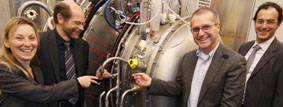 The heat source is a particle beam named Elise (Extraction from a Large Ion Source Experiment), and was unveiled at the Max-Planck Institute for Plasma Physics in Garching near Munich on 27th of November. It represents a major step forward not only in the energy of the particles, but also in the size of the beam; its cross-section is about half the area of the final models planned for ITER, reckoned as being the size of a door.
Elise is the largest device of its kind in the world, eclipsing the dinner-plate sized neutral beam heaters at JET. However it is planned to only retain that crown for the next two years, at which point MITICA, a neutral beam facility in Padova, Italy, will come online, with a full size prototype of one of ITER’s heating beams.
The successive generations of test facilities are important because ITER’s high energy beams use negative ion beams, a different technology to most existing systems. All accelerated ion beams need to be neutralised just before they enter the vessel so that they can penetrate the magnetic field. Lower energy systems, such as JET, accelerate positive ions; however positive ions present a problem because at the higher energies required to penetrate deeply into ITER’s large plasma it is almost impossible to re-attach electrons to neutralise the ions. Instead the new systems will accelerate negative ions, which are harder to create and have a very short lifetime, but have a much higher neutralisation efficiency (around 60 percent at 1 megavolt).
The ion beam is created by injecting a high frequency RF wave in hydrogen, thereby creating a plasma. This plasma is then brought into contact with a material with loosely bound electrons, for example caesium. The hydrogen picks up electrons from the material, creating negative ions, which are then separated by a complex series of water cooled grids from the other species – such as electrons, which are also negatively charged.
The Elise experiment will be conducted within IPP’s newly established “ITER Technology and Diagnostics” research division headed by Prof. Dr. Ursel Fantz.
The Max Planck Institute for Plasma Physics is one of three German signatories to the European Fusion Development Agreement.
Source: EFDA
Local News
- 1
- 2
- 3
- 4
- 5
IPPLM joins the Enterprise Europe Network
31-03-2026
On 23 March 2026, the Institute of Plasma Physics and Laser Microfusion (IPPLM) joined, with its technological offer, the group of entities affiliated with the Enterprise Europe Network (EEN), interested...
Read moreIPPLM as a co-creator of the exhibition "E = mc² – the formula that changed the world" at the National…
18-02-2026

On 16 February 2026, the official opening of two new permanent exhibitions took place at the National Museum of Technology in Warsaw. The Institute of Plasma Physics and Laser Microfusion...
Read moreIPPLM supports children and young people at the TPD "Helenów" Centre
22-12-2025

The Sylwester Kaliski Institute of Plasma Physics and Laser Microfusion (IPPLM) has for many years been actively engaged in initiatives supporting children and young people supported by the TPD "Helenów"...
Read moreIPPLM researchers took part in an experimental campaign on the GEKKO XII laser
20-11-2025

On 10–14 November 2025, a research team from the Sylwester Kaliski Institute of Plasma Physics and Laser Microfusion (IPPLM) – Prof. Katarzyna Batani, Dr Hanna Marchenko and Dr Agnieszka Zaraś-Szydłowska...
Read moreRegister for the 18th Kudowa Summer School on Plasma Physics!
07-11-2025

We invite you to take part in the 18th Kudowa Summer School "Towards Fusion Energy", which will be held on 8–12 June 2026 in Kudowa-Zdrój, Poland. The event is organised...
Read moreIPPLM participated in the second technical meeting within the DONES Con-P1 project
17-10-2025
The Institute of Plasma Physics and Laser Microfusion (IPPLM) took part in the second technical meeting held as part of the DONES Consolidation Phase 1 (DONES ConP1) project, co-financed by...
Read moreProf. Jan Badziak from IPPLM among the World’s Top 2% Scientists
15-10-2025
Prof. Jan Badziak, from the Department of Laser Plasma and Magnetized Dense Plasma Physics at the Institute of Plasma Physics and Laser Microfusion (IPPLM), has been included in the prestigious...
Read more29th Science Festival with the participation of IPPLM
10-10-2025

During the 29th Science Festival in Warsaw, held on 19–28 September 2025, researchers from the Institute of Plasma Physics and Laser Microfusion (IPPLM) conducted lessons for upper-grade primary school students. The...
Read morePLASMA 2025 and the 20th Anniversary of the Euratom–IPPLM Association – event summary
26-09-2025

From 15 to 19 September 2025, Warsaw hosted the international scientific conference PLASMA 2025 – International Conference on Research and Application of Plasmas, dedicated to plasma research, diagnostics, and applications....
Read moreWe bid farewell with deep sorrow to Professor Jerzy Wołowski
25-09-2025

It is with great sadness that we have received the news of the passing of Professor Jerzy Wołowski (1936–2025) an outstanding physicist, long-time employee of the Institute of Plasma Physics...
Read more20th anniversary of the Euratom–IPPLM Association (CeNTE): Celebrating two decades of fusion research coordination
16-09-2025

On 19 September 2025, during the PLASMA 2025 International Conference on Research, Diagnostics and Applications of Plasma in Warsaw, the IPPLM will mark 20th anniversary of the coordination of research on nuclear fusion...
Read moreIPPLM at the 49th Congress of Polish Physicists in Katowice
13-09-2025
During the 49th Congress of Polish Physicists, held from September 5–11, 2025, in Katowice, the Institute of Plasma Physics and Laser Microfusion (IPPLM) was represented both among the speakers and...
Read moreProf. Agata Chomiczewska appointed Deputy Director for Scientific Affairs at the IPPLM
03-09-2025

We are pleased to announce that the Minister of Energy, Mr. Miłosz Motyka, has appointed Dr. hab. Agata Chomiczewska to the position of Deputy Director for Scientific Affairs at the...
Read moreA historic milestone – the Scientific Council of the Institute confers the degree of habilitated doctor
10-07-2025
For the first time in the history of the Institute of Plasma Physics and Laser Microfusion (IPPLM), the Scientific Council has adopted a resolution to confer the degree of habilitated...
Read moreNew Board of the Plasma Physics Division of the European Physical Society
04-07-2025

In the first quarter of 2025, elections were held for the Board of the Plasma Physics Division of the European Physical Society (EPS Plasma Physics Division). Six candidates who received...
Read moreIPPLM researchers bring fusion expertise to 10th Central & Eastern Europe Nuclear Industry Congress 2025
12-06-2025
Researchers from the Institute of Plasma Physics and Laser Microfusion (IPPLM), Dr. Natalia Wendler and Dr. Paweł Gąsior, recently participated in a panel discussion at the 10th Central & Eastern...
Read moreIPPLM at the 3rd edition of the "Science for Society" Congress
29-05-2025

On 25-26 May 2025, the 3rd edition of the "Science for Society" Congress took place in the Large Hall of the Warsaw University of Technology. The aim of the event...
Read moreInvitation to the 3rd edition of the "Science for Society" Congress with the participation of IPPLM
22-05-2025

The 3rd edition of the "Science for Society" Congress will take place on 25–26 May 2025 at the Warsaw University of Technology. This unique event demonstrates that science is not...
Read moreJoin the 28th Science Picnic!
07-05-2025

The Institute of Plasma Physics and Laser Microfusion (IPPLM) invites you to its stand on Saturday, 10 May, during the 28th Science Picnic, organized by Polish Radio and the Copernicus...
Read moreCooperation agreement between the IPPLM and the National Museum of Technology
18-04-2025

On 17 April 2025, a cooperation agreement was signed between the National Museum of Technology (NMT) and the Institute of Plasma Physics and Laser Microfusion (IPPLM). The ceremonial meeting, attended by...
Read morePolish and French researchers join forces in research on nuclear fusion
31-03-2025

On 24-25 March 2025, a Polish-French meeting was held at the headquarters of the Institute of Nuclear Physics of the Polish Academy of Sciences (IFJ PAN) and the French Institute...
Read moreJoin us for the International Conference on Research and Application of Plasmas – PLASMA 2025!
13-03-2025

The Institute of Plasma Physics and Laser Microfusion (IPPLM) invites you to attend the PLASMA 2025 – International Conference on Research and Application of Plasmas, which will be held from...
Read moreExperimental research session in the Plasma-Focus PF1000U laboratory as part of the ICDMP collaboration
27-02-2025

On February 10–21, 2025, an experimental session was held in the Plasma-Focus PF-1000U laboratory, in which, in addition to the IPPLM team, a three-person team of researchers from the Prague...
Read moreLaser demonstration on JET detects fusion fuels
11-02-2025

Scientists and engineers from eight nations, including Poland, have carried out a project using lasers on the Joint European Torus (JET) to study fusion fuel retention. Laser Induced Breakdown Spectroscopy (LIBS),...
Read moreIPPLM employee nominated for the Personality of the Year title in the Science category
24-01-2025
Research and technical employee Mr. Olgierd Cichorek, M.Sc., from the Laboratory of Plasma Nudge for Satellites at the IPPLM has been nominated for the title of Personality of the Year...
Read moreWorld News
- 1
- 2
- 3
- 4
- 5
In Memoriam — Professor Francesco Romanelli
24-03-2026

The world of fusion research mourns the loss of Professor Francesco Romanelli, a visionary scientist whose work helped bring humanity closer to clean, limitless energy. Over four decades, he explored...
Read moreIgniting the future: Breakthroughs in inertial confinement Fusion
25-07-2025

In December 2022, the National Ignition Facility (NIF) at Lawrence Livermore National Laboratory (USA) marked a historic milestone in fusion science: an experiment produced 3.15 MJ of fusion energy from 2.05 MJ of laser...
Read moreWendelstein 7-X sets new fusion performance records
04-06-2025

On May 22, 2025, the Wendelstein 7-X (W7-X) stellarator at the Max Planck Institute for Plasma Physics (IPP) in Greifswald concluded its latest experimental campaign with a major success: a...
Read moreEuropean tokamak sets new fusion plasma record
20-02-2025

On February 12, 2025, the WEST tokamak, located at CEA Cadarache in southern France, set a new world record by sustaining fusion plasma for 1,337 seconds, or over 22 minutes....
Read moreDr. Gianfranco Federici appointed as the new EUROfusion Programme Manager
17-12-2024
At the 49th General Assembly held in Barcelona, December 2024, Dr. Gianfranco Federici was elected as the new Programme Manager of EUROfusion. He succeeds Prof. Ambrogio Fasoli, who will return...
Read moreEUROfusion and F4E join forces for Europe’s fusion future
16-12-2024

EUROfusion and Fusion for Energy (F4E) have signed a Memorandum of Understanding (MoU) to advance fusion research and development in Europe. This agreement reinforces cooperation in...
Read moreJohn J. Hopfield and Geoffrey E. Hinton awarded the 2024 Nobel Prize in Physics
08-10-2024

John J. Hopfield and Geoffrey E. Hinton have been awarded the 2024 Nobel Prize in Physics "for foundational discoveries and inventions that enable machine learning with artificial neural networks." The Nobel...
Read moreWendelstein 7-X begins new experimental campaign
10-09-2024

The Wendelstein 7-X, the world’s most advanced stellarator, is launching a new experimental campaign after a year of intensive maintenance and upgrades. This phase, known as OP2.2, begins on 10...
Read moreITER's New Project Baseline: A Robust Path to Fusion Energy Research
04-07-2024

On 3 July, ITER Director-General Pietro Barabaschi presented the new project baseline, under evaluation by the ITER Organization's governing body. This plan aims to ensure a robust start to scientific...
Read moreITER Council Presents Updated Project Baseline
21-06-2024

The ITER Council convened this week for its 34th meeting, where nearly 100 attendees reviewed significant updates to the project baseline. The proposed changes aim to optimize the overall project...
Read moreEurope and Japan celebrate breakthrough in paving the way for fusion energy
01-12-2023

The prospect of harnessing fusion energy is closer. The successful operation of JT-60SA, the most powerful experimental device to date, built by Europe and Japan, is a landmark achievement for...
Read moreFirst plasma was successfully generated at JT-60SA
26-10-2023

A momentous achievement in the field of nuclear fusion has been accomplished by a collaborative team of engineers from Europe and Japan. They have successfully generated tokamak plasma for the...
Read moreThe Nobel Prize in Physics 2023
03-10-2023
Pierre Agostini, Ferenc Krausz and Anne L’Huillier are the winners of this year's Nobel Prize in Physics. It was awarded "for experimental methods that generate attosecond pulses of light for...
Read moreUS Lab Replicates Fusion Ignition Breakthrough
08-08-2023
The US National Ignition Facility (NIF) has achieved fusion ignition once again, building on its landmark 2022 success. This achievement, powered by hydrogen within a diamond capsule, signifies a major...
Read moreNew Programme Manager Elect announced by EUROfusion
20-07-2023
Professor Ambrogio Fasoli became the new EUROfusion Programme Manager Elect. The decision was made by EUROfusion General Assembly at the meeting on 18 July 2023. His tenure will officially commence...
Read moreEUROfusion stands in solidarity with research in Ukraine
24-02-2023

Today, as we commemorate the anniversary of the invasion of Ukraine by Russia, the EUROfusion consortium stands in solidarity with our Ukrainian member and research colleagues. EUROfusion remains committed to supporting...
Read moreEight-minute production of plasma with gigajoule energy turnover at Wendelstein 7-X
23-02-2023

Another target has been achieved only recently by the W7-X researchers, namely they managed to acquire an energy turnover of 1.3 gigajoules in the device, which is 17 times higher...
Read moreThe Nobel Prize in Physics 2022
04-10-2022

Alain Aspect, John F. Clauser and Anton Zeilinger are the winners of this year's Nobel Prize in Physics. It was awarded “for experiments with entangled photons, establishing the violation of...
Read moreNew experiments for fusion energy record breaker JET
27-09-2022

A new wave of fusion energy experiments on UK Atomic Energy Authority’s record-breaking Joint European Torus (JET) started this month. EUROfusion researchers are using the famous JET machine to conduct a...
Read moreITER appoints new Director-General
21-09-2022
Pietro Barabaschi has become the next Director-General of the ITER Organization as a result of the unanimous choice of the Council from among finalist candidates. In the transition period Dr....
Read moreStarting power plant design
07-07-2022

At a livestreamed Horizon EUROfusion event in Brussels on 5 July 2022, EUROfusion celebrated the start of conceptual design activities for Europe's first demonstration fusion power plant DEMO. This first-of-a-kind...
Read moreCelebration of achieving a crucial assembly milestone in the ITER Project
17-05-2022

This month, we have witnessed the successful lifting and lowering into the machine well of the first sub-section of the ITER plasma chamber. The weight of the component is the...
Read moreBurning plasma achieved in inertial fusion at the National Ignition Facility
15-02-2022
Obtaining a burning plasma is a critical step towards self-sustaining fusion energy. A burning plasma is one in which the fusion reactions themselves are the primary source of heating in...
Read moreHistoric milestone reached by JET scientists
20-01-2022

Iconic fusion energy machine JET – which reaches controlled temperatures 10 times hotter than the core of the sun – completed its 100,000th live pulse last night. Weighing 2,800 tonnes, the...
Read moreHorizon Europe Grant Agreement signed
20-12-2021

15 December 2021 saw the EUROfusion consortium signing the Grant Agreement under Horizon Europe, the European Framework Programme from 2021 – 2027, in an aim to launch comprehensive R&D approach...
Read more |
 |
 |
 |
 |
 |
 |
 |
What we do
Our laboratories
Online seminars
| Thursday, 30 Apr 2026, godz. 13.00 Seminarium instytutowe: "Equation of State of Shock Compressed BN in the Megabar Pressure Range", dr hab. Katarzyna Batani, IFPiLM |


Research projects carried out at the IPPLM are funded by the Polish Ministry of Education and Science, the National Science Centre and by the European Commission within the framework of EUROfusion Consortium under grant agreement No 101052200. Financial support comes also from the International Atomic Energy Agency, European Space Agency and LaserLab Consortium as well as from the Fusion for Energy Agency.