



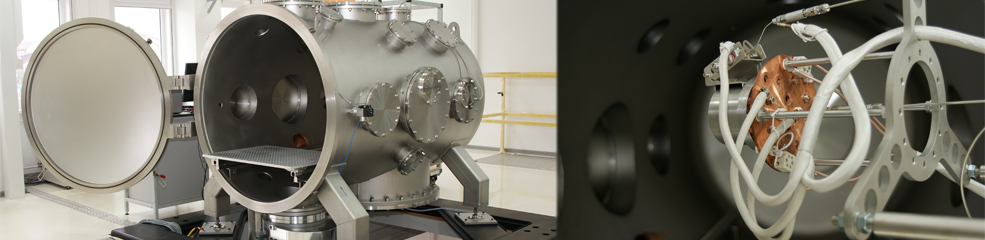


Zestaw obrazów 2019
zdjecie1.jpg
zdjecie2.jpg
zdjecie3.jpg
zdjecie4.jpg
zdjecie5.jpg
zdjecie6.jpg
2019_1.JPG
2019_2.JPG
2019_4.JPG


Światowe
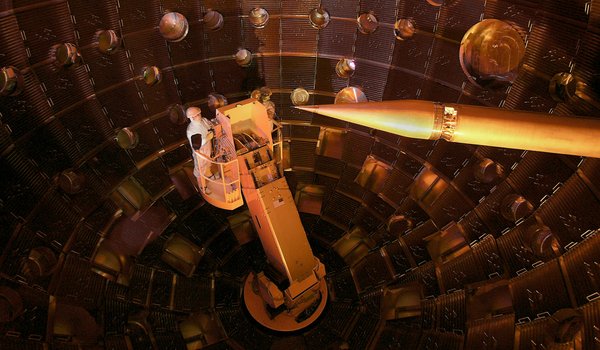
For more than 50 years, physicists have been eager to achieve controlled fusion, an elusive goal that could potentially offer a boundless and inexpensive source of energy.
To do so, American scientists have built a giant laser, now the size of a football stadium, that takes target practice on specks of fuel smaller than peppercorns. The device has so far cost taxpayers more than $5 billion, making it one of the most expensive federally financed science projects ever. But so far, it has not worked.
Unfortunately, the due date is Sunday, the last day of the fiscal year. And Congress, which would need to allocate more money to keep the project alive, is going to want some explanations.
“We didn’t achieve the goal,” said Donald L. Cook, an official at the National Nuclear Security Administration who oversees the laser project. Rather than predicting when it might succeed, he added in an interview, “we’re going to settle into a serious investigation” of what caused the unforeseen snags.
The failure could have broad repercussions not only for the big laser, which is based at the Lawrence Livermore National Laboratory in California, but also for federally financed science projects in general.
On one hand, the laser’s defenders point out, hard science is by definition risky, and no serious progress is possible without occasional failures. On the other, federal science initiatives seldom disappoint on such a gargantuan scale, and the setback comes in an era of tough fiscal choices and skepticism about science among some lawmakers. The laser team will have to produce a report for Congress about what might have gone wrong and how to fix it if given more time.
“The question is whether you continue to pour money into it or start over,” said Stephen Bodner, a former director of a rival laser effort at the Naval Research Laboratory in Washington. “I think they’re in real trouble and that continuing the funding at the current level makes no sense.”
China is studying the program’s mistakes, Dr. Bodner added, perhaps with a goal of building an improved machine.
“It’s kind of an amazing device,” said William Happer, a physicist at Princeton University who directed federal energy research for the first President George Bush. “Still, it’s not science if you don’t fail now and then. But you do have to have some wins.”
Many science analysts predict that the big laser will survive, because its powerful beams can still squeeze materials to extraordinarily high pressures, temperatures and densities that are useful in safeguarding the nation’s nuclear arms — a goal that attracts bipartisan support. For instance, the laser might help engineers see if a particular metal part that had to be substituted in a class of aging nuclear arms would still work as needed.
Even so, skeptics outside the government have long assailed the laser project, known as the National Ignition Facility, or NIF, as a colossal waste of money. Just operating it, officials concede, costs roughly $290 million a year. Some doubters have ridiculed it as the National Almost Ignition Facility, or NAIF.
Big science projects more costly than the laser include NASA’s newest space telescope, whose price tag now runs to more than $8 billion, and the 17-mile circular accelerator in Europe that recently helped pin down the elusive subatomic particle known as the Higgs boson. It cost about $10 billion.
In interviews, the laser’s architects and supporters at the Livermore lab defended the device as working beautifully and pointed to the challenge of planned breakthroughs as the fundamental problem.
“It’s like having a cure for cancer by a certain date,” said Penrose C. Albright, the laboratory’s director. “I understand why people want to have milestones. But when you’re dealing with science and Mother Nature, all you really can do is agree on whether you’re on the right path.”
The sprawling laser complex, the officials insisted, would one day achieve its advertised goal: fusing the hydrogen atoms in a speck of fuel into helium, and thus creating what physicists liken to a tiny star.
“Contrary to what some people say, this has been a spectacular success,” said Edward Moses, the laser’s director. Even so, he added, “science on schedule is a hard thing to do.”
The result, scientists hope, would include not just new science but radically new kinds of reactors to generate electric power at low cost. Hydrogen, they note, is the most abundant element in the universe.
“Bringing Star Power to Earth,” read a giant banner that workers in 2009 unfurled on the newly inaugurated National Ignition Facility. Over budget and behind schedule, the construction had taken a decade.
Today, the complex has millions of parts and 192 lasers made up of 15 miles of mirrors and lenses, crystals and light amplifiers. Its innards look something like a spaceship engine room from a science fiction movie.
From the start, critics saw NIF’s delays and spiraling price tag as symptoms of overreaching. In 2000, soon after the start of construction, what was then the General Accounting Office questioned the “independence” of ad hoc assessment panels and detailed a number of management and oversight failures.
By 2005, a panel of scientific experts judged the goal of ignition in 2010 during the initial laser firings as unlikely and faulted the project for what it called a lack of “standing external oversight.”
In July, a report to Dr. Cook, the official in charge, called ignition by the end of this year “highly unlikely” and recommended that the project be “redirected towards a broader and more balanced research program.”
Dr. Moses, the laser’s director at Livermore, called many of the critics misinformed and defended the project as fundamentally sound. He said that China, France and Russia all have similar laser projects under way that use NIF as a model.
“They’re betting with their pocketbooks to recreate what we’re doing,” he said.
Dr. Albright, the laboratory’s director, insisted that the big laser would still end up being the first on the planet to make a tiny star. The question is when.
“Everybody believes we can get there,” he said. “But we’re exploring parts of physical space that no one has ever done before, and that’s a hard problem.”
Source: nytimes.com
 W Sandia National Laboratories przeprowadzono udane testy berylowych rurek, które mają w przyszłości posłużyć do przeprowadzenia reakcji termojądrowej. Opanowanie tego typu reakcji dałoby dostęp do olbrzymiej ilości czystej energii.
Wspomniane na wstępie berylowe rurki przetrwały w dobrym stanie implozję silnego pola magnetycznego, wywołaną w maszynie Z. To najpotężniejszy na świecie akcelerator impulsowy. Fakt, że rurki przeszły testy oznacza, iż naukowcy z Sandia Labs mogą kontynuować badania nad koncepcją MagLIF (Magnetized Liner Inertial Fusion), która zakłada wykorzystanie pól magnetycznych i laserów do rozpoczęcia reakcji.
Jeśli pojemniki by się nie sprawdziły, oznaczałoby, że nie mogą zostać one wykorzystane do przechowywania deuteru i, ewentualnie, trytu, które miałyby ze sobą reagować.
Wyniki eksperymentów, stopień w jakim rurki zachowały swoją integralność po implozji, zgadza się z wcześniej uzyskanymi wynikami teoretycznych symulacji - powiedział główny autor badań, Ryan McBride.
Symulacje, których wyniki opublikowano w 2010 roku w piśmie Physics of Plasma dowodzą, że zamknięte w berylowym pojemniku deuter i tryt, podgrzane laserem i poddane działaniu olbrzymiego pola magnetycznego wygenerowanemu przez pracującą z natężeniem 25 milionów amperów maszynę Z powinny wyemitować nieco więcej energii niż otrzymały.
Z kolei w styczniu bieżącego roku kolejny artykuł autorstwa naukowców z Sandia Labs. Dowiadujemy się z niego, że jeśli zostanie użyta maszyna generująca wyładowania rzędu 60 milionów amperów, to w wyniku rozpoczętej dzięki niej reakcji uzyskamy ponad 1000-krotnie więcej energii niż włożyliśmy.
Do przeprowadzenia tego typu reakcji są jednak potrzebne wytrzymałe pojemniki na paliwo.
Maszyna Z generuje olbrzymie pole magnetyczne, w wyniku którego prąd przechodzi przez pojemnik, zamieniając jego zewnętrzną warstwę w plazmę. Plazma sięga coraz głębiej i pojemnik zaczyna się rozpadać. Trzeba zatem znaleźć taki cylinder, który dotrwa do końca reakcji. Można co prawda zwiększać grubość ścian pojemnika, jednak im są one grubsze tym większą energię trzeba włożyć w reakcję.
Uczeni z Sandia Labs szukali optymalnej konstrukcji, która połączy dobrą grubość ścian z wytrzymałością. Testy wykazały, że wierzchnia warstwa pojemnika uległa rozpuszczeniu, jednak warstwa wewnętrzna pozostała wystarczająco stabilna. Obawy o integralność cylindra były największym zmartwieniem naukowców od czasu powstania koncepcji MagLIF.
W grudniu bieżącego roku rozpoczną się testy dwóch ostatnich elementów systemu. Najpierw zostaną sprawdzone lasery, które mają ogrzać paliwo wewnątrz pojemnika zanim zostanie on poddany magnetycznej kompresji. Następnie zostaną przeprowadzone testy dwóch cewek elektrycznych umieszczonych z obu stron pojemnika. Generowane przez nie pola magnetyczne mają zapobiegać ucieczce z paliwa zbyt dużej ilości naładowanych cząstek. Jeśli uciekłoby ich zbyt wiele, paliwo ulegnie schłodzeniu i reakcja samodzielnie wygaśnie.
Udane testy berylowych pojemników dają nadzieję, że test pełnego systemu MagLIF będzie można przeprowadzić już w przyszłym roku.
Autor: Mariusz Błoński
Więcej informacji na stronie www.sandia.gov
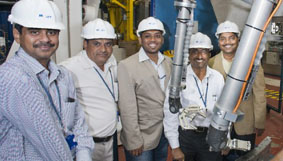 A new chapter in JET’s career is opening, as a significant international collaboration with India gets underway. The project is to design and build prototype ELM control coils for JET, and is being almost entirely funded and carried out by the Indian ITER partners.
The project leader on the EFDA side is Dr Christopher Lowry: “The coils are vital to demonstrating a fully integrated ITER scenario on JET,” he says, “and such collaboration is the future of JET – as a training ground for all the ITER partners.”
Two teams of Indian scientists and engineers from the Institute for Plasma Reseach (IPR) in Gandhinagar, in the west of India, have arrived at JET in recent times to begin work in earnest.
The six-strong conceptual design team arrived in mid-September for a six month stay. Team leader Ravi Prakash, who also heads the Remote Handling and Robotics Technology Development Division at IPR, is enthusiastic about the project. “It is an exciting project, ELM mitigation and suppression is leading edge technology in tokamaks!” he says. “It’s inspiring to work with the remote handling system.” His team, consisting of analysts Manoah Stephen Manuelraj and Pramit Dutta, CAD designers Vishnubhai Prajapati and Kanubhai Rathod and design engineer Prosenjit Santra, is responsible for the conceptual design of all 32 coils, including support structures, housing, interfacing with other JET subsystems, assembly and integration. Moreover, because the coils will be assembled inside the vessel the team needs to take into consideration any remote handling requirements, such as designing bespoke tooling.
The second team, which has the goal of building a prototype coil, is Subrata Pradhan (team leader), Mahesh Ghate (engineer), Ananya Kundu (analyst) and Kirit Vasava (draughtsman). Although much of the work will be carried out at the IPR in India, the team kickstarted their project with a month long visit to JET, arriving in mid-August.
“The exposure to the JET machine is an important aspect” says Mr Pradhan. His team spent the visit familiarising themselves with the preconceptual design and preparing preliminary models for the prototype coil, which it is scheduled to deliver mid 2013.
Despite the many JET systems that they need to become familiar with the teams have found the information they need easily. “The JET team has done things very systematically. We can reach the top expert very quickly for clarifications and discussions” says Mr Prakash. “Experience that has been gained through the years is available to the next generation through a carefully designed knowledge base – there is no data loss!”
The conceptual design of the ELM coils, associated support structures, in-vessel components and remote handling integration is expected to be completed by March next year.
Source: EFDA
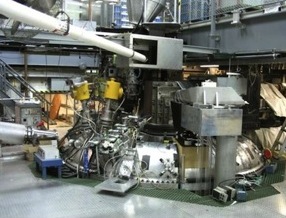 The Madison Symmetric Torus, a leading piece of equipment in plasma physics research for more than 20 years, recently gained a new capability with the installation of a neutral beam injector.
The addition allows University of Wisconsin-Madison researchers to delve further into the basic properties of plasmas—hot gases of charged particles—which are important in astrophysics research as well as numerous more down-to-Earth applications such as microchip fabrication, plasma TVs and other displays, and development of fusion technology.
A new study published online this week in Physical Review Letters reports the first description of the effects of instabilities generated by injecting hot plasmas with beams of uncharged particles—generally hydrogen—in a type of plasma confinement device known as a reversed field pinch, or RFP.
The nature of those instabilities can help researchers understand how the beam particles interact with the plasma and their potential beneficial uses, says UW-Madison graduate student Jonathan Koliner, who led the study with UW physics professors Cary Forest and John Sarff. Paper co-authors include other colleagues at UW-Madison, the University of California at Los Angeles, and Oak Ridge National Laboratory.
Neutral beams have sometimes been used to heat plasmas and drive electric currents in another type of plasma device, called a tokamak. Other times, the effects are more problematic.
"Like throwing rocks into a pond generates ripples, these particles come in and generate ripples [in the plasma]. Those ripples can feed back on themselves and start to grow very big, and when the ripples get big enough they'll kick the particles out," says Koliner.
More work is needed to understand and, ultimately, control the bursts to harness the particles' energy rather than losing them from the plasma, he says. In addition, RFPs offer some advantages over tokamaks in studying basic plasma properties due to the way they contain and control plasmas. The beam on the Madison Symmetric Torus is the first on an RFP device and offers the first opportunity to characterize beam-generated instabilities in this type of plasma environment and compare them to those in tokamaks.
"Seeing what neutral beams can do in an RFP is a good way to figure out if you can use them to control [the plasma] in other ways in the future," Koliner says. "It's important first to lock down exactly what they do in all of the different possible plasma equilibria we can make in our machine. Once you figure out what they do, then you can come up with a plan."
Koliner and his colleagues are studying the particle bursts under several plasma conditions and operating modes to form the best possible picture of what the plasma looks like and how it is behaving in the different situations. "The bursts themselves have illuminated a lot of what the beam is doing that has been somewhat mysterious, not perfectly understood up to this point," he says. "Knowing what these bursts do fills in a large piece of the picture."
Source: phys.org
 At 54.6 million km away at its closest, the fastest travel to Mars from Earth using current technology (and no small bit of math) takes around 214 days — that’s about 30 weeks, or 7 months. A robotic explorer like Curiosity may not have any issues with that, but it’d be a tough journey for a human crew. Developing a quicker, more efficient method of propulsion for interplanetary voyages is essential for future human exploration missions… and right now a research team at the University of Alabama in Huntsville is doing just that.
This summer, UAHuntsville researchers, partnered with NASA’s Marshall Space Flight Center and Boeing, are laying the groundwork for a propulsion system that uses powerful pulses of nuclear fusion created within hollow 2-inch-wide “pucks” of lithium deuteride. And like hockey pucks, the plan is to “slapshot” them with plasma energy, fusing the lithium and hydrogen atoms inside and releasing enough force to ultimately propel a spacecraft — an effect known as “Z-pinch”.
“If this works,” said Dr. Jason Cassibry, an associate professor of engineering at UAH, “we could reach Mars in six to eight weeks instead of six to eight months.”
The key component to the UAH research is the Decade Module 2 — a massive device used by the Department of Defense for weapons testing in the 90s. Delivered last month to UAH (some assembly required) the DM2 will allow the team to test Z-pinch creation and confinement methods, and then utilize the data to hopefully get to the next step: fusion of lithium-deuterium pellets to create propulsion controlled via an electromagnetic field “nozzle”.
Although a rocket powered by Z-pinch fusion wouldn’t be used to actually leave Earth’s surface — it would run out of fuel within minutes — once in space it could be fired up to efficiently spiral out of orbit, coast at high speed and then slow down at the desired location, just like conventional rockets except… better.
“It’s equivalent to 20 percent of the world’s power output in a tiny bolt of lightning no bigger than your finger. It’s a tremendous amount of energy in a tiny period of time, just a hundred billionths of a second.” – Dr. Jason Cassibry on the Z-pinch effect
In fact, according to a UAHuntsville news release, a pulsed fusion engine is pretty much the same thing as a regular rocket engine: a “flying tea kettle.” Cold material goes in, gets energized and hot gas pushes out. The difference is how much and what kind of cold material is used, and how forceful the push out is.
Everything else is just rocket science.
By Jason Major
Read more on www.uah.edu
Local News
- 1
- 2
- 3
- 4
- 5
IPPLM joins the Enterprise Europe Network
31-03-2026
On 23 March 2026, the Institute of Plasma Physics and Laser Microfusion (IPPLM) joined, with its technological offer, the group of entities affiliated with the Enterprise Europe Network (EEN), interested...
Read moreIPPLM as a co-creator of the exhibition "E = mc² – the formula that changed the world" at the National…
18-02-2026

On 16 February 2026, the official opening of two new permanent exhibitions took place at the National Museum of Technology in Warsaw. The Institute of Plasma Physics and Laser Microfusion...
Read moreIPPLM supports children and young people at the TPD "Helenów" Centre
22-12-2025

The Sylwester Kaliski Institute of Plasma Physics and Laser Microfusion (IPPLM) has for many years been actively engaged in initiatives supporting children and young people supported by the TPD "Helenów"...
Read moreIPPLM researchers took part in an experimental campaign on the GEKKO XII laser
20-11-2025

On 10–14 November 2025, a research team from the Sylwester Kaliski Institute of Plasma Physics and Laser Microfusion (IPPLM) – Prof. Katarzyna Batani, Dr Hanna Marchenko and Dr Agnieszka Zaraś-Szydłowska...
Read moreRegister for the 18th Kudowa Summer School on Plasma Physics!
07-11-2025

We invite you to take part in the 18th Kudowa Summer School "Towards Fusion Energy", which will be held on 8–12 June 2026 in Kudowa-Zdrój, Poland. The event is organised...
Read moreIPPLM participated in the second technical meeting within the DONES Con-P1 project
17-10-2025
The Institute of Plasma Physics and Laser Microfusion (IPPLM) took part in the second technical meeting held as part of the DONES Consolidation Phase 1 (DONES ConP1) project, co-financed by...
Read moreProf. Jan Badziak from IPPLM among the World’s Top 2% Scientists
15-10-2025
Prof. Jan Badziak, from the Department of Laser Plasma and Magnetized Dense Plasma Physics at the Institute of Plasma Physics and Laser Microfusion (IPPLM), has been included in the prestigious...
Read more29th Science Festival with the participation of IPPLM
10-10-2025

During the 29th Science Festival in Warsaw, held on 19–28 September 2025, researchers from the Institute of Plasma Physics and Laser Microfusion (IPPLM) conducted lessons for upper-grade primary school students. The...
Read morePLASMA 2025 and the 20th Anniversary of the Euratom–IPPLM Association – event summary
26-09-2025

From 15 to 19 September 2025, Warsaw hosted the international scientific conference PLASMA 2025 – International Conference on Research and Application of Plasmas, dedicated to plasma research, diagnostics, and applications....
Read moreWe bid farewell with deep sorrow to Professor Jerzy Wołowski
25-09-2025

It is with great sadness that we have received the news of the passing of Professor Jerzy Wołowski (1936–2025) an outstanding physicist, long-time employee of the Institute of Plasma Physics...
Read more20th anniversary of the Euratom–IPPLM Association (CeNTE): Celebrating two decades of fusion research coordination
16-09-2025

On 19 September 2025, during the PLASMA 2025 International Conference on Research, Diagnostics and Applications of Plasma in Warsaw, the IPPLM will mark 20th anniversary of the coordination of research on nuclear fusion...
Read moreIPPLM at the 49th Congress of Polish Physicists in Katowice
13-09-2025
During the 49th Congress of Polish Physicists, held from September 5–11, 2025, in Katowice, the Institute of Plasma Physics and Laser Microfusion (IPPLM) was represented both among the speakers and...
Read moreProf. Agata Chomiczewska appointed Deputy Director for Scientific Affairs at the IPPLM
03-09-2025

We are pleased to announce that the Minister of Energy, Mr. Miłosz Motyka, has appointed Dr. hab. Agata Chomiczewska to the position of Deputy Director for Scientific Affairs at the...
Read moreA historic milestone – the Scientific Council of the Institute confers the degree of habilitated doctor
10-07-2025
For the first time in the history of the Institute of Plasma Physics and Laser Microfusion (IPPLM), the Scientific Council has adopted a resolution to confer the degree of habilitated...
Read moreNew Board of the Plasma Physics Division of the European Physical Society
04-07-2025

In the first quarter of 2025, elections were held for the Board of the Plasma Physics Division of the European Physical Society (EPS Plasma Physics Division). Six candidates who received...
Read moreIPPLM researchers bring fusion expertise to 10th Central & Eastern Europe Nuclear Industry Congress 2025
12-06-2025
Researchers from the Institute of Plasma Physics and Laser Microfusion (IPPLM), Dr. Natalia Wendler and Dr. Paweł Gąsior, recently participated in a panel discussion at the 10th Central & Eastern...
Read moreIPPLM at the 3rd edition of the "Science for Society" Congress
29-05-2025

On 25-26 May 2025, the 3rd edition of the "Science for Society" Congress took place in the Large Hall of the Warsaw University of Technology. The aim of the event...
Read moreInvitation to the 3rd edition of the "Science for Society" Congress with the participation of IPPLM
22-05-2025

The 3rd edition of the "Science for Society" Congress will take place on 25–26 May 2025 at the Warsaw University of Technology. This unique event demonstrates that science is not...
Read moreJoin the 28th Science Picnic!
07-05-2025

The Institute of Plasma Physics and Laser Microfusion (IPPLM) invites you to its stand on Saturday, 10 May, during the 28th Science Picnic, organized by Polish Radio and the Copernicus...
Read moreCooperation agreement between the IPPLM and the National Museum of Technology
18-04-2025

On 17 April 2025, a cooperation agreement was signed between the National Museum of Technology (NMT) and the Institute of Plasma Physics and Laser Microfusion (IPPLM). The ceremonial meeting, attended by...
Read morePolish and French researchers join forces in research on nuclear fusion
31-03-2025

On 24-25 March 2025, a Polish-French meeting was held at the headquarters of the Institute of Nuclear Physics of the Polish Academy of Sciences (IFJ PAN) and the French Institute...
Read moreJoin us for the International Conference on Research and Application of Plasmas – PLASMA 2025!
13-03-2025

The Institute of Plasma Physics and Laser Microfusion (IPPLM) invites you to attend the PLASMA 2025 – International Conference on Research and Application of Plasmas, which will be held from...
Read moreExperimental research session in the Plasma-Focus PF1000U laboratory as part of the ICDMP collaboration
27-02-2025

On February 10–21, 2025, an experimental session was held in the Plasma-Focus PF-1000U laboratory, in which, in addition to the IPPLM team, a three-person team of researchers from the Prague...
Read moreLaser demonstration on JET detects fusion fuels
11-02-2025

Scientists and engineers from eight nations, including Poland, have carried out a project using lasers on the Joint European Torus (JET) to study fusion fuel retention. Laser Induced Breakdown Spectroscopy (LIBS),...
Read moreIPPLM employee nominated for the Personality of the Year title in the Science category
24-01-2025
Research and technical employee Mr. Olgierd Cichorek, M.Sc., from the Laboratory of Plasma Nudge for Satellites at the IPPLM has been nominated for the title of Personality of the Year...
Read moreWorld News
- 1
- 2
- 3
- 4
- 5
In Memoriam — Professor Francesco Romanelli
24-03-2026

The world of fusion research mourns the loss of Professor Francesco Romanelli, a visionary scientist whose work helped bring humanity closer to clean, limitless energy. Over four decades, he explored...
Read moreIgniting the future: Breakthroughs in inertial confinement Fusion
25-07-2025

In December 2022, the National Ignition Facility (NIF) at Lawrence Livermore National Laboratory (USA) marked a historic milestone in fusion science: an experiment produced 3.15 MJ of fusion energy from 2.05 MJ of laser...
Read moreWendelstein 7-X sets new fusion performance records
04-06-2025

On May 22, 2025, the Wendelstein 7-X (W7-X) stellarator at the Max Planck Institute for Plasma Physics (IPP) in Greifswald concluded its latest experimental campaign with a major success: a...
Read moreEuropean tokamak sets new fusion plasma record
20-02-2025

On February 12, 2025, the WEST tokamak, located at CEA Cadarache in southern France, set a new world record by sustaining fusion plasma for 1,337 seconds, or over 22 minutes....
Read moreDr. Gianfranco Federici appointed as the new EUROfusion Programme Manager
17-12-2024
At the 49th General Assembly held in Barcelona, December 2024, Dr. Gianfranco Federici was elected as the new Programme Manager of EUROfusion. He succeeds Prof. Ambrogio Fasoli, who will return...
Read moreEUROfusion and F4E join forces for Europe’s fusion future
16-12-2024

EUROfusion and Fusion for Energy (F4E) have signed a Memorandum of Understanding (MoU) to advance fusion research and development in Europe. This agreement reinforces cooperation in...
Read moreJohn J. Hopfield and Geoffrey E. Hinton awarded the 2024 Nobel Prize in Physics
08-10-2024

John J. Hopfield and Geoffrey E. Hinton have been awarded the 2024 Nobel Prize in Physics "for foundational discoveries and inventions that enable machine learning with artificial neural networks." The Nobel...
Read moreWendelstein 7-X begins new experimental campaign
10-09-2024

The Wendelstein 7-X, the world’s most advanced stellarator, is launching a new experimental campaign after a year of intensive maintenance and upgrades. This phase, known as OP2.2, begins on 10...
Read moreITER's New Project Baseline: A Robust Path to Fusion Energy Research
04-07-2024

On 3 July, ITER Director-General Pietro Barabaschi presented the new project baseline, under evaluation by the ITER Organization's governing body. This plan aims to ensure a robust start to scientific...
Read moreITER Council Presents Updated Project Baseline
21-06-2024

The ITER Council convened this week for its 34th meeting, where nearly 100 attendees reviewed significant updates to the project baseline. The proposed changes aim to optimize the overall project...
Read moreEurope and Japan celebrate breakthrough in paving the way for fusion energy
01-12-2023

The prospect of harnessing fusion energy is closer. The successful operation of JT-60SA, the most powerful experimental device to date, built by Europe and Japan, is a landmark achievement for...
Read moreFirst plasma was successfully generated at JT-60SA
26-10-2023

A momentous achievement in the field of nuclear fusion has been accomplished by a collaborative team of engineers from Europe and Japan. They have successfully generated tokamak plasma for the...
Read moreThe Nobel Prize in Physics 2023
03-10-2023
Pierre Agostini, Ferenc Krausz and Anne L’Huillier are the winners of this year's Nobel Prize in Physics. It was awarded "for experimental methods that generate attosecond pulses of light for...
Read moreUS Lab Replicates Fusion Ignition Breakthrough
08-08-2023
The US National Ignition Facility (NIF) has achieved fusion ignition once again, building on its landmark 2022 success. This achievement, powered by hydrogen within a diamond capsule, signifies a major...
Read moreNew Programme Manager Elect announced by EUROfusion
20-07-2023
Professor Ambrogio Fasoli became the new EUROfusion Programme Manager Elect. The decision was made by EUROfusion General Assembly at the meeting on 18 July 2023. His tenure will officially commence...
Read moreEUROfusion stands in solidarity with research in Ukraine
24-02-2023

Today, as we commemorate the anniversary of the invasion of Ukraine by Russia, the EUROfusion consortium stands in solidarity with our Ukrainian member and research colleagues. EUROfusion remains committed to supporting...
Read moreEight-minute production of plasma with gigajoule energy turnover at Wendelstein 7-X
23-02-2023

Another target has been achieved only recently by the W7-X researchers, namely they managed to acquire an energy turnover of 1.3 gigajoules in the device, which is 17 times higher...
Read moreThe Nobel Prize in Physics 2022
04-10-2022

Alain Aspect, John F. Clauser and Anton Zeilinger are the winners of this year's Nobel Prize in Physics. It was awarded “for experiments with entangled photons, establishing the violation of...
Read moreNew experiments for fusion energy record breaker JET
27-09-2022

A new wave of fusion energy experiments on UK Atomic Energy Authority’s record-breaking Joint European Torus (JET) started this month. EUROfusion researchers are using the famous JET machine to conduct a...
Read moreITER appoints new Director-General
21-09-2022
Pietro Barabaschi has become the next Director-General of the ITER Organization as a result of the unanimous choice of the Council from among finalist candidates. In the transition period Dr....
Read moreStarting power plant design
07-07-2022

At a livestreamed Horizon EUROfusion event in Brussels on 5 July 2022, EUROfusion celebrated the start of conceptual design activities for Europe's first demonstration fusion power plant DEMO. This first-of-a-kind...
Read moreCelebration of achieving a crucial assembly milestone in the ITER Project
17-05-2022

This month, we have witnessed the successful lifting and lowering into the machine well of the first sub-section of the ITER plasma chamber. The weight of the component is the...
Read moreBurning plasma achieved in inertial fusion at the National Ignition Facility
15-02-2022
Obtaining a burning plasma is a critical step towards self-sustaining fusion energy. A burning plasma is one in which the fusion reactions themselves are the primary source of heating in...
Read moreHistoric milestone reached by JET scientists
20-01-2022

Iconic fusion energy machine JET – which reaches controlled temperatures 10 times hotter than the core of the sun – completed its 100,000th live pulse last night. Weighing 2,800 tonnes, the...
Read moreHorizon Europe Grant Agreement signed
20-12-2021

15 December 2021 saw the EUROfusion consortium signing the Grant Agreement under Horizon Europe, the European Framework Programme from 2021 – 2027, in an aim to launch comprehensive R&D approach...
Read more |
 |
 |
 |
 |
 |
 |
 |
What we do
Our laboratories
Online seminars
| Thursday, 30 Apr 2026, godz. 13.00 Seminarium instytutowe: "Equation of State of Shock Compressed BN in the Megabar Pressure Range", dr hab. Katarzyna Batani, IFPiLM |


Research projects carried out at the IPPLM are funded by the Polish Ministry of Education and Science, the National Science Centre and by the European Commission within the framework of EUROfusion Consortium under grant agreement No 101052200. Financial support comes also from the International Atomic Energy Agency, European Space Agency and LaserLab Consortium as well as from the Fusion for Energy Agency.