



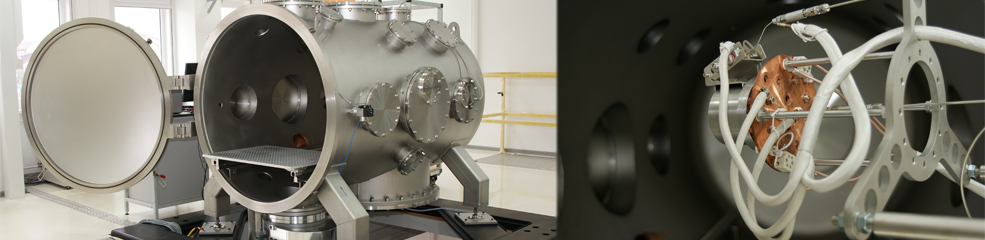


Zestaw obrazów 2019
zdjecie1.jpg
zdjecie2.jpg
zdjecie3.jpg
zdjecie4.jpg
zdjecie5.jpg
zdjecie6.jpg
2019_1.JPG
2019_2.JPG
2019_4.JPG


Światowe
 Defrosting the freezer is one of those summer tasks that everyone has to do, and JET is no exception. Its “freezer” is set of panels that make up the cryo pump, a crucial part of the system that keeps the inside of the JET vessel at an extremely low vacuum. Over the course of 11 months of experiments quite a build up of frozen material forms, so one of the first jobs to perform now that experiments have finished is to warm up the cryo panels, and melt the frost deposits.
But it’s more than just a chore, the material that has accumulated on the panels tells a story about what has been going on in JET’s plasma chamber. This means that as soon as experiments ceased the Active Gas Handling team swung into action, working round-the-clock shifts to capture and analyse the gases being released as the cryo pumps warmed up. Most of it of course will be the deuterium fuel, but there will be other constituents used in the experiments, for example argon or nitrogen, or maybe even carbon or tritium from previous experimental campaigns.
There will also be combinations of all the above species. Hydrocarbons are well known at JET – in fact they are one of the reason that carbon was replaced in the vessel by the ITER-Like Wall. The recent experiments using nitrogen seeding may well lead to the formation of ammonia (a compound of nitrogen and hydrogen) so its collection will also be under scrutiny.
Every substance will have a story to tell about the processes that happen in a plasma at 100 million degrees, and so the analysis in the next couple of months will create another piece in the jigsaw of fusion energy research.
Source: EFDA
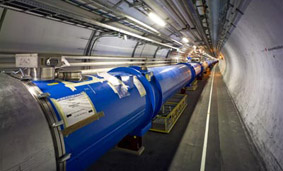 A group of physicists from Switzerland, Japan, Russia, US and the UK has proposed using the tunnel that currently houses the Large Hadron Collider (LHC) at the CERN particle-physics lab near Geneva for a dedicated machine to study the Higgs boson. The facility, dubbed LEP3, is named after CERN's previous accelerator, the Large Electron–Positron Collider (LEP), which used to exist in the LHC tunnel before being shut down in 2000. In a preliminary study submitted to the European Strategy Preparatory Group, LEP3's backers say that the machine could be constructed within the next 10 years.
The plans for LEP3 come just weeks after physicists working at CERN reported that they had discovered a new particle that bears a striking resemblance to a Higgs boson, as described by the Standard Model of particle physics. The ATLAS experiment measured its mass at around 125 GeV and the CMS experiment at 126 GeV.
LEP3 would operate at 240 GeV and comprise two separate accelerator rings that would smash electrons and positrons rather than protons and protons, as with the LHC. In their study, the 20 authors call the concept for LEP3 "highly interesting" and that it deserves more detailed study. "Now is the right moment to get this on the table," says theorist John Ellis from Kings College London in the UK, who is an author of the preliminary study and hopes that it will trigger debate among physicists as to how to study the new boson in detail.
Tunnel vision
LEP3 is designed to be installed in the LHC tunnel and serve the two LHC's general-purpose detectors – ATLAS and CMS. If LEP3 is to be built, it will have to fight off two rival proposals for a future collider to study the Higgs – the International Linear Collider (ILC) and the Compact Linear Collider (CLIC). But Ellis says that one advantage of LEP3 is that the tunnel to house it is already built and the collider would use the existing infrastructure, such as cryogenics equipment, thus making LEP3 more cost-effective. LEP3 would also use conventional electromagnets to accelerate particles rather than the accelerating superconducting cavities that will be employed by the ILC.
Which collider is built to succeed the LHC will depend on what the LHC discovers in the next couple of years after it has run at its full design energy of 14 TeV. If it turns out that the LHC finds only the Higgs, then Ellis says there would be a strong case for LEP3. But if more particles are discovered by the LHC – such as supersymmteric particles – it would make sense to consider the other two proposals. "LEP3 could be a more secure option than the ILC if only a Higgs is discovered," Ellis told physicsworld.com. "But, of course, it would be foolish to choose anything now, given that the LHC has not hit full energy yet."
CERN plans to run the LHC into the 2030s after it has undergone a major upgrade in energy and luminosity in the coming decade. However, Ellis thinks that it may even be possible for the LHC and LEP3 to cohabit for a short time. "It would not be ideal, but it could be something to think about," says Ellis. "If the LHC does not discover anything beyond the Higgs, then would you keep running it for years?"
"Little scope"
Yet some disagree that LEP3 represents the best way to study the Higgs, adding that a decision would have to be made between building LEP3 and running the high-luminosity upgrade to the LHC in the 2020s. "They both have an excellent physics case, but somehow LEP3 presents less chance of a huge breakthrough," says one leading CERN researcher who prefers not to be named. "[The LHC upgrade] has precision measurements as well as discovery reach to offer."
That view is shared by linear-collider director Lyn Evans, who toldphysicsworld.com that he thinks it is unlikely that the proposal for LEP3 will get very far. "The first job is to fully exploit the LHC and all its upgrades," says Evans, who led the construction of the LHC. "This is at least a 20 year programme of work, so I think that it is very unlikely that the LHC will be ripped out and replaced by a very modest machine with little scope apart from studying the Higgs."
Source: physicsworld.com
 Operating JET is like flying its namesake aeroplane. You need to take off and land safely – the part in the middle is comparatively easy. Ramping up the power too quickly can make for an unstable plasma, but too slow can allow contaminants to percolate into the plasma. And coming into land is tricky too, you can’t just turn off the system, you need to allow the power of the plasma to dissipate slowly and evenly. Getting the sequence of events just right is vital to the safe and productive operation of JET – at ITER with five times as much current in the plasma, even more will be at stake.
However, recent tests of JET operation have given the ITER team some encouraging results. To achieve ITER’s high level of fusion power, the proposal is to apply high-powered heating to the plasma a lot earlier in the pulse than is usually done at JET. This heating scenario was tested successfully four years ago at JET using carbon as first wall material.
However, carbon is not an ideal plasma-facing material, because it retains the fusion fuel. Recent experiments at JET have instead been testing tungsten as an alternative wall material for ITER – it is much less predisposed to bonding with hydrogen isotopes and has a very high melting point. However, because tungsten has many more electrons than carbon and therefore tends to radiate more, there were concerns that the tungsten impurities would lead to substantial energy loss from the plasma through radiation.
Hence, the experiments from four years ago were repeated with JET’s new tungsten divertor (area where the hot plasma interacts mostly with the wall). Much to the relief of the ITER team, JET successfully demonstrated the feasibility of using early heating. In fact it seems the change from carbon to tungsten in the divertor may even give the operators a little more flexibility with their scenarios as the power required to obtain good plasma confinement is somewhat lower, an unexpected bonus!
Source: EFDA
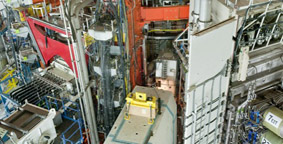
Last week marks the end of the first period of JET operations with the all-metal ‘ITER-Like Wall’. The machine is now going into a period of several months of maintenance, ready to restart operations early in 2013.
The last 11 months of machine operations have been a busy and challenging time. The scientists at JET have gathered a lot of valuable data which is certainly going to be prominently featured at coming conferences. More data will be gathered over the next few months during which some components of the ITER-Like Wall will be removed from the inside of the torus for detailed inspection and analysis.
Although there have been a number of operational difficulties on some of the JET facilities a lot has been learnt and a few of the highlights will be mentioned briefly here. As you will remember, many aspect
JET has never been operated in divertor configuration with an all-metal wall before and this has required development of some different operational strategies. The metal wall was intended to reduce the amount of fuel retention, but that affects operations more than expected. The protection systems for the plasma facing components have been brought into operation and many of them are now fully commissioned. Heating and current drive systems have been operating at high power. In particular, the neutral beam injection systems have reached a record power of 25.8MW, even though 2 of the 16 beams have not been available due to technical issues.s of the machine are new, and many challenges were associated with shaking down the new and highly modified systems. The majority of the difficulties were due to a total of only three single-point failures, which unfortunately affected critical facilities and resulted in lost operational time. Theses issues are now understood, and they are being addressed through procurement and installation of new components. A ‘Refurbishments Study Group’ has been set up by CCFE and is currently reviewing the JET facilities to identify where further refurbishments should be targeted.
High plasma current operation (at up to 3.5 MA) has also been demonstrated. This has required the operation of a device known as the ‘disruption mitigation valve’ which introduces a large puff of gas to spread the heat of the plasma more uniformly over the inner wall, preventing excessive heating of small areas. The DMV is now operating routinely and reliably.
Staff training has also been a big feature of operations, as key people learned the differences or were trained to implement the new systems. Covering 10 or 12 operational shifts per week has been quite a challenge.
Now the machine is going into a state called ‘intervention’ rather than a full shutdown. The differences are quite subtle to an external observer. During a full shutdown every system on the JET experiment is fully shut down, requiring a much more lengthy re-commissioning process. Under intervention conditions, some critical facilities remains operational in specific cases. As the intervention progresses we will describe purpose and progress of the work.
Source: EFDA
 Last week JET performed its last experiments until 2013. But, as JET shuts down and many of the scientists return to their homes across Europe and embark on summer holidays, the work does not stop.
“We’ve ticked all the boxes for the ITER-Like wall” says Task Force Leader Guy Matthews. JET Department Leader Lorne Horton agrees: “It wasn’t at all obvious that it would go this well! However the experiments have also thrown up a couple of surprises that we will need to look into.”
During the shutdown many of JET’s systems are being upgraded or refurbished. New systems are also being installed or calibrated, especially those that measure gamma rays and neutrons, as JET gears up for deuterium-tritium experiments in 2015. Also tiles will be extracted to examine in detail the wear and tear sustained during these experiments – vital information for evaluating the new ITER-Like wall.
Scientists will also continue analysing the large amounts of data accumulated during the eleven month campaign, checking calibrations and making careful comparisons with previous experiments conducted with the old carbon wall.
Then planning for next year’s campaign needs to be done. Initial meetings have happened, so the task force leaders will use the summer to make detailed plans for the campaign. Already staff from ITER have been involved, requesting certain experiments relevant to ITER be performed to give them more information on which to base their design decisions.
With all this going on, it’s clear every fusion scientist needs to find a good sized-beach to jot down their future research plans!
Source: EFDA
Local News
- 1
- 2
- 3
- 4
- 5
IPPLM joins the Enterprise Europe Network
31-03-2026
On 23 March 2026, the Institute of Plasma Physics and Laser Microfusion (IPPLM) joined, with its technological offer, the group of entities affiliated with the Enterprise Europe Network (EEN), interested...
Read moreIPPLM as a co-creator of the exhibition "E = mc² – the formula that changed the world" at the National…
18-02-2026

On 16 February 2026, the official opening of two new permanent exhibitions took place at the National Museum of Technology in Warsaw. The Institute of Plasma Physics and Laser Microfusion...
Read moreIPPLM supports children and young people at the TPD "Helenów" Centre
22-12-2025

The Sylwester Kaliski Institute of Plasma Physics and Laser Microfusion (IPPLM) has for many years been actively engaged in initiatives supporting children and young people supported by the TPD "Helenów"...
Read moreIPPLM researchers took part in an experimental campaign on the GEKKO XII laser
20-11-2025

On 10–14 November 2025, a research team from the Sylwester Kaliski Institute of Plasma Physics and Laser Microfusion (IPPLM) – Prof. Katarzyna Batani, Dr Hanna Marchenko and Dr Agnieszka Zaraś-Szydłowska...
Read moreRegister for the 18th Kudowa Summer School on Plasma Physics!
07-11-2025

We invite you to take part in the 18th Kudowa Summer School "Towards Fusion Energy", which will be held on 8–12 June 2026 in Kudowa-Zdrój, Poland. The event is organised...
Read moreIPPLM participated in the second technical meeting within the DONES Con-P1 project
17-10-2025
The Institute of Plasma Physics and Laser Microfusion (IPPLM) took part in the second technical meeting held as part of the DONES Consolidation Phase 1 (DONES ConP1) project, co-financed by...
Read moreProf. Jan Badziak from IPPLM among the World’s Top 2% Scientists
15-10-2025
Prof. Jan Badziak, from the Department of Laser Plasma and Magnetized Dense Plasma Physics at the Institute of Plasma Physics and Laser Microfusion (IPPLM), has been included in the prestigious...
Read more29th Science Festival with the participation of IPPLM
10-10-2025

During the 29th Science Festival in Warsaw, held on 19–28 September 2025, researchers from the Institute of Plasma Physics and Laser Microfusion (IPPLM) conducted lessons for upper-grade primary school students. The...
Read morePLASMA 2025 and the 20th Anniversary of the Euratom–IPPLM Association – event summary
26-09-2025

From 15 to 19 September 2025, Warsaw hosted the international scientific conference PLASMA 2025 – International Conference on Research and Application of Plasmas, dedicated to plasma research, diagnostics, and applications....
Read moreWe bid farewell with deep sorrow to Professor Jerzy Wołowski
25-09-2025

It is with great sadness that we have received the news of the passing of Professor Jerzy Wołowski (1936–2025) an outstanding physicist, long-time employee of the Institute of Plasma Physics...
Read more20th anniversary of the Euratom–IPPLM Association (CeNTE): Celebrating two decades of fusion research coordination
16-09-2025

On 19 September 2025, during the PLASMA 2025 International Conference on Research, Diagnostics and Applications of Plasma in Warsaw, the IPPLM will mark 20th anniversary of the coordination of research on nuclear fusion...
Read moreIPPLM at the 49th Congress of Polish Physicists in Katowice
13-09-2025
During the 49th Congress of Polish Physicists, held from September 5–11, 2025, in Katowice, the Institute of Plasma Physics and Laser Microfusion (IPPLM) was represented both among the speakers and...
Read moreProf. Agata Chomiczewska appointed Deputy Director for Scientific Affairs at the IPPLM
03-09-2025

We are pleased to announce that the Minister of Energy, Mr. Miłosz Motyka, has appointed Dr. hab. Agata Chomiczewska to the position of Deputy Director for Scientific Affairs at the...
Read moreA historic milestone – the Scientific Council of the Institute confers the degree of habilitated doctor
10-07-2025
For the first time in the history of the Institute of Plasma Physics and Laser Microfusion (IPPLM), the Scientific Council has adopted a resolution to confer the degree of habilitated...
Read moreNew Board of the Plasma Physics Division of the European Physical Society
04-07-2025

In the first quarter of 2025, elections were held for the Board of the Plasma Physics Division of the European Physical Society (EPS Plasma Physics Division). Six candidates who received...
Read moreIPPLM researchers bring fusion expertise to 10th Central & Eastern Europe Nuclear Industry Congress 2025
12-06-2025
Researchers from the Institute of Plasma Physics and Laser Microfusion (IPPLM), Dr. Natalia Wendler and Dr. Paweł Gąsior, recently participated in a panel discussion at the 10th Central & Eastern...
Read moreIPPLM at the 3rd edition of the "Science for Society" Congress
29-05-2025

On 25-26 May 2025, the 3rd edition of the "Science for Society" Congress took place in the Large Hall of the Warsaw University of Technology. The aim of the event...
Read moreInvitation to the 3rd edition of the "Science for Society" Congress with the participation of IPPLM
22-05-2025

The 3rd edition of the "Science for Society" Congress will take place on 25–26 May 2025 at the Warsaw University of Technology. This unique event demonstrates that science is not...
Read moreJoin the 28th Science Picnic!
07-05-2025

The Institute of Plasma Physics and Laser Microfusion (IPPLM) invites you to its stand on Saturday, 10 May, during the 28th Science Picnic, organized by Polish Radio and the Copernicus...
Read moreCooperation agreement between the IPPLM and the National Museum of Technology
18-04-2025

On 17 April 2025, a cooperation agreement was signed between the National Museum of Technology (NMT) and the Institute of Plasma Physics and Laser Microfusion (IPPLM). The ceremonial meeting, attended by...
Read morePolish and French researchers join forces in research on nuclear fusion
31-03-2025

On 24-25 March 2025, a Polish-French meeting was held at the headquarters of the Institute of Nuclear Physics of the Polish Academy of Sciences (IFJ PAN) and the French Institute...
Read moreJoin us for the International Conference on Research and Application of Plasmas – PLASMA 2025!
13-03-2025

The Institute of Plasma Physics and Laser Microfusion (IPPLM) invites you to attend the PLASMA 2025 – International Conference on Research and Application of Plasmas, which will be held from...
Read moreExperimental research session in the Plasma-Focus PF1000U laboratory as part of the ICDMP collaboration
27-02-2025

On February 10–21, 2025, an experimental session was held in the Plasma-Focus PF-1000U laboratory, in which, in addition to the IPPLM team, a three-person team of researchers from the Prague...
Read moreLaser demonstration on JET detects fusion fuels
11-02-2025

Scientists and engineers from eight nations, including Poland, have carried out a project using lasers on the Joint European Torus (JET) to study fusion fuel retention. Laser Induced Breakdown Spectroscopy (LIBS),...
Read moreIPPLM employee nominated for the Personality of the Year title in the Science category
24-01-2025
Research and technical employee Mr. Olgierd Cichorek, M.Sc., from the Laboratory of Plasma Nudge for Satellites at the IPPLM has been nominated for the title of Personality of the Year...
Read moreWorld News
- 1
- 2
- 3
- 4
- 5
In Memoriam — Professor Francesco Romanelli
24-03-2026

The world of fusion research mourns the loss of Professor Francesco Romanelli, a visionary scientist whose work helped bring humanity closer to clean, limitless energy. Over four decades, he explored...
Read moreIgniting the future: Breakthroughs in inertial confinement Fusion
25-07-2025

In December 2022, the National Ignition Facility (NIF) at Lawrence Livermore National Laboratory (USA) marked a historic milestone in fusion science: an experiment produced 3.15 MJ of fusion energy from 2.05 MJ of laser...
Read moreWendelstein 7-X sets new fusion performance records
04-06-2025

On May 22, 2025, the Wendelstein 7-X (W7-X) stellarator at the Max Planck Institute for Plasma Physics (IPP) in Greifswald concluded its latest experimental campaign with a major success: a...
Read moreEuropean tokamak sets new fusion plasma record
20-02-2025

On February 12, 2025, the WEST tokamak, located at CEA Cadarache in southern France, set a new world record by sustaining fusion plasma for 1,337 seconds, or over 22 minutes....
Read moreDr. Gianfranco Federici appointed as the new EUROfusion Programme Manager
17-12-2024
At the 49th General Assembly held in Barcelona, December 2024, Dr. Gianfranco Federici was elected as the new Programme Manager of EUROfusion. He succeeds Prof. Ambrogio Fasoli, who will return...
Read moreEUROfusion and F4E join forces for Europe’s fusion future
16-12-2024

EUROfusion and Fusion for Energy (F4E) have signed a Memorandum of Understanding (MoU) to advance fusion research and development in Europe. This agreement reinforces cooperation in...
Read moreJohn J. Hopfield and Geoffrey E. Hinton awarded the 2024 Nobel Prize in Physics
08-10-2024

John J. Hopfield and Geoffrey E. Hinton have been awarded the 2024 Nobel Prize in Physics "for foundational discoveries and inventions that enable machine learning with artificial neural networks." The Nobel...
Read moreWendelstein 7-X begins new experimental campaign
10-09-2024

The Wendelstein 7-X, the world’s most advanced stellarator, is launching a new experimental campaign after a year of intensive maintenance and upgrades. This phase, known as OP2.2, begins on 10...
Read moreITER's New Project Baseline: A Robust Path to Fusion Energy Research
04-07-2024

On 3 July, ITER Director-General Pietro Barabaschi presented the new project baseline, under evaluation by the ITER Organization's governing body. This plan aims to ensure a robust start to scientific...
Read moreITER Council Presents Updated Project Baseline
21-06-2024

The ITER Council convened this week for its 34th meeting, where nearly 100 attendees reviewed significant updates to the project baseline. The proposed changes aim to optimize the overall project...
Read moreEurope and Japan celebrate breakthrough in paving the way for fusion energy
01-12-2023

The prospect of harnessing fusion energy is closer. The successful operation of JT-60SA, the most powerful experimental device to date, built by Europe and Japan, is a landmark achievement for...
Read moreFirst plasma was successfully generated at JT-60SA
26-10-2023

A momentous achievement in the field of nuclear fusion has been accomplished by a collaborative team of engineers from Europe and Japan. They have successfully generated tokamak plasma for the...
Read moreThe Nobel Prize in Physics 2023
03-10-2023
Pierre Agostini, Ferenc Krausz and Anne L’Huillier are the winners of this year's Nobel Prize in Physics. It was awarded "for experimental methods that generate attosecond pulses of light for...
Read moreUS Lab Replicates Fusion Ignition Breakthrough
08-08-2023
The US National Ignition Facility (NIF) has achieved fusion ignition once again, building on its landmark 2022 success. This achievement, powered by hydrogen within a diamond capsule, signifies a major...
Read moreNew Programme Manager Elect announced by EUROfusion
20-07-2023
Professor Ambrogio Fasoli became the new EUROfusion Programme Manager Elect. The decision was made by EUROfusion General Assembly at the meeting on 18 July 2023. His tenure will officially commence...
Read moreEUROfusion stands in solidarity with research in Ukraine
24-02-2023

Today, as we commemorate the anniversary of the invasion of Ukraine by Russia, the EUROfusion consortium stands in solidarity with our Ukrainian member and research colleagues. EUROfusion remains committed to supporting...
Read moreEight-minute production of plasma with gigajoule energy turnover at Wendelstein 7-X
23-02-2023

Another target has been achieved only recently by the W7-X researchers, namely they managed to acquire an energy turnover of 1.3 gigajoules in the device, which is 17 times higher...
Read moreThe Nobel Prize in Physics 2022
04-10-2022

Alain Aspect, John F. Clauser and Anton Zeilinger are the winners of this year's Nobel Prize in Physics. It was awarded “for experiments with entangled photons, establishing the violation of...
Read moreNew experiments for fusion energy record breaker JET
27-09-2022

A new wave of fusion energy experiments on UK Atomic Energy Authority’s record-breaking Joint European Torus (JET) started this month. EUROfusion researchers are using the famous JET machine to conduct a...
Read moreITER appoints new Director-General
21-09-2022
Pietro Barabaschi has become the next Director-General of the ITER Organization as a result of the unanimous choice of the Council from among finalist candidates. In the transition period Dr....
Read moreStarting power plant design
07-07-2022

At a livestreamed Horizon EUROfusion event in Brussels on 5 July 2022, EUROfusion celebrated the start of conceptual design activities for Europe's first demonstration fusion power plant DEMO. This first-of-a-kind...
Read moreCelebration of achieving a crucial assembly milestone in the ITER Project
17-05-2022

This month, we have witnessed the successful lifting and lowering into the machine well of the first sub-section of the ITER plasma chamber. The weight of the component is the...
Read moreBurning plasma achieved in inertial fusion at the National Ignition Facility
15-02-2022
Obtaining a burning plasma is a critical step towards self-sustaining fusion energy. A burning plasma is one in which the fusion reactions themselves are the primary source of heating in...
Read moreHistoric milestone reached by JET scientists
20-01-2022

Iconic fusion energy machine JET – which reaches controlled temperatures 10 times hotter than the core of the sun – completed its 100,000th live pulse last night. Weighing 2,800 tonnes, the...
Read moreHorizon Europe Grant Agreement signed
20-12-2021

15 December 2021 saw the EUROfusion consortium signing the Grant Agreement under Horizon Europe, the European Framework Programme from 2021 – 2027, in an aim to launch comprehensive R&D approach...
Read more |
 |
 |
 |
 |
 |
 |
 |
What we do
Our laboratories
Online seminars
| Thursday, 30 Apr 2026, godz. 13.00 Seminarium instytutowe: "Equation of State of Shock Compressed BN in the Megabar Pressure Range", dr hab. Katarzyna Batani, IFPiLM |


Research projects carried out at the IPPLM are funded by the Polish Ministry of Education and Science, the National Science Centre and by the European Commission within the framework of EUROfusion Consortium under grant agreement No 101052200. Financial support comes also from the International Atomic Energy Agency, European Space Agency and LaserLab Consortium as well as from the Fusion for Energy Agency.