





Zestaw obrazów 2019
zdjecie1.jpg
zdjecie2.jpg
zdjecie3.jpg
zdjecie4.jpg
zdjecie5.jpg
zdjecie6.jpg
2019_1.JPG
2019_2.JPG
2019_4.JPG


Światowe
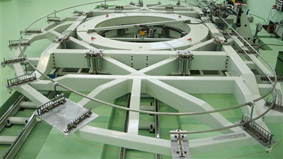 The winding line, to be used for winding the superconducting Toroidal Field (TF) coils which produce the magnetic field that confines the plasma in the ITER tokamak, is now ready. It is the first time a winding line with such impressive dimensions – 40 metres long, 20 metres wide, 5 metres high – has been built and it gives the opportunity to carry out winding trials which have never been undertaken before: it is the first time a full-size trial winding turn of a large dummy conductor has been carried out.
Located in F4E supplier ASG premises in Italy (ASG is part of a consortium which also includes Iberdrola and Elytt), the winding line will have the task of winding the superconducting coil cables into a D-shaped double spiral called a double pancake. The 7-tonne heavy superconductor coil will be delivered to ASG on spool in a single 760 metre length, so the first task of the winding line will be to unspool and straighten the cable, after which the cable will be cleaned and sandblasted. A continuous length of around 760 metres of superconductor cable will be used and shaped into the 12 metres long and 9 metres wide double pancake, which will then be heat treated at over 650 °C in a specially constructed inert atmosphere oven. After electrical insulation, the double pancake will finally be transferred into the grooves of the stainless steel radial plates, thus forming the double pancake module. As it is necessary that the double pancake fits precisely into the radial plate groove, it is vital to control that the trajectory of the conductor in the double pancakes is very accurate. This is why the winding line is required to achieve a precision on the bending of the conductor of a few tens of parts per million: a very demanding target considering its large dimensions (although the successful result during winding of the trial full size turn has demonstrated the capability of the winding line to achieve the required precisions). After insertion into the radial plates, each double pancake module will be impregnated with epoxy resin, stacked in groups of seven and jointed electrically to form the so-called winding packs. These winding packs will be inserted into stainless steel cases which will be welded in order to form the crucial TF coils.
For the moment, the winding line will however continue to be tested. In total, 70 superconductor lengths are needed to produce the ten TF coils to be procured by F4E (Japan will contribute an additional nine TF coils). They will be produced by five different suppliers, so each type of superconductor will have a slightly different mechanical behavior and therefore, individual tests with prototypes of each superconductor type will have to be carried out in the winding line during the next few months before starting the real production. The final qualification, to take place in the Autumn, will consist of winding a real superconducting cable into a full size double pancake prototype.
Another large machine, a large inert atmosphere oven, which measures 48x20x5 metres and which will be used to carry out the heat treatment of the double pancakes, is also in its final installation phase in ASG premises. The oven will be able to heat-treat up to three double pancakes at a time. After the successful completion of the leak test, carried out in order to verify the capability of the furnace to keep the concentration of impurities during the heat treatment below the required threshold of tens of parts per million, the oven is now in the final phase of the installation. The assembly of external components (electrical connections, sensors, piping, fans and vacuum pumps) is currently being completed and the final testing should start at the end of July.
With the winding line and the oven ready to be used, the main and most complex machinery for the production of the superconductors has been completed.
Source: fusionforenergy.europa.eu
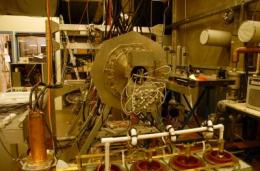 A University of Washington lab has been working for more than a decade on fusion energy, harnessing the energy-generating mechanism of the sun. But in one of the twists of scientific discovery, on the way the researchers found a potential solution to a looming problem in the electronics industry.To bring their solution to market two UW engineers have launched a startup, Zplasma, that aims to produce the high-energy light needed to etch the next generation of microchips. "In order to get smaller feature sizes on silicon, the industry has to go to shorter wavelength light," said Uri Shumlak, a UW professor of aeronautics and astronautics. "We're able to produce that light with enough power that it can be used to manufacture microchips." The UW beam lasts up to 1,000 times longer than competing technologies and provides more control over the million-degree plasma that produces the light. For more than four decades the technology industry has kept up with Moore's Law, a prediction that the number of transistors on a computer chip will double every two years. This trend has allowed ever-smaller, faster, lighter and less energy-intensive electronics. But it's hit a roadblock: the 193-nanometer ultraviolet light now being used cannot etch circuits any smaller.
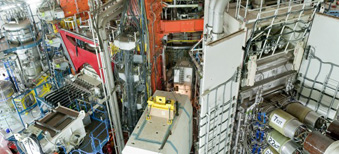 Cleanliness is the key to many aspects of operation of a tokamak like JET, in common with other ultra-high vacuum systems. Since you can not gain access to the inside of the torus, a technique called ‘glow discharge cleaning‘ is used in most machines to clean the walls of the vacuum vessel.
 Soon scientists at JET will be able to probe further into the 150 million degree core of the plasma than they ever have before. This unprecedented view is thanks to a newly refurbished X-ray detection system, KX1, which is just about to be put into action.
What they are looking for is contamination of the plasma by tungsten from the newly installed wall tiles. While the light metal beryllium was used for most of the tiles, tungsten was chosen for where JET's plasma touches the walls, as it is the metal with the highest melting point (3422 degrees Celsius). However tungsten also has the unfortunate characteristic of having many electrons, which emit radiation out of the plasma as they bounce around between levels, thereby sapping the fusion experiment's energy. Hydrogen isotopes – fusion fuel – make up the bulk of the plasma, but they do not cause energy leakage via this process. This is because their single electron is stripped off by the heat of the plasma. Similarly beryllium does not contribute much to energy loss either, as it has only four electrons, which are readily removed in the hot environment.
However stripping off all 74 electrons from a tungsten atom is a bigger task – it has 74 protons in the nucleus binding them. Even in JET's plasmas of over 100 million degrees, more than a third of tungsten's electrons are typically still attached, jumping around absorbing energy and re-emitting it. It is the energy coming from these inner-shell transitions in tungsten that the new system can see, in the X-ray region of the spectrum. In particular the system is precisely tuned to detect the X-rays from tungsten that has lost 46 of its electrons, a species which occurs in the core of the plasma.
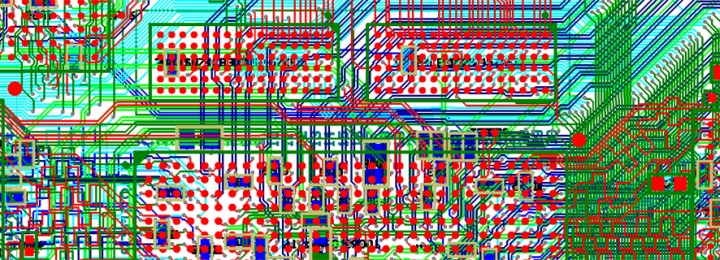
Before reaching the new detectors the X-rays travel along a 20 metre pipe and are then dispersed by a crystal. The X-rays create ionisation in a small cell containing a mixture of argon and carbon dioxide, which generates a tiny electrical signal which is amplified fed into a computer system. The new system is extremely fast, sampling every 10 nanoseconds, so it generates one hundred spectra in each second, each composed of a million data points. This amounts to around one quarter of a terabyte of data generated every second. As this volume of data would be impractical to store, a major part of the project has been developing a sophisticated electronic processing system (part of which is pictured above). The system is based on field programmable gate arrays and can filter and analyse the raw data in real time. A feature of the new system is that it provides additional frequency analysis, on top of the crystal's dispersion, which allows the separation of tungsten spectral line from the background radiation.
The final tests of the system are being performed by a team from the Polish association IPPLM who developed it. The information yielded by KX1 will reveal the spread of tungsten throughout the core of the plasma, vital information for evaluating the performance of JET's new ITER-Like Wall.
IPPLM is the Polish signatory to the European Fusion Development Agreement.
Source: EFDA
 Researchers from the Max Born Institute for Nonlinear Optics and Short Pulse Spectroscopy (MBI) were involved in the development of a table-top solid-state laser system that could cut brain tissue with unprecedented precision. The achievement is a result of an interdisciplinary EU project that involved partners from seven European countries.
Local News
- 1
- 2
- 3
- 4
- 5
IPPLM joins the Enterprise Europe Network
31-03-2026
On 23 March 2026, the Institute of Plasma Physics and Laser Microfusion (IPPLM) joined, with its technological offer, the group of entities affiliated with the Enterprise Europe Network (EEN), interested...
Read moreIPPLM as a co-creator of the exhibition "E = mc² – the formula that changed the world" at the National…
18-02-2026

On 16 February 2026, the official opening of two new permanent exhibitions took place at the National Museum of Technology in Warsaw. The Institute of Plasma Physics and Laser Microfusion...
Read moreIPPLM supports children and young people at the TPD "Helenów" Centre
22-12-2025

The Sylwester Kaliski Institute of Plasma Physics and Laser Microfusion (IPPLM) has for many years been actively engaged in initiatives supporting children and young people supported by the TPD "Helenów"...
Read moreIPPLM researchers took part in an experimental campaign on the GEKKO XII laser
20-11-2025

On 10–14 November 2025, a research team from the Sylwester Kaliski Institute of Plasma Physics and Laser Microfusion (IPPLM) – Prof. Katarzyna Batani, Dr Hanna Marchenko and Dr Agnieszka Zaraś-Szydłowska...
Read moreRegister for the 18th Kudowa Summer School on Plasma Physics!
07-11-2025

We invite you to take part in the 18th Kudowa Summer School "Towards Fusion Energy", which will be held on 8–12 June 2026 in Kudowa-Zdrój, Poland. The event is organised...
Read moreIPPLM participated in the second technical meeting within the DONES Con-P1 project
17-10-2025
The Institute of Plasma Physics and Laser Microfusion (IPPLM) took part in the second technical meeting held as part of the DONES Consolidation Phase 1 (DONES ConP1) project, co-financed by...
Read moreProf. Jan Badziak from IPPLM among the World’s Top 2% Scientists
15-10-2025
Prof. Jan Badziak, from the Department of Laser Plasma and Magnetized Dense Plasma Physics at the Institute of Plasma Physics and Laser Microfusion (IPPLM), has been included in the prestigious...
Read more29th Science Festival with the participation of IPPLM
10-10-2025

During the 29th Science Festival in Warsaw, held on 19–28 September 2025, researchers from the Institute of Plasma Physics and Laser Microfusion (IPPLM) conducted lessons for upper-grade primary school students. The...
Read morePLASMA 2025 and the 20th Anniversary of the Euratom–IPPLM Association – event summary
26-09-2025

From 15 to 19 September 2025, Warsaw hosted the international scientific conference PLASMA 2025 – International Conference on Research and Application of Plasmas, dedicated to plasma research, diagnostics, and applications....
Read moreWe bid farewell with deep sorrow to Professor Jerzy Wołowski
25-09-2025

It is with great sadness that we have received the news of the passing of Professor Jerzy Wołowski (1936–2025) an outstanding physicist, long-time employee of the Institute of Plasma Physics...
Read more20th anniversary of the Euratom–IPPLM Association (CeNTE): Celebrating two decades of fusion research coordination
16-09-2025

On 19 September 2025, during the PLASMA 2025 International Conference on Research, Diagnostics and Applications of Plasma in Warsaw, the IPPLM will mark 20th anniversary of the coordination of research on nuclear fusion...
Read moreIPPLM at the 49th Congress of Polish Physicists in Katowice
13-09-2025
During the 49th Congress of Polish Physicists, held from September 5–11, 2025, in Katowice, the Institute of Plasma Physics and Laser Microfusion (IPPLM) was represented both among the speakers and...
Read moreProf. Agata Chomiczewska appointed Deputy Director for Scientific Affairs at the IPPLM
03-09-2025

We are pleased to announce that the Minister of Energy, Mr. Miłosz Motyka, has appointed Dr. hab. Agata Chomiczewska to the position of Deputy Director for Scientific Affairs at the...
Read moreA historic milestone – the Scientific Council of the Institute confers the degree of habilitated doctor
10-07-2025
For the first time in the history of the Institute of Plasma Physics and Laser Microfusion (IPPLM), the Scientific Council has adopted a resolution to confer the degree of habilitated...
Read moreNew Board of the Plasma Physics Division of the European Physical Society
04-07-2025

In the first quarter of 2025, elections were held for the Board of the Plasma Physics Division of the European Physical Society (EPS Plasma Physics Division). Six candidates who received...
Read moreIPPLM researchers bring fusion expertise to 10th Central & Eastern Europe Nuclear Industry Congress 2025
12-06-2025
Researchers from the Institute of Plasma Physics and Laser Microfusion (IPPLM), Dr. Natalia Wendler and Dr. Paweł Gąsior, recently participated in a panel discussion at the 10th Central & Eastern...
Read moreIPPLM at the 3rd edition of the "Science for Society" Congress
29-05-2025

On 25-26 May 2025, the 3rd edition of the "Science for Society" Congress took place in the Large Hall of the Warsaw University of Technology. The aim of the event...
Read moreInvitation to the 3rd edition of the "Science for Society" Congress with the participation of IPPLM
22-05-2025

The 3rd edition of the "Science for Society" Congress will take place on 25–26 May 2025 at the Warsaw University of Technology. This unique event demonstrates that science is not...
Read moreJoin the 28th Science Picnic!
07-05-2025

The Institute of Plasma Physics and Laser Microfusion (IPPLM) invites you to its stand on Saturday, 10 May, during the 28th Science Picnic, organized by Polish Radio and the Copernicus...
Read moreCooperation agreement between the IPPLM and the National Museum of Technology
18-04-2025

On 17 April 2025, a cooperation agreement was signed between the National Museum of Technology (NMT) and the Institute of Plasma Physics and Laser Microfusion (IPPLM). The ceremonial meeting, attended by...
Read morePolish and French researchers join forces in research on nuclear fusion
31-03-2025

On 24-25 March 2025, a Polish-French meeting was held at the headquarters of the Institute of Nuclear Physics of the Polish Academy of Sciences (IFJ PAN) and the French Institute...
Read moreJoin us for the International Conference on Research and Application of Plasmas – PLASMA 2025!
13-03-2025

The Institute of Plasma Physics and Laser Microfusion (IPPLM) invites you to attend the PLASMA 2025 – International Conference on Research and Application of Plasmas, which will be held from...
Read moreExperimental research session in the Plasma-Focus PF1000U laboratory as part of the ICDMP collaboration
27-02-2025

On February 10–21, 2025, an experimental session was held in the Plasma-Focus PF-1000U laboratory, in which, in addition to the IPPLM team, a three-person team of researchers from the Prague...
Read moreLaser demonstration on JET detects fusion fuels
11-02-2025

Scientists and engineers from eight nations, including Poland, have carried out a project using lasers on the Joint European Torus (JET) to study fusion fuel retention. Laser Induced Breakdown Spectroscopy (LIBS),...
Read moreIPPLM employee nominated for the Personality of the Year title in the Science category
24-01-2025
Research and technical employee Mr. Olgierd Cichorek, M.Sc., from the Laboratory of Plasma Nudge for Satellites at the IPPLM has been nominated for the title of Personality of the Year...
Read moreWorld News
- 1
- 2
- 3
- 4
- 5
In Memoriam — Professor Francesco Romanelli
24-03-2026

The world of fusion research mourns the loss of Professor Francesco Romanelli, a visionary scientist whose work helped bring humanity closer to clean, limitless energy. Over four decades, he explored...
Read moreIgniting the future: Breakthroughs in inertial confinement Fusion
25-07-2025

In December 2022, the National Ignition Facility (NIF) at Lawrence Livermore National Laboratory (USA) marked a historic milestone in fusion science: an experiment produced 3.15 MJ of fusion energy from 2.05 MJ of laser...
Read moreWendelstein 7-X sets new fusion performance records
04-06-2025

On May 22, 2025, the Wendelstein 7-X (W7-X) stellarator at the Max Planck Institute for Plasma Physics (IPP) in Greifswald concluded its latest experimental campaign with a major success: a...
Read moreEuropean tokamak sets new fusion plasma record
20-02-2025

On February 12, 2025, the WEST tokamak, located at CEA Cadarache in southern France, set a new world record by sustaining fusion plasma for 1,337 seconds, or over 22 minutes....
Read moreDr. Gianfranco Federici appointed as the new EUROfusion Programme Manager
17-12-2024
At the 49th General Assembly held in Barcelona, December 2024, Dr. Gianfranco Federici was elected as the new Programme Manager of EUROfusion. He succeeds Prof. Ambrogio Fasoli, who will return...
Read moreEUROfusion and F4E join forces for Europe’s fusion future
16-12-2024

EUROfusion and Fusion for Energy (F4E) have signed a Memorandum of Understanding (MoU) to advance fusion research and development in Europe. This agreement reinforces cooperation in...
Read moreJohn J. Hopfield and Geoffrey E. Hinton awarded the 2024 Nobel Prize in Physics
08-10-2024

John J. Hopfield and Geoffrey E. Hinton have been awarded the 2024 Nobel Prize in Physics "for foundational discoveries and inventions that enable machine learning with artificial neural networks." The Nobel...
Read moreWendelstein 7-X begins new experimental campaign
10-09-2024

The Wendelstein 7-X, the world’s most advanced stellarator, is launching a new experimental campaign after a year of intensive maintenance and upgrades. This phase, known as OP2.2, begins on 10...
Read moreITER's New Project Baseline: A Robust Path to Fusion Energy Research
04-07-2024

On 3 July, ITER Director-General Pietro Barabaschi presented the new project baseline, under evaluation by the ITER Organization's governing body. This plan aims to ensure a robust start to scientific...
Read moreITER Council Presents Updated Project Baseline
21-06-2024

The ITER Council convened this week for its 34th meeting, where nearly 100 attendees reviewed significant updates to the project baseline. The proposed changes aim to optimize the overall project...
Read moreEurope and Japan celebrate breakthrough in paving the way for fusion energy
01-12-2023

The prospect of harnessing fusion energy is closer. The successful operation of JT-60SA, the most powerful experimental device to date, built by Europe and Japan, is a landmark achievement for...
Read moreFirst plasma was successfully generated at JT-60SA
26-10-2023

A momentous achievement in the field of nuclear fusion has been accomplished by a collaborative team of engineers from Europe and Japan. They have successfully generated tokamak plasma for the...
Read moreThe Nobel Prize in Physics 2023
03-10-2023
Pierre Agostini, Ferenc Krausz and Anne L’Huillier are the winners of this year's Nobel Prize in Physics. It was awarded "for experimental methods that generate attosecond pulses of light for...
Read moreUS Lab Replicates Fusion Ignition Breakthrough
08-08-2023
The US National Ignition Facility (NIF) has achieved fusion ignition once again, building on its landmark 2022 success. This achievement, powered by hydrogen within a diamond capsule, signifies a major...
Read moreNew Programme Manager Elect announced by EUROfusion
20-07-2023
Professor Ambrogio Fasoli became the new EUROfusion Programme Manager Elect. The decision was made by EUROfusion General Assembly at the meeting on 18 July 2023. His tenure will officially commence...
Read moreEUROfusion stands in solidarity with research in Ukraine
24-02-2023

Today, as we commemorate the anniversary of the invasion of Ukraine by Russia, the EUROfusion consortium stands in solidarity with our Ukrainian member and research colleagues. EUROfusion remains committed to supporting...
Read moreEight-minute production of plasma with gigajoule energy turnover at Wendelstein 7-X
23-02-2023

Another target has been achieved only recently by the W7-X researchers, namely they managed to acquire an energy turnover of 1.3 gigajoules in the device, which is 17 times higher...
Read moreThe Nobel Prize in Physics 2022
04-10-2022

Alain Aspect, John F. Clauser and Anton Zeilinger are the winners of this year's Nobel Prize in Physics. It was awarded “for experiments with entangled photons, establishing the violation of...
Read moreNew experiments for fusion energy record breaker JET
27-09-2022

A new wave of fusion energy experiments on UK Atomic Energy Authority’s record-breaking Joint European Torus (JET) started this month. EUROfusion researchers are using the famous JET machine to conduct a...
Read moreITER appoints new Director-General
21-09-2022
Pietro Barabaschi has become the next Director-General of the ITER Organization as a result of the unanimous choice of the Council from among finalist candidates. In the transition period Dr....
Read moreStarting power plant design
07-07-2022

At a livestreamed Horizon EUROfusion event in Brussels on 5 July 2022, EUROfusion celebrated the start of conceptual design activities for Europe's first demonstration fusion power plant DEMO. This first-of-a-kind...
Read moreCelebration of achieving a crucial assembly milestone in the ITER Project
17-05-2022

This month, we have witnessed the successful lifting and lowering into the machine well of the first sub-section of the ITER plasma chamber. The weight of the component is the...
Read moreBurning plasma achieved in inertial fusion at the National Ignition Facility
15-02-2022
Obtaining a burning plasma is a critical step towards self-sustaining fusion energy. A burning plasma is one in which the fusion reactions themselves are the primary source of heating in...
Read moreHistoric milestone reached by JET scientists
20-01-2022

Iconic fusion energy machine JET – which reaches controlled temperatures 10 times hotter than the core of the sun – completed its 100,000th live pulse last night. Weighing 2,800 tonnes, the...
Read moreHorizon Europe Grant Agreement signed
20-12-2021

15 December 2021 saw the EUROfusion consortium signing the Grant Agreement under Horizon Europe, the European Framework Programme from 2021 – 2027, in an aim to launch comprehensive R&D approach...
Read more |
 |
 |
 |
 |
 |
 |
 |
What we do
Our laboratories
Online seminars
| Thursday, 30 Apr 2026, godz. 13.00 Seminarium instytutowe: "Equation of State of Shock Compressed BN in the Megabar Pressure Range", dr hab. Katarzyna Batani, IFPiLM |


Research projects carried out at the IPPLM are funded by the Polish Ministry of Education and Science, the National Science Centre and by the European Commission within the framework of EUROfusion Consortium under grant agreement No 101052200. Financial support comes also from the International Atomic Energy Agency, European Space Agency and LaserLab Consortium as well as from the Fusion for Energy Agency.