





Zestaw obrazów 2019
zdjecie1.jpg
zdjecie2.jpg
zdjecie3.jpg
zdjecie4.jpg
zdjecie5.jpg
zdjecie6.jpg
2019_1.JPG
2019_2.JPG
2019_4.JPG

Gallery
The 16th edition of the Kudowa Summer School "Towards Fusion Energy" has drawn to a close. 48 people from 9 countries took part in the event organized by the Institute of Plasma Physics and Laser Microfusion on 6-10 June in Kudowa-Zdrój.
Dr. Jozef Ongena from the Royal Military Academy in Brussels attended the inauguration of the Kudowa Summer School. The scientific and organizational committees were headed by Prof. Monika Kubkowska and Ms. Agnieszka Jardin, MA from the Institute of Plasma Physics and Laser Microfusion.
The lectures were conducted by 19 outstanding specialists from leading research centers, including the Max Planck Institute for Plasma Physics (Germany), Imperial College London (UK), ENEA (Italy), Technical University of Lisbon (Portugal), Czech Technical University in Prague (Czech Republic), Institute of Nuclear Physics Polish Academy of Sciences (Poland).

During the student sessions, 20 participants presented their own research results, and the best presentations were awarded. Yuliia Volkova from V. N. Karazin Kharkiv National University (Ukraine) won the first place. The prizes for the second place were awarded ex aequo to Przemysław Tchórz from the Institute of Plasma Physics and Laser Microfusion (Poland) and Bartłomiej Jabłoński from Lodz University of Technology (Poland). Two prizes were also awarded for the third place: one went to Jędrzej Walkowiak from the Institute of Nuclear Physics of the Polish Academy of Sciences (Poland), and the other went to Patryk Nowak vel Nowakowski from the Lodz University of Technology (Poland).
The topics of the classes during the Kudowa Summer School concerned various aspects of plasma physics, including fusion energy, experiments with the use of plasma, its technology and diagnostics. The issues related to astrophysics were also discussed.

The next edition of the Summer School of Plasma Physics will be held in 2024. We cordially invite you to participate in this event today!
Photos: © IFPiLM
In the latest video, we present the contribution of researchers from the Institute of Plasma Physics and Laser Microfusion (IPPLM) to the unquestionable breakthrough in nuclear fusion research at the world's largest JET (Joint European Torus) tokamak in Culham near Oxford (UK).
During the last experimental campaign (DTE2), this device set a new record for fusion energy. In December 2021, 59 megajoules of energy were obtained in a steady state lasting 5 seconds, which as a result is almost three times higher than the previous record from 1997. For more information please visit: https://bit.ly/3hBh6T4
The achievement in question is the culmination of many years of research carried out by experts from Europe, including Poland. The researchers from the IPPLM have been actively involved in this work since 2005. Their contribution to the research conducted at the JET tokamak includes:
- design and preparation of modern detectors for soft X-ray diagnostics,
- analysis and interpretation of experimental data recorded using various diagnostics,
- studies on the behavior of plasma impurities in order to control them and minimize their accumulation,
- measurements of fusion reaction products (neutrons and fast helium ions),
- calibration of the neutron diagnostics system in JET for the energy of 14 MeV,
- performing numerous reconstructions of tomographic plasma radiation based on bolometric data,
- development and application of numerical methods in plasma research.
The video features the following IPPLM researchers:
- dr hab. Monika Kubkowska – member of the Governing Board of the EUROfusion consortium, IPPLM deputy director for scientific affairs,
- dr hab. Agata Chomiczewska – national coordinator of research at the JET tokamak,
- dr hab. Maryna Chernyshova – head of the Department of Nuclear Fusion and Plasma Spectroscopy,
- dr Ewa Łaszyńska – head of the Laboratory of Neutron Diagnostics and Gamma Radiation,
- dr Piotr Chmielewski – head of the Laboratory of Numerical Plasma Modeling.
 European scientists express their deep solidarity with the people of Ukraine and ask for the signing of a petition to stop Russia's aggression against Ukraine and withdraw troops: https://www.ipetitions.com/petition/an-open-letter-from-european-scientists-against

On 9 February 2022, the breakthrough in the efforts of researchers and engineers in the field of nuclear fusion was announced.
The research on fusion energy is carried out in Europe under the European Atomic Energy Community EUARTOM research and training programme by the EUROfusion consortium (www.euro-fusion.org) consisting of 30 research organizations from 25 European Union countries as well as Great Britain, Switzerland and Ukraine. Poland in the consortium is represented by the Institute of Plasma Physics and Laser Microfusion (IPPLM, www.ifpilm.pl), which has been authorized by the Minister of Education and Science to represent the Polish research community in this project and to coordinate all fusion research in Poland. For this purpose, the Scientific and Industrial Centre of New Energy Technologies (CeNTE, https://cente.ifpilm.pl) was established, gathering the research potential of many national institutions.
The largest operating system in the world able to carry out a controlled fusion reaction, working with a mixture of deuterium and tritium (D-T) fuel, is the JET (Joint European Torus) tokamak located in Culham, UK. During the last experimental campaign (DTE2), this device set a new record for fusion energy. In December 2021, 59 megajoules of energy were obtained in a steady state lasting 5 seconds, which as a result is almost three times higher than the previous record from 1997. In the very centre of the plasma, the temperature of 150 million degrees Celsius was obtained, which is ten times higher than the temperature in the heart of the Sun. Generating this energy required 0.17 milligrams of fusion fuel: about 0.1 mg of tritium and 0.07 mg of deuterium. By comparison, fossil fuels would require 10 million times as much fuel to produce the same amount of energy (1.06 kg of natural gas or 3.9 kg of lignite). The results obtained in JET are very promising in the perspective of further research on nuclear fusion in the new generation ITER tokamak, and then in the prototype fusion power plant DEMO.
|
| Comparison of 1997 (DTE1) and 2021 (DTE2) fusion energy performance on the JET tokamak. Credit: EUROfusion consortium |
The achievement in question is the culmination of many years of research carried out by experts from Europe, including Poland, with the IPPLM, INP PAS, Opole University or NCNR. The researchers from the Institute of Plasma Physics and Laser Microfusion have been actively involved in this work since 2005. They focused on the preparation and optimization of operational scenarios and scenarios of the so-called plasma heating for the DT campaign and for ITER, an experimental reactor to be built in the south of France. IPPLM researchers specialize in the analysis and interpretation of experimental data recorded using various diagnostics. They studied the behaviour of plasma contaminants to control them and minimize their accumulation. They participated in the design and preparation of modern detectors for soft X-ray diagnostics in JET. In addition, IPPLM research staff participated in the measurement of fusion products, i.e. neutrons and fast helium ions, also known as alpha particles. In preparation for the DT campaign, they participated in the calibration of the neutron diagnostic system in JET for the energy of 14 MeV. Moreover, they performed numerous tomographic reconstructions of plasma radiation based on bolometric data. They also dealt with the development and application of numerical programs modelling physical processes in order to extrapolate the obtained results and predictions for the DT plasma and the ITER tokamak. Thanks to their extensive experience in plasma management, the IPPLM researchers also acted as the leader of the experimental session at JET.
The experience gained during the DTE2 experimental campaign is undoubtedly an important step on the way to obtain new energy sources. The record set is a breakthrough as it shows for the first time that it is possible to maintain a stable plasma and produce large amounts of fusion power using the same fuel mix that will be used in the international ITER experiment and in future fusion power plants.
 |
|
Record discharge No. 99 971 during the DTE2 experimental campaign. |
 |
| View of the hall with the JET tokamak. Credit: UKAEA
|
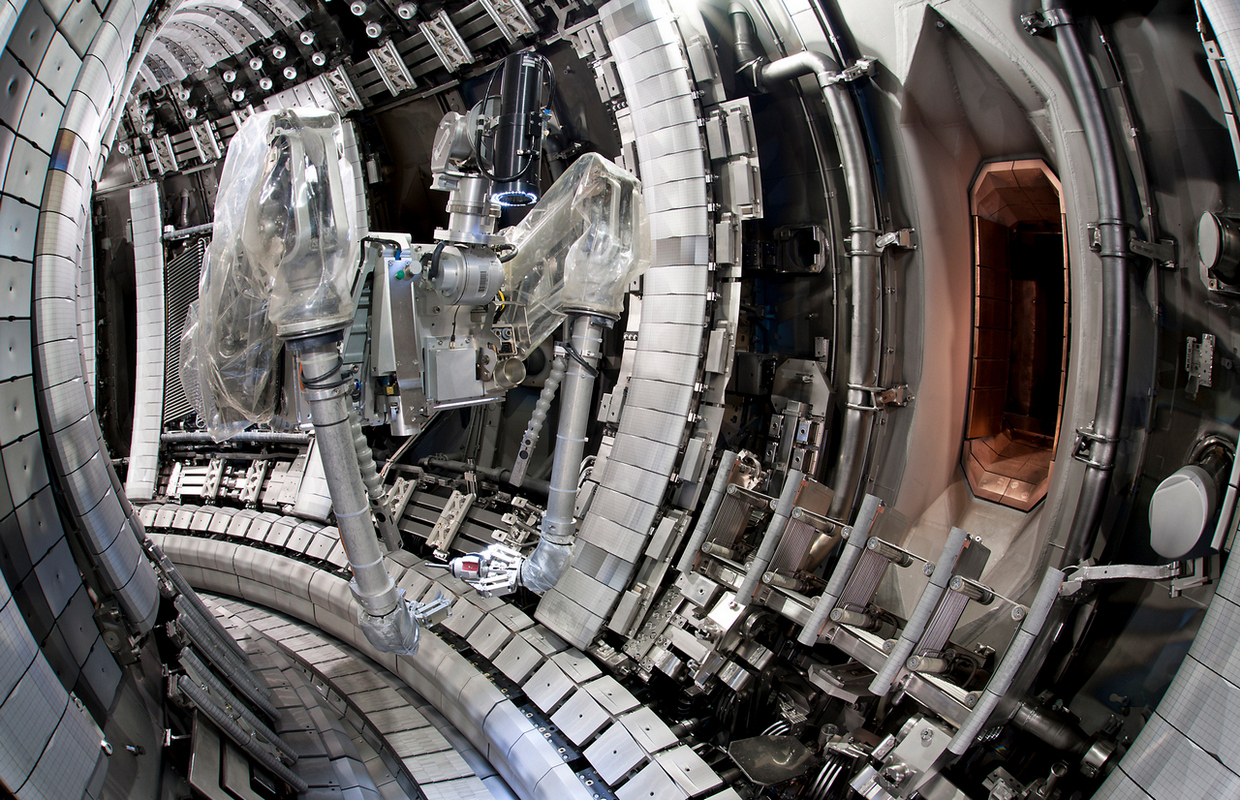 |
| Inside of a JET tokamak with remotely controlled devices. Credit: UKAEA
|
 |
| Control room. Credit: UKAEA |
 |
| Credit: UKAEA |
Source: IFPiLM, UKAEA, EUROfusion consortium
 The Institute of Plasma Physics and Laser Microfusion invites you to participate in the 16th Summer School of Plasma Physics which will be held on 6 - 10 June 2022 in Kudowa-Zdrój.
Kudowa Summer School "Towards Fusion Energy" is addressed to young researchers, MSc and PhD students, both from Poland and abroad. Participants will have the opportunity to present their own research results. Lectures will be run by the acknowledged specialists from leading research centers.
The topics of the classes will deal with various aspects of plasma physics, including fusion energy, experiments with the application of plasma, its technology and diagnostics. Issues related to the operation of satellite thrusters will also be covered.
Deadline for application and submitting abstracts: 21 February 2022.
Registration can be made through: https://kudowaschool.ipplm.pl/registration
More information can be found at: https://kudowaschool.ipplm.pl/


nsp_133.JPG)


nsp_133.JPG)


 |
 |
 |
 |
 |
 |
 |
 |
Media


Research projects carried out at the IPPLM are funded by the Polish Ministry of Education and Science, the National Science Centre and by the European Commission within the framework of EUROfusion Consortium under grant agreement No 101052200. Financial support comes also from the International Atomic Energy Agency, European Space Agency and LaserLab Consortium as well as from the Fusion for Energy Agency.