





Zestaw obrazów 2019
zdjecie1.jpg
zdjecie2.jpg
zdjecie3.jpg
zdjecie4.jpg
zdjecie5.jpg
zdjecie6.jpg
2019_1.JPG
2019_2.JPG
2019_4.JPG

Gallery
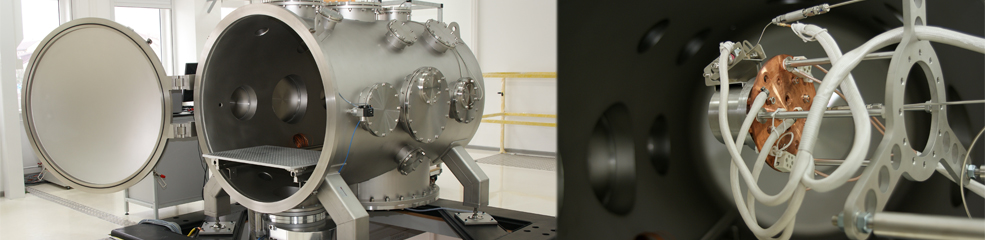
In April 2021 the group led by dr Jacek Kurzyna of the Institute of Plasma Physics and Laser Microfusion completed the High Impulse Krypton Hall Effect Thruster (HIKHET) project (funded by the European Space Agency in the scope of Polish Industry Incentive Scheme programme), which was aimed to develop a high specific impulse version of the IPPLM’s 500 W class Hall plasma thruster operated with krypton propellant.
 |
| Hall thruster fed with krypton and working in PlaNS Laboratory |
Specific impulse, i.e. the impulse per one kilogram of the propellant, is a measure of how effectively the propellant available onboard of a satellite is utilized. Since almost all of the new satellites are equipped with a propulsion system which allows them to carry out orbital maneuvers to extend their mission and to finally deorbit, it is the amount of available propellant onboard which largely determines the lifetime of the satellite.
During the 3 years of the project, in the Plasma Nudge for Satellites (PlaNS) Laboratory the initial version of the thruster (developed in the scope of the earlier KLIMT project) was enhanced and extensively tested, new diagnostics of the emitted plasma beam were implemented (Faraday Cup and Retarding Potential Analyzer), and an entirely new thruster was designed relying on the results from magnetic field modelling and thermal simulations. The final version of the thruster was tested in a wide range of operating parameters (type of propellant, mass flow rate, discharge voltage, magnetic field strength), showing an increase of the specific impulse from 1400 s to 2600 s and simultaneous efficiency improvement from 20% to 34% (for krypton). Moreover, the new design resulted in operating temperature lower by 100oC and mass reduced by 30%. The achieved performance allows to compete with other Hall thruster of similar power, and makes the IPPLM’s thruster unique in the way of specific impulse production.
 |
| Specific impulse as a function of discharge power – comparison of KLIMT and HIKHET thrusters with other Hall thrusters described in literature (data for krypton) |
Figures: © IPPLM
In February this year, one of the IPPLM staff, namely Dr. Katarzyna Batani, was appointed Editor-in-Chief of Laser and Particle Beams. LPB is an international journal which deals with basic physical issues of intense laser and particle beams, and the interaction of these beams with matter. The subjects covered include the physics of high energy densities, non-LTE phenomena, hot dense matter and related atomic, plasma and hydrodynamic physics and astrophysics, intense sources of coherent radiation, high current particle accelerators, beam-wave interaction, as well as research on pulsed power technology associated with beam generation.
Currently, the journal is going through a transition phase including changes in the Editorial Board and editorial politics. It is expected that this transformation will strengthen the position of the journal in the scientific environment and increase its impact. A vital part of it is providing researchers with fast, constructive, and excellent review of their papers.

Source: www.hindawi.com
The Royal Society of Chemistry awarded our employee Dr. Paweł Gąsior a distinction as an active reviewer of articles in the Journal of Analytical Atomic Spectrometry. Based on the number, timeliness and quality of reports, which Dr. Gąsior prepared in 2020, he was awarded the title of Outstanding Reviewer for JAAS.
Congratulations!

 We were deeply saddened to hear that on 24 January 2021 our former employee, an outstanding specialist in the field of explosive technologies, Prof. Wiktor Babul died.
In the 70s and 80s of the last century, professor was the head of the department at the Military University of Technology dealing with the applications of explosive technologies. At that time, he also worked in the IPPLM, cooperating with a team of researchers and technologists to prepare and apply special explosive systems for the generation and compression of plasma with thermonuclear parameters. It was the original concept of Prof. Sylwester Kaliski, an alternative to the methods of generating such plasma in systems with magnetic plasma confinement and in systems where high-power lasers generate fusion plasma. In cooperation with Prof. Babul, the Institute developed various types of systems applying explosives for plasma testing. In a few cases, original results were highly appreciated by the international scientific community. The works in question were halted after Prof. Kaliski died in 1978.
Prof. Wiktor Babul also collaborated with a team of IPPLM employees dealing with the development and application of explosive methods in construction (e.g. for demolition) and in material technologies (e.g. for modification of metal structures). Many original technical solutions, also used in commercial orders, were developed to implement such applications.
Professor was known for his great knowledge of explosive technologies and experience in their practical application in various fields. He was not only a recognized scientist willingly cooperating with younger researchers, but also a warm person who would talk on various topics, not only focusing on the development and applications of explosive technologies.
That’s how we will remember him.
Photo: Private Archive
 This year marks the 100th anniversary of the Polish Physical Society. It is an excellent occasion to recall and underline how crucial Polish discoveries and achievements in the field of world physics are. The scientists will talk about it all during the upcoming 46th Extraordinary Congress of Polish Physicists in Warsaw.
The event will commence on 16 October 2020 to last three days. The congress has been organized in a hybrid mode. All presentations will be held on-site with the participation of lecturers, invited speakers and technical staff. The entire event will be broadcast via the YouTube platform.
- This is a great celebration for Polish physicists. We have been setting scientific trends for 100 years. Without physicists, there would be no smartphones, computers or the Internet. It is their achievements that support cancer diagnosis and the development of photovoltaics. Polish physicists participate in almost every significant international research project and are successful in their endeavours, says Prof. Andrzej Wysmołek, chairman of the Organizing Committee of the 46th Extraordinary Congress of Polish Physicists.
The program of the congress will present Polish achievements in the field of physics in a nutshell. On the first day, the professors will talk about the beginnings of the Polish Physical Society. Moreover, there will be awards, medals and the unveiling of a plaque to commemorate the establishment of the Polish Physical Society. On Saturday, 17 October, 13 half-hour popular science speeches dealing with the most current issues in physics are to be given. The last day of the event will be dedicated to teachers and cover the subject of teaching physics at school.
The open poster session "100 posters for the century" (17 October, 6:00 pm - 8:00 pm) will play a special role in the program of the Congress when the scientists from the Institute of Plasma Physics and Laser Microfusion will present their works.
Source: 100 years of the PPS


nsp_133.JPG)


nsp_133.JPG)


 |
 |
 |
 |
 |
 |
 |
 |
Media


Research projects carried out at the IPPLM are funded by the Polish Ministry of Education and Science, the National Science Centre and by the European Commission within the framework of EUROfusion Consortium under grant agreement No 101052200. Financial support comes also from the International Atomic Energy Agency, European Space Agency and LaserLab Consortium as well as from the Fusion for Energy Agency.