





Zestaw obrazów 2019
zdjecie1.jpg
zdjecie2.jpg
zdjecie3.jpg
zdjecie4.jpg
zdjecie5.jpg
zdjecie6.jpg
2019_1.JPG
2019_2.JPG
2019_4.JPG

Gallery
 With deep regret and great sadness we learnt about the death of Dr. Andrzej Kasperczuk (1942-2020), a long-time employee of the Institute of Plasma Physics and Laser Microfusion.
Dr. Kasperczuk graduated from the Military University of Technology in 1974 and then started working as an assistant at the Faculty of Chemistry and Technical Physics at the Military University of Technology. He studied plasma generated in plasma focus devices. His first task was to develop and launch multi-frame laser interferometry and auxiliary optical diagnostics to study plasma. He also dealt with numerical methods necessary to process interferograms. Dr. Kasperczuk conducted many experiments which led to numerous publications, and their culmination came as a doctoral dissertation entitled "Interferometric studies of the formation and decay of the plasma cord in the plasma focus PF-150 device" defended in 1984. The team he joined dealt with the study of the structure and dynamics of the layer plasma. Joint efforts were awarded in 1989 by the Minister of Science and Higher Education.
Witnessing the great experience and effectiveness in performing research, the management of the Institute entrusted Andrzej Kasperczuk with a new important task, namely to manage the construction of laser interferometry for a large T-15 tokamak under construction in the former USSR. The team carrying out this task consisted of the IPPLM employees and those of the Institute of Precision and Optical Instruments at the Warsaw University of Technology. Unfortunately, the project was not completed as the T-15 tokamak construction program came to a close. The innovative ideas of solutions proposed for this interferometer were applied for other systems.
After 1990, the scientific activity of Dr. Kasperczuk focused on researching laser plasma, and particularly laser plasma in an external magnetic field.
The basic diagnostics used in this research was a unique 3-frame interferometric system co-authored by Dr. Kasperczuk. The system made it possible to obtain the time-space distributions of plasma concentration, allowing to study the influence of the external magnetic field on the dynamics of the laser plasma. Dr. Kasperczuk played a significant role in the interpretation and analysis of the results of these studies. Thanks to his efforts, many articles were published in prestigious journals which are still referred to by laser plasma researchers.
Since 2001, there have been new opportunities to conduct interferometric studies at the PALS (Prague Asterix Laser System) laser system in Prague as part of the Laserlab projects in which Dr. Kasperczuk took part as the main researcher. With his significant participation, a multi-frame interferometric system was installed and launched on the PALS which provided the team at the IPPLM with great opportunities to undertake effective research related to various areas of laser plasma applications, in particular research on the implementation of inertial fusion (ICF - Inertial Confinement Fusion) as well as the research related to the so-called laboratory astrophysics.
A new method of plasma streams generation proposed by Dr. Kasperczuk turned out to be a great success during the interferometric research at PALS. The application of a massive target made of a material with a relatively high atomic number (Z>29, Cu) allowed to obtain a single laser beam as a result of the interaction:
• supersonic plasma streams with speeds over 500 km/s,
• maximum electron concentration in a stream above 1019 cm-3,
• plasma beam lifetime over 2 orders of magnitude in excess of the pulse duration of laser radiation.
This method turned out to be competitive as opposed to very complicated methods applied to generate plasma streams through multi-beam illumination of conical targets which were implemented only on the largest laser systems in the world, namely Nova in Livermore and GEKKO XII in Osaka.
The expectations related to the application of this method, both in research on the implementation of inertial confinement fusion (ICF) and in astrophysical research, became the motivation to undertake intensive experimental research on the PALS system where Andrzej Kasperczuk played an important role.
Thanks to this method, space-time electron density distributions (the first published in world literature) were obtained, illustrating the processes of generation and movement of the shock wave brought about by the movement of the plasma stream in the gas, the analysis of which showed the possibility of scaling them to real astrophysical objects.
The last PALS research with Dr. Kasperczuk’s participation focused on the most promising concept of inertial fusion, namely the shock ignition. In these studies, a 3-channel polar-interferometer illuminated by a femtosecond laser was applied, which made it possible to obtain information on the distribution of the magnetic field and electron concentration with very high temporal resolution. This enhanced the identification of the anomalous processes responsible for generating hot electrons which transport the energy of laser radiation to the wave initiating thermonuclear ignition.
For his interferometric studies carried out at the PALS system, Dr. Kasperczuk was twice awarded the Director's Award - including the first degree award in 2013.
The scientific achievements of Dr. Kasperczuk encompass over 120 publications, mainly from the Philadelphia list, including a large number of publications with him as the first author.
The Doctor's activity was not limited to research only. He also actively participated in organizational work. For two years he was the deputy director of the Experimental Department established at the IPPLM and created the foundations for the technological base of the Institute.
We will remember Dr. Andrzej Kasperczuk as a righteous and noble man with invaluable features of character. He was characterized by gentleness, peace and kindness. We appreciated his involvement in the Institute’s life regardless of the area concerned. Collaboration with him was always very fruitful, and its results enriched the development of the subject matter.
He will remain in our memory forever.
Photo: © IFPiLM
 At the end of July 2020, an official ceremony was held in France to inaugurate the assembly of the ITER tokamak. After 14 years of signing the agreement in Paris for the construction and operation of a next-generation fusion experimental reactor, the ITER project has entered its decisive phase.
The event, which is an important step towards confining fusion as a source of energy, drew extensive media attention from all over the world.
Director of the Institute of Plasma Physics and Laser Microfusion, Prof. Andrzej Gałkowski and Prof. Monika Kubkowska, head of the national consortium dealing with fusion, joined the "Eureka" radio programme on Jedynka station. The guests explained to the audience, among others, what difficulties are involved in recreating the reactions taking place inside the Sun under terrestrial conditions and why, among all possible reactions, the synthesis of deuterium and tritium - two isotopes of hydrogen - was chosen as a source of energy for future fusion power plants.
The Institute of Plasma Physics and Laser Microfusion, the coordinator of fusion research in Poland, as part of the national scientific and industrial center New Energy Technologies (CeNTE), performs research related to the ITER project.
Link to the radio programme (in Polish): www.polskieradio.pl
The participants of the ITER project are: European Union, Japan, USA, Russia, China, India and South Korea. Seven partners chose ITER to be located in Cadarache, a small town in the south of France, near Aix-en-Provence.
ITER will be the next step on the way to confine the new source of the released energy of light nuclei fusion. The reactor is meant to generate more than 500 MW of fusion energy, with the main goal to finally demonstrate the possibility to generate electricity thanks to fusion reactions. The aim of the project is to show the scientific and technical feasibility of nuclear fusion as the basis of fusion energy.
Basic ITER parameters:
• large radius - 6.2 m;
• small radius - 2 m;
• chamber volume - 840 m3;
• plasma current - 15 MA;
• magnetic induction - 5.3 T;
• plasma concentration - 1020 m−3;
• discharge duration - 500 s in pulse mode and 1000 s in quasi-continuous mode;
• power of plasma heating devices (electromagnetic waves with frequencies of 50 MHz and 170 GHz and particle beams) - 75 MW;
• plasma temperature - 120 MK;
• power generated (in the fusion reaction) - 500÷700 MW;
• gain factor (fusion power/heating power) - 10 in pulse mode and 5 in quasi-continuous mode;
• average load of the tokamak’s surface due to neutron radiation - 0.5 MW/m2.
An extremely important issue on a global scale is to provide people with a stable source of energy. It is possible that nuclear fusion will provide a sufficiently large amount of usable energy (practically infinite), while remaining a safe source, available at any point on the globe and not causing the emission of hazardous gases into the atmosphere.
Only one question remains to be answered: when will we be able to develop the technology allowing to obtain electrical energy from fusion on an industrial scale, and when fusion energy will be economically profitable. Professor Andrzej Gałkowski answers this question quoting Lev Arcymowicz, one of the pioneers of nuclear fusion research: "Exactly when humanity will need it". The time is coming.
Photo: Credit © ITER Organization, http://www.iter.org/

The 15th edition of the Kudowa Summer School "Towards Fusion Energy" has drawn to a close. The event, organized extraordinarily online this year, turned to be very popular. Over 50 participants from 16 countries joined the School.
During the inauguration ceremony, the director of the School, Dr. Jozef Ongena from the Royal Military Academy in Brussels, took the floor. An additional attraction for the participants was the premiere of the film devoted to the activities of the Institute of Plasma Physics and Laser Microfusion (link to the film: https://www.youtube.com).
The lectures were given by 19 outstanding specialists (list of lecturers: https://kudowaschool.ipplm) from leading research centers from all over the world, including the Max Planck Institute for Plasma Physics (Germany), EUROfusion Consortium (Germany), Italian National Research Council (Italy), Imperial College London (UK), University of Bordeaux (France), Czech Technical University in Prague (Czech Republic), Eindhoven University of Technology (The Netherlands).
During the student sessions, 21 participants presented results of their own research, and the best presentations were awarded. Ayushi Vashistha from the Institute for Plasma Research (India) and Yuliia Volkova from the Kharkiv Institute of Physics and Technology (Ukraine) tied for first place, and the second-place award went to Jerguš Stručka from Imperial College London (UK). Two special prizes were also granted, namely to Sandeep Kumar from Lovely Professional University (India) and Agnieszka Szelecka from the Institute of Plasma Physics and Laser Microfusion (Poland).
The subjects of the classes during the Kudowa Summer School dealt with various aspects of plasma physics, including fusion energy, experiments with the application of plasma, its technology and diagnostics. The issues related to the operation of satellite thrusters were also tackled.
The next edition of the Summer School of Plasma Physics will take place in 2022. Already today we cordially invite you to join this event!
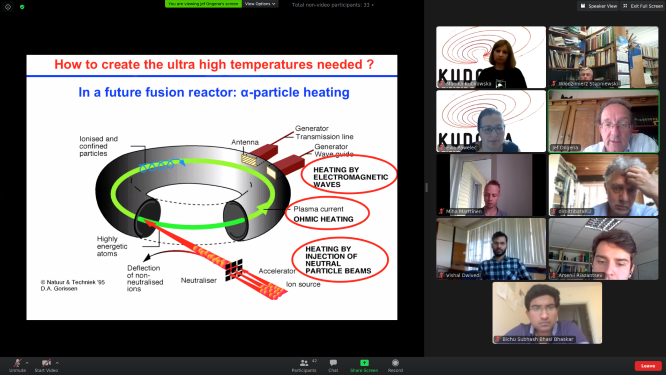


Photo: © IFPiLM
The latest film promoting the activities of the Sylwester Kaliski Institute of Plasma Physics and Laser Microfusion is now available on our YouTube channel.
The viewers can follow our history, plasma physics and nuclear fusion research conducted by the scientists, as well as the collaboration of the IPPLM with leading scientific centers worldwide focused on creating the proper conditions for conducting controlled thermonuclear fusion.
The film also features our laboratories, i.e. we will have a look inside Europe's largest plasma focus plasma concentrator, we will show a laser of 10 terawatts power and the laboratory where Hall plasma thrusters for small satellites are constructed and tested. We will also explain why a helicopter arrived in our laboratory hall.
The film was produced by Foundation Proscenium.
Due to the coronavirus pandemic, the 15th edition of the Summer School of Plasma Physics (http://kudowaschool.ipplm.pl/), to be held on 29 June – 3 July 2020 in Kudowa-Zdrój, will take place online via the Zoom connection.
Kudowa Summer School "Towards Fusion Energy" is addressed to young scientists both from Poland and abroad. In addition to acquiring knowledge, participants of the virtual School will also have the opportunity to present the results of their own research. Awards will go to the authors of the three best presentations.
The Institute of Plasma Physics and Laser Microfusion has invited 19 outstanding specialists from leading scientific centers to give lectures during the School.
Topics of lectures and sessions will deal with various aspects of fusion energy, plasma experiments, its technology and diagnostics. Issues related to the space thrusters operation will also be discussed.
Link to the event: https://www.facebook.com/events
Organizer: Institute of Plasma Physics and Laser Microfusion


nsp_133.JPG)


nsp_133.JPG)


 |
 |
 |
 |
 |
 |
 |
 |
Media


Research projects carried out at the IPPLM are funded by the Polish Ministry of Education and Science, the National Science Centre and by the European Commission within the framework of EUROfusion Consortium under grant agreement No 101052200. Financial support comes also from the International Atomic Energy Agency, European Space Agency and LaserLab Consortium as well as from the Fusion for Energy Agency.