





Zestaw obrazów 2019
zdjecie1.jpg
zdjecie2.jpg
zdjecie3.jpg
zdjecie4.jpg
zdjecie5.jpg
zdjecie6.jpg
2019_1.JPG
2019_2.JPG
2019_4.JPG

Gallery

The 15th edition of the Kudowa Summer School "Towards Fusion Energy" has drawn to a close. The event, organized extraordinarily online this year, turned to be very popular. Over 50 participants from 16 countries joined the School.
During the inauguration ceremony, the director of the School, Dr. Jozef Ongena from the Royal Military Academy in Brussels, took the floor. An additional attraction for the participants was the premiere of the film devoted to the activities of the Institute of Plasma Physics and Laser Microfusion (link to the film: https://www.youtube.com).
The lectures were given by 19 outstanding specialists (list of lecturers: https://kudowaschool.ipplm) from leading research centers from all over the world, including the Max Planck Institute for Plasma Physics (Germany), EUROfusion Consortium (Germany), Italian National Research Council (Italy), Imperial College London (UK), University of Bordeaux (France), Czech Technical University in Prague (Czech Republic), Eindhoven University of Technology (The Netherlands).
During the student sessions, 21 participants presented results of their own research, and the best presentations were awarded. Ayushi Vashistha from the Institute for Plasma Research (India) and Yuliia Volkova from the Kharkiv Institute of Physics and Technology (Ukraine) tied for first place, and the second-place award went to Jerguš Stručka from Imperial College London (UK). Two special prizes were also granted, namely to Sandeep Kumar from Lovely Professional University (India) and Agnieszka Szelecka from the Institute of Plasma Physics and Laser Microfusion (Poland).
The subjects of the classes during the Kudowa Summer School dealt with various aspects of plasma physics, including fusion energy, experiments with the application of plasma, its technology and diagnostics. The issues related to the operation of satellite thrusters were also tackled.
The next edition of the Summer School of Plasma Physics will take place in 2022. Already today we cordially invite you to join this event!
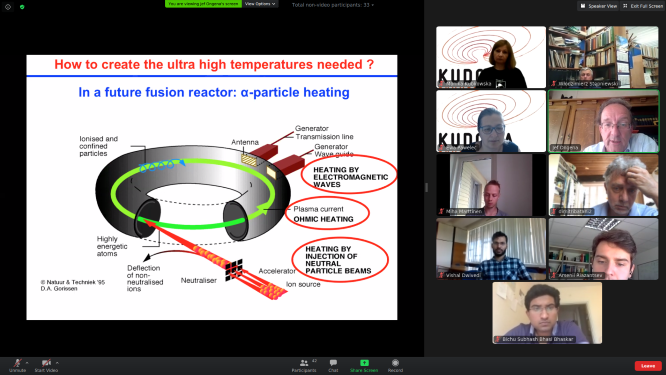


Photo: © IFPiLM
The latest film promoting the activities of the Sylwester Kaliski Institute of Plasma Physics and Laser Microfusion is now available on our YouTube channel.
The viewers can follow our history, plasma physics and nuclear fusion research conducted by the scientists, as well as the collaboration of the IPPLM with leading scientific centers worldwide focused on creating the proper conditions for conducting controlled thermonuclear fusion.
The film also features our laboratories, i.e. we will have a look inside Europe's largest plasma focus plasma concentrator, we will show a laser of 10 terawatts power and the laboratory where Hall plasma thrusters for small satellites are constructed and tested. We will also explain why a helicopter arrived in our laboratory hall.
The film was produced by Foundation Proscenium.
Due to the coronavirus pandemic, the 15th edition of the Summer School of Plasma Physics (http://kudowaschool.ipplm.pl/), to be held on 29 June – 3 July 2020 in Kudowa-Zdrój, will take place online via the Zoom connection.
Kudowa Summer School "Towards Fusion Energy" is addressed to young scientists both from Poland and abroad. In addition to acquiring knowledge, participants of the virtual School will also have the opportunity to present the results of their own research. Awards will go to the authors of the three best presentations.
The Institute of Plasma Physics and Laser Microfusion has invited 19 outstanding specialists from leading scientific centers to give lectures during the School.
Topics of lectures and sessions will deal with various aspects of fusion energy, plasma experiments, its technology and diagnostics. Issues related to the space thrusters operation will also be discussed.
Link to the event: https://www.facebook.com/events
Organizer: Institute of Plasma Physics and Laser Microfusion


 We are extremely sorry to inform that Professor Vladimir Gribkov (1944-2020) passed away.
The collaboration of Prof. Gribkov with the Institute of Plasma Physics and Laser Microfusion began in the late 1990s. Thanks to his assistance, it was possible to launch the large PF-1000 plasma generator, which was built in the IPPLM, with full energy of 1 MJ. In this difficult period, he got involved in the preparation of several sets of electrodes in Russia and supported the Institute’s team with his extensive knowledge and experience.
In 1997, Prof. Gribkov initiated the participation of the IPPLM team in international scientific programs, preparing an application for the 6th EU Framework Program under the INCO-COPERNICUS project. Our team's involvement in material research for the needs of nuclear fusion, implemented through Plasma-Focus systems, whose Prof. Gribkov was the informal coordinator and leader, dates back from this Project.
We remember with great nostalgia another joint activities in which Prof. Gribkov played a key role: NATO Project (Science for PEACE), projects under the IAEA CRP programs, establishing the Plasma-Focus laboratory at the ICTP Trieste, joint organization of workshops at the ICTP and Kudowa Zdrój, construction of PF -6 for application tests according to Professor’s project and many others.
Prof. Gribkov was the initiator of establishing the International Centre for Dense Magnetised Plasmas (ICDMP), actively participated in all activities related to this purpose.
He was a man of many talents - not only an outstanding physicist but also an erudite in the field of literature, poetry, and music.
He was a good and kind man. We were lucky that he was among us ...
 Instytut Fizyki Plazmy i Laserowej Mikrosyntezy wraz z liderem przemysłowym - firmą Progresja Space Sp. z o.o. - otrzymają dofinansowanie na realizację projektu pt. „Impulsowy napęd plazmowy do nano i mikro satelitów”. Wniosek został złożony w ramach Programu Operacyjnego Inteligentny Rozwój 2014-2020 i otrzymał pozytywną ocenę Narodowego Centrum Badań i Rozwoju.
Celem projektu jest udoskonalenie i wdrożenie technologii impulsowego napędu plazmowego dla nano i mikro satelitów. W odróżnieniu od rozwiązań klasycznych, w których wykorzystywany jest teflon, opracowany silnik będzie zasilany ciekłym paliwem. Będą go wyróżniać przede wszystkim mała masa i objętość, bardzo niski pobór mocy oraz wysoka wydajność. Rozwijana technologia zapewnia wysoką precyzję dozowania ciągu, umożliwiającą dokładne pozycjonowanie i orientację satelity. Napęd PPT (Pulsed Plasma Thruster) będzie pierwszym polskim komercyjnym silnikiem satelitarnym.
Wartość projektu to ponad 5,5 mln zł.
Zdjęcie: © IFPiLM


nsp_133.JPG)


nsp_133.JPG)


 |
 |
 |
 |
 |
 |
 |
 |
Media


Research projects carried out at the IPPLM are funded by the Polish Ministry of Education and Science, the National Science Centre and by the European Commission within the framework of EUROfusion Consortium under grant agreement No 101052200. Financial support comes also from the International Atomic Energy Agency, European Space Agency and LaserLab Consortium as well as from the Fusion for Energy Agency.