





Zestaw obrazów 2019
zdjecie1.jpg
zdjecie2.jpg
zdjecie3.jpg
zdjecie4.jpg
zdjecie5.jpg
zdjecie6.jpg
2019_1.JPG
2019_2.JPG
2019_4.JPG

Gallery
 The Institute of Plasma Physics and Laser Microfusion has for many years supported the "Helenów" Rehabilitation, Education and Care Centre in Warsaw. This year, in addition to the traditional fundraising, there was also a fair of Christmas decorations and ornaments made by the charges of the "Helenów" centre.
A group of students and their tutors came to the IPPLM on 1 December 2022 at the invitation of the Staff Council. During the visit, the guests visited the Laboratory of Laser Plasma Spectroscopy, the Laboratory of Plasma Nudge for Satellites and the PF-1000U Laboratory. An additional attraction for the children was the workshop 'States of focus - science and art' in the GO Theatre of the Proscenium Foundation. The workshop was followed by a Christmas market.
From 28 November to 9 December, the Institute held a collection of donations for the wards of the "Helenów" centre. Thanks to the funds collected, Christmas presents were purchased and presented to the children on 15 December during a Christmas Eve meeting. The kindness of heart shown by the IPPLM staff evoked many warm smiles and joy.
 |
 |
|
|
 |
|
|
 |


Photo: © IFPiLM
On 13 December 2022, the US Department of Energy announced that researchers at the National Ignition Facility (NIF) at the Lawrence Livermore National Laboratory in the US succeeded in achieving a positive energy balance in the laser fusion process, meaning that more energy of 3.15 MJ was obtained for the first time than was put in by the 2.05 MJ lasers initiating the process.
This is a ground-breaking scientific achievement. It represents a milestone in research work on inertial fusion, where, with the application of powerful laser beams, fusion fuel can be compressed with sufficient precision to maximise the efficiency of the fusion process.
"Monday, 5 December 2022, was an important day in science, (…) During experiments, 192 high energy lasers converge on a target about the size of a peppercorn heating a capsule of deuterium and tritium to over 3 million degrees Celsius and briefly simulating the conditions of a star," Dr Jill Hruby, Under Secretary for Nuclear Security of the U.S. Department of Energy, said at a press conference. "We have taken the first tentative steps towards a clean energy source that can revolutionise the world," she added.
For laser fusion to have practical applications, it is necessary to build more efficient lasers with higher repetition rates so that the interaction with the fuel ball can occur more frequently. The development of new technologies also plays a key role. The road to building a fusion power plant is still quite complicated and scientists still have a lot of work ahead of them. However, the latest experiment shows that it is possible to build it precisely on the basis of inertial fusion powered by lasers.
"A small step has now been taken towards harnessing nature and achieving pure 'star' energy, based on inertial nuclear fusion. Just as the Apollo programme developed in the USA between 1966 and 1972 propelled various fields of science and technology, and it was a success for all mankind when Neil Armstrong took his first step on the moon in 1969, now the result obtained at the NIF will hopefully become the flywheel for the fact that it is possible and worthwhile to follow this development to make nuclear fusion a source of energy for future generations.", Dr. Marcin Rosiński, Head of the Department of Laser Plasma Physics and Applications at the IPPLM, commented the achieved results.
On the occasion of the announcement of success at the NIF, we must not forget about fusion energy developed in the concept with magnetic plasma confinement. In February 2022, it was announced that a record was achieved on the JET tokamak, in which the IPPLM researchers had their contribution as well.
On 27 October 2022, after a three-year break, the Wendelstein 7-X stellarator resumed its activity at the Max Planck Institute for Plasma Physics (IPP) in Greifswald. The device was rebuilt and equipped with a water-cooled carbon divertor.
From the beginning of the testing and commissioning of the W7-X, researchers from the Institute of Plasma Physics and Laser Microfusion are on-site to best prepare for operation the pulse height analyzer (PHA) designed by the IPPLM team.
The IPPLM staff in cooperation with the University of Opole also participate in the launch of another measuring system to monitor the presence of light impurities in plasma - the so-called CO-monitor spectrometer. This is the second device designed and launched by the Polish team in cooperation with IPP in Greifswald.
The actual experimental campaign on the W7-X will start in the second half of November 2022.
The Wendelstein 7-X Stellarator is an experimental fusion reactor which was first launched in 2015. It is currently the largest device of this type in the world. This project aims to investigate the concept of magnetic plasma retention as an alternative to the tokamak.
 |
 |
|
| IPPLM and the University of Opole researchers | ||
 |
||
| PHA X-ray diagnostics | CO-monitor spectrometer |
Photo: © IPPLM

At the end of September 2022, researchers from the Institute of Plasma Physics and Laser Microfusion took part in the 26th edition of the Science Festival. After a two-year break due to the pandemic, students from primary and secondary schools were again able to participate in festival lessons which took place at the Institute's premises.
This year, as part of the Science Festival at the IPPLM, the following meetings were held:
Radioactivity in food products and the environment. Is there anything to fear?, Dr. Ewa Łaszyńska
The aim of the lesson was to discuss the types of nuclear radiation and the methods of its detection. The meeting included, among others, demonstration of the measurement of radiation from radioactive sources, and during the visit to the Laboratory of Gamma Radiation Spectrometry participants carried out radiation measurements of products used in everyday life.
Lasers: music of light, Dr. Paweł Gąsior
During the meeting, the students got to know, among others, the quality differences between incoherent light emitted by standard light sources and coherent laser light, the possibilities and applications of various types of lasers were also presented. During their visit to the Laboratory of Laser-Induced Plasma Spectroscopy, the students watched the demonstrations prepared for them, and at the end there was a discussion on the safety of using lasers.
Fusor - an experiment "in practice", Dr. Piotr Chmielewski, Maciej Szymanski, MSc
The researchers explained to the students the concept of plasma and what kind of experiments are carried out in fusion devices. Participants also learned about the construction and operation of the fusion reactor with electrostatic-inertial plasma fusor maintenance and the general principles of conducting experiments in a physics laboratory.
Additionally, after the main topics of the meetings, students visited the selected IPPLM laboratories.
The Warsaw Science Festival is a series of meetings with scientists who present the latest achievements, research methods and challenges for the future in an accessible way. As part of the Festival, there are also lessons for organized school groups at all levels of education. The events are organized by scientific, educational and cultural institutions, as well as by associations and research societies.
 |
 |
 |
 |
 |
 |
Photo: © IFPiLM
On 12 September 2022, the 30th anniversary of the Main Council of Research Institutes (RGIB) was celebrated in the Main Building of the Warsaw University of Technology.
As part of the Jubilee, the best institutes having received the A or A + category in recent years as a result of the evaluation of their scientific activity were awarded. Among the winners was the Institute of Plasma Physics and Laser Microfusion. The commemorative statuette was collected by the Assoc. Prof. Andrzej Gałkowski, IPPLM Director.
During the event, videos presenting the achievements and successes of individual research institutes were shown. On this occasion, the guests also received the monograph entitled "Research Institutes - 30th anniversary of the Main Council" and visited the exhibition held in the auditorium of the Warsaw University of Technology. At the IPPLM stand, guests had the opportunity to learn about the subject of nuclear fusion and the Institute's scientific activities.
The RGIB is a representative body of 91 research institutes in Poland performing research for the economy, infrastructure, environment, agriculture, medicine, and broadly understood security and the humanities. The Council represents the interests of the research community in Poland and abroad as well as participates in economic and social policy, in particular in science and innovation. Prof. Henryk Skarżyński has been the chairman of the RGIB since 2022, and the IPPLM is represented by Assoc. Prof. Monika Kubkowska.
|
|
|
 |
|
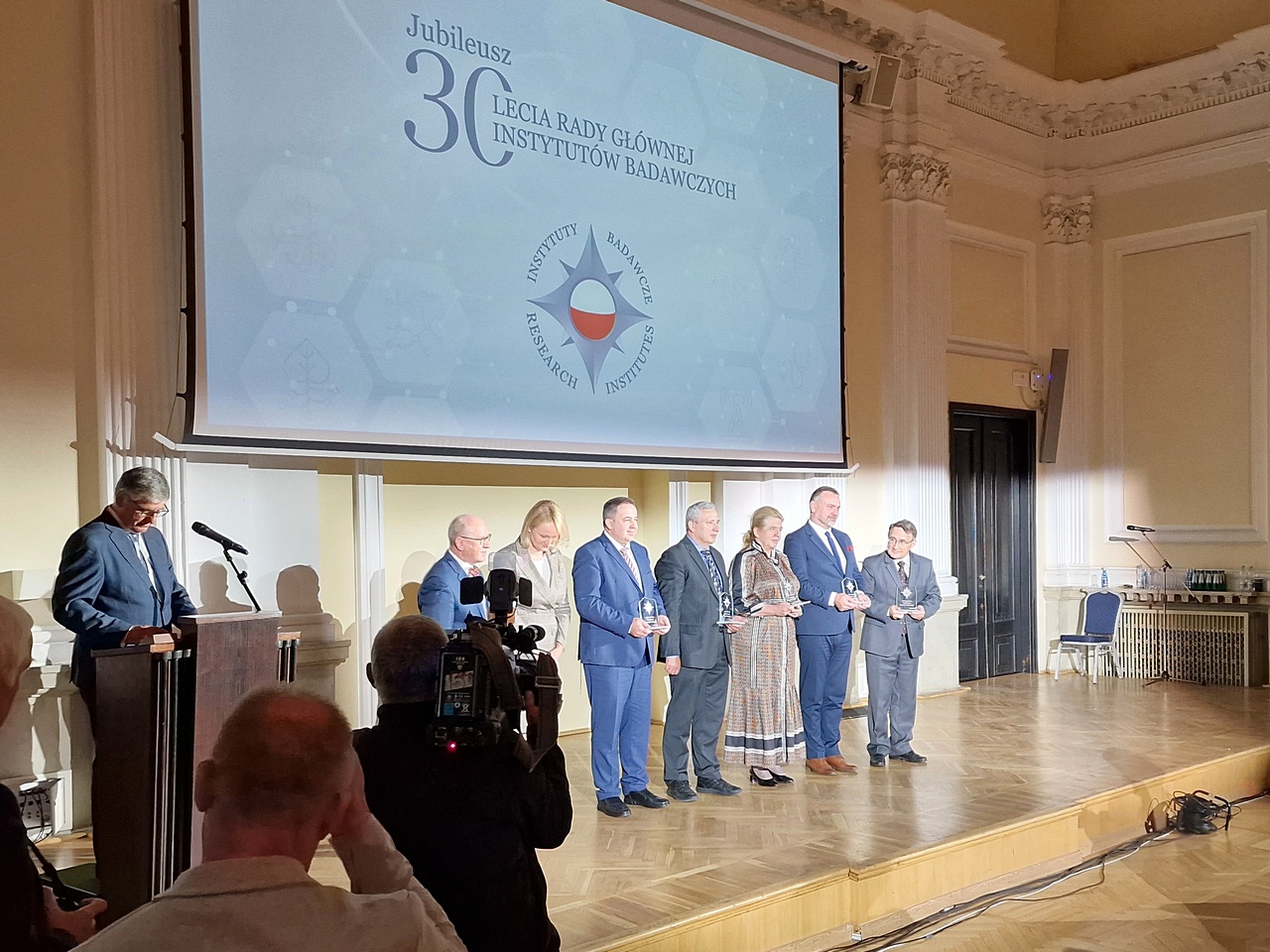


Photo: © IFPiLM


nsp_133.JPG)


nsp_133.JPG)


 |
 |
 |
 |
 |
 |
 |
 |
Media


Research projects carried out at the IPPLM are funded by the Polish Ministry of Education and Science, the National Science Centre and by the European Commission within the framework of EUROfusion Consortium under grant agreement No 101052200. Financial support comes also from the International Atomic Energy Agency, European Space Agency and LaserLab Consortium as well as from the Fusion for Energy Agency.