





Zestaw obrazów 2019
zdjecie1.jpg
zdjecie2.jpg
zdjecie3.jpg
zdjecie4.jpg
zdjecie5.jpg
zdjecie6.jpg
2019_1.JPG
2019_2.JPG
2019_4.JPG

Gallery

"Science is a journey into the future" - this is the slogan of the 27th edition of the Science Festival in Warsaw on 15-29 September 2023.
As part of the Festival, researchers from the Institute of Plasma Physics and Laser Microfusion prepared classes for students conducted at the Institute’s premises.
Dr. Ewa Łaszyńska and Dr. Katarzyna Mikszuta-Michalik during the lesson entitled "Radiation around us" told fourth-grade primary school students in an accessible way about nuclear radiation and methods of its detection. During a visit to the Gamma Radiation Spectrometry Laboratory, participants carried out radiation measurements of products used in everyday life, including food products.
During the classes entitled Fuzor – an experiment "in practice" Dr. Piotr Chmielewski and M.Sc. Eng. Maciej Szymański explained to the students what plasma and nuclear fusion is and how the work of plasma-containing devices, such as a tokamak or a stellarator looks like. In the laboratory, high school students learned about the structure and principles of operation of a fusion reactor with electrostatic-inertial plasma maintenance of the fusor type. Students could observe, among others, the influence of gas pressure on the current-voltage characteristics and the nature of the discharge, and also measured the temperature of the reactor cathode using an optical pyrometer. Additionally, after the main meeting, the participants visited the PF1000U Laboratory.
The Warsaw Science Festival is a series of meetings with scientists who present the latest achievements, research methods and challenges for the future in an accessible way. The topics of festival meetings concern exact and natural sciences, medicine, humanities and social sciences, as well as cultural and artistic sciences. The events take the form of debates, lectures, workshops, film screenings, visits to laboratories, exhibitions, trips, competitions and educational games. The Festival also includes lessons for organized school groups at all levels of education. Events are organized by scientific, educational and cultural institutions as well as scientific associations and societies.
 |
 |
 |
 |
Photo: © IPPLM
On 18-22 September 2023, the international scientific conference PLASMA 2023 on plasma research and applications was held in Warsaw. The event was organized by the Institute of Plasma Physics and Laser Microfusion. The conference was attended by almost 100 participants from 16 countries including Belgium, China, France, Spain, the Netherlands, Japan, South Korea, Lithuania, Germany, Poland, the Czech Republic, Serbia, the United States, Switzerland, Sweden and the United Kingdom.
The topics covered during the conference included:
- Plasmas in tokamaks and stellarators. Magnetic confinement fusion
- Plasmas generated by laser beams. Inertial confinement fusion
- Space plasmas and laboratory astrophysics
- Dusty plasmas
- Plasma diagnostics. Measurements and data processing, including AI
- Plasma medicine
- Elementary processes, general plasma physics.
The chairperson of the International Scientific Committee was Monika Kubkowska, IPPLM Professor, Deputy Director for Scientific Affairs, and the Local Organizing Committee was headed by Agata Chomiczewska, IPPLM Professor.
During the conference, there were 22 invited lectures, 21 oral presentations and two poster sessions with 40 posters.
|
|
| Participants of the PLASMA 2023 conference. Photo: © IPPLM |

During the second day of the event, a plenary session was held on groundbreaking achievements in the field of nuclear fusion. Dr. Ernesto Lerche from the Culham Science Center (UKAEA), LPP-ERM/KMS discussed the landmark results obtained by European researchers in December 2021 on the world's largest device for carrying out controlled thermonuclear reactions, namely JET (Joint European Torus) tokamak, which is located in the UK. Dr. Clement Trosseille from the Lawrence Livermore National Laboratory in the United States presented the success of American researchers related to obtaining a positive energy balance in the process of laser nuclear fusion in December 2022 and July 2023.
In addition to the conference participants, the session was also attended by media representatives, including: PAP, Gazeta.pl, Focus.pl, Postępy Techniki Jądrowej, representatives of national institutions, students as well as high school students.
The plenary session was broadcast on the IPPLM YouTube channel. It can currently be viewed on: www.youtube.com/@ifpilm/streams
The project is co-financed by the state budget funds under the program of the Minister of Education and Science called "Excellent science II - support for scientific conferences: International Conference on Research and Applications of Plasmas - PLASMA 2023”, project No. KONF/SN/0198/2023/01.
Event sponsors: EKSPLA, Hamamatsu, IRtech Sp. z o.o., Precoptic, Quantum Design, Tespol Sp. z o.o. oraz Krajowy Punkt Kontaktowy Euratom-IFPiLM. Partner: Applied Science journal.
The next edition of the PLASMA conference will take place in 2025.
 Sylwester Kaliski Institute of Plasma Physics and Laser Microfusion (IPPLM) invites you all to participate in an open plenary session devoted to groundbreaking achievements in the field of nuclear fusion.
The session is a unique opportunity to participate in the first joint meeting of representatives of the world's leading research centres, which have recently announced record achievements.
Outstanding researchers will be our special guests: Dr. Ernesto Lerche from the Culham Science Center (UKAEA), LPP-ERM/KMS and Dr. Clement Trosseille from the Lawrence Livermore National Laboratory in the United States. Dr. Ernesto Lerche will discuss the groundbreaking results obtained by European researchers in December 2021 on the world's largest device for carrying out controlled thermonuclear reactions, namely JET (Joint European Torus) tokamak, which is located in the UK. Dr. Clement Trosseille will present the success of American researchers related to obtaining a positive energy balance in the process of laser nuclear fusion in December 2022 and July 2023.
The event is an excellent opportunity to gain comprehensive knowledge about the latest advances in research on a new source of energy, namely fusion energy. Participants will also have the opportunity to ask questions to invited guests and IPPLM researchers.
Nuclear fusion brings great hopes for solving the global energy crisis and revolutionizing the way energy is generated, therefore it is extremely important for as many recipients as possible to be aware of the changes taking place in the energy sector and the potential of fusion, which is also being developed in Poland.
Date: 19 September 2023 at 4 p.m.
Venue: ADN Conference Centre, „Biura przy Warzelni”
Address: 56 Grzybowska Str., GH building, B entrance, 4th floor, Warsaw
To participate in the session, please register by 14 September at 12:00 p.m. at: https://plasma2023.ipplm.pl/plenary-session-registration
The number of places is limited. Admission to the plenary session is free.
The open plenary session will be held as part of an international scientific conference PLASMA 2023 organised by Institute of Plasma Physics and Laser Microfusion.
The official language of the plenary session will be English.
Event: www.facebook.com/events
------------------------------
* You can watch the plenary session devoted to groundbreaking achievements in the field of nuclear fusion on our YouTube channel: www.youtube.com/@ifpilm
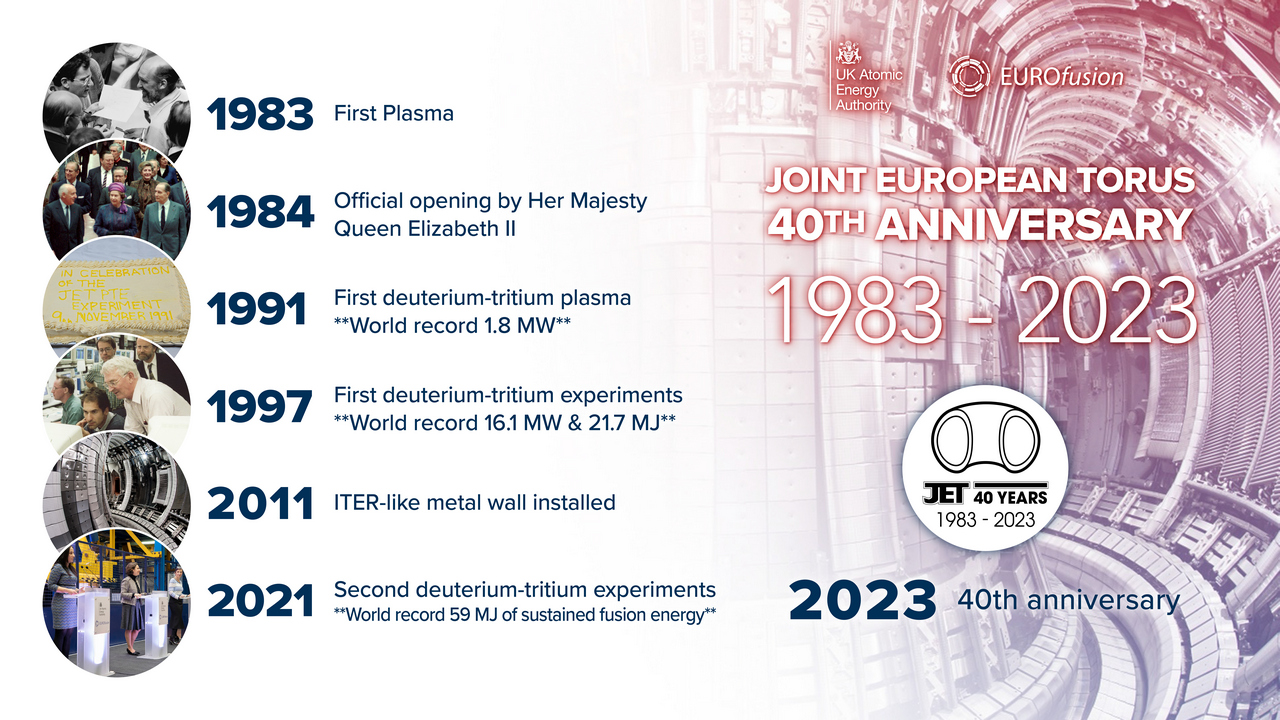
On Sunday, 25 June 2023, 40 years have passed since the first plasma was produced at the JET (Joint European Torus) tokamak located in Culham near Oxford, UK. It is the most advanced device in the world designed for nuclear fusion research. JET is currently the only tokamak in the world that can operate using deuterium and tritium (D-T), the fuel mix planned for future fusion power plants.
More than 31 European laboratories, namely experts, students and researchers from all over Europe are involved in the research (co-funded by the European Commission) led by the EUROfusion consortium.
Several dozen Polish scientists have also participated in numerous experiments conducted at the tokamak since 2005, including the IPPLM, IFJ PAN, PW, PWr, UO, NCU, AM and NCBJ. Their contribution to the research conducted at JET concerns, among others:
- design and preparation of modern detectors for soft X-ray diagnostics,
- analysis and interpretation of experimental data recorded using various diagnostics,
- studies on the behaviour of plasma impurities in order to control them and minimize their accumulation,
- measurements of fusion reaction products (neutrons and fast helium ions),
- calibration of the neutron diagnostics system in JET for the energy of 14 MeV,
- performing numerous reconstructions of tomographic plasma radiation based on bolometric data,
- development and application of numerical methods in plasma research.
JET is currently the largest and most powerful operating tokamak in the world. It is a key element in the history of fusion energy research. We Poles have been part of the JET community for 18 years. Over the years, we have become specialists, having the opportunity to work in an international team of scientists. We not only witnessed but also participated in the groundbreaking achievement when the world record for fusion energy was set at JET. For 40 years, JET has inspired generations of researchers, including physicists and engineers, to go even further in this very interesting research on nuclear fusion" - concludes Dr. Agata Chomiczewska, IPPLM professor, national coordinator of research at the JET tokamak from the IPPLM.
 |
| Credit: UKAEA |
For more information please visit: https://euro-fusion.org
Dr. Katarzyna Batani from the Department of Laser Plasma Physics and Applications at the IPPLM became a member of the panel of reviewers in the field of Plasma physics of ELI-ERIC (Extreme Light Infrastructure (ELI) European Research Infrastructure Consortium (ERIC)).
The first meeting of the ELI - Extreme Light Infrastructure review panel on 5-6 June 2023 in Prague turned out to be a great success, as almost 100 applications related to granting experimental time at the ELI-BL laser installations in the Czech Republic and ELI-ALPS in Hungary were processed.
The ELI ERIC consortium makes laser installations available to the academic community through a neutral and professional selection process of projects submitted under the competition. An important part of this process is the independent reviews of external experts conducted during the review panel, which significantly contribute to the overall success and ensure a high scientific level of approved projects.
For more information please visit: https://up.eli-laser.eu, https://eli-laser.eu
Photo: Participants of the panel in Prague, 5-6 June 2023


nsp_133.JPG)


nsp_133.JPG)


 |
 |
 |
 |
 |
 |
 |
 |
Media


Research projects carried out at the IPPLM are funded by the Polish Ministry of Education and Science, the National Science Centre and by the European Commission within the framework of EUROfusion Consortium under grant agreement No 101052200. Financial support comes also from the International Atomic Energy Agency, European Space Agency and LaserLab Consortium as well as from the Fusion for Energy Agency.