





On 27 October 2022, after a three-year break, the Wendelstein 7-X stellarator resumed its activity at the Max Planck Institute for Plasma Physics (IPP) in Greifswald. The device was rebuilt and equipped with a water-cooled carbon divertor.
From the beginning of the testing and commissioning of the W7-X, researchers from the Institute of Plasma Physics and Laser Microfusion are on-site to best prepare for operation the pulse height analyzer (PHA) designed by the IPPLM team.
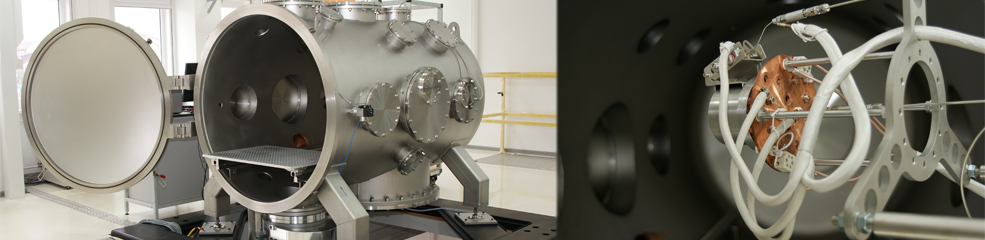
The IPPLM staff in cooperation with the University of Opole also participate in the launch of another measuring system to monitor the presence of light impurities in plasma - the so-called CO-monitor spectrometer. This is the second device designed and launched by the Polish team in cooperation with IPP in Greifswald.
The actual experimental campaign on the W7-X will start in the second half of November 2022.
The Wendelstein 7-X Stellarator is an experimental fusion reactor which was first launched in 2015. It is currently the largest device of this type in the world. This project aims to investigate the concept of magnetic plasma retention as an alternative to the tokamak.
 |
 |
|
| IPPLM and the University of Opole researchers | ||
 |
||
| PHA X-ray diagnostics | CO-monitor spectrometer |
Photo: © IPPLM


nsp_133.JPG)


nsp_133.JPG)


