





On 9 February 2022, the breakthrough in the efforts of researchers and engineers in the field of nuclear fusion was announced.
The research on fusion energy is carried out in Europe under the European Atomic Energy Community EUARTOM research and training programme by the EUROfusion consortium (www.euro-fusion.org) consisting of 30 research organizations from 25 European Union countries as well as Great Britain, Switzerland and Ukraine. Poland in the consortium is represented by the Institute of Plasma Physics and Laser Microfusion (IPPLM, www.ifpilm.pl), which has been authorized by the Minister of Education and Science to represent the Polish research community in this project and to coordinate all fusion research in Poland. For this purpose, the Scientific and Industrial Centre of New Energy Technologies (CeNTE, https://cente.ifpilm.pl) was established, gathering the research potential of many national institutions.
The largest operating system in the world able to carry out a controlled fusion reaction, working with a mixture of deuterium and tritium (D-T) fuel, is the JET (Joint European Torus) tokamak located in Culham, UK. During the last experimental campaign (DTE2), this device set a new record for fusion energy. In December 2021, 59 megajoules of energy were obtained in a steady state lasting 5 seconds, which as a result is almost three times higher than the previous record from 1997. In the very centre of the plasma, the temperature of 150 million degrees Celsius was obtained, which is ten times higher than the temperature in the heart of the Sun. Generating this energy required 0.17 milligrams of fusion fuel: about 0.1 mg of tritium and 0.07 mg of deuterium. By comparison, fossil fuels would require 10 million times as much fuel to produce the same amount of energy (1.06 kg of natural gas or 3.9 kg of lignite). The results obtained in JET are very promising in the perspective of further research on nuclear fusion in the new generation ITER tokamak, and then in the prototype fusion power plant DEMO.
 |
| Comparison of 1997 (DTE1) and 2021 (DTE2) fusion energy performance on the JET tokamak. Credit: EUROfusion consortium |
The achievement in question is the culmination of many years of research carried out by experts from Europe, including Poland, with the IPPLM, INP PAS, Opole University or NCNR. The researchers from the Institute of Plasma Physics and Laser Microfusion have been actively involved in this work since 2005. They focused on the preparation and optimization of operational scenarios and scenarios of the so-called plasma heating for the DT campaign and for ITER, an experimental reactor to be built in the south of France. IPPLM researchers specialize in the analysis and interpretation of experimental data recorded using various diagnostics. They studied the behaviour of plasma contaminants to control them and minimize their accumulation. They participated in the design and preparation of modern detectors for soft X-ray diagnostics in JET. In addition, IPPLM research staff participated in the measurement of fusion products, i.e. neutrons and fast helium ions, also known as alpha particles. In preparation for the DT campaign, they participated in the calibration of the neutron diagnostic system in JET for the energy of 14 MeV. Moreover, they performed numerous tomographic reconstructions of plasma radiation based on bolometric data. They also dealt with the development and application of numerical programs modelling physical processes in order to extrapolate the obtained results and predictions for the DT plasma and the ITER tokamak. Thanks to their extensive experience in plasma management, the IPPLM researchers also acted as the leader of the experimental session at JET.
The experience gained during the DTE2 experimental campaign is undoubtedly an important step on the way to obtain new energy sources. The record set is a breakthrough as it shows for the first time that it is possible to maintain a stable plasma and produce large amounts of fusion power using the same fuel mix that will be used in the international ITER experiment and in future fusion power plants.
 |
|
Record discharge No. 99 971 during the DTE2 experimental campaign. |
 |
| View of the hall with the JET tokamak. Credit: UKAEA
|
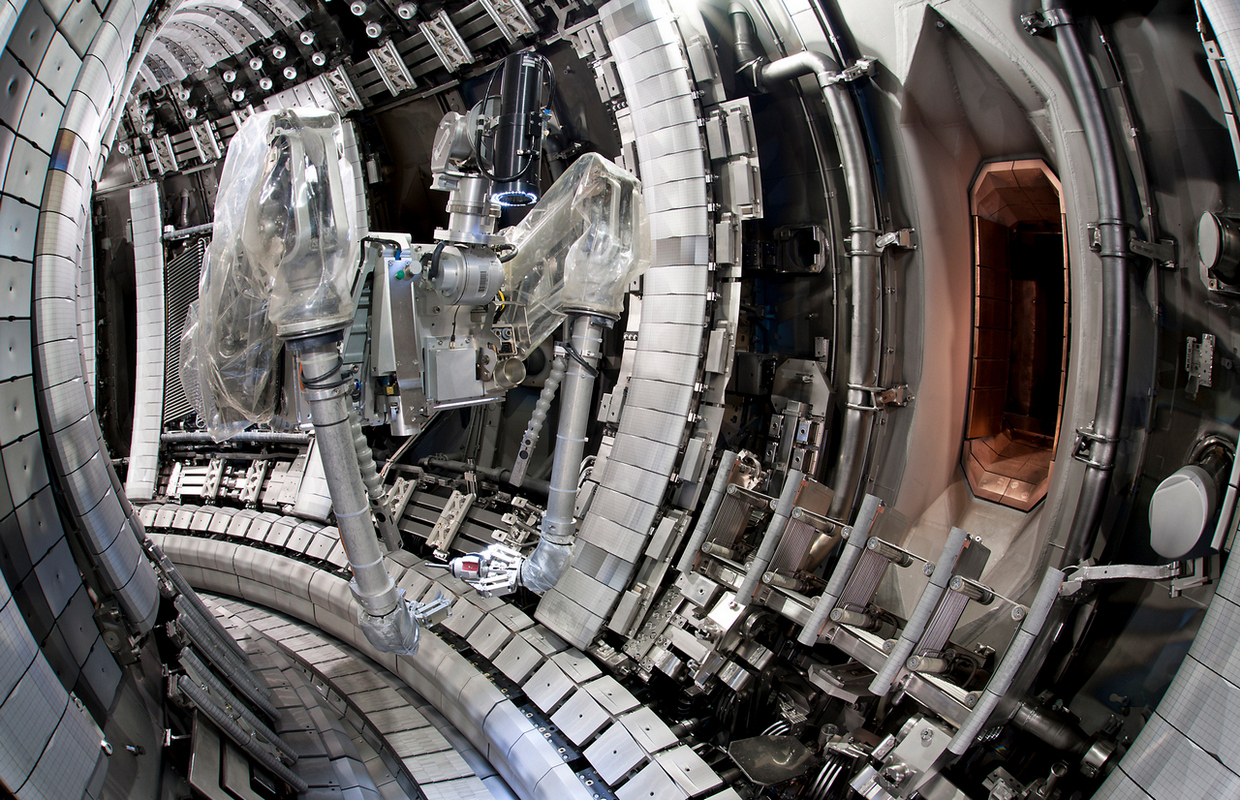 |
| Inside of a JET tokamak with remotely controlled devices. Credit: UKAEA
|
 |
| Control room. Credit: UKAEA |
 |
| Credit: UKAEA |
Source: IFPiLM, UKAEA, EUROfusion consortium


nsp_133.JPG)


nsp_133.JPG)


