



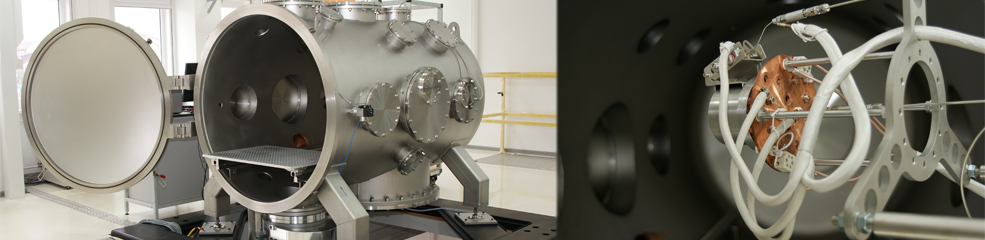


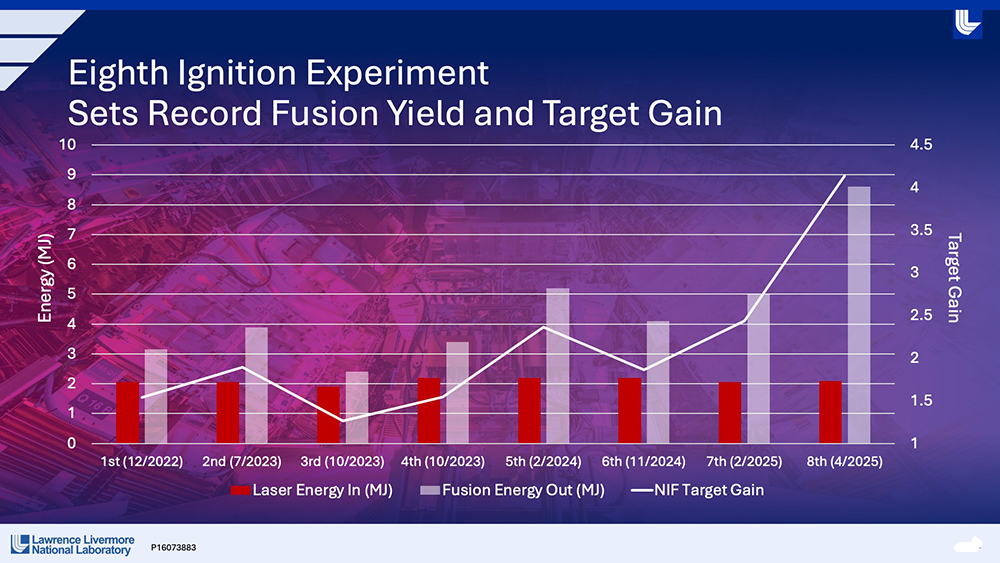
In December 2022, the National Ignition Facility (NIF) at Lawrence Livermore National Laboratory (USA) marked a historic milestone in fusion science: an experiment produced 3.15 MJ of fusion energy from 2.05 MJ of laser input – a gain factor (Q) of 1.54 – achieving scientific energy gain for the first time. This result demonstrated that the energy generated within the fusion target exceeded the energy delivered to it by the lasers, a condition also referred to as target gain.
Since then, NIF has repeatedly refined its techniques, achieving ignition seven times by early 2025. Notable experiments include:
- July 30, 2023: 2.05 MJ delivered yielded 3.88 MJ (Q≈1.89)
- October 8, 2023: ignition with 1.9 MJ input → 2.4 MJ output
- October 30, 2023: 2.2 MJ → 3.4 MJ
- February 12, 2024: 2.2 MJ → 5.2 MJ
- November 18, 2024: 2.2 MJ → 4.1 MJ
- February 23, 2025: 2.05 MJ → 5.0 MJ (Q≈2.44)
- April 7, 2025: record yield 8.6 MJ from 2.08 MJ (Q≈4.13)
These achievements stem from meticulous improvements in target design, laser pulse shaping, and hohlraum symmetry. Each experiment brings scientists closer to a self-sustaining plasma state, where alpha-particle heating dominates over energy losses – fulfilling a key condition for sustained fusion reactions.
 |
| Source: Lawrence Livermore National Laboratory, https://lasers.llnl.gov/science/achieving-fusion-ignition. Used under CC BY-NC-SA 4.0 license. |
What happens inside NIF?
NIF uses 192 precisely synchronized lasers aimed at a tiny capsule containing cryogenically cooled deuterium tritium fuel. The lasers heat the inner walls of a hohlraum to create a burst of X-rays. These X rays cause the outer shell of the capsule to rapidly expand, generating a powerful inward force that compresses the fuel to extreme densities and temperatures – hundreds of millions of degrees.
At the center of this implosion, a "hot spot" forms and fusion begins. The alpha particles produced deposit energy into the surrounding fuel, potentially creating a larger burning region. When the conditions are optimal – high enough density, temperature, and symmetry – the process results in ignition and scientific energy gain.
Why it matters?
Although these experiments do not yet produce net electricity – since the full energy input to the laser system still exceeds the fusion output – the fact that target gain has been achieved is a groundbreaking step. It validates the central principles of inertial confinement fusion (ICF) and provides a foundation for future technologies aimed at clean, abundant energy production.
In summary, NIF’s repeated ignition results represent a transition from proof-of-concept to reproducible fusion conditions. Each success advances our understanding of plasma physics and fusion science – and moves us closer to practical fusion energy.
More information on this topic is available at: https://lasers.llnl.gov/science/achieving-fusion-ignition
Source: https://lasers.llnl.gov/


