





Zestaw obrazów 2019
zdjecie1.jpg
zdjecie2.jpg
zdjecie3.jpg
zdjecie4.jpg
zdjecie5.jpg
zdjecie6.jpg
2019_1.JPG
2019_2.JPG
2019_4.JPG

Gallery

On 17 April 2025, a cooperation agreement was signed between the National Museum of Technology (NMT) and the Institute of Plasma Physics and Laser Microfusion (IPPLM).
The ceremonial meeting, attended by the IPPLM director Dr. hab. Monika Kubkowska, and the NMT director Mr. Mirosław Zientarzewski, took place at the Museum's headquarters in the Palace of Culture and Science in Warsaw. Representatives of both institutions also took part in the event.
The concluded agreement assumes cooperation in the field of scientific and exhibition activities as well as popularization, dissemination and promotion of knowledge in the field of physical sciences, in particular through:
– co-creation of educational, exhibition and popularization projects,
– development of competences in the field of development, cataloguing, storage and presentation of collections concerning plasma research, in particular its generation, diagnostics and application in broadly understood energy technology,
– presentation of the results of cooperation and dissemination of its results at conferences, congresses, exhibitions or other events.
The agreement was concluded for five years, until 16 April 2030, with the possibility of its extension.
After the end of the official part, the IPPLM employees had the opportunity to visit the exhibitions of the National Museum of Technology, which has in its collections over 15 thousand exhibits from fields such as physics, astronomy, mining, transport, computer science, and energy.
Photo: IPPLM
 On 24-25 March 2025, a Polish-French meeting was held at the headquarters of the Institute of Nuclear Physics of the Polish Academy of Sciences (IFJ PAN) and the French Institute in Krakow, the aim of which was to exchange experiences and develop scientific cooperation between institutions from Poland and France.
The meeting gathered representatives of prestigious research centres, including the Institute of Nuclear Physics of the Polish Academy of Sciences (IFJ PAN) in Krakow, CEA IRFM from Cadarache, AGH University of Science and Technology in Krakow (AGH), the Institute of Plasma Physics and Laser Microfusion in Warsaw (IFPILM), the National Centre for Nuclear Research (NCBJ) in Otwock and the Nicolaus Copernicus University in Toruń.
The meeting was attended by Dr. hab. Agata Chomiczewska and Dr. Piotr Chmielewski, who represented the Institute of Plasma Physics and Laser Microfusion. During the meeting, key issues related to cooperation in the field of research related to thermonuclear fusion were discussed. Participants exchanged experiences and determined the direction of the future joint research and development project.
The meeting was also an opportunity to strengthen relations between researchers and institutions that play a key role in research on modern energy technologies, including projects related to nuclear fusion and the development of plasma systems.
Photo: IPPLM
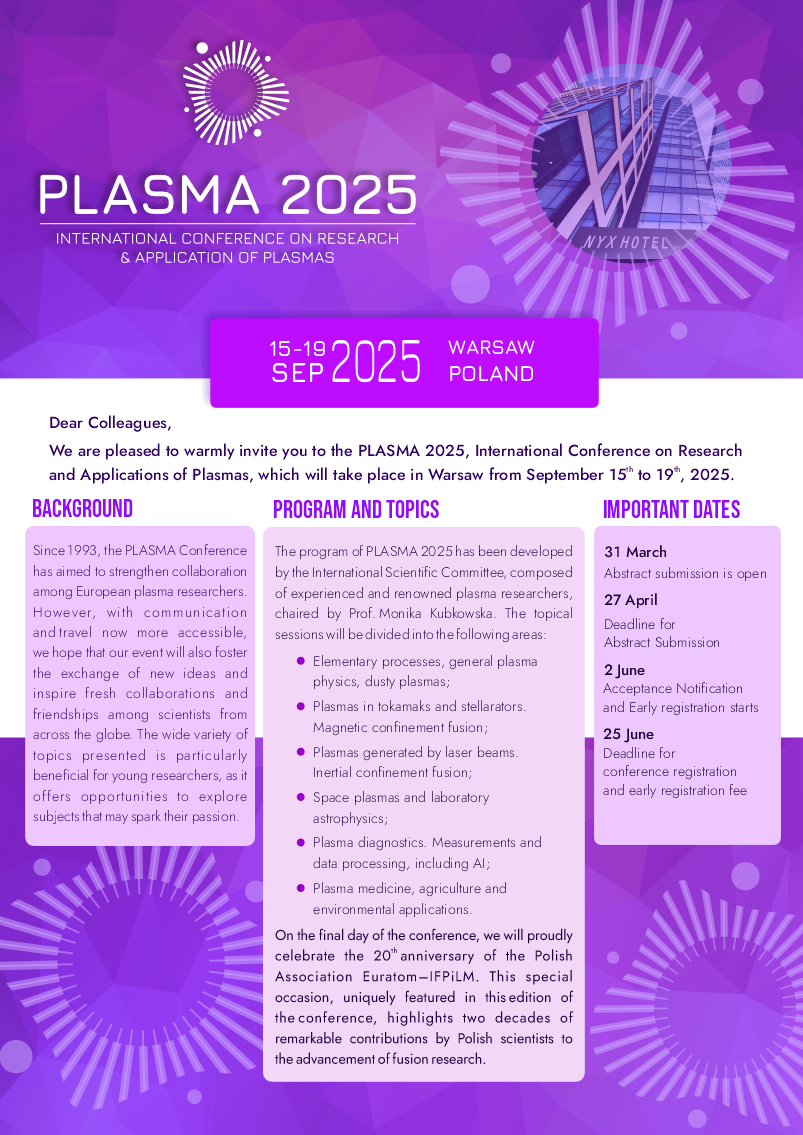
 The Institute of Plasma Physics and Laser Microfusion (IPPLM) invites you to attend the PLASMA 2025 – International Conference on Research and Application of Plasmas, which will be held from 15 until 19 September 2025 in Warsaw, Poland. This prestigious event, organized for over 30 years, attracts leading researchers from around the world and offers a unique opportunity for knowledge exchange and collaboration in the field of plasma physics.
A comprehensive scientific program
PLASMA 2025 will cover a wide range of topics, from fundamental plasma processes to advanced technologies and their practical applications. The planned thematic sessions include:
- Plasmas in tokamaks and stellarators. Magnetic confinement fusion.
- Plasmas generated by laser beams. Inertial confinement fusion.
- Space plasmas and laboratory astrophysics.
- Plasma diagnostics. Measurements and data processing, including AI.
- Plasma medicine, agriculture and environmental applications.
- Elementary processes, general plasma physics, dusty plasmas.
20th anniversary of the Polish Euratom-IPPLM Association
This year's edition of the conference will have a unique character - during the last day of the event, the 20th anniversary of the coordination of research on nuclear fusion and the establishment of the Polish Euratom-IPPLM Association will be celebrated. The program includes lectures and discussion panels with the participation of people who co-founded the Association, as well as leading representatives of the world of science and industry, involved in the research and development of technologies leading to the realization of nuclear fusion.
Important dates
- 31 March 2025 – Abstract submission is open
- 27 April 2025 – Deadline for abstract submission
- 2 June 2025 – Acceptance notification and early registration starts
- 25 June 2025 – Deadline for conference registration
Conference venue
The conference will take place at the NYX Hotel (71 Chmielna Street), located in the heart of Warsaw. Its convenient location will allow participants to easily explore both the historical and modern sides of the capital.
Official Conference Website
All information about the event can be found at: plasma2025.ipplm.pl/
The official language of the conference is English.
Below is the First Announcement PLASMA 2025, also available for download in PDF format.

On February 10–21, 2025, an experimental session was held in the Plasma-Focus PF-1000U laboratory, in which, in addition to the IPPLM team, a three-person team of researchers from the Prague University of Technology (ČVUT), led by Prof. Pavel Kubes. The research program of the session, which was a continuation of the activities of the International Centre for Dense Magnetized Plasmas (ICDMP), included the implementation of two basic tasks:
- Analysis of the characteristics of neutron pulses recorded simultaneously by three neutron probes (system: scintillator + photomultiplier + oscilloscope), placed at a distance of 7 meters from the plasma focus, at an angle of 0, 90 and 180 degrees to the axis of the system. The use of a 16-frame laser interferometer in each discharge made it possible to link the characteristics of neutron pulses with the time evolution of the plasma electron density distributions.
- Testing a prototype of a unique laser polaro-interferometer, allowing for simultaneous registration of the plasma electron density distribution and the poloidal component of the magnetic field.
The obtained results are currently being analysed by a Polish-Czech team of researchers with a view to taking them into account when developing a model of neutron emission from Plasma-Focus generators. Additionally, the positive result of the laser polaro-interferometer tests will be an important argument in the Czech-Polish grant application being prepared (OPUS/Weave), regarding the similarities in the formation and breakdown of self-aligned plasma-magnetic field structures in laser plasma and Z-Pinch (Plasma-Focus) systems.
 |
 |
 |
 |
| A team of Polish-Czech researchers during an experimental session in the PF-1000U laboratory. | |
Photos: © IFPiLM
Scientists and engineers from eight nations, including Poland, have carried out a project using lasers on the Joint European Torus (JET) to study fusion fuel retention.
Laser Induced Breakdown Spectroscopy (LIBS), an analytical technique that uses a high-powered laser to measure the composition of a material, was deployed using a remotely operated robotics system on JET.
Initial use of the LIBS system detected JET’s fuel mix of tritium and deuterium on the tokamak’s plasma-facing components.
JET provides an ideal engineering and diagnostic testbed for developing technologies to manage tritium inventories in future power plants.
“The experiment was the culmination of several years of efforts to create a method for measuring fuel retention and the accumulation of impurities in the walls of thermonuclear reactors such as ITER. The Institute of Plasma Physics and Laser Microfusion has played an important role in this research from the beginning, which will now focus on developing artificial intelligence models to analyse the LIBS measurements in real time. Due to the numerous unknown factors related to the operation of future fusion power plants, this is certainly a big challenge, but when we started working with LIBS over a decade ago, the successes now achieved at JET seemed no less significant," said Dr. Paweł Gąsior from the Department of Fusion Plasma Research at the IPPLM.
In addition to Polish researchers, teams from Finland, Germany, Italy, Estonia, Latvia, Slovakia and Great Britain also took part in the international cooperation. These countries belong to EUROfusion, a consortium engaged in the research and development of fusion energy.
The project partners include:
- ENEA, Italian National Agency for New Technologies, Energy and Sustainable Economic Development (Italy)
- Forschungszentrum Jülich (Germany)
- VTT Technical Research Centre of Finland Ltd
- United Kingdom Atomic Energy Authority
The work was also supported by:
- Comenius University of Bratislava (Slovakia)
- Institute of Plasma Physics Laser Microfusion, IPPLM (Poland)
- Institute of Solid State Physics, University of Latvia
- University of Tartu (Estonia)
 |
 |
 |
 |
| LIBS on JET, Credit: UKAEA | |
How LIBS technology works
Jari Likonen, Principal Scientist at VTT, explained: “LIBS works by firing a laser beam rapidly at the surface of a tile or component. This generates a small plasma containing atoms, ions and free electrons which emit light that is in turn measured by a spectrometer.”
The LIBS technique is already widely used in industry sectors that involve challenging environments for humans and require rapid, comprehensive chemical analysis at the atomic level. Applications include geological analysis in space exploration, diagnostics of archaeological artifacts, and the study of metal diffusion in solar photovoltaic cells.
For its deployment on JET, modifications were made to adapt the LIBS technology to the facility’s vacuum pressured, donut ringed shaped environment. Salvatore Almaviva, Researcher for Laser-Based Metrology at ENEA, Italian National Agency for New Technologies, Energy and Sustainable Economic Development in Italy, said: “The technology was made compact, lightweight, reliable and robust to perform hundreds of measurements in JET.
The LIBS sensor was mounted on MASCOT, JET’s remotely operated robotic system designed for maintenance, repair and diagnostics tasks within its radioactive environment. Almaviva added, “With a single laser shot, the sensors aim to detect all the chemical elements present in the tile or component being analysed and, within limits, their isotopes.”
Rahul Rayaprolu, from Forschungszentrum Jülich (FZJ) in Germany, elaborated on the data collection process: “The LIBS unit transfers the collected light through a 20-metre-long optical fibre into four high-resolution spectrometers for spectral analysis. One spectrometer provides detailed insights into retained fuel, while a compact broad-range spectrometer simultaneously captures and records the overall spectral overview.”
Ionut Jepu, Materials Research Scientists at the UK Atomic Energy Authority, highlighted the importance of the facility: “JET offers the perfect testbed. Following its recent deuterium-tritium experiments, important measurements of tritium were attempted[GU2] within its tiles and components while reducing the hazard to humans and minimising any shutdown time.”
Over 800 locations within JET’s inner vessel were exposed to the LIBS system. Further details of the project’s results will be presented at the 20th International Conference on Plasma-Facing Materials and Components for Fusion Applications to be held in May 2025 in Slovenia.
The collaborative effort demonstrates the potential for future joint initiatives in the design, safety and operational efficiency of technologies for future fusion machines and exploring fuel retention management.
Source: EUROfusion


nsp_133.JPG)


nsp_133.JPG)


 |
 |
 |
 |
 |
 |
 |
 |
Media


Research projects carried out at the IPPLM are funded by the Polish Ministry of Education and Science, the National Science Centre and by the European Commission within the framework of EUROfusion Consortium under grant agreement No 101052200. Financial support comes also from the International Atomic Energy Agency, European Space Agency and LaserLab Consortium as well as from the Fusion for Energy Agency.