



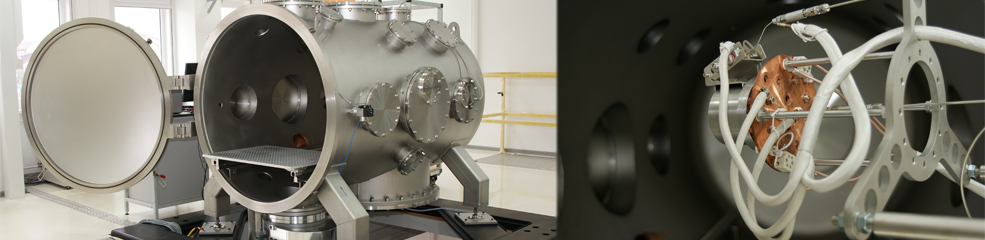


On February 10–21, 2025, an experimental session was held in the Plasma-Focus PF-1000U laboratory, in which, in addition to the IPPLM team, a three-person team of researchers from the Prague University of Technology (ČVUT), led by Prof. Pavel Kubes. The research program of the session, which was a continuation of the activities of the International Centre for Dense Magnetized Plasmas (ICDMP), included the implementation of two basic tasks:
- Analysis of the characteristics of neutron pulses recorded simultaneously by three neutron probes (system: scintillator + photomultiplier + oscilloscope), placed at a distance of 7 meters from the plasma focus, at an angle of 0, 90 and 180 degrees to the axis of the system. The use of a 16-frame laser interferometer in each discharge made it possible to link the characteristics of neutron pulses with the time evolution of the plasma electron density distributions.
- Testing a prototype of a unique laser polaro-interferometer, allowing for simultaneous registration of the plasma electron density distribution and the poloidal component of the magnetic field.
The obtained results are currently being analysed by a Polish-Czech team of researchers with a view to taking them into account when developing a model of neutron emission from Plasma-Focus generators. Additionally, the positive result of the laser polaro-interferometer tests will be an important argument in the Czech-Polish grant application being prepared (OPUS/Weave), regarding the similarities in the formation and breakdown of self-aligned plasma-magnetic field structures in laser plasma and Z-Pinch (Plasma-Focus) systems.
 |
 |
 |
 |
| A team of Polish-Czech researchers during an experimental session in the PF-1000U laboratory. | |
Photos: © IFPiLM


nsp_133.JPG)


nsp_133.JPG)


