





Zestaw obrazów 2019
zdjecie1.jpg
zdjecie2.jpg
zdjecie3.jpg
zdjecie4.jpg
zdjecie5.jpg
zdjecie6.jpg
2019_1.JPG
2019_2.JPG
2019_4.JPG

Gallery
 The US Department of Energy (DOE) has announced the launch of INFUSE, a program created to encourage partnerships in fusion research between industry and DOE national laboratories.
The Innovation Network for Fusion Energy (INFUSE) will select a number of projects for awards between $50,000 and $200,000 each, with a 20 percent project cost share for industry partners. Of particular focus will be "enabling technologies" that could contribute to accelerating the development of fusion energy such as new and improved superconducting magnets, materials science, diagnostics, modelling and simulation, and experimental capabilities.
DOE's Oak Ridge National Laboratory (ORNL) will manage the new program with the Princeton Plasma Physics Laboratory (PPPL). ORNL's Dennis Youchison, a fusion engineer with extensive experience in plasma-facing components, will serve as director, and PPPL's Ahmed Diallo, a physicist with expertise in laser diagnostics, will serve as deputy director.
"I am excited about the potential of INFUSE and believe this step will instill a new vitality to the entire fusion community," says Youchison in the DOE press release. "With growing interest in developing cost-effective sources of fusion energy, INFUSE will help focus current research. Multiple private companies in the United States are pursuing fusion energy systems, and we want to contribute scientific solutions that help make fusion a reality."
The first call for proposals has been issued (deadline 30 June).
See the 4 June press release and the INFUSE website.
Source: www.iter.org
Over 100 million degrees.
Experimental Advanced Superconducting Tokamak (EAST), nicknamed Chinese artificial sun, has achieved over 100 million degrees electron temperature in the core plasma in its 2018 four-month-long experiment campaign.
Collaborating with domestic and international colleagues, EAST team in Hefei Institutes of Physical Science, Chinese Academy of Sciences (CASHIPS) made significant progress along the China’s roadmap towards tokamak based fusion energy production.
By effectively integration and synergy of four kinds of heating power, namely, lower hybrid wave heating, electron cyclotron wave heating, ion cyclotron resonance heating and neutral beam ion heating, the plasma current density profile was optimized.
The power injection exceeded 10MW, and plasma stored energy boosted to 300 kJ after scientists optimized the coupling of different heating techniques, and utilized advanced plasma control, theory/simulation prediction. The electron temperature of the core plasma increased beyond 100 million degrees.
Scientists carried out the experiments on plasma equilibrium and instability, confinement and transport, plasma-wall interaction and energetic particle physics to demonstrate the long time scale steady-state H-mode operation with good control of impurity, core/edge MHD stability, heat exhaust using an ITER-like tungsten divertor.
With the ITER-like operation conditions such as radio frequency wave dominant heating, lower torque, water-cooling tungsten divertor, EAST achieved fully non-inductive steady-state scenario with high confinement, high density and high energy confinement enhanced factor.
Meanwhile, to resolve the particle and power exhaust which is of crucial importance for high performance steady state operation, EAST team has employed many techniques in controlling the edge localized modes and tungsten impurity in ITER-like operation conditions, along with active feedback control of divertor heat load.
The operation scenarios of steady-state high performance H-mode and reactor-level electron temperature over 100 million degrees on EAST offer unique contributions toward ITER, Chinese Fusion Engineering Test Reactor (CFETR) and DEMO.
These results provide key data for validation of heat exhaust, transport and current drive models, and enhance confidence in the fusion performance predictions for CFETR.
At present, CFETR physics design focuses on optimization of a third-evolution machine with large radium at 7 m, minor radium 2 m, toroildal magnet field at 6.5-7 Tesla and plasma current 13 MA.
In support of the engineering development of CFETR and a future DEMO, a new National Mega Science Project -- Comprehensive Research Facility will be launched at the end of this year.
This new project will advance the development of tritium blanket test modules, superconducting technology, reactor relevant heating and current drive actuators and sources, and divertor materials.
EAST is the first fully superconducting tokamak with non-circular cross section in the world, designed and constructed by China aiming at key science issues for the application of fusion power. Since its virgin operation in 2006, EAST has become a fully open test facility for world fusion community to conduct steady-state operation and ITER-related physics researches.
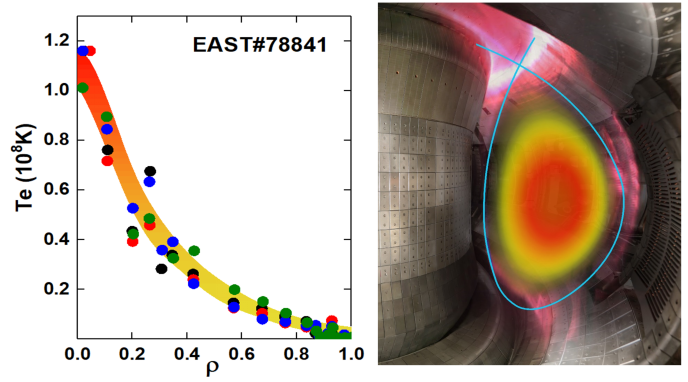
Fig. 1 The plasma electron temperature over 100 million degrees achieved in 2018 on EAST. (Image by the EAST Team)

Fig. 2 The extension of EAST operation scenario in 2018, with the comparion of its energy confinement enhanced
factor to the ITER baseline scenario. (Image by the EAST Team)
Contact: ZHOU Shu, Hefei Institutes of Physical Science
Source: english.hf.cas.cn

When it comes to the kinds of technology needed to contain a sun, there are currently just two horses in the race. Neither is what you'd call 'petite'.
An earlier form of fusion technology that barely made it out of the starting blocks has just overcome a serious hurdle. It's got a long way to catch up, but given its potential cost and versatility, a table-sized fusion device like this is worth watching out for.
While many have long given up on an early form of plasma confinement called the Z-pinch as a feasible way to generate power, researchers at the University of Washington in the US have continued to look for a way to overcome its shortcomings.
Fusion power relies on clouds of charged particles you can squeeze the literal daylights out of - it's the reaction that powers that big ball of hot gas we call the Sun.
But containing a buzzing mix of superhot ions is extremely challenging - in the lab, scientists use intense magnetic fields for this task. Tokamaks like China's Experimental Advanced Superconducting Tokamak reactor swirl their insanely hot plasma in such a way that they generate their own internal magnetic fields, helping contain the flow.
This approach gets the plasma cooking enough for it to release a critical amount of energy. But what it gains in generating heat it loses in long-term stability.
Stellerators like Germany's Wendelstein 7-X, on the other hand, rely more heavily on banks of externally applied magnetic fields. While this makes for better control over the plasma, it also makes it harder to reach the temperatures needed for fusion to occur.
Both are making serious headway in our march towards fusion power. But those doughnuts holding the plasma are at least a few metres (a dozen feet) across, surrounded by complex banks of delicate electronics, making it unlikely we'll see them shrink to a home or mobile version any time soon.
In the early days of fusion research, a somewhat simpler method for squeezing a jet of plasma was to 'pinch' it through a magnetic field.
A relatively small device known as a zeta or 'Z'-pinch uses the specific orientation of a plasma's internal magnetic field to apply what's known as the Lorentz force to the flow of particles, effectively forcing its particles together through a bottleneck.
In some sense, the device isn't unlike a miniature version of its tokamak big brother. As such, it also suffers from similar stability issues that can cause its plasma to jump from the magnetic tracks and crash into the sides of its container.
In fact, iterations of the Z-pinch led to the chunky tokamak technology that superseded it. Given this major limitation, the Z-pinch has all but become a relic of history.
Hope remains that by going back to the roots of fusion, researchers might find a way to generate power without the need for complicated banks of surrounding machinery and magnets.
Now, researchers from the University of Washington have found an alternative approach to stabilising the plasma in a Z-pinch not only works, but it can be used to generate a burst of fusion.
To prevent the distortions in the plasma that cause it to escape the confines of its magnetic cage, the team manages the flow of the particles by applying a bit of fluid dynamics.
Introducing what is known as sheared axial flow to a short column of plasma has previously been studied as a potential way to improve stability in a Z-pinch, to rather limited effect.
Not to be deterred, physicists relied on computer simulations to show the concept was possible.
Using a mix of 20 percent deuterium and 80 percent hydrogen, the team managed to hold stable a 50 centimetre (1.6 foot) long column of plasma enough to achieve fusion, evidenced by a signature generation of neutrons being emitted.
We're only talking 5 microseconds worth of neutrons here, so don't clear space in your basement for your Z-Pinch 3000 Home Fusion Box quite yet. But the stability was 5,000 times longer than you'd expect without such a method being used, showing the principle is ripe for further study.
Generating clean, abundant fusion energy is still a dream we're all holding onto. A new approach to a less complex form of plasma technology could help remove at least some of the obstacles, if not prove to be a cheaper, more compact source of clean power in its own right.
The race towards the horizon of limitless energy production is only just warming up, folks. And it really can't come soon enough.
This research was published in Physical Review Letters.
MIKE MCRAE
Source: Sciencealert.com
Photo: Image by kai kalhh from Pixabay
 The future of the world’s largest operational fusion research facility has been secured with a new contract signed between the UK and the European Commission.
A contract extension for the world’s largest fusion research facility, Joint European Torus, has been signed by the UK and the European Commission
The contract extension will secure at least €100m in additional inward investment from the EU over the next two years.
The news brings reassurance for the more than 500 staff at site in Culham, near Oxford.
Staff at the Joint European Torus (JET) facility in Oxfordshire undertake research in the latest technologies aimed at providing clean, safe, inexhaustible energy. The new contract guarantees its operations until the end of 2020 regardless of the EU Exit situation, and secures at least €100m in additional inward investment from the EU over the next two years.
Science Minister Chris Skidmore said:
"Having made my first speech at Culham, I know how hardworking and dedicated UK Atomic Energy Authority staff are, which is why I’m pleased to announce today’s agreement, which is great news for the future of scientific research in Oxfordshire, the UK and Europe.
Extending this contract means cutting-edge and world-leading fusion research can continue in this country, which I know will be a welcome reassurance to the hundreds of workers at Culham.
Science has no borders and as we leave the EU, this kind of international collaboration remains at the heart of our modern Industrial Strategy to maintain the UK’s position as a world leader in research and innovation".
JET is operated by the UK Atomic Energy Authority at Culham Science Centre, near Oxford. Scientists from 28 European countries use it to conduct research into the potential for carbon-free fusion energy in the future, through work coordinated by the EUROfusion consortium which manages and funds European fusion research activities on behalf of Euratom.
The future of the facility has been under discussion since 2017, as its work is covered by the Euratom Treaty, which the UK Government intends to leave as part of the process of leaving the EU.
This new contract provides reassurance for over 500 staff at JET, including many from outside the UK. It also means JET can conduct a series of vital fusion tests planned for 2020. These tests will serve as a ‘dress rehearsal’ for the new international experimental fusion reactor, ITER, currently being built in southern France.
Prof Ian Chapman, CEO of the UK Atomic Energy Authority, said:
"The extension to the contract is excellent news for both EU and UK science. JET has been a shining example of scientific co-operation between EU members, and this news means that these mutually beneficial collaborations will continue, allowing us to do essential experiments on the path to delivering fusion power".
Prof Tony Donné, Programme Manager of EUROfusion, added:
"A heavy weight has been lifted off our shoulders. This is extraordinarily good news for EUROfusion and the European fusion community as a whole. We can now continue to work on the realisation of fusion energy together with the indispensable experience of our British partner".
Contacts:
Howard Wheeler, Department for Business, Energy & Industrial Strategy, This email address is being protected from spambots. You need JavaScript enabled to view it. / 0207 215 2748
Nick Holloway, United Kingdom Atomic Energy Authority, This email address is being protected from spambots. You need JavaScript enabled to view it. / 01235 466232
Notes to Editors
Fusion energy research
Fusion research aims to copy the process which powers the Sun for a new large-scale source of clean energy here on Earth. When light atomic nuclei fuse together to form heavier ones, a large amount of energy is released. To do this, fuel is heated to extreme temperatures, hotter than the centre of the Sun, forming a plasma in which fusion reactions take place. A commercial power station will use the energy produced by fusion reactions to generate electricity.
Nuclear fusion has huge potential as a long-term energy source that is environmentally responsible (with no carbon emissions) and inherently safe, with abundant and widespread fuel resources (the raw materials are found in seawater and the Earth’s crust).
Researchers at Culham are developing a type of fusion reactor known as a ‘tokamak’ – a magnetic chamber in which plasma is heated and controlled. The research is focused on preparing for the international tokamak experiment ITER, now being built in southern France. ITER – due to start up in 2025 – is designed to show that fusion can work on the scale of a power plant, and if successful should lead to electricity from fusion being on the grid by around 2050.
Joint European Torus (JET)
The Joint European Torus, based at Culham Science Centre, UK, is the central research facility of the European fusion programme. It is the largest and most powerful fusion experiment in the world. JET is collectively used under EUROfusion management by more than 40 European laboratories. JET was the first fusion device to perform controlled nuclear fusion (in 1991), holds the world record for fusion power and is the only tokamak that can test the fusion fuel mix (deuterium and tritium – two isotopes of hydrogen) expected to be used in commercial reactors. Today, its primary task is to prepare for the construction and operation of ITER, acting as a test bed for ITER technologies and plasma operating scenarios.
UK Atomic Energy Authority (UKAEA)
The UK Atomic Energy Authority carries out fusion energy research on behalf of the UK Government at Culham Science Centre near Abingdon. It is also developing Culham as a location of hi-tech research and business, with around 40 tenant companies now on site.
UKAEA oversees Britain’s fusion programme, headed by the MAST Upgrade (Mega Amp Spherical Tokamak) experiment. It also hosts the world’s largest fusion research facility, JET (Joint European Torus), which it operates for European scientists under a contract with the European Commission. Website: www.gov.uk/ukaea Twitter: @fusionenergy
EUROfusion
EUROfusion’s mission is to pave the way for fusion power reactors.
Currently, 30 research organisations and universities from 26 European Union member states plus Switzerland and Ukraine are part of the consortium. In addition, well over 150 universities contribute to the programme. The Consortium has received funding from the Euratom research and training programme 2014-2018 and 2019-2020 under grant agreement No 633053.
Website: www.euro-fusion.org Twitter: @fusionincloseup
Source: www.gov.uk
Photo: JET internal vessel view; Source: EUROfusion; Photographer: Christopher Roux (CEA-IRFM); CC BY 4.0 licence
 The Budgetary Control Committee of the European Parliament, chaired by German MEP Ingeborg Graessle, organized a public hearing on the added value of EU funding on 21 January 2019. The hearing was moderated by its Vice-Chair, Czech MEP Martina Dlabajova who is also the rapporteur in the current discharge procedure of EU agencies and joint undertakings (including F4E) for the 2017 budget. In the framework of the competitiveness panel of the hearing, MEP Dlabajova invited the F4E Director to report on success stories that the EU contribution to the ITER project brings to many European companies and research centres involved in the manufacturing of the high-tech components for this big science project.
Johannes Schwemmer, F4E Director, kicked off the panel discussion with a short presentation on fusion and its benefits, and presented the international partnership to build ITER, one of the largest high-technology projects in modern history. The F4E Director explained the role of F4E, as the domestic agency for ITER, and highlighted the different projects underway to make fusion energy a reality.
Massimo Garribba, Director at the Commission’s Directorate-General for Energy, picked up the torch to underline the key role of ITER in the European roadmap for the realization of fusion energy and the important milestone of 60% completion of the project in its drive to reach first plasma by the end of 2025. The Commission director insisted on the significant economic impact of ITER which over the period of 2008-2017 has produced almost 4,8 billion euro in Gross Value Added and almost 34,000 job years, through awarding over 900 contracts and grants in 24 EU countries worth 4,5 billion Euro. European companies report that working on ITER generates a new knowledge base, offers new business opportunities and increases their competitiveness and growth, helping to create additional jobs.
In order to highlight the role of EU industry in the construction of ITER and the benefits arising from their participation in such an international endeavour, two representatives shared their experiences.
Prof. C.J.M. Heemskerk from HiT, a small company in the Netherlands, presented an unexpected but important spin-off generated during the development of the remoting handling systems for the maintenance of ITER, which will be needed once the reactor becomes operational. The R&D in this area has led to a prototype robot ROSE (Remotely Operated SErvice Robot) providing home care support for elderly people and those in need. Prof. Heemskerk added that their involvement in ITER has given the company “an exposure to an international community” and has strengthened their competitiveness as “we have to be on our (their) toes” to fend off potential competitors around the world. In addition, the company has managed to gain contracts from international clients which would have not been possible “without our involvement in ITER”.
Giovanni Grasso from ASG Superconductors, an Italian company specialized in superconducting magnet technology has worked for many big science organizations such as CERN and ITER. The superconducting technology which has been developed over the years for fusion has led to a number of spin-offs in sectors such as health (magnetic resonance scanners and health therapies). The most recent important spin-off from the ITER work consists of a superconducting cable which may be used for energy transmissions over last distances across Europe.
In the discussion that followed, a number of MEPs took the floor to highlight the benefits for European industry arising from their participation to the project. Italian MEP Flavio Zanonato underlined the important industrial investment realized in Padova in building a Neutral Beam Test facility to develop the most challenging heating system for ITER.
In concluding the competitiveness panel of the European added value hearing, MEP Dlabajová thanked the participants and highlighted “the real and tangible added value” coming from the EU support of the ITER project.
Source: Fusion for Energy
Photo: Credit © ITER Organization, http://www.iter.org/


nsp_133.JPG)


nsp_133.JPG)


 |
 |
 |
 |
 |
 |
 |
 |
Media


Research projects carried out at the IPPLM are funded by the Polish Ministry of Education and Science, the National Science Centre and by the European Commission within the framework of EUROfusion Consortium under grant agreement No 101052200. Financial support comes also from the International Atomic Energy Agency, European Space Agency and LaserLab Consortium as well as from the Fusion for Energy Agency.