





Zestaw obrazów 2019
zdjecie1.jpg
zdjecie2.jpg
zdjecie3.jpg
zdjecie4.jpg
zdjecie5.jpg
zdjecie6.jpg
2019_1.JPG
2019_2.JPG
2019_4.JPG

Gallery
 A recent article in the online journal Nature Communications confirms that the complex topology of the magnetic field of Wendelstein 7-X—the world's largest stellarator—is highly accurate, with deviations from design configuration measured at fewer than 1-in-100,000.
In the complex shape of a stellarator, high engineering accuracy is needed because even the smallest magnetic field errors can have a large effect on the magnetic surfaces and the confinement of the plasma.

After having completed the insulation of ITER’s first-ever winding pack, the inner core of the massive Toroidal Field coils which will magnetically confine the hot plasma, the stage of resin impregnation followed. Technically speaking this has been one of the most delicate operations to be performed on the most complex magnet to date. For Alessandro Bonito-Oliva, F4E’s Project Manager for Magnets, his team and their suppliers, this is an important achievement underpinned by the collective commitment to deliver on time, plan carefully and be sufficiently flexible to adapt to the engineering challenges along the way.
A team of ten technicians worked relentlessly to get the magnet ready for this important manufacturing milestone. First, they had to apply the impregnation mould all over the surface of the 14 m high, 9 m wide and 1 m thick magnet. It has taken an entire week to cover its surface with pads in order to make sure that the resin injected during impregnation would flow in an even and controlled manner. Next, the magnet was enclosed in a layer of stainless steel sheets and clamped by heating plates to create a solid shell. Approximately 100 clamps, tightened one by one, sandwiched the magnet to compact the electrical insulation at the right level. Welding of the stainless steel sheets came next, and after having completed this step, the leak and electrical tests were carried out.
The successful completion of the works paved the way for the impregnation process. What were the main elements of this step? First, the component needed to be heat-dried in vacuum at 110 ˚C to eliminate any vapor or humidity trapped in the insulation. Second, with the mould under vacuum, resin was injected from the bottom of the magnet to fill in any gap, and pressure of approximately 3,5 atmospheres was applied to ensure complete filling of the mould. Finally, the winding pack went through a curing cycle, at temperatures reaching 155 ˚C during five days, before extracting the impregnated magnet from the mould.
After having completed this step, dimensional checks were carried out together with laser scans to examine the state of the component. In order to protect the component in operation a special conductive paint was applied all over its surface. So what works are currently ongoing? Magnetic measurements, checking the geometrical compliance of the magnet, are being performed. The mechanical works for the electrical joints are advancing together with the external helium piping, which is going to channel the cold helium in the coil, and the high voltage wire connection.
And what will come next? Paschen tests, considered as the most demanding electrical conditions because even a tiny insulation defect would cause failure, and last but not least, leak tests to assess the vacuum tightness. When this cycle of activities is completed then the winding pack will be transported to SIMIC to go through a series of cold tests and be inserted in its coil case.
Source: F4E
 South Korea's state-run laboratory said Wednesday that it has successfully developed a technology for the mass production of tritium for nuclear fusion energy.
The technology allows the annual production of more than 50 kilograms of tritium, which is one of two core fuels used for nuclear fusion energy, according to the National Fusion Research Institute (NFRI). Another fuel, called deuterium, is naturally abundant while tritium can only be produced artificially.
This is the first time the mass production of the material will be possible. The NFRI said the technology would gradually decrease the cost needed to import tritium which costs about 30 million won (US$26,700) per one kilogram.
The tritium is needed for the International Thermonuclear Experimental Reactor (ITER) project under way in France, the NFRI said.
The US$20 billion project is an experimental reactor currently being built in Cadarache, France, to see if a super-hot plasma field can be used to create an artificial sun on Earth. If the experiment is successful, it could provide mankind with a limitless energy source. "South Korea can now produce the tritium needed for the ITER project instead of importing it," said Kim Ki-man, chief of the NFRI. The project is being participated by South Korea, the European Union, Japan and China, the NFRI said.
The NFRI also forecast that it can export tritium to countries conducting experiments on nuclear fusion energy.
The findings will be published in Fusion Engineering and Design, a monthly nuclear fusion journal, in November.
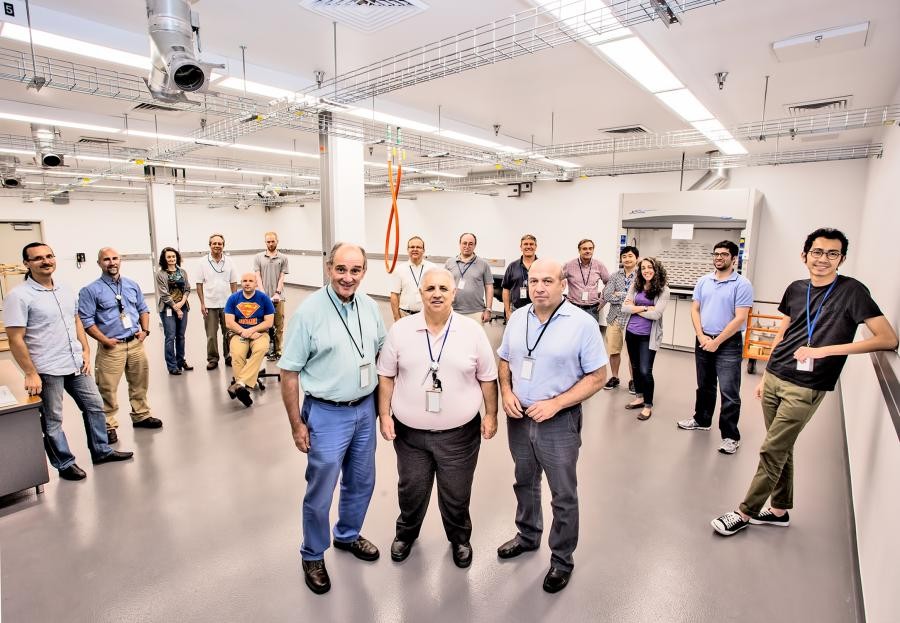 Plasma—the hot ionized gas that fuels fusion reactions—can also create super-small particles used in everything from pharmaceuticals to tennis racquets. These nanoparticles, which measure billionths of a metre in size, can revolutionize fields from electronics to energy supply ... but scientists must first determine how best to produce them.
After more than two years of planning and construction, the U.S. Department of Energy's Princeton Plasma Physics Laboratory (PPPL) has commissioned a major new facility to explore ways to optimize plasma for the production of such particles. The collaborative facility, called the Laboratory for Plasma Nanosynthesis, is nearly three times the size of the original nanolab, which remains in operation, and launches a new era in PPPL research on plasma nanosynthesis. Experiments and simulations that could lead to new methods for creating high-quality nanomaterials at relatively low cost can now proceed at an accelerated pace.
Nanomaterials exhibit remarkable strength, flexibility and electrical conductivity. Carbon nanotubes, found in sporting goods, body armor, transistors and countless other products, are tens of thousands of times thinner than a human hair and stronger than steel on an ounce-for-ounce basis.
Plasma could serve as an ideal substance for synthesizing, or producing, nanomaterial. The new laboratory will study so-called low-temperature plasmas that are tens of thousands degrees hot, compared with fusion plasmas that are hotter than the 15-million-degree core of the sun. These low-temperature plasmas contain atoms and free-floating electrons and atomic nuclei, or ions, that can be shaped by magnetic fields to provide reliable, predictable and low-cost synthesis of tailored nanoparticles.
Source: ITER/PPPL
 Iran is hoping to join an international project in southern France that aims to build the first machine to generate significant amounts of energy using nuclear fusion, which is considered a clean, safe and virtually limitless form of nuclear power.
Laban Coblentz, spokesman for the ITER project, said a high-level Iranian delegation led by nuclear chief Ali Akbar Salehi and Vice President for Science and Technology Sorena Sattari visited St. Paul Lez Durance on June 30-July 1, where the fusion device is being built. Coblentz said fusion-generated nuclear power has no significant weapons applications.
Salehi was quoted by the Mehr news agency as telling reporters on Wednesday that during the visit “we discussed possibilities of Iran’s joining to ITER, and the other members welcomed a prospective Iran membership.”
Nuclear fusion, which joins atoms together, is the process that powers the sun and stars, and “harnessing fusion’s power is the goal of ITER,” according to its website. The project “has been designed as the key experimental step between today’s fusion research machines and tomorrow’s fusion power plants.”
Coblentz said in a telephone interview and email exchanges with The Associated Press this week that the six world powers who signed last summer’s nuclear deal with Iran to rein in its nuclear program — the US, Russia, China, Britain, France and Germany — encouraged Tehran’s participation in the ITER project.
The six powers believe that Iran wanted to use its nuclear reactors — which are based on fission where atoms are split — to produce uranium for nuclear weapons, which Tehran denies.
An annex to the nuclear agreement on Civil Nuclear Cooperation says the six powers and Iran can “explore cooperation” on an Iranian contribution to the ITER project
Coblentz said the Iranians are “very eager to get moving” and join the 35 countries collaborating on building the world’s largest experimental fusion machine called a tokamak.
Iran has not made a formal application and new members must be approved unanimously by the ITER council which also includes India, South Korea and Japan who were not part of the Iran nuclear deal, he said.
“But the ITER Charter makes it clear that ITER is a project open to any country that is prepared to have meaningful participation,” both technological and financial, Coblentz said.
He said “it was clear from statements that Iran made that they view themselves as having a gap to make up technologically, but their first move is to understand what is the nature of that gap” and if they need to take any further steps before seeking membership.
Iran’s nuclear agency announced in July 2010 that it had begun studies to build an experimental nuclear fusion reactor.
Coblentz said Iran now has three small tokamak machines and is building a fourth.
It also has about a hundred plasma physicists and about 150 scientists with doctorates in fields related to nuclear fusion “so they clearly have a serious academic program,” he said.
The heart of a tokamak — invented by Russian researchers in the late 1960s — is a doughnut-shaped vacuum chamber where under extreme heat and pressure, gaseous hydrogen fuel becomes a plasma. That plasma is where hydrogen atoms can be fused to produce energy, and the particles can be controlled by massive magnetic coils placed around the chamber.
The ITER project’s goal is to produce the world’s largest tokamak which can produce 500 megawatts of fusion power — far more than a European tokamak that holds the current record of 16 megawatts of fusion power.
Coblentz said the best technically achievable schedule for making the ITER tokamak fully functional is 2025.
How long it would then take to build a commercial fusion power plant will depend on “the level of political will and the sense of urgency,” he said.
Source: fusion4freedom.us


nsp_133.JPG)


nsp_133.JPG)


 |
 |
 |
 |
 |
 |
 |
 |
Media


Research projects carried out at the IPPLM are funded by the Polish Ministry of Education and Science, the National Science Centre and by the European Commission within the framework of EUROfusion Consortium under grant agreement No 101052200. Financial support comes also from the International Atomic Energy Agency, European Space Agency and LaserLab Consortium as well as from the Fusion for Energy Agency.