





Zestaw obrazów 2019
zdjecie1.jpg
zdjecie2.jpg
zdjecie3.jpg
zdjecie4.jpg
zdjecie5.jpg
zdjecie6.jpg
2019_1.JPG
2019_2.JPG
2019_4.JPG

Gallery
 We have recently seen the launch of the MAST Upgrade tokamak which produced the first plasma (the video is available on YouTube). This brings us closed to obtain safe low-carbon electricity supply without any harm to the environment.
A new exhaust system called the 'Super-X divertor' at MAST Upgrade is planned to be tested in an aim to guarantee the long-term viability of future fusion power stations, including ITER.
To get more details regarding the funding and next steps to deliver sustainable, clean fusion energy go to: ccfe.ukaea.uk
Source: ccfe.ukaea.uk
Photo: Plasma in the MAST spherical tokamak device - Credit UK Atomic Energy Authority - Credit EUROfusion
 Similarly to the cycle of nature, winter is coming also in the field of science. Namely, the cool down of the 140 tons superconducting Toroidal Field magnet has started under the 24/7 supervision of experts announcing the next WEST experimental campaign.
Let's also have a new look on the WEST limiters for the next campaign. Tungsten tiles were switched to 92 boron nitride tiles to investigate midplane impurity sources impact. Boron nitride has attractive thermal properties for a plasma facing material. A tile prototype was successfully tested in mechanical fatigue last June. However, we do not fully know how it is going to behave in a tokamak operation. The first weeks of the coming C5 campaign will be crucial for the future of boron nitride in WEST.
Plasma radiation subject also should not be underestimated since its role in the power balance of plasma scenarios is of significant importance. That is why a global effort to improve tungsten radiation models in view of preparing ITER operation is undertaken.
For more information on the current work on the WEST tokamak go to the newsletter available on: irfm.cea.fr/en
Source: irfm.cea.fr
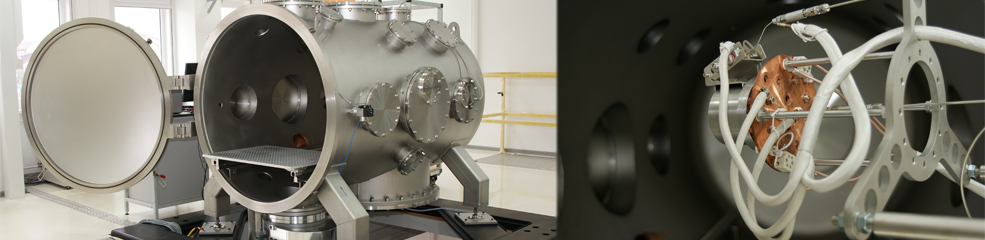
Photo: WEST Vacuum Vessel; CEA/IRFM - C. Roux
 A new Cooperation Agreement between the international ITER fusion project, the Italian Consorzio RFX and EUROfusion will allow European researchers from eight countries to join the Neutral Beam Test Facility in Padua and work on the world's largest plasma heating system.
ITER Director-General Bernard Bigot: "I am very happy to announce the cooperation agreement recently signed between ITER, RFX and EUROfusion. EUROfusion have made a strong commitment to the ITER NBTF by proposing the support of 20 staff to work at the NBTF in Padua and at IPP Garching. For this support, we are very grateful. We are also convinced that with the collaboration of our European partners, and the scientists and engineers in the European laboratories, NBTF will be a success".
The Cooperation Agreement will see up to 14 experts from across Europe to work on the ITER neutral beam heating system at the Neutral Beam Test Facility (NBTF) in Padua, Italy. Another 6 researchers will support NBTF from the ELISA neutral beam facility in Garching, Germany. Intellectual Property derived from the work will be the joint property of all partners involved. As such, this first agreement will serve as a framework for future collaborations between ITER and the European fusion community.
The new project partners include EUROfusion beneficiaries Max Planck IPP (Germany) with its existing but smaller ion source ELISE, CIEMAT (Spain), Consorzio RFX (Italy), INRNE (Bulgaria), EPFL (Switzerland), IST (Portugal), NCBJ (Poland), the University of Ljubljana (Slovenia); and CCFE (UK).
EUROfusion Programme Manager Tony Donné: "The neutral beam systems being developed at NBTF are the first systems being tested for ITER, so our engineers and scientists being involved here is like them already getting experience with the operation of ITER. Such education and training is one of EUROfusion's main pillars as we work on our Roadmap towards fusion power, and we look forward to helping develop this important technology".
About the Neutral Beam Test Facility
Neutral beam injection is one of the main external plasma heating systems planned for ITER; it will deliver over half of all the planned heating power to the plasma. Neutral beam technology heats the plasma by accelerating beams of neutral atoms into the fusion plasma. Although neutral beam injection is routine in many fusion devices, ITER's size requires several enhancements such as much thicker particle beams and increased particle speed to penetrate far into the core of the plasma.
To develop and test the ITER neutral beam injection system, ITER joined forces with the Italian Consorzio RFX. At the NBTF, researchers and engineers built and are testing two full-size prototypes of ITER's future neutral beam system: SPIDER, the most powerful ion source in the world, and MITICA, the full scale prototype of the ITER neutral beam.
RFX director Piergiorgio Sonato: "I'm particularly pleased to welcome our colleagues from other European fusion laboratories to Consorzio RFX here in Padua. I look forward to promoting the implementation of an international NBTF team to support ITER’s success and the design of Europe’s future demonstration fusion power plant DEMO, which will be the first to produce fusion electricity".
About ITER
The ITER fusion experiment is designed to demonstrate the technical feasibility of fusion as a source of safe and practically inexhaustible low-carbon energy. To reach fusion conditions, ITER will need to heat its fuel of hydrogen isotopes into a 150-million-degree-Celsius-plasma. In comparison even the center of the sun only reaches 15 million degrees Celsius.
Source: EUROfusion
Photo: Inside the faraday cage of the SPIDER ion source. Credit © ITER Organization, http://www.iter.org/
 Ten years after the start of construction in August 2010, ITER marked a new chapter in its long history. This historic moment was witnesses by distinguished guests, including French President Emmanuel Marcon, ITER’s Director-General, Bernard Bigot and heads of governments of countries being partners of ITER on 28 July 2020. The pandemic led to a hybrid celebration, both online and in person: the Council of the European Union and the European Commission as Host Member, China, India, Japan, Korea, Russia and the United States were there to join the celebrations.
President Macron, speaking from the Elysée Palace in Paris, defined ITER in terms of its promise. ITER is a promise of peace, he said—the proof that "what brings together people and nations is stronger than what pulls them apart." It is also a "promise of progress and of confidence in science" that, if successful, will be an energy that will "answer the needs of populations in all parts of the world, meet the challenges of climate change and preserve natural resources." And, perhaps above all, ITER is "an act of confidence" in the future. "ITER belongs to the spirit of discovery, of ambition. At its core is the conviction that science can truly make tomorrow better than today."
The first major component has been already installed (i.e. toroidal field coils) and others shipped from all over the world are waiting for their turn to be handled by the team of 3,000 participants.
"As we launch the assembly phase of the ITER machine," said ITER Director-General Bernard Bigot in his introductory address, "we feel the weight of history. It is now one hundred years since scientists first understood that fusion energy was the power source for the Sun and stars and some six decades since the first tokamak was built in the Soviet Union... [...] We feel the need for both urgency and patience. We know we need a replacement for fossil fuels as soon as possible. [...] We are moving forward as rapidly as possible ... If we succeed, it will be worth all the time and effort that have brought us to this point."
Each of the guests presented his/her position or acted on the behalf of their superiors stressing the importance of the device for human efforts in the future, following the introductory speeches of President Macron and Director-General Bigot. The ITER Assembly Hall huge screen and the giant assembly tools were the perfect scenery to depict the unique nature of ITER.
Watch the full video of the event here.
Photo: ITER celebrates assembly; Credit © ITER Organization, http://www.iter.org/
Source: https://www.iter.org/
 In the recent newsletter published on the Max Planck Institute for Plasma Physics website you can learn more about the preparation of the Wendelstein 7-X stellarator for the next experimental campaign.
Significant developments refer to the construction elements of the W7-X. Now, the divertor will be water-cooled as opposed to earlier operation with uncooled wall cladding. Thanks to the changes introduced, it will be possible to study plasma at a maximum heating energy of 18 GJ for 30 minutes.
Additionally, the system of plasma heating will be expanded with a new NBI (Neutral Beam Injector) system which is now being extended to two neutral beam injectors with two sources each and a total heating power of 7 MW (particle energy 55 keV) for the injection of hydrogen ions.
For more information on the current work on the Wendelstein 7-X stellarator go to the newsletter available on: https://www.ipp.mpg.de
Photo: Wendelstein 7-X; IPP, Jan Michael Hosan


nsp_133.JPG)


nsp_133.JPG)


 |
 |
 |
 |
 |
 |
 |
 |
Media


Research projects carried out at the IPPLM are funded by the Polish Ministry of Education and Science, the National Science Centre and by the European Commission within the framework of EUROfusion Consortium under grant agreement No 101052200. Financial support comes also from the International Atomic Energy Agency, European Space Agency and LaserLab Consortium as well as from the Fusion for Energy Agency.