





Zestaw obrazów 2019
zdjecie1.jpg
zdjecie2.jpg
zdjecie3.jpg
zdjecie4.jpg
zdjecie5.jpg
zdjecie6.jpg
2019_1.JPG
2019_2.JPG
2019_4.JPG

Gallery
 30 years ago, on 21 March 1991, the ASDEX Upgrade experimental device at Max Planck Institute for Plasma Physics (IPP) in Germany generated its first plasma. The main aim of this device is to prepare plasma scenarios for JET, ITER and DEMO. ASDEX Upgrade is a full tungsten machine which deliver a lot of important information for fusion as a source of electricity.
The operation of ASDEX Upgrade resulted in performing 38,700 discharges so far and providing answers to crucial research questions dealing with, among others, the wall of the plasma vessel, instabilities in the plasma confinement conditions, continuous operation (not in pulses), and countermeasures against disruptions.
According to project leader Professor Dr. Arne Kallenbach, "ASDEX Upgrade can be seen as a 'blueprint' for a tokamak fusion power plant."
For more information about the thirty-year experience of the prototype discharges, please visit: www.ipp.mpg.de
Source: www.ipp.mpg.de
Photo: IPP; Plasma discharge in the ASDEX Upgrade fusion device
 The WEST experimental campaign which took place between the 27th of November and the 27th of January 2021 proved successful with testing of a significant number of ITER-like Plasma Facing Components (PFC). Moreover, new tiles made from a low Z materials were introduced on the inner and outer start up limiters as well as a new Impurity Powder Dropper (IPD) installed thanks to the collaboration of WEST and the US Department of Energy. The implementation of the latter one resulted in the promising reduction of the radiation power and improved energy confinement.
What needs to be noted, the WEST tokamak applies for its operation an actively cooled divertor. Its technology resembles the ITER one and can provide plasma discharges similar in duration to the discharges of ITER. The divertor ring will be composed of 456 actively cooled tungsten PFC which are now undergoing the validation process. Among the stages are: PFC pipe cutting, mounting, welding and leak detection. It is planned to install the sectors with standard PFC in spring 2021 and the first plasma is expected in summer 2021 given the complete divertor configuration.
For more technical details please visit: irfm.cea.fr/en
Source: irfm.cea.fr
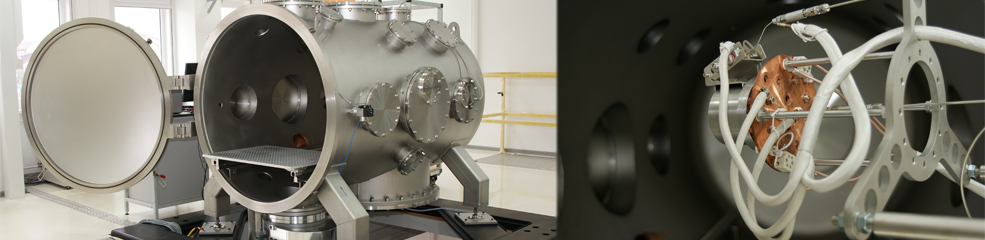
Photo: WEST Vacuum Vessel; CEA/IRFM - C. Roux
 The scientific world can boast about efficient energizing of the toroidal field magnet, which made it possible to attain its full magnetic field. Plasma inside the vessel will be generated among coils of total weight of 370 tonnes. Many tokamak systems have been put into action to maintain the magnet at 4.2K under the supervision of the central control system.
For more information including the animation depicting the event, please visit: www.jt60sa.org
Photo: JT-60SA TF Magnet after its assembly. © JT-60SA
The team of engineers from the Research Instruments (RI), Germany, has successfully completed the ITER Inner-Vertical Target (IVT) prototype’s engineering phase. The very complex component was produced no matter how complicated it became during pandemic. According to the technical details, the Divertor IVT prototype weighs 0.5 t and measures around 1.5 m. Its surface is covered by 1 104 tungsten blocks, and the temperature on the tungsten cassette surface will amount to 2000 °C. The next phase will entail going through high heat flux tests in Russia at the Efremov Institute.
Michael Pekeler, Director of Superconducting RF, Fusion and Special Manufacturing, Research Instruments (RI), underlines reaching the milestone: "We are very happy to have reached this milestone. This would not have been possible without the excellent cooperation with the F4E team, the passion and dedication of our project team. It is a clear demonstration of the high quality products we design and manufacture at RI. It is also a success bringing us closer to the qualification for the tender phase of the IVT series production."
To read more about the Inner-Vertical Target prototype please visit: fusionforenergy.europa.eu
Source: Fusion for Energy
 The recommendations of the DEMO expert panel will facilitate the implementation of the next step of the Roadmap aimed at the construction of the demonstration power plant. Review-based approach makes it possible to gather the experience from all over the community which can guarantee, as experts put it, a viable DEMO design.
The article on the EUROfusion website contains the panel’s recommendations and opinions stating that the gate review is a valuable exercise broadening the knowledge with the state-of-the-art fusion technology and the importance of this ‘fusion energy adventure’. EUROfusion Programme Manager Tony Donné underscores the possibility to move into the DEMO conceptual phase thanks to implementing the gate review strategy.
Source: www.euro-fusion.org
Photo: Artist's concept of a fusion power plant converting the heat of fusion into heat and electricity. Source: EUROfusion, license CC-BY 4.0


nsp_133.JPG)


nsp_133.JPG)


 |
 |
 |
 |
 |
 |
 |
 |
Media


Research projects carried out at the IPPLM are funded by the Polish Ministry of Education and Science, the National Science Centre and by the European Commission within the framework of EUROfusion Consortium under grant agreement No 101052200. Financial support comes also from the International Atomic Energy Agency, European Space Agency and LaserLab Consortium as well as from the Fusion for Energy Agency.