





Zestaw obrazów 2019
zdjecie1.jpg
zdjecie2.jpg
zdjecie3.jpg
zdjecie4.jpg
zdjecie5.jpg
zdjecie6.jpg
2019_1.JPG
2019_2.JPG
2019_4.JPG

Gallery
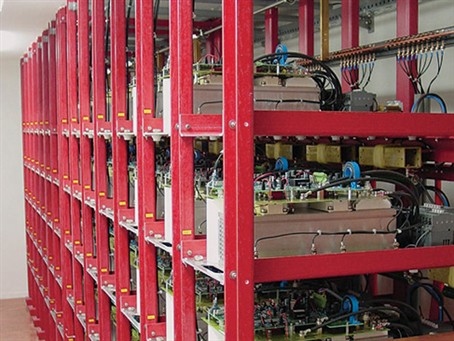 Fusion for Energy (F4E), the organisation managing Europe’s contribution to ITER, has signed a contract with Ampegon to design, manufacture, install and commission the power supplies for the Electron Cyclotron system, one of ITER’s heating systems, that will make its hot plasma reach 150 million degrees Celsius.
The company has made history being Switzerland’s first ever SME to contribute to the prestigious fusion energy project. According to Professor Henrik Bindslev, F4E Director, “ITER offers a vast range of business opportunities to small, medium and larger companies. Today’s signature proves yet again that SMEs have a role to play to the most ambitious international collaboration in the field of energy”. Josef Troxler, Ampegon CEO, explained that “the power supplies are a critical element of the machine. We are proud to offer our expertise and be amongst the companies that will build the world’s largest fusion project”.
It will operate like a powerful microwave oven. High frequency electromagnetic waves will transfer their energy to the plasma, raise its temperature and drive additional current to sustain longer discharges. The precision of the electron cyclotron will help scientists to target specific plasma areas that require an extra blast of heat and maintain plasma confinement and stability.
During the next six years, Ampegon AG will work to deliver 8 out of the ITER’s 12 main high voltage power supplies (55kV/100A) and 16 body power supplies (35kV/100mA). The main task of power supplies will be to transform the electricity from the grid to regulated direct current and voltage that ITER will need to generate the electromagnetic waves. The power supplies system will be designed to shut down in less than 10 micro-seconds.
Source: F4E
 Forschungszentrum Jülich will lead a consortium of European partners to design a measuring system for the fusion experiment ITER. The facility is currently under construction in Cadarache in the south of France as part of a major international cooperation. The consortium signed a Framework Partnership Agreement with the European Union's Joint Undertaking for ITER and the Development of Fusion Energy (F4E) to develop the ITER core plasma Charge Exchange Recombination Spectroscopy (CXRS) diagnostic. This measuring system will help determine the composition and temperature of the plasma in the vacuum vessel. The Framework Partnership Agreement runs for four years with an F4E contribution of 4.9 million euros.
ITER is the next major step in international fusion research. F4E is responsible for providing the European contribution to ITER, which is scheduled to go into operation in the early 2020's and demonstrate the feasibility of fusion energy on a power-plant scale for the first time ever. The fusion of atomic nuclei will be used to generate energy. Similar processes occur inside the sun. If they can be controlled here on Earth, then we would have access to a safe and practically inexhaustible source of energy.
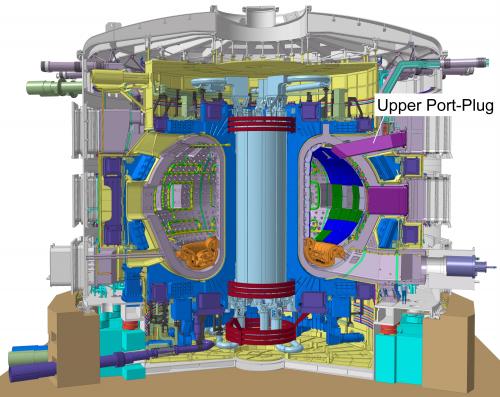
Once designed by the consortium, the core plasma CXRS system will be procured by F4E and assembled into a port plug, to be installed in an inset at the upper edge of the vacuum vessel. The consortium gained a significant knowledge related to this diagnostic through R&D tasks funded in the past years by the European Fusion Development Association (EFDA) and by the Federal Ministry of Education and Research (BMBF). In particular, deployment of such a system under the extreme conditions that will be encountered in ITER necessitates complex development work and tests. Indeed, temperatures exceeding 100 million degrees Celsius are expected within the vacuum vessel and the associated plasma radiation, neutron flux, and electromagnetic forces all impact significantly on the design choices for components. In addition, maintenance and repairs are usually only possible using remote-controlled tools or robots.
The CXRS diagnostic views a region of the ITER plasma illuminated by a high-energy beam of neutral hydrogen particles injected into the plasma by a companion device being constructed by ITER's Indian partners. Collisions with particles in the fusion plasma produce visible light. Its wavelength and spatial distribution allow conclusions to be drawn on various properties of the plasma. The measurements provide information that is crucial for sustaining the fusion reaction. The density of helium, in particular, is recorded. Helium is formed during the fusion reaction and must be removed from the combustion chamber if the fusion fire is to be kept alight. Other important parameters such as the concentration, temperature and velocity of different plasma species can be determined using the diagnostic.
The design of the CXRS diagnostic device is being performed, in particular, by physicists and engineers from the Jülich Institute of Energy and Climate Research (IEK-4) and by their colleagues at Jülich's Central Institute of Engineering, Electronics and Analytics (ZEA-1) as well as by their European partners (members of the consortium) including Karlsruhe Institute of Technology (KIT), universities of technology in Budapest (BME) and Eindhoven (TU/e), the Dutch Institute for Fundamental Energy Research (DIFFER), and CCFE in the UK. Contributing third parties include the Spanish CIEMAT centre and the Hungarian Wigner-RCP institute.
Source: phys.org
Solar energy is a potential resource for power. But how about having a mini Sun right here on Earth?
Built at Hydro Quebec's Research Institute facility in Varennes, Que. and operational from 1987 to 1997, the Tokamak Fusion Reactor was an attempt at just that.
This week's video explains the science behind this reactor. Unlike modern nuclear reactors that produce energy through fission — splitting large particles into smaller ones — the Tokamak tried to do the opposite. It used fusion, which has the potential to produce nearly limitless, non-polluting energy. In fact, people may not realize it, but they witness the power of fusion everyday by walking in sunlight.
Source: Canadian Geographic
 A Department of Energy internal review committee has concluded that the US share of ITER, the international project to build a fusion test reactor in Cadarache, France, could cost as much as $6.5 billion—$2.6 billion more than is estimated by DOE’s ITER project office. At the insistence of congressional appropriators who requested the figures, the Obama administration is now reviewing ongoing US participation in ITER. A possible shift in policy would be included in the department’s fiscal year 2015 budget request, the release of which reportedly has been delayed by at least one month from the first Monday in February date set by statute.
The US contribution to ITER consists mainly of components for the giant tokamak. A small fraction, though, would be in cash to pay for the US share of assembly costs and central office administration. Originally expected to cost €5 billion ($6.8 billion), ITER currently has no official price tag. (See Physics Today, July 2013, page 24.)
A DOE spokesperson said the department would not release details of the $6.5 billion estimate, which was prepared by the Office of Science’s office of project assessment (OPA), until a decision has been made. In a statement, Edmund Synakowski, DOE’s associate director of science for fusion energy sciences, said, “The new cost estimate, which is a range from $4.0 to $6.5 billion, is a reflection of the historical cost growth of the project and the high level of risk and uncertainty associated with this highly complicated international undertaking.”
Ned Sauthoff, director of the US ITER project office, told the nonprofit industry group Fusion Power Associates in December that his office stands behind its $3.9 billion US contribution estimate. He said his office included a contingency of $800 million (47%) on the remaining $1.5 billion of the US hardware contribution. (About $400 million worth of hardware has already been produced in the US.) The project office estimated the cash portion of the contribution would be $800 million, including the US share of a potential €1 billion operations overrun for ITER’s central offices in Cadarache, and $400 million to cover a cost escalation resulting from an expected three-year delay of ITER’s official 2020 completion date.
A worst-case scenario?
The OPA assessment tacked $1.5 billion onto the US project office’s $3.1 billion hardware cost estimate, including upping the contingency to 130%. The OPA review more than doubled the project office’s cash estimate, to $1.9 billion. “What [OPA] did was to answer the question, ‘How bad could it get—what is the outer bound on the cost?’ They took pessimistic assumptions,” Sauthoff said.
Ironically, US ambivalence to ITER is contributing to the cost escalation. The Obama administration has imposed a $225 million limit on the US annual contribution. At that rate, US obligations to the project won’t be finished until 2033—10 years after the expected date for completion of the reactor. Sauthoff estimated that the total US contribution to ITER could be reduced by as much as $500 million if the annual cap were eliminated.
Complicating matters, Congress has imposed a cap of $2.2 billion on the US total contribution for ITER’s construction phase. The other six ITER members—the European Union (EU), Japan, Russia, China, India, and South Korea—appear committed to contribute whatever it takes to build the reactor. The ITER Council, the ministerial-level body that is the project’s governing board, already has agreed to defer the cash portion of US contributions to a later date so that the entire annual payments can fund critical components.
Another look
Senator Dianne Feinstein (D-CA), who chairs the Appropriations subcommittee that funds DOE, has insisted that the administration reassess its commitment to ITER. “[She] put the onus on the White House and the administration to decide what to do,” says a Senate source. “The current approach is intolerable; either withdraw from the project or give it the necessary resources. We have to go higher than $225 million.” The administration should be able to find a few more million for several years to support the US’s largest international scientific project, he said, considering that the White House asked for a $1 billion increase for its energy efficiency and renewable energy programs in FY 2014.
Osamu Motojima, ITER director general, told the Fusion Power Associates meeting that the OPA’s numbers are too high compared with the EU’s estimate of €7.4 billion ($10.2 billion) to cover its 45% share of construction costs. Indeed, extrapolating the $6.5 billion estimate for the US’s 9.1% share would put ITER’s total cost well over $50 billion.
But the OPA review said the US ITER project office had underestimated the difficulty of obtaining seismic, safety, and tritium operating approvals from French regulatory authorities. It also was concerned that the ITER design is just 55% complete and that there is insufficient project management expertise at Cadarache to integrate so many components from such a variety of countries.
Meanwhile, the ITER Council is to consider the findings of a biennial external review of project management at a special meeting in France this month. Although the ITER Organization (IO) declined to release the review report, the Senate source says it urged major changes in IO staffing practices. Rather than having key technical positions designated for particular member nations, as is currently the case, the best-qualified individuals for those positions should be installed without regard to their nationality, the review said. The outcome of the council meeting will be critical in determining ITER’s cost, the Senate source says. Should the recommended reforms be implemented, they could bring the cost well below the upper OPA estimate.
Motojima said he agrees with all of the management review’s recommendations and is now taking steps to centralize construction management at the IO. The central office is working to reduce bureaucracy and simplify decision-making processes and approvals and will eliminate three of its nine directorates. Kattalai Sriram, director for ITER’s finance, budget, and management systems, said the IO had achieved 92% of milestones for “critical and supercritical” components—including the vacuum vessel, toroidal and poloidal field magnets, and the building that will house the reactor—during the year that ended August 2013. But he acknowledged that only 52% of milestones for all ITER’s components were met during that period.
The US and the former Soviet Union initiated ITER in the 1980s as a Cold War tension-easing cooperative science program. It was quickly joined by Japan and the EU. Bowing to pressure from Representative James Sensenbrenner (R-WI), then chairman of the House Science and Technology Committee, the US withdrew from the project in 1999. Since US reentry in 2003, much of the ITER contribution has been taken from the existing DOE budget for fusion, resulting in substantial reductions to the US domestic fusion research program.
Source: AIP Scitation
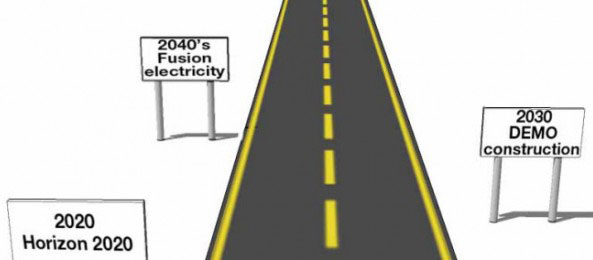 This week a two-week long marathon of meetings ended kicking off a package of 25 research topics defined in Europe’s Roadmap to the realisation of fusion electricty published twelve months ago.
Fusion energy is still in the research phase, making it all the more important to focus the European funded part of the programme on areas which are relevant for bringing electricity to the grid. Even more so given the latest BP Energy Outlook prediction of a 40% increase in the demand for electricity by 2035.
Since the publication of the Roadmap, physicists, engineers and administrators all across Europe have been working feverishly to turn paper into reality. EFDA and JET Leader Francesco Romanelli explains: ‘I appreciate the devotion that our colleagues in about 40 laboratories show to face the challenges that come with every change. On our journey from the old EFDA to the establishment of the new Consortium EUROfusion we can built on the profound experience and dedication of the colleagues involved to shape the new fusion research landscape.’
Project and Task Force Leaders like Piero Martin, Consorzio RFX; Italy, are enthusiastic. He sees the position as a unique opportunity of professional growth. He adds inspired: ‘Managing a large scientific team coming potentially from all EU countries, designing and implementing scientific programs, building consensus, and communicating efficiently will require creativity and vision.’
The accompanying or Medium-Size Tokamak campaigns expand the proven scheme used to operate and exploit JET. The first physics plasma of the Medium-Sized Tokamak campaigns was run yesterday on the tokamak ASDEX Upgrade in Germany.
Darren McDonald, Head of the ITER Physics Department, comments: ‘The programme brings together JET and the other key fusion experimental machines in Europe. These devices will be exploited on the basis of the roadmap’s defined missions using a scheme based on the one under which JET has been working effectively for a long time.’
Francesco Romanelli already looks at the next step towards fusion energy, ITER: ‘The main aim of the roadmap and the re-organisation of the research programme is to make ITER a success.’
Read more: EFDA


nsp_133.JPG)


nsp_133.JPG)


 |
 |
 |
 |
 |
 |
 |
 |
Media


Research projects carried out at the IPPLM are funded by the Polish Ministry of Education and Science, the National Science Centre and by the European Commission within the framework of EUROfusion Consortium under grant agreement No 101052200. Financial support comes also from the International Atomic Energy Agency, European Space Agency and LaserLab Consortium as well as from the Fusion for Energy Agency.